oh-my-tianshu
Health Gecti
- License — License: Apache-2.0
- Description — Repository has a description
- Active repo — Last push 0 days ago
- Community trust — 44 GitHub stars
Code Gecti
- Code scan — Scanned 12 files during light audit, no dangerous patterns found
Permissions Gecti
- Permissions — No dangerous permissions requested
Bu listing icin henuz AI raporu yok.
Oh My Tianshu 是一款完全体开源 coding agent:在 dsh harness 基础之上带视觉、跨会话记忆、验证门、agent 路由、语义 + 图谱代码检索、文件回滚和全屏终端 UI——全部以插件组合。它是 DeepSeek Harness(dsh)的友好 MIT fork,保留上游一切皆插件的架构,界面交互对标 oh-my-pi。
Oh My Tianshu
English | 中文
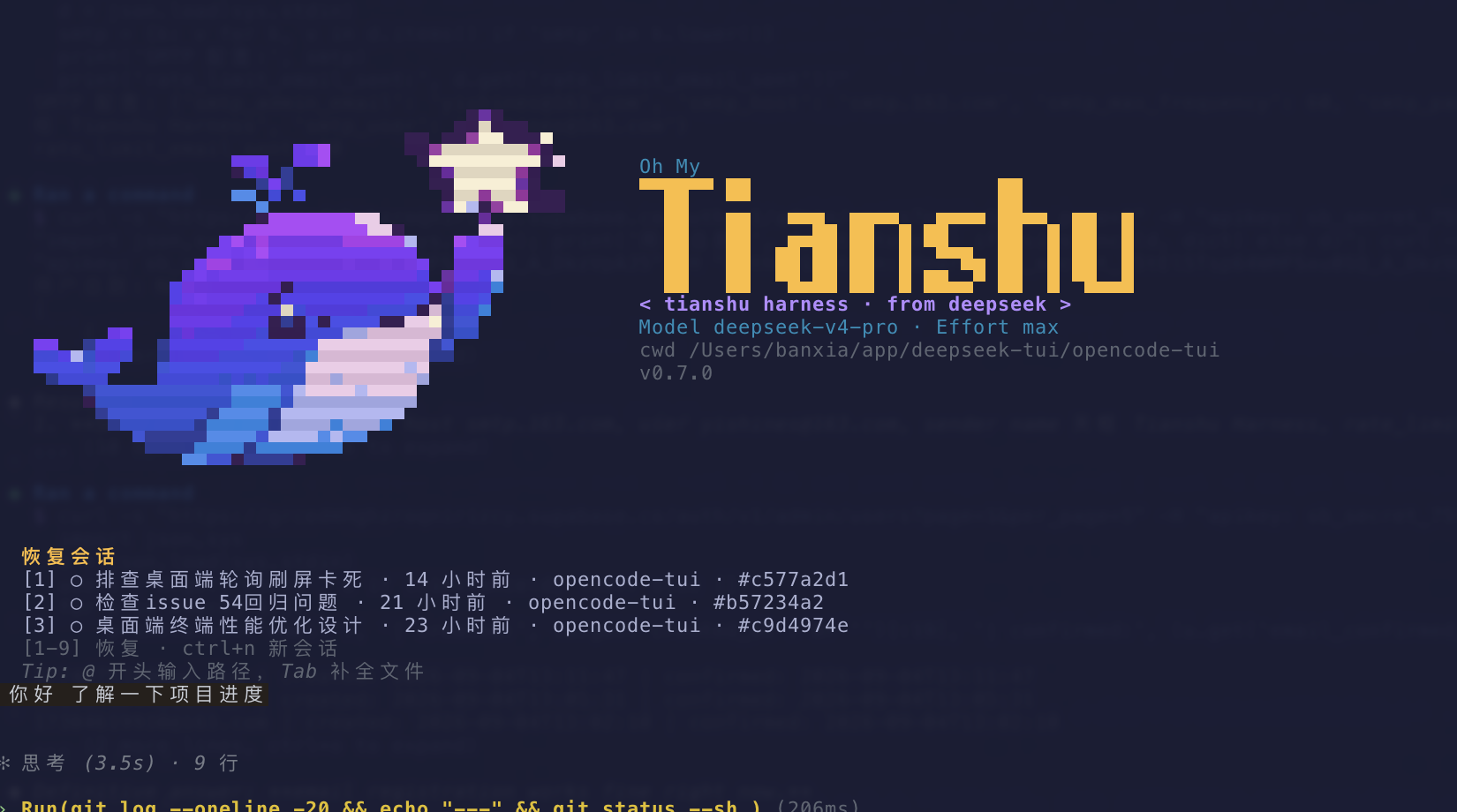






Oh My Tianshu (oh-my-tianshu) is a full-capability open-source coding agent built on a plugin harness: models, tools, policies, memory, retrieval, and interfaces are all Cordis plugins a deployment can compose, replace, or extend without touching the agent loop.
One distribution, four surfaces — full-screen terminal UI, browser UI, headless one-shot runs, and an ACP automation server — over a deep capability bench: a vision bridge plus an ask_image co-pilot so text-only primaries still work with images, cross-session project memory with a write-quality gate, an evidence gate enforcing RED→GREEN on bugfix edits, an agent router that moves from shadow to gradual dispatch over native subagents, semantic (BM25, CJK-aware, optional vector) and tree-sitter graph code retrieval, plan mode with per-session presets, pre-write file snapshots behind /rewind, and prefix-cache health observation that keeps long sessions cheap.
Sessions are authoritative and reconstructable: anything the model sees is logged to the session stream, and persistence, resume/fork/query, replay, telemetry, and every UI derive from the same events. Composition stays cache-friendly by design — presets own the agent plane, so the cached prefix stays byte-stable while a session's toolset and persona change.
It is a friendly fork of DeepSeek Harness (dsh, MIT) released under the Apache License 2.0; this line evolves independently from the 2026-08 baseline and does not track upstream. Full attribution lives in NOTICE.
The repository is a pnpm monorepo: 250+ Cordis plugin packages (including vendored upstreams), indexed by group — core / tui / host / client / guard / subagent / context / memory and friends — in packages/README.md, all published to npm under the @huiliyi37/* scope. See the architecture doc for the design overview and docs/user for usage docs.
Install
Requirements: Node ^22.19 || >=24, and a DeepSeek API key (DEEPSEEK_API_KEY).
One-line installer (recommended — it auto-recovers the npm-mirror sync window, where a mirror already has the new entry package but not all of its dependencies and a plain install dies with ETARGET):
curl -fsSL https://raw.githubusercontent.com/huiliyi37/oh-my-tianshu/main/scripts/install.sh | sh
Windows PowerShell:
irm https://raw.githubusercontent.com/huiliyi37/oh-my-tianshu/main/scripts/install.ps1 | iex
Run it straight from npm:
npx @huiliyi37/oh-my-tianshu tui
Or install globally:
npm i -g @huiliyi37/oh-my-tianshu
oh-my-tianshu tui
npm 11 and newer blocks lifecycle scripts it has not been told to allow (allowScripts). The native dependencies need theirs — koffi compiles from source, node-pty builds its PTY binary, @huiliyi37/dsh-subprocess-local restores the PTY spawn-helper's executable bit, and @google/genai / protobufjs generate runtime assets — so allow them on the global install:
npm i -g --allow-scripts=koffi,node-pty,@huiliyi37/dsh-subprocess-local,@google/genai,protobufjs @huiliyi37/oh-my-tianshu
If npm still warns about a package not on this list, append it and re-run; a silently skipped native build surfaces later as Cannot find module at runtime.
Android (Termux)
On Termux (or a proot-distro root) process.platform is android, the koffi FFI dependency has no Android prebuilt and compiles from source, and its CMake configure needs the Termux prefix — which a proot-distro root may not export. Set it before installing:
export PREFIX=/data/data/com.termux/files/usr
npm i -g @huiliyi37/oh-my-tianshu
API key: export it before starting, or drop it in the user env file once (loaded automatically on every boot):
export DEEPSEEK_API_KEY=sk-…
echo 'DEEPSEEK_API_KEY=sk-…' >> ~/.dsh-tianshu/.env
The first line covers the current shell; the second persists it.
On the welcome screen, check the environment line: API Key ✓ means the key is in place; API Key ✗ means it was not found — set it and restart. Quit with Ctrl+Q or /exit.
For development (or to hack on the harness itself), run from a repository checkout — requires git, Node ^22.19 || >=24, and pnpm:
git clone https://github.com/huiliyi37/oh-my-tianshu.git
cd oh-my-tianshu
pnpm install
pnpm run build
pnpm oh-my-tianshu tui
pnpm oh-my-tianshu web
pnpm oh-my-tianshu tui runs the full-screen terminal UI from source; pnpm oh-my-tianshu web serves the Web UI at http://127.0.0.1:3080.
What the full build adds
Beyond the upstream baseline (files, shell/PTY, skills, tasks/goals/plans, subagents and workflows, sandboxing and approvals, resumable sessions, LSP, web access, context compaction, loop-hygiene guards), this monorepo ships the differentiated capability set:
| Capability | Package | What it does |
|---|---|---|
| Vision bridge | @huiliyi37/dsh-vision-bridge |
A text-only primary still reads user images: a dedicated vision model describes attachments and injects the description at agent/pre-step. |
| Vision co-pilot | @huiliyi37/dsh-vision-ask |
Session-scoped image registry + ask_image tool: the main model re-interrogates any retained image, any number of times, without the user re-sending it. |
| Project memory | @huiliyi37/dsh-memory |
Cross-session recall (BM25 hybrid over structured claims and knowledge notes) with a quality gate on writes; /memory, /remember. |
| Evidence gate | @huiliyi37/dsh-evidence-gate |
RED→GREEN discipline for bugfix tasks: edits gated on a failing-first verification account. |
| Agent router | @huiliyi37/dsh-agent-router |
Base metrics → routing algorithm → MoE-style dispatch onto native subagents. |
| Pheromone | @huiliyi37/dsh-pheromone |
File-level stigmergy: session-scoped spatial memory via exponential-decay signals (fragile / entry-point / …). |
| Semantic index | @huiliyi37/dsh-semantic-index |
Workspace retrieval: file-level BM25 (CJK-bigram aware) over definition-aligned chunks, optional vector layer fused via RRF; powers semantic_search. |
| Meridian | @huiliyi37/dsh-meridian |
Codebase graph index (tree-sitter → sqlite): repo map, impact analysis, flow queries, behavior signals; powers repo_graph. |
| File rewind | @huiliyi37/dsh-fs-snapshot |
Pre-write snapshots of every file a write tool touches, backing /rewind's code/both granularity. |
| Git seam | @huiliyi37/dsh-git |
Typed git capability service (GitLocal CLI provider, typed GitErrors) consumed by tools and UI. |
| Terminal UI | @huiliyi37/dsh-tui |
Full-screen TUI on the Tianshu (Tianshu-harness) render core — Apache-2.0 provenance chain preserved. |
| Spark anchors | @huiliyi37/dsh-spark-anchors |
Pairs with reasoning-truncating provider routes: re-injects excluded paths so the model does not re-derive ruled-out options. |
Use Tianshu
Web UI
One command from the npm install; the default http://127.0.0.1:3080 opens in your browser automatically (--no-open suppresses the auto-open):
oh-my-tianshu web
oh-my-tianshu web --host 0.0.0.0 --port 8080
Common flags: --host / --port bind the address and port, --dev mounts the HMR receiver (run pnpm run dev:web alongside to rebuild bundles), --workspace-root sets the parent directory for workspaces created from the browser, --trusted-host extends the /api browser-trust fence, --no-open skips the auto-open. A source checkout runs pnpm run build for the frontend artifacts, then pnpm oh-my-tianshu web.
Profiles
oh-my-tianshu boots profiles — ordered stacks of plugin-bundle patch layers under your own overrides in $DSH_HOME/profiles/<name>:
oh-my-tianshu --profile web                       # the browser UI (same as: oh-my-tianshu web)
oh-my-tianshu plugin --profile tui add <package>  # install a plugin into a custom profile
oh-my-tianshu --profile tui                       # boot it
The CLI contract describes profile layout, layer semantics, and config dump commands.
Terminal UI
Start the full-screen terminal interface:
oh-my-tianshu tui # or: oh-my-tianshu --profile tui
The TUI is a port of the Tianshu (Tianshu-harness) render core adapted to the harness seams, with an oh-my-pi-aligned interface: a bordered welcome card with a gradient logo, a segmented status bar embedded in the composer's top border, full-width message-surface tints (user bubble, per-status tool blocks), and 17 themes (the amber omp is the default, graphite and friends remain via /theme). Type / to open the command menu — ↑↓ to select, Tab to accept, Enter to submit, Esc to close. Press Ctrl+. any time for the shortcut map.
Slash commands
| Command | Effect |
|---|---|
/session |
session management (list / switch) |
/fork [directive] |
fork the current session (history copied) and switch; optional first message |
/branch |
alias of /fork |
/model [provider/model] |
view or switch the model (hot-swaps the live session; spark-flash / spark-pro aliases switch to DeepSeek Spark) |
/theme [name] |
switch themes |
/welcome [whale|fox] |
switch the welcome hero mascot (default whale; applies on next startup) |
/clear |
clear the current conversation's scrollback |
/compact |
compact the current session's context |
/steer <text> |
mid-turn steering (redirect without interrupting) |
/status |
status panel (goal/todos/plan projections + session totals) |
/config |
settings panel (settings / permission / credentials) |
/skills |
skill browser panel |
/subagents |
delegation-tree panel |
/workflow |
running-workflow panel |
/next-workflow [candidates] <objective> |
run the fixed intent → plan → critique → implement → verify → review pipeline; VERIFY reports unverified unless the profile configures verifyCommand; invoke after zen promotion |
/tasks |
task panel (background tasks) |
/goal |
goal management (create / pause / resume / complete / block) |
/memory |
memory browser (list / filter / delete / preview) |
/remember <text> |
save a memory |
/rewind |
two-phase rollback (message list → granularity) |
/btw <question> |
side-question to the background agent |
/doctor |
terminal diagnostics with fix guidance |
/mcp |
list connected MCP servers and tools |
/export [path] |
export the current session's transcript to a Markdown file |
/density |
toggle compact tool-card rendering |
/permission |
switch the permission preset (workspace-write / danger-full-access) |
Keyboard shortcuts
| Key | Effect |
|---|---|
Ctrl+N |
new session |
Ctrl+S |
resume the most recent session |
Ctrl+Q |
quit |
Ctrl+P |
command palette |
Ctrl+. |
shortcut map overlay |
Ctrl+F |
history search (n/N jump) |
Ctrl+O |
open the input line in $EDITOR |
Ctrl+T |
mid-turn steer |
Ctrl+V |
paste the system-clipboard image (clipboard-text fallback when the clipboard holds no image) |
Alt+W |
copy the selection to the system clipboard (OSC52) |
Shift+Tab |
cycle mode: normal → plan → always-approve |
Tab |
@-path completion; accept a slash-menu selection |
↑/↓ |
input history (menu selection while the slash menu is open) |
PageUp/PageDown |
page the slash menu |
Esc |
close the slash menu or overlays |
Interaction
Tool approvals prompt inline as ⚠ 允许执行 …?[y/N] with a unified diff preview above the prompt. Subagent runs appear as spinner lines in the live region and settle into ✓/✗/◌ scrollback entries on completion. The bottom three rows are the input line (with a bottom-edge line colored by mode), the footer (mode badges + shortcut hints), and the metrics row (model / token usage / cache hit rate).
Image paste and terminal preview
Ctrl+V (or right-click / terminal-menu paste) reads the system clipboard image — macOS osascript, Linux wl-paste/xclip, Windows PowerShell — and attaches it; pasting text that looks like an image path loads the file as an attachment instead. Attached images render as a 📎 N images marker above the input line and, on submit, as inline terminal graphics (kitty / iTerm2 protocols) under the user bubble. The bubble carries a vision hint: an image-capable primary sees the image directly; a text-only primary with a vision bridge configured gets the image described by the vision model first; with neither, the TUI warns that the image was not sent (and does not submit it).
Vision bridge (optional)
dsh-vision-bridge lets a text-only primary still read user images: at agent/pre-step it describes image attachments through a dedicated vision model and injects the description as a plugin-source user message (model-visible ⟺ logged; bridge failure degrades to a visible note, never a failed turn). Enable by adding the plugin with a vision-capable provider/model:
# cordis.yml
- id: vision-bridge
  name: '@huiliyi37/dsh-vision-bridge'
  config:
    provider: deepseek-official   # any registered llm route that can see images
    model: <vision-capable model>
and set the TUI's vision state (in the tui-runner bundle config) so the bubble hint reflects the bridge: supportsVision: false, bridgeEnabled: true.
Vision co-pilot (ask_image, optional)
dsh-vision-ask goes one step further than the bridge: every image the user attaches is registered in a session-scoped registry under a short id (img_1, …), and the ask_image tool lets the main model re-interrogate any retained image — different questions, different angles — without the user re-sending it. A multimodal primary gets the original image forwarded back; a text-only primary gets a vision-model answer about the image. See packages/tui/vision-ask for configuration.
DeepSeek Spark mode
The deepseek-spark provider route truncates assistant reasoning to the tail N tokens on the wire (flash 300 / pro opt-in), keeping the model's context lean; dsh-spark-anchors pairs with it, re-injecting the excluded paths so the model does not re-derive ruled-out options. Enable once — settings hot-reload, no restart:
# settings.yaml
llm-deepseek:
  spark:
    enabled: true
then switch with /model spark-flash or /model spark-pro (aliases for deepseek-spark/deepseek-v4-flash / deepseek-spark/deepseek-v4-pro). Spark shares the DeepSeek API key — no extra configuration. dsh-spark-anchors mounts with the tui bundle, so the anchor compensation is live once a session runs on the deepseek-spark route; a self-assembled profile adds it explicitly (see the package README).
Headless
Run one task, print the final answer, and exit:
oh-my-tianshu run "summarize this workspace"
Automation and SDKs
From a source checkout with DEEPSEEK_API_KEY in the environment or its root .env, start the ACP automation server:
pnpm run demo:acp
The Python SDK drives a bundled JSON-RPC runtime. The examples cover the runnable headless, ACP, JSON-RPC, Code Mode, and self-referential compositions.
Architecture
- Everything is a plugin. Models, tools, policies, storage, context management, and interfaces are composable Cordis plugins, so deployments can extend or replace behavior without forking the agent loop. See the architecture for the underlying design.
- Runs are reconstructable. Anything visible to the model is logged in the authoritative session stream; persistence, resume/fork/query, replay, telemetry, and UIs derive from the same events. See the session-log architecture.
- Code Mode (opt-in). It exposes a
run_codetool and a generated TypeScript SDK; only program output re-enters model context. See Code Mode. - Self-referential Cordis tools are opt-in. They let the agent inspect its live runtime and mount or unmount plugins while it runs. See the Cordis tools.
Telemetry
Disabled by default — nothing is uploaded anywhere. To stream session telemetry to your own OTLP/HTTP collector, set DSH_TELEMETRY_OTLP_URL (e.g. https://collector.example.com/v1/logs). A non-empty DSH_TELEMETRY_DISABLED force-disables it regardless of other settings.
Relationship with upstream dsh and coexistence
This project forked from DeepSeek Harness (MIT) at the 2026-08 baseline and evolves independently — it does not track upstream releases, and its packages live under the @huiliyi37/* npm scope (CLI: @huiliyi37/oh-my-tianshu, bin oh-my-tianshu). The repository is licensed under the Apache License 2.0; upstream attribution is preserved in NOTICE, and the TUI package carries its own Apache-2.0 provenance chain (LICENSE / NOTICE / SOURCE-MAP).
Two distribution lines, installable side by side without conflicts:
| Line | What it is | Data home |
|---|---|---|
Official dsh + dsh-tianshu-tui (plugin) |
A TUI plugin for the official DeepSeek Harness, installed into an official profile | ~/.dsh (fixed by the official CLI) |
| This repo (oh-my-tianshu, formerly tianshu-public) | A standalone integrated distribution with its own CLI (oh-my-tianshu) |
A dedicated $DSH_HOME (defaults to ~/.dsh-tianshu, isolated from the official ~/.dsh) |
- This repo fully honors
$DSH_HOME(precedence: explicit config >$DSH_HOME> default home). When coexisting with the official dsh, setexport DSH_HOME=~/.dsh-tianshu(no manual setup needed once the default-home isolation lands). Sessions / profiles / settings stay separate. - Naming memo (avoid confusion):
dsh-tianshu-tui= the TUI plugin for official dsh;oh-my-tianshu/@huiliyi37/oh-my-tianshu= the standalone integrated distribution;Tianshu-harness(Tianshu) = the render-core source repository (Apache-2.0). - Renaming plan (phase 2): the repo will be uniformly named
oh-my-tianshu, and the launch command plus npm package name will follow (oh-my-tianshu→ new command name) to eliminate semantic confusion with the plugin namedsh-tianshu-tui; this section will be updated then.
Development
Start with the development guide and read the architecture before changing packages.
For agents, follow AGENTS.md.
License
Apache-2.0. Upstream and third-party attributions: NOTICE and THIRD_PARTY_NOTICES.md.
Yorumlar (0)
Yorum birakmak icin giris yap.
Yorum birakSonuc bulunamadi