veyra
Health Uyari
- License — License: NOASSERTION
- Description — Repository has a description
- Active repo — Last push 0 days ago
- Low visibility — Only 5 GitHub stars
Code Basarisiz
- exec() — Shell command execution in console/src/components/chart.test.tsx
- process.env — Environment variable access in console/src/components/chart.test.tsx
Permissions Gecti
- Permissions — No dangerous permissions requested
Bu listing icin henuz AI raporu yok.
Autonomous, provider-neutral trading service in Rust. LLM and Jev decisions pass a deterministic risk gate before any MT4 order; includes an operations console.
Veyra
Veyra is an autonomous, provider-neutral trading service built with Rust and
Actix Web. It combines a configured LLM runtime, Jev structured judgements,
broker execution, and durable risk and reconciliation logic. Every order passes
through a deterministic risk gate, and operators use a web console to monitor
the service.
New here? GETTING_STARTED.md walks through
everything from cloning the repository to a supervised, 24/7 install, one
stage at a time and in plain language.
Current status
What exists and what has been proven live:
- Typed runtime configuration parsed into refined types.
- Read-only
/health,/ready, and/statusHTTP endpoints. - Broker integration abstraction (
BrokerLink) with a configuration-selected
provider; the MetaTrader 4 EA control channel is the first implementation. - Model-provider abstraction (
DecisionEngine) overagent-runtime(pinned git
revision), configurable to OpenRouter or any OpenAI-compatible endpoint, with
schema-constrained answers — proven live with a real structured response. - Jev (TypeSafe System One) behind its own
SemanticJudgecontract: typed
choice/noul/score questions, answers validated against the request that
produced them — proven live (jev-1.13.0, about 1.3 s per request). - Loopback-only EA endpoint with token authentication, refined payloads,
heartbeat state, and an idempotent command queue — proven live end-to-end
with MT4 under Wine through a Cloudflare Tunnel (heartbeat, ping/pong, and a
realaccount_snapshotcommand round trip). - Deterministic, fail-closed risk gate (kill switch, instrument allowlist, UTC
session, volume/order caps, duplicate suppression) in front of every intent,
plus broker-side order validation (order_check) that never sends an order —
proven live (retcode 0 for a valid request, 129 for a wrong-side limit). - Autonomous operation: an autopilot loop gathers closed candles, optional
Jev judgements, the venue's instrument contracts, ATR and scheduled news,
one structured model proposal, the deterministic gate, and the same staged
execution as the control surface — live-proven with the first autonomous
order (EURUSD 0.01 sell, ticket 10650805, executed with retcode 0 after
explicit owner approval of both switches). - Scheduled-news awareness: a provider-neutral economic calendar
(ForexFactory weekly export, no key, cached) feeds per-assetupcoming_eventsto the model and blackouts high-impact entries through a
console-editable window;GET /calendarlists what the bot sees. - Pre-queue venue checks: after gate approval, a draft's volume must land
on the venue's lot band and step, its estimated margin must fit reported
free margin, and its stop must clear the current spread, the broker's
minimum stop level, and a console-editable ATR(14) noise floor
(minStopAtrFraction, default 0.25) — otherwise nothing is queued. - Deterministic position management: break-even, trailing-stop, and
profit-harvest policies run on their own cadence across every managed
position, moving stops only in the favourable direction through the same
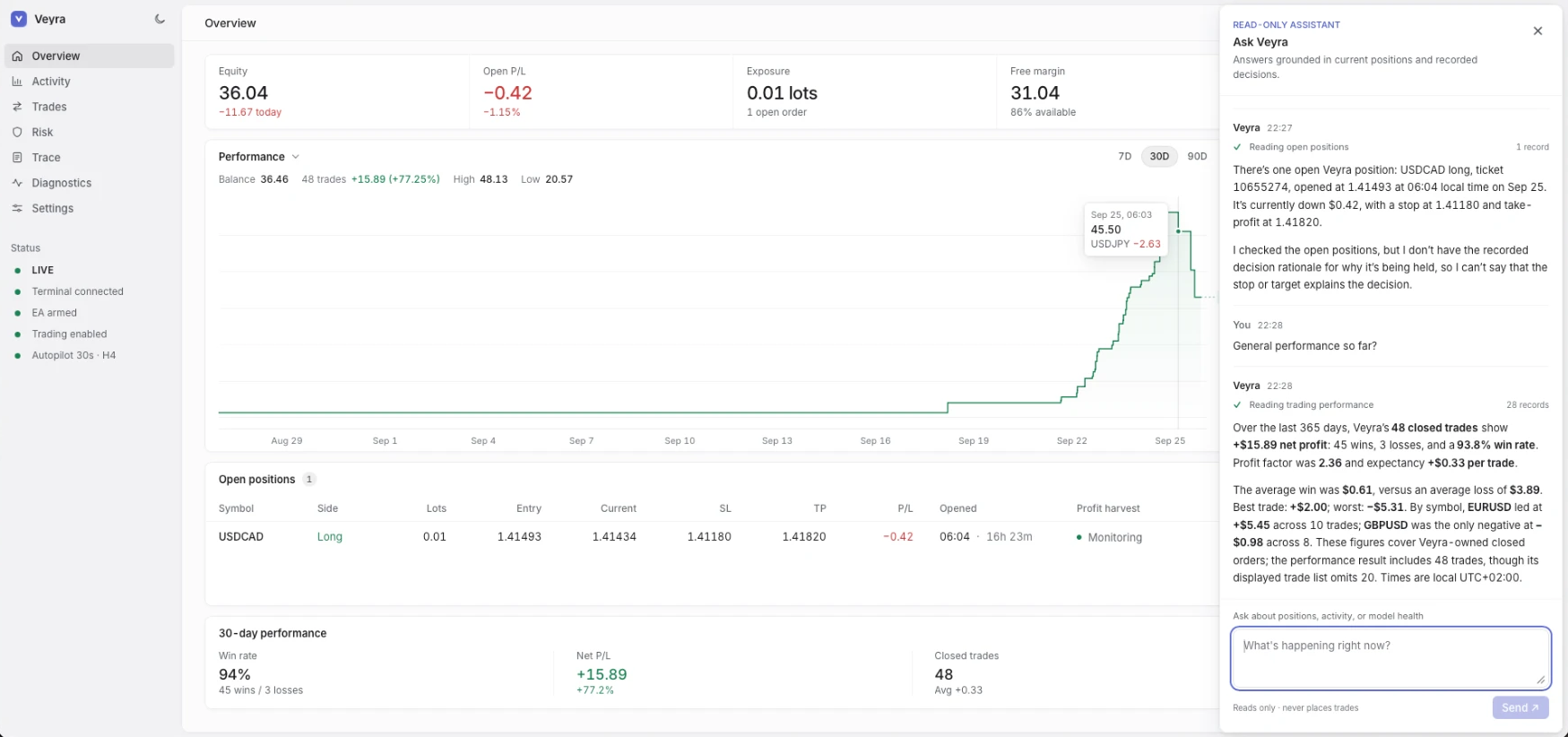
stagedmodify_order/ close path (seedocs/architecture.md). - An operations console (TanStack Start) on
http://127.0.0.1:3000:
account equity and a balance-history chart, open positions with stops, time
held, and a close action, closed trades with why each closed, a streaming
activity feed, risk controls, decision traces, diagnostics, and settings. - A read-only assistant in the console that answers from retained
positions, account state, recorded decisions, and model health. It has no
order, close, or modify tool. - Notifications to email, Telegram, Discord, Slack, ntfy, Pushover, or any
webhook, set up in the console's Notifications tab with a guide per channel. Breaker trips,
halts, a stale broker link, drift, failed orders, model trouble, opened and
closed trades, and a daily summary, each switchable. Delivery is a
background fan-out that never blocks trading, and a separate watchdog
reports when the service itself is down. See
docs/notifications.md. - 24/7 supervision: launchd agents for the terminal, tunnel, service, console,
outage watchdog, hourly log rotation, and daily verified audit backups (kept
locally and uploaded off-machine to R2) with crash restart on the service,
tunnel, and console (ADR 0005). - Durable audit trail in PostgreSQL (SQLx migrations, append-only
audit_events, loopbackGET /audit) — commands, acknowledgements, and
broker snapshots survive restarts. ConfigureVEYRA_DATABASE_URL; a
configured but unreachable database fails startup. - Structured JSON logging, bind-failure propagation, and graceful shutdown.
- Rust unit, integration, and line-coverage gates.
- GitHub Actions quality workflow.
- Architecture and roadmap documentation.
Real orders require two controls: the service switch
(VEYRA_TRADING_ENABLED=true) and the EA's InAllowLiveOrders input. Until
both are on, execution stops at a dry run.
Broker credentials never reach the service; the MT4 terminal owns the session.
Architecture direction
- Service core: Rust 2024 + Actix Web + Tokio owns durable orchestration and the execution boundary.
- Agent runtime: integration point for the existing
agent-runtimecrate so OpenAI-compatible, Anthropic, Gemini, Cohere, Bedrock, and self-hosted models remain configurable. - Jev adapter: separate structured decision adapter, never a chat wrapper; implemented with typed, validated judgements (
SemanticJudge). - Risk gate: deterministic policy validates every proposed action before execution. Model confidence does not override limits.
- Broker integration: every venue implements the
BrokerLinkcontract and
is selected byVEYRA_BROKER_PROVIDERat startup. The first implementation is
the MQL4 EA control channel (loopback HTTP, token-authenticated); a hosted
bridge or direct API can be added later without touching callers. - Persistence: PostgreSQL/SQLx for the append-only audit trail, balance
history, and position-management state. - Console: TanStack Start + TypeScript + React + Tailwind + shadcn/ui,
proxying/apito the loopback service.
See docs/architecture.md and docs/roadmap.md.
Runtime
An unedited copy of .env.example starts with every optional integration off.
Each section is turned on by filling it in; a partly filled section fails
closed at startup and names the missing setting. The
getting-started guide turns them on one stage at a time.
set -a; source .env; set +a
cargo run -p veyra-service
With VEYRA_BROKER_PROVIDER=ea the service also serves the EA control channel
on loopback (VEYRA_EA_BIND_HOST:VEYRA_EA_BIND_PORT). Build and install the
probe EA with ./scripts/compile_ea.sh (reads VEYRA_EA_TOKEN from .env).
Moving the stack to an always-on machine is covered step by step indocs/deployment.md; the Mac mini hybrid Docker profile is indocs/deployment-docker.md. scripts/preflight.sh checks a launchd target
machine's prerequisites and scripts/check.sh runs every local quality gate.
For unattended operation, install the supervised stack (release build; the
tunnel and service restart automatically, MT4 starts at login, logs rotate
hourly under ~/Library/Logs/veyra, and the audit database is backed up
daily to ~/Library/Application Support/veyra/backups):
cargo build --release
(cd console && npm install && npm run build) # one-time console build
./scripts/install-launchd.sh                 # render + bootstrap the agents
./scripts/install-launchd.sh --uninstall     # remove them again
The supervised stack includes the console on http://127.0.0.1:3000; it
proxies /api to the loopback service, so nothing is exposed beyond this
machine.
After changing code, rebuild and restart the supervised service:cargo build --release && launchctl kickstart -k gui/$(id -u)/cc.antonlabs.veyra.service
(see ADR 0005).
Then inspect:
http://127.0.0.1:8080/healthhttp://127.0.0.1:8080/ready(dependency-aware: reports broker and audit
status, degrading when either is unhealthy)http://127.0.0.1:8080/status
Model configuration
Select OpenRouter, OpenAI, Anthropic, Groq, DeepSeek, xAI, Mistral,
Moonshot/Kimi, Ollama, a connected ChatGPT/Claude subscription, or a custom
OpenAI-compatible endpoint withVEYRA_MODEL_PROVIDER. Configure three explicit tier models
(VEYRA_MODEL_FAST, VEYRA_MODEL_BALANCED, VEYRA_MODEL_REASONING). API
providers require VEYRA_MODEL_API_KEY; Ollama and connected subscriptions do
not. Partial configuration fails closed at startup. Custom providers requireVEYRA_MODEL_BASE_URL.
For console key entry, configure VEYRA_CONSOLE_SECRET_KEY (a base64-encoded
32-byte random key), VEYRA_CONSOLE_ADMIN_TOKEN (at least 32 characters), and
the database. The console asks for the operator token each time a key is saved
or removed, sends it only with that request, and never displays the saved key.
The service encrypts it before storage and does not include it in live settings
or audit entries. Preserve the encryption key across restarts.
The console assistant reads retained positions, account state, audit decisions,
and model health. Its /assistant/chat stream shows each retrieval as it runs.
The assistant has no order, close, or modify tool and cannot authorize a trade.
ChatGPT and Claude consumer subscriptions are available through the console's
Subscription connections section. Connect ChatGPT through Codex or Claude
through Claude Code, then select the corresponding subscription provider and
three model IDs in Model configuration. The browser sign-in callback is pasted
back into the console to complete the PKCE exchange; the service encrypts the
result in its runtime store. A connected account does not change the active
model until the new settings are applied. The OpenAI and Anthropic API choices
continue to use developer API credentials. Subscription credentials require
the console vault and database described above, and provider access depends on
the models available to the connected account.
Tier models must support structured answers. VEYRA_MODEL_COMPEL_STRUCTURED
selects forced tool choice when a provider supports it; turn it off for
reasoning models that reject a forced choice.
Live check:
set -a; source .env; set +a
cargo test --test model_live -- --ignored --nocapture
Quality
cargo fmt --all -- --check
cargo check --all-targets
cargo clippy --all-targets --all-features -- -D warnings
cargo test --all-targets
cargo coverage
scripts/check.sh runs all of them; scripts/smoke.sh exercises the real
binary, including shutdown.
EA channel operation (MT4)
One-time terminal setup:
./scripts/compile_ea.sh(readsVEYRA_EA_TOKENfrom.env; setVEYRA_EA_URLto the tunnel endpoint when using Cloudflare). The EA'sInAllowLiveOrdersinput is compiled fromVEYRA_EA_ALLOW_LIVE, which
defaults tofalse(dry runs only); set it totrueonce live trading is
approved. The input stays editable in the EA properties.- MT4 → Options → Expert Advisors: enable automated trading, and add the
endpoint URL (for examplehttps://veyra.antonlabs.cc/ea/poll) to the
WebRequest allowlist. Listing the exact URL is the habit that has held on
every build; a host-only entry has also matched by prefix in practice. - Attach
VeyraProbeto a chart. After recompiling the EA, restart the
terminal (or remove and re-attach the EA): MT4 does not hot-reload
externally rebuilt.ex4files.
Commands: the service delivers typed commands (ping, account_snapshot,rates, symbol_spec, order_history, list_symbols, order_check,open_order, close_order, modify_order) on a poll; the EA executes and acknowledges by id. Delivery is
at-least-once, a command fails after a 15 s timeout, and acknowledgements are
validated against the command's typed payload before they are recorded.order_check only validates a gate-approved request through the terminal's
market rules and margin engine — it never sends an order, and mutating commands
will keep the same id/ack discipline and must be idempotent per id.
Loopback control surface (127.0.0.1:8080): POST /intents/evaluate returns a
risk decision without queueing anything and POST /intents/check queues oneorder_check for an approved intent. The mutating routes — POST /intents/execute (queues open_order), POST /intents/close, and POST /intents/modify (stops on a Veyra-owned ticket) — all refuse unlessVEYRA_TRADING_ENABLED=true. POST /commands/account_snapshot refreshes venue
state (orders, open volume, bounded position list with magic numbers) — the
service also refreshes it automatically every VEYRA_RECONCILE_SECS (default
30 s). GET /reconciliation classifies every open order as Veyra-managed or
unknown and reports drift, and every command is pollable throughGET /commands/{id}.
Staged execution: with the service switch on, the terminal still validates the
request and reports a dry run while the EA's InAllowLiveOrders input is off,
so real money moves only when both controls are on.
Platform notes (see docs/decisions/0002):
- MQL4 has no sockets, and WebRequest only supports the scheme-default port
(80/443), so the channel runs over HTTPS via the tunnel. - Wine does not fall back from IPv6 to IPv4; the tunnel hostname is pinned to
its Cloudflare IPv4 addresses in/etc/hosts.
Live proof (requires MT4 with the probe attached):
set -a; source .env; set +a
cargo test --test ea_channel_live -- --ignored --nocapture
Safety
Veyra is intended to operate an existing brokerage account only after explicit risk controls, credentials, reconciliation, and staged testing are in place. It does not provide financial advice and does not guarantee profitable trading.
License
Copyright © 2026 Ngonidzashe Mangudya. All rights reserved.
Veyra is source-available, not open source. You may use it for your own
personal, non-commercial purposes only. Any other use, including commercial
use, redistribution, hosting it for others, or building a product or service on
it, requires explicit approval through an agreement signed by the copyright
holder. See LICENSE for the full terms.
Yorumlar (0)
Yorum birakmak icin giris yap.
Yorum birakSonuc bulunamadi