LLMIngress
Health Warn
- License — License: Apache-2.0
- Description — Repository has a description
- Active repo — Last push 0 days ago
- Low visibility — Only 5 GitHub stars
Code Warn
- process.env — Environment variable access in apps/console/next.config.ts
Permissions Pass
- Permissions — No dangerous permissions requested
No AI report is available for this listing yet.
Self-hosted AI gateway for agents — route providers, virtual models, limits, and usage from one console.

LLMIngress
Route your AI agents across the model providers you already use.
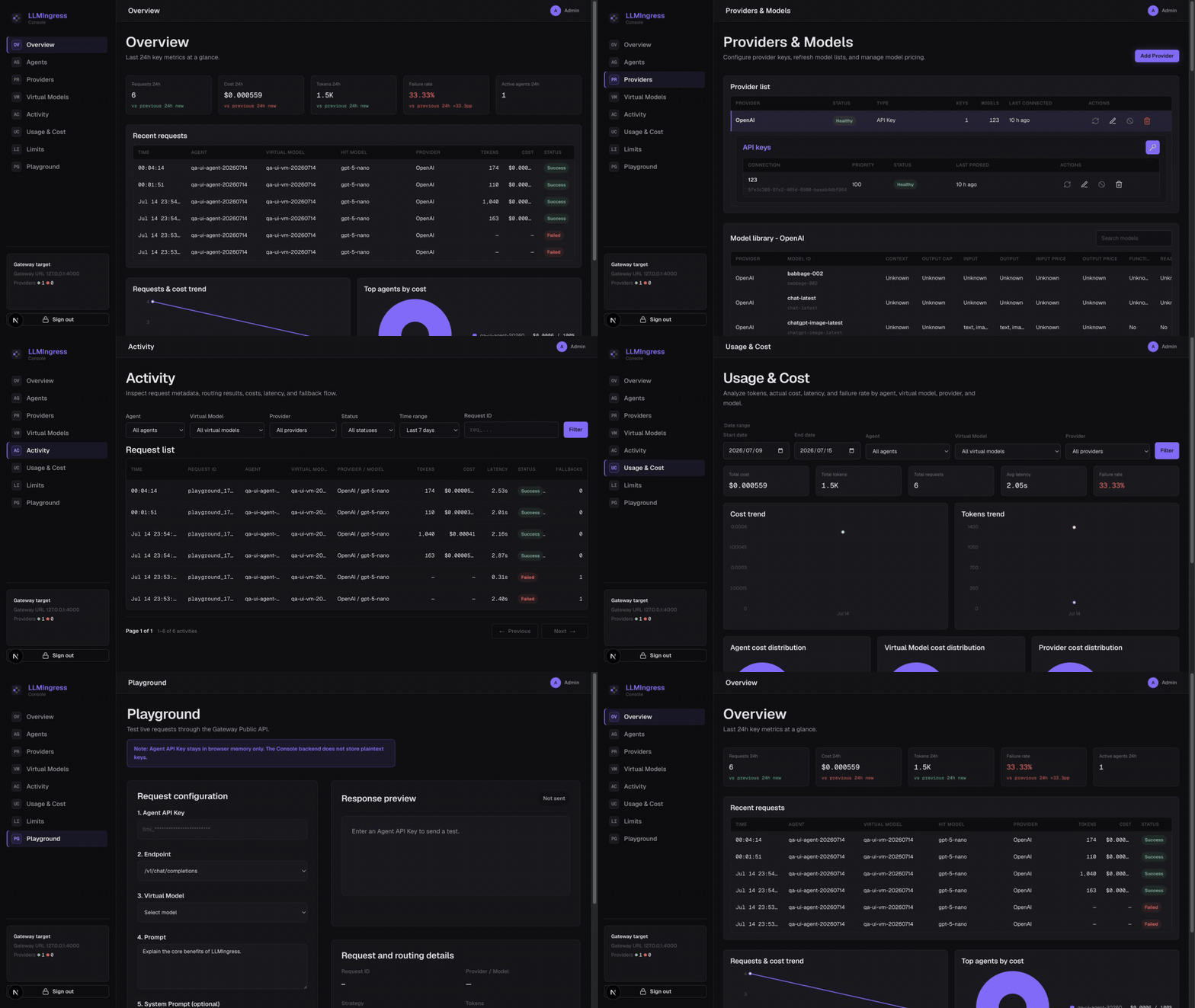



What is LLMIngress?
LLMIngress is an open-source, self-hosted AI Gateway for agents. Connect Provider API keys,
subscription accounts, and local model servers, expose them through stable Virtual Model names,
and control routing, access, limits, fallback, and usage from one Console.
- 🔀 Route Virtual Models with
fixed,cost_first, orrandompolicies - 🚑 Track the health of each Provider connection and fall back before streaming begins
- 🔐 Give every Agent a dedicated API key and explicit Virtual Model grants
- 🛡️ Enforce optional budget, RPM, TPM, token, and concurrency limits
- 📊 Track activity, tokens, latency, failures, fallback, connection health, and request cost
- 🕶️ Keep prompts, successful responses, tool arguments, and credentials out of operational logs
Quick start
Self-hosted with Docker Compose
git clone https://github.com/IamNotShady/LLMIngress.git
cd LLMIngress
./scripts/deploy.sh
./scripts/deploy.sh writes a random ENCRYPTION_KEY into a gitignored .env when missing,
then runs docker compose up --build. Compose still uses a local-only default PostgreSQL
password (llmi-local-db). Published ports bind to 127.0.0.1 by default. Keep a backup of.env — the same ENCRYPTION_KEY is required to decrypt stored provider credentials.
Compose runs two containers: the app (Console, Gateway, and Worker in one process group) and
PostgreSQL.
| Endpoint | Address | Purpose |
|---|---|---|
| Console | http://localhost:3000 | Configure and observe LLMIngress |
| Gateway | http://localhost:4000 | Serve Agent API traffic |
| PostgreSQL | localhost:55432 |
Store configuration and operational metadata |
| Worker | Inside the app container | Refresh models, probe connections, and synchronize prices |
Runtime and port overrides are documented in .env.example.
Send your first request
Open http://localhost:3000, create the administrator password, then:
- Add a Provider connection.
- Create a Virtual Model with at least one candidate.
- Create an Agent allowed to use that Virtual Model.
- Copy the Agent's one-time
llmi_API key.
curl http://localhost:4000/v1/chat/completions \
  --header "Authorization: Bearer llmi_your_agent_key" \
  --header "Content-Type: application/json" \
  --data '{
    "model": "your-virtual-model",
    "messages": [{"role": "user", "content": "Hello"}]
  }'
Providers
LLMIngress supports remote API keys, subscription OAuth, and local model servers. The current
built-in templates are:
| Connection type | Built-in templates |
|---|---|
| Subscription | OpenAI Codex, Claude Code |
| API key | Google Gemini, OpenRouter, DeepSeek, xAI, Qwen, Moonshot/Kimi, MiniMax, Z.ai |
| Local | Ollama, LM Studio, llama.cpp |
Model refresh can enrich Provider catalogs with capability and price data from models.dev,
OpenRouter, LiteLLM, and Vercel. Missing metadata remains unknown, and manual values take
precedence.
Health belongs to a Provider connection: each API key or OAuth token is checked independently,
while a Local Provider has one logical connection. Confirmed unhealthy connections are filtered
from routing until a successful probe recovers them.
Gateway APIs
Agents use the same API key and Virtual Model grants across all supported protocols:
| Protocol | Endpoint |
|---|---|
| OpenAI Chat Completions | POST /v1/chat/completions |
| OpenAI Responses | POST /v1/responses |
| Anthropic Messages | POST /v1/messages |
| Virtual Model discovery | GET /v1/models |
Provider payloads remain protocol-native. LLMIngress replaces the Virtual Model name with the
selected Provider model while preserving the Provider request and response contract.
Gateway health endpoints do not require an Agent API key:
| Endpoint | Purpose |
|---|---|
GET /health/live |
Process liveness |
GET /health/ready |
Database and configuration readiness |
GET /health |
Readiness-compatible alias |
How it works
- Gateway authenticates Agents, enforces enabled limits, resolves Virtual Models, executes
fallback, and records request metadata. - Console owns configuration and operational views. It does not proxy Agent traffic or call
Providers. - Worker performs model discovery, exact Provider-connection probes, and price synchronization.
- PostgreSQL stores durable configuration, jobs, usage, cost, fallback, and connection health.
Local development
LLMIngress uses Node.js 24, pnpm 11.5.1, and PostgreSQL 18.4.
pnpm install
cp .env.example .env.local
# Set ENCRYPTION_KEY (e.g. openssl rand -base64 32) and confirm DATABASE_URL / TEST_DATABASE_URL.
pnpm run db:migrate
./init.sh
To exercise the production-shaped stack from a checkout, run ./scripts/deploy.sh.
Compose builds one multi-role application image, runs it as a single app container alongside
PostgreSQL (published on 127.0.0.1:55432 for development).
./init.sh runs lint, type-checking, unit tests, and the build before starting Console, Gateway,
and Worker. The standalone verification commands are:
pnpm run verify
pnpm run verify:features
The project is pre-release. The current 0001_core_baseline.sql schema is authoritative;
databases created from older development migration histories should be recreated rather than
upgraded in place.
Quick links
Contributing
Read AGENTS.md and the coding guide before changing behavior.
Work on one feature at a time, write unit and E2E coverage before implementation, and run both
verification commands before marking a feature complete.
License
Reviews (0)
Sign in to leave a review.
Leave a reviewNo results found