humanities-superpowers
Health Uyari
- License — License: MIT
- Description — Repository has a description
- Active repo — Last push 0 days ago
- Low visibility — Only 7 GitHub stars
Code Gecti
- Code scan — Scanned 12 files during light audit, no dangerous patterns found
Permissions Gecti
- Permissions — No dangerous permissions requested
Bu listing icin henuz AI raporu yok.
Structured research skills and quality gates for humanities scholars using AI agents.
Humanities Superpowers
한국어 · Documentation · Quick start · White paper · Manifesto · Examples
Structured research skills and quality gates for humanities scholars using AI agents.
Use AI without surrendering scholarly judgment.
Not an AI paper writer. A scholarly judgment scaffold.
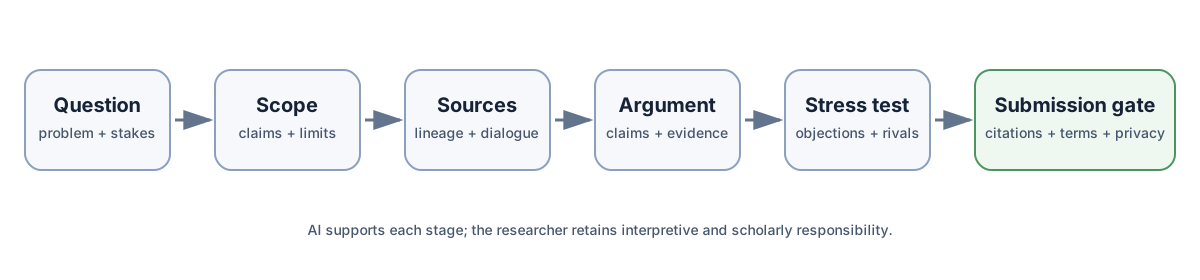
Humanities Superpowers helps researchers slow down the moments where fluent AI output is most dangerous: framing a question, defining concepts, connecting claims to evidence, testing objections, checking citations, and deciding whether a manuscript is ready to submit.
It provides 13 core research skills and one Level 3 router that selects the smallest valid route through them. It supports scholarly judgment; it does not replace interpretation, source verification, ethics, or authorship, and it does not promise a publication-ready manuscript.
Critical testing invited
The initial goal is to recruit 10 humanities researchers willing to test one research skill on a real project and report where the framework is too rigid, too technical, or methodologically weak.
- Submit a test report
- Offer methodological criticism
- Report an installation problem
- Join a broader discussion
Literary scholars, historians, philosophers, digital humanists, DH librarians, graduate researchers, and scholars working in languages other than English are especially welcome. Do not post unpublished manuscripts, personal data, reviewer identities, or copyrighted source text; use anonymized descriptions and minimal excerpts.
Quick start
git clone https://github.com/icerain-cmd/humanities-superpowers.git
cd humanities-superpowers
python3 scripts/validate_repository.py
On Windows, use python instead of python3 if that is the available launcher.
Copy skills/ into your agent's skill directory, or follow INSTALLATION.md.
Then ask:
Use Humanities Superpowers to formulate a research question about artificial nature and platform aesthetics. Separate verified evidence, interpretation, inference, hypothesis, and unknowns. Do not invent sources.
For a complete workflow:
Follow
workflows/write-a-paper.md. Stop at every quality gate and report unresolved risks before proceeding.
Verification and compatibility
Tested: Claude Code and OpenAI Codex.
Installation guidance provided, but not yet independently verified: Cursor.
Other Markdown-capable agents may use the skills manually, but compatibility is not guaranteed. Product conventions can change; see INSTALLATION.md for the tested project layouts, file-count checks, and a read-only pilot workflow.
Why it exists
AI agents can produce polished academic prose before the underlying research has been verified. Humanities research requires a different discipline: conceptual lineage, close reading, argumentative restraint, traceable evidence, serious counterarguments, and explicit uncertainty.
The framework therefore organizes work around three commitments:
- Research before prose
- Evidence over confidence
- Completion must be demonstrated
Read the methodology white paper, project philosophy, and design principles.
13 core research skills + 1 Level 3 router
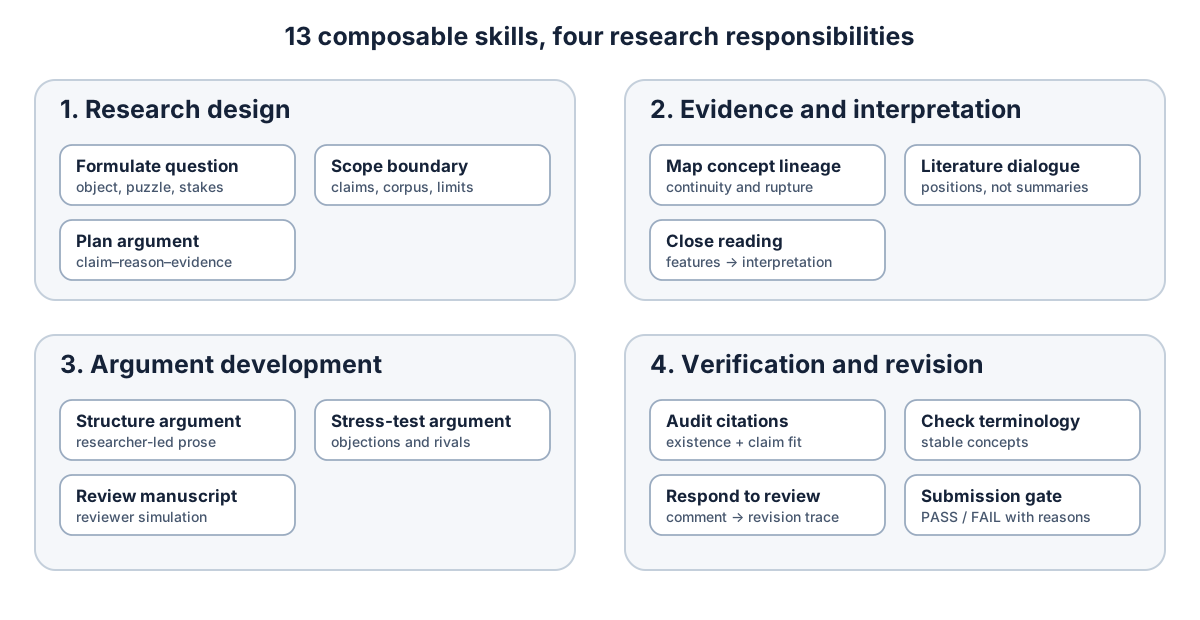
| Research responsibility | Skill |
|---|---|
| Turn a topic into an arguable question | formulating-research-question |
| Define what the argument will and will not claim | scoping-argument-boundary |
| Trace a concept across thinkers and contexts | mapping-concept-lineage |
| Turn sources into a scholarly conversation, not a summary list | conducting-literature-dialogue |
| Build a claim–reason–evidence structure | planning-humanities-argument |
| Analyze passages, images, and media artifacts closely | performing-close-reading |
| Structure the researcher's argument without ghostwriting it | structuring-humanities-argument |
| Attack the argument before reviewers do | stress-testing-argument |
| Verify citation existence and claim–source fit | auditing-citations |
| Keep concepts and translations stable | checking-terminology-consistency |
| Simulate a rigorous manuscript review | reviewing-manuscript |
| Convert reviews into traceable revisions | responding-to-peer-review |
| Run a final PASS/FAIL submission gate | verifying-before-submission |
Each skill defines invocation conditions, required inputs, a procedure, stop signals, anti-fabrication rules, completion criteria, output records, and next steps.
The separate using-humanities-superpowers router diagnoses research state and selects among these 13 core skills. The repository therefore contains 14 SKILL.md files: 13 core research skills and 1 router.
Research quality gates
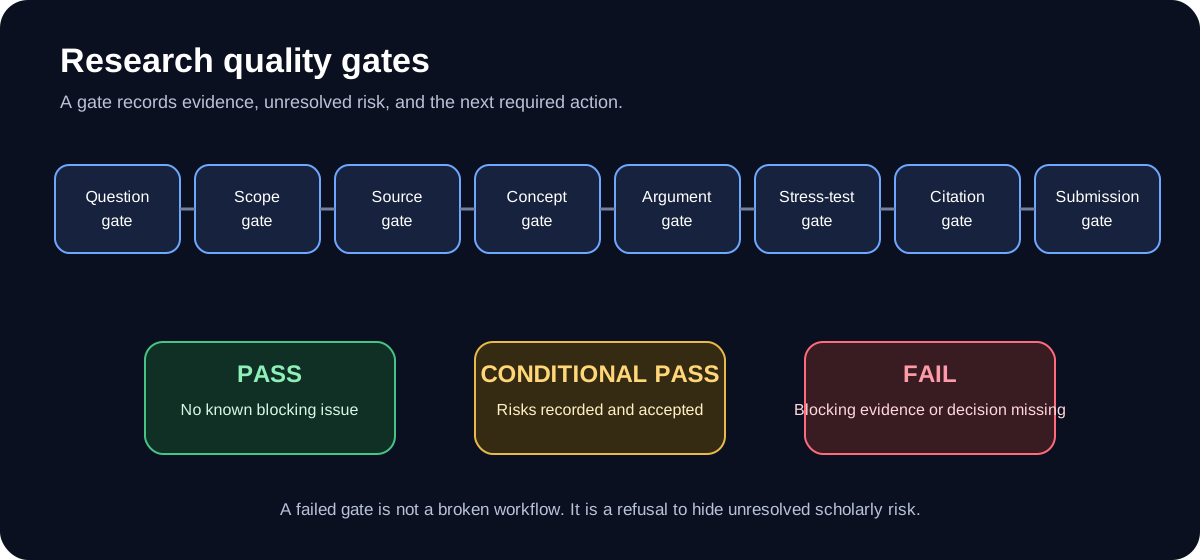
A gate returns:
PASS— no known blocking issue remains;CONDITIONAL PASS— recorded risks are explicitly accepted;FAIL— evidence, verification, or researcher judgment is still missing.
A failed gate is not a broken workflow. It is a refusal to hide unresolved scholarly risk. See QUALITY_GATES.md.
Human–AI division of responsibility
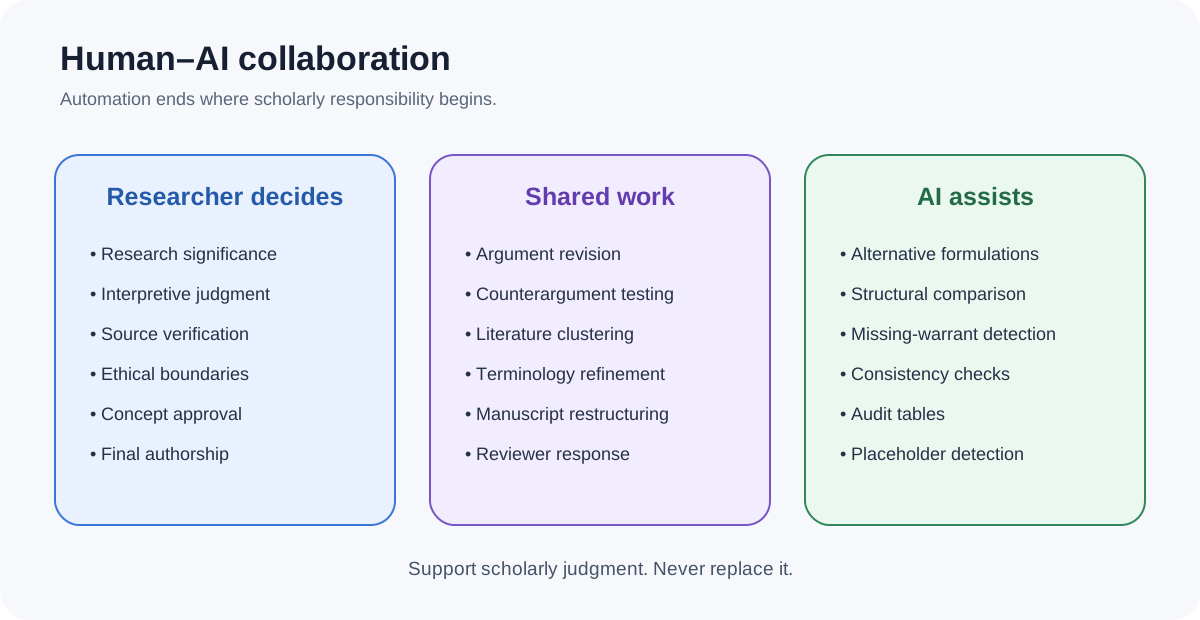
AI may organize, compare, test, and flag. The researcher remains responsible for significance, interpretation, source verification, ethics, conceptual commitments, disclosure, and final authorship.
Worked examples
End-to-end concept paper
Artificial Nature and Platform Mediation runs from a research brief through question formation, scope, concept lineage, argument mapping, terminology control, citation audit, and final verification.
The final gate intentionally returns FAIL. No verified source set is supplied, so the framework refuses to label the project publication-ready. This is expected behavior.
Focused examples
What this project does not claim
Humanities Superpowers does not guarantee truth, originality, acceptance, or citation accuracy. It does not turn an AI agent into an autonomous scholar. It reduces avoidable risk by making assumptions, evidence, unresolved verification, and researcher decisions visible.
See ANTI_PATTERNS.md for common failure modes.
Origin and independence
Humanities Superpowers was inspired by Jesse Vincent's obra/superpowers, which applies composable skills and systematic verification to coding agents. This project independently adapts that general design idea to humanities research.
It is not affiliated with, endorsed by, or maintained by Jesse Vincent, Prime Radiant, or the Superpowers project. See ACKNOWLEDGMENTS.md, DIFFERENCES.md, and THIRD_PARTY_NOTICES.md.
Author
Lee Yong Wook · Jeonju University
GitHub: @icerain-cmd · [email protected]
Contributing, citation, and license
Read CONTRIBUTING.md before opening an issue or pull request. Citation metadata is provided in CITATION.cff. Released under the MIT License.
Research orchestration
The Level 3 router diagnoses the current research state, selects the smallest valid skill route, and treats failed gates as reasons to pause or roll back—not as obstacles to hide. It can preserve a resumable session record without treating memory as evidence.
Documentation site
The live documentation is published at icerain-cmd.github.io/humanities-superpowers. It is built with MkDocs Material and deployed from main through GitHub Actions.
Public release status
The v1.0.0 release notes and final publication checklist are available in docs/release/.
Social media launch kit
Yorumlar (0)
Yorum birakmak icin giris yap.
Yorum birakSonuc bulunamadi