weir
Health Gecti
- License — License: Apache-2.0
- Description — Repository has a description
- Active repo — Last push 0 days ago
- Community trust — 17 GitHub stars
Code Gecti
- Code scan — Scanned 12 files during light audit, no dangerous patterns found
Permissions Gecti
- Permissions — No dangerous permissions requested
Bu listing icin henuz AI raporu yok.
API key leak detection for the agents you build and the coding agent you use. Test any agent with planted fake keys, or see which of your real keys a Claude Code session exposed.
Weir
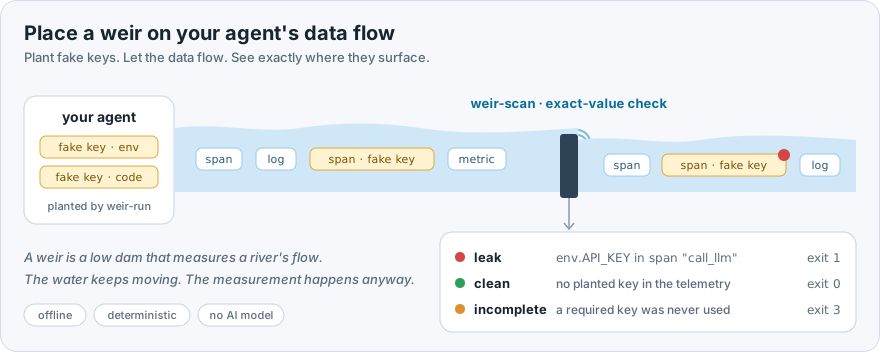
Catch your AI agent leaking API keys. Agent frameworks can copy keys into traces and logs, and coding agents can read them into the model's context. Weir finds each key by its exact value, names where it went, and never prints it.
- The agents you build: plant fake keys where your real ones live, run the agent's own flows, and get a verdict for every place they reached: spans, logs, console output, the model, other services. Leak, clean or incomplete. It found GHSA-j7qq-vr8c-xvw3 in MLflow.
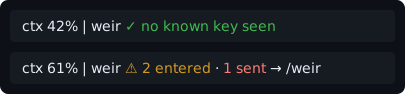
- The coding agent you use: in Claude Code, a status line shows which of your real keys entered the session or left in a tool call, and an optional hook strips known keys from tool results before the model reads them.


Try it in 10 seconds
pip install weir-scan
weir canary judge --sample

Two ways to use it
1. Test your agent, in CI or on your laptop
weir-run plants a unique fake key wherever a real one would live, runs your agent's own flows against a local fake model, and captures everything the agent sends out. weir canary judge then searches all of it for those exact values.
pip install weir-scan weir-run
weir-run run --config canary.toml
[[placement]]
id = "env.OPENAI_API_KEY"
kind = "env"
shape = "openai"
required = true
provider = "model"     # where this key is allowed to go

[[flow]]
id = "quickstart"
command = ["{python}", "examples/quickstart.py"]
In a pull request, one step runs it and posts the verdict as a comment:
- uses: IdoGol24/weir@<ref>
Config, pytest fixture and the full workflow: weir-run README · action README.
2. Watch your own Claude Code sessions
A status-line segment counts how many of your real credentials entered the session's context, and how many were sent out in a tool call. /weir explains each one: where it came from, the turn that moved it, where it sits now, and what to do. It never shows a value.
Setup can also add a redaction hook. When a Read, Bash, Grep, Glob or WebFetch result holds one of your inventoried keys as a whole value, in the forms weir audit matches, the hook replaces it with [weir: NAME removed] before the model sees it, and the status line counts it as kept out. Claude Code's hooks reference says this replacement "only changes what Claude sees". For a large output, such as a Bash output past about 30,000 characters, Claude Code also saves the whole output to a file in the session's folder and gives Claude its path (tools reference). That saved copy holds the original output, written before the hook runs, so the hook also rewrites it the same way, owner-only. If the hook fails, the status line says "possibly not redacted".
uv tool install weir-scan     # or: pipx install weir-scan
weir statusline setup         # shows the change, applies it only when you type yes
weir statusline undo removes it. Linux and macOS. Details: docs/statusline.md.
Why it's different
- It doesn't guess. It looks for the exact values it planted, raw or encoded, so a hit is a real leak.
- It checks every way out: spans, logs, metrics, console output, prompts sent to the model, and requests to any other service. On Linux, where unprivileged user namespaces are allowed, the agent runs with no outside network, so a direct connection is caught too.
- No false all-clear in the test rig. In a
weir-runtest, if something you marked required wasn't exercised, the result is "incomplete", never "clean". Exit codes: 0 clean, 1 leak, 2 unusable input, 3 incomplete. - Offline and deterministic. No AI model decides anything, and Weir itself sends nothing anywhere. Tests enforce both.
Found with Weir: GHSA-j7qq-vr8c-xvw3, an MLflow advisory, fixed in 3.17.0.
Limits
- It finds whole values only, not hashed, split or truncated ones.
- It sees only what the agent sends while the test runs.
- Network isolation is Linux-only and needs unprivileged user namespaces. Elsewhere the report says the network wasn't isolated.
- The fake model speaks the OpenAI-compatible and Anthropic Messages APIs.
- The status line knows only the keys in your inventory, as whole values. A key that leaves inside a file or by its variable name isn't seen.
- The inventory covers one project at a time.
The full lists are in docs/canary.md and docs/statusline.md.
The redaction hook:
- It only changes what the model reads after a tool call. It can't undo a command that already ran, or catch a key pasted into the chat.
- It matches your inventoried keys as whole values only. A key glued to other text, or inside a PDF, isn't removed.
- When the hook can't finish, or a tool call fails, Claude Code passes the original output on. The status line then shows "possibly not redacted" or "entered", never green.
Full list: docs/statusline.md#the-redaction-hook
Also in the box
weir scan: follows sensitive data through traces you already have, for example from untrusted tool output to an outgoing email.weir inventory: lists the credentials an agent could reach, by name only.weir audit: checks your real credentials against saved agent sessions, offline.
FAQ
Does it need my real keys? No. Tests use fake values only. For the status line, Weir stores only keyed fingerprints of your real keys, never the keys themselves.
How is it different from gitleaks or trufflehog? They find strings that look like secrets in your code. Weir proves whether a specific value actually left through your agent. Use both.
Does it send anything anywhere? No. The fake model listens on 127.0.0.1 only and forwards nothing, and the scanner opens no network connections. Tests enforce both.
License
Apache-2.0, all of it, permanently. Nothing held back, nothing gated, nothing phoning home.
Why "weir"

A weir is a low dam that measures a river's flow. The water keeps moving; the measurement happens anyway.
Damhead Weir, Water of Leith. Photo by 501ghost, Wikimedia Commons, CC0.
Yorumlar (0)
Yorum birakmak icin giris yap.
Yorum birakSonuc bulunamadi