claude-code-session-cleaner
Health Gecti
- License — License: MIT
- Description — Repository has a description
- Active repo — Last push 0 days ago
- Community trust — 31 GitHub stars
Code Basarisiz
- rm -rf — Recursive force deletion command in scripts/delete-session.sh
- rm -rf — Recursive force deletion command in tests/test.sh
Permissions Gecti
- Permissions — No dangerous permissions requested
Bu listing icin henuz AI raporu yok.
A safe, recoverable terminal session manager for Claude Code — browse, diagnose, clean, and restore conversations.
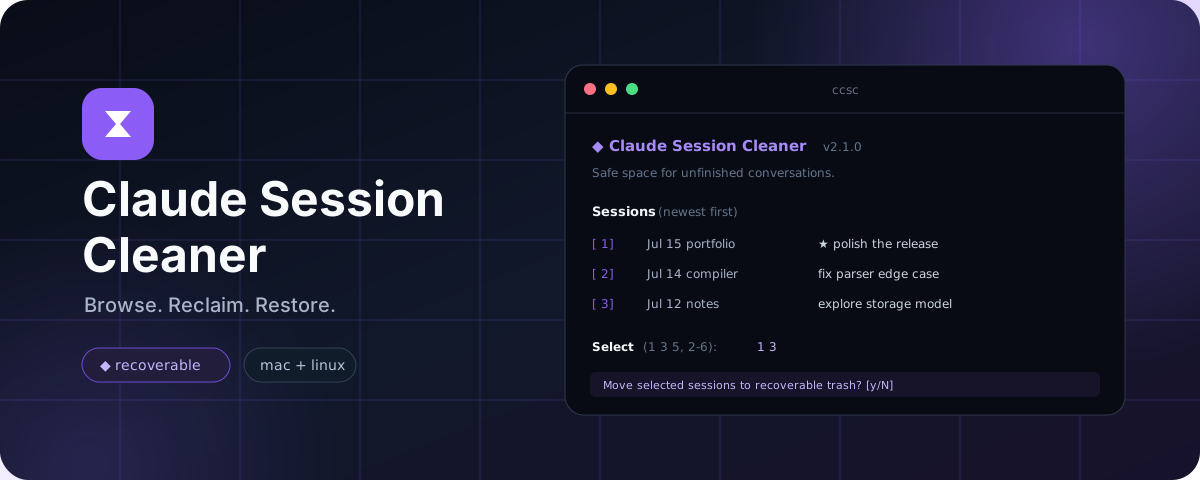
Claude Session Cleaner
A safe, recoverable terminal session manager for Claude Code.



No telemetry · No cloud · No database
Why ccsc?
Claude Code stores conversations as JSONL transcripts under ~/.claude/projects. Once /resume becomes crowded, manually matching encoded project paths, UUID files, and sibling artifact directories is slow—and one incorrect rm is permanent.
ccsc turns that storage into a focused terminal product. It uses the same labels as /resume, protects recently active work, and moves complete sessions into a recoverable local trash.
🛟 RecoverableTranscripts and their derivative artifacts move together. Restore puts both back at the exact original path. |
🛡️ DefensiveActive sessions, ambiguous UUIDs, restore conflicts, and destructive bulk actions are explicitly refused. |
⚡ ScriptableProject scoping, age-based cleanup previews, diagnostics, and JSON output work in terminals and automation. |
Terminal experience
$ ccsc --all list release

  ◆ Claude Session Cleaner v2.1.0
  Safe space for unfinished conversations.

  Sessions (newest first)

[  1] 2026-07-15 20:31  portfolio           728K  bcf9c007…  ★ polish the release
[  2] 2026-07-15 20:24  compiler             24K  34738f62…  fix parser edge case  ● active

  2 session(s) · all scope

$ ccsc --all clean --older-than 30d
  6 candidate session(s).
  Preview only. Re-run with --yes to move them to recoverable trash.
The same engine also powers /delete-session inside Claude Code, where natural selections such as 1 3-5, all, or all except 2 are resolved and confirmed conversationally.
Features
- Recoverable local trash with conflict-safe restore and explicit permanent purge
- Transcript plus same-UUID
subagents, tool results, and memory cleanup - 10-minute active-session guard with a visible
● activestatus /resume-compatible label priority: custom title → latest prompt → user message- Safe age policies such as
clean --older-than 30d, preview-only by default - Environment diagnostics through
ccsc doctor - Current-project, all-project, explicit-path, keyword, and UUID-prefix lookup
- Structured JSON for session lists, stats, and cleanup previews
- Bash 3.2 compatibility with macOS and Linux CI
Requirements
- macOS or Linux
- Bash 3.2+
jq
Run ccsc doctor after installation to validate the complete environment.
Quick start
git clone https://github.com/ihoooohi/claude-code-session-cleaner.git
cd claude-code-session-cleaner
./install.sh
ccsc doctor
ccsc
The idempotent installer adds ccsc to ~/.local/bin and installs /delete-session under ~/.claude. Existing files are never replaced unless --force is supplied.
If needed, add the binary directory to your shell profile:
export PATH="$HOME/.local/bin:$PATH"
Command reference
| Command | Purpose | Destructive? |
|---|---|---|
ccsc |
Open the interactive browser for the current project | No |
ccsc list [pattern] |
List or filter current-project sessions | No |
ccsc --all list |
List sessions across every project | No |
ccsc --project /path list |
Inspect an explicit project | No |
ccsc stats |
Show session, project, storage, and trash totals | No |
ccsc doctor |
Diagnose dependencies, storage, and permissions | No |
ccsc clean --older-than 30d |
Preview sessions matching an age policy | No |
ccsc clean --older-than 30d --yes |
Move previewed sessions to recoverable trash | Recoverable |
ccsc trash <uuid>... |
Move exact sessions to recoverable trash | Recoverable |
ccsc restore [uuid] |
List trash or restore one session | No |
ccsc purge <uuid> |
Permanently delete one trash entry | Yes |
ccsc purge --all |
Permanently empty the recovery trash | Yes |
Use --json with list, stats, or a clean preview:
ccsc --all --json clean --older-than 30d | jq '.[].uuid'
How it works
flowchart LR
    A["Scan project JSONL"] --> B["Resolve /resume label"]
    B --> C["Select by index, age, or UUID"]
    C --> D{"Recently active?"}
    D -- Yes --> E["Refuse and explain"]
    D -- No --> F["Move transcript + artifacts"]
    F --> G["Write recovery metadata"]
    G --> H["Local recovery trash"]
    H -->|restore| I["Original project path"]
    H -->|purge| J["Permanent deletion"]
Every trash entry is self-contained: session.jsonl, an optional artifacts/ directory, and metadata.json with the UUID, original path, and trash timestamp. A failed artifact move rolls the transcript back instead of leaving a half-moved session.
Safety by design
| Risk | Guardrail |
|---|---|
| Current conversation is selected | Sessions modified inside the active threshold are refused |
| UUID prefix matches multiple files | Ambiguous prefixes never resolve automatically |
| Bulk policy catches too much | clean is preview-only until explicit --yes |
| Subagent/tool data becomes orphaned | Transcript and derivative directory move as one transaction |
| Restore would overwrite a session | Existing destinations are never replaced |
| User confuses trash with deletion | Recoverable trash and irreversible purge are separate commands |
Design decisions
- Local-first: session contents never leave the machine.
- Trash over undo: filesystem moves remain understandable and inspectable without a database.
- Policy previews: bulk cleanup separates selection from mutation.
- Small dependency surface: Bash and
jqkeep installation auditable and portable. - Real storage format: labels come directly from Claude Code JSONL records rather than a parallel index.
Configuration
| Variable | Default | Meaning |
|---|---|---|
CLAUDE_HOME |
~/.claude |
Claude Code data directory |
CCSC_PROJECTS_DIR |
$CLAUDE_HOME/projects |
Session storage override |
CCSC_TRASH_DIR |
$CLAUDE_HOME/session-cleaner-trash |
Recovery trash location |
CCSC_ACTIVE_THRESHOLD_SEC |
600 |
Recent-session protection window |
NO_COLOR |
unset | Disable ANSI color when set |
Project structure
.
├── scripts/delete-session.sh   # CLI, JSONL parser, policy and recovery engine
├── commands/delete-session.md  # Claude Code conversational workflow
├── tests/test.sh               # isolated filesystem integration suite
├── assets/hero.svg             # repository artwork
├── .github/                    # CI, issue forms, and PR template
├── install.sh                  # idempotent installer
└── uninstall.sh                # uninstaller that preserves recovery data
Development
bash tests/test.sh
shellcheck scripts/delete-session.sh install.sh uninstall.sh tests/test.sh
Tests use a temporary CLAUDE_HOME; they never inspect or mutate real sessions. GitHub Actions runs the suite on macOS and Ubuntu and applies ShellCheck to every pull request.
See CONTRIBUTING.md for the development workflow and SECURITY.md for responsible disclosure.
FAQ
Does ccsc upload or analyze my conversations?No. It only reads and moves local files. There is no telemetry, network request, account, or hosted service. Can it remove the conversation I am currently using?
The active-session guard is designed to refuse it. Use another terminal for cleanup and never lower the threshold merely to bypass that protection. What happens when Claude Code adds native session deletion?
Native deletion solves one operation. ccsc still provides recovery, storage diagnostics, policy previews, JSON automation, and complete artifact cleanup.
Roadmap
- Size-aware cleanup policies (
--larger-than) - Storage trends and per-project insights
- Optional desktop trash integration
Acknowledgements
Built from real-world Claude Code storage behavior and community feedback. Thanks to all contributors. Native deletion is tracked in anthropics/claude-code#26904.
License
Released under the MIT License.
Yorumlar (0)
Yorum birakmak icin giris yap.
Yorum birakSonuc bulunamadi