Codemm
Health Gecti
- License — License: MIT
- Description — Repository has a description
- Active repo — Last push 0 days ago
- Community trust — 15 GitHub stars
Code Uyari
- fs module — File system access in .github/workflows/ci.yml
- process.env — Environment variable access in .github/workflows/desktop-release.yml
- fs module — File system access in .github/workflows/desktop-release.yml
Permissions Gecti
- Permissions — No dangerous permissions requested
Bu listing icin henuz AI raporu yok.
Turn Claude Code or Codex into a step-by-step coding tutor. Free and open source, and every exercise is verified in a sandbox before you see it.


Supercharge your coding journey with your own coding agent.



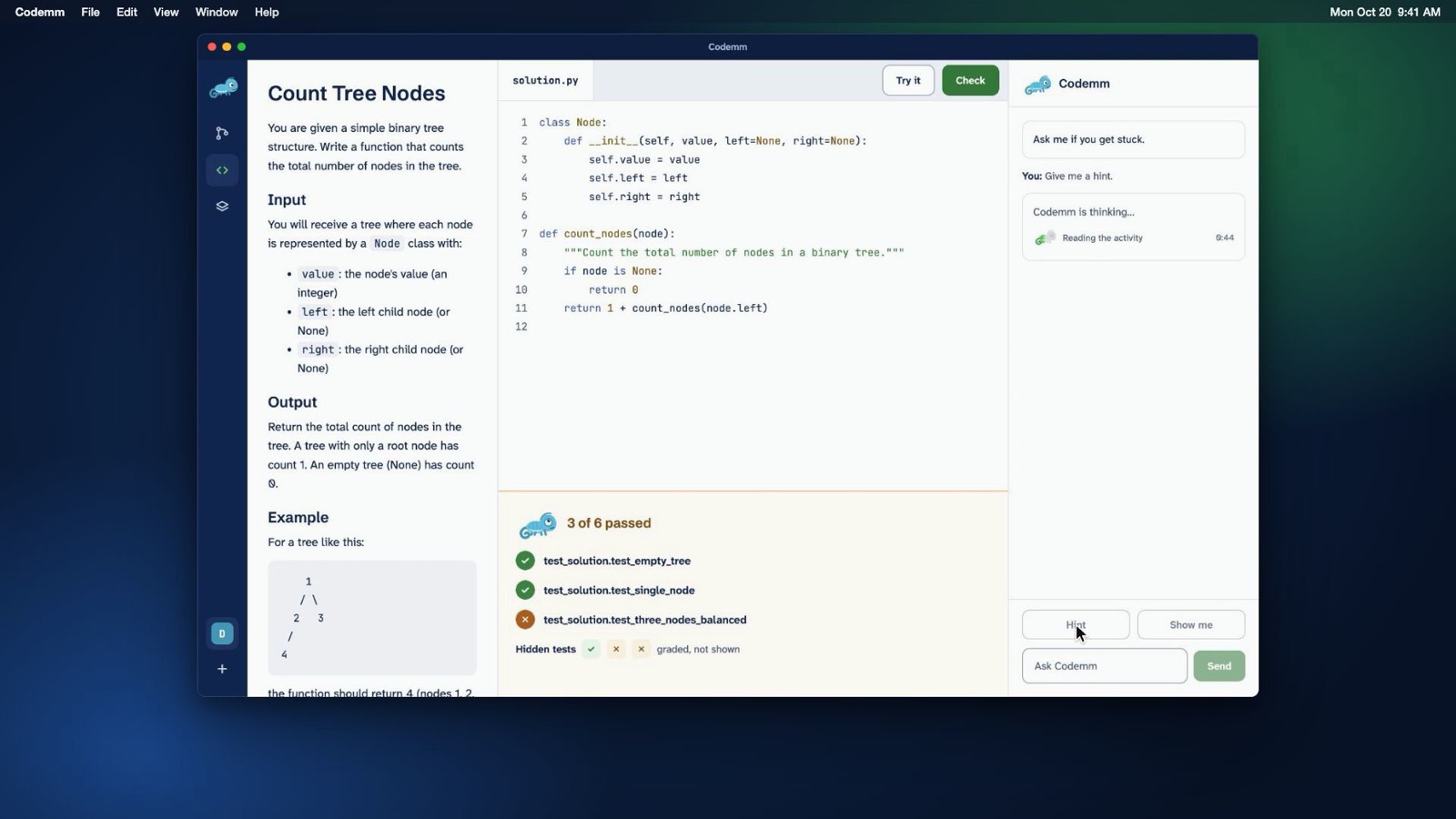
What is Codemm
Codemm is an open-source app for learning to code by practice. Your own coding agent (Claude Code or Codex, with your own account) writes the lessons and exercises. Codemm checks each exercise against its tests, grades your code in a sandbox, and tracks what you've mastered.
Codemm launches your agent; it never calls a model API, and it never reads, stores or asks for credentials. It ships no languages: your agent sets up each language or framework the first time you need it, and Codemm checks that it works.
How it works
- Connect your agent and let Codemm check this computer (Docker installed, running, and the sandbox working).
- Say what you want to learn. Your agent writes a roadmap of topics. You can approve it, ask for changes, or rename, reorder, add and remove topics yourself.
- Agree to setup once. Your agent proposes an environment for the language (a Dockerfile, a
track.yamland small probe programs). Codemm shows you the files and builds exactly those, only after you agree, and installs the track only if its probes pass with the network off. - Read the lesson for each topic, and keep notes beside it.
- Do the activity. Your agent writes an exercise: a statement, starter code, a reference solution, 2–4 deliberately broken variants, and visible and hidden tests. Codemm accepts it only if the reference passes, the starter fails, and the tests catch every broken variant. You edit the code, use Try it for the visible tests, then Check.
- Ask Codemm when you're stuck. It explains and hints; it doesn't edit your code. Skip means "come back later", never "mastered".
What counts. Try it is never recorded. Check records an attempt, except for a check of the unedited starter or one that failed for a reason outside your code (Docker stopped, for example). Mastery moves only on an exercise's first check, or when you beat your best score on it; re-checking a solved exercise adds nothing. Difficulty goes up (to at most 3) after a first-try pass without assistance, and down (to 1) after repeated failures.
Install (beta)
A private beta is planned once the packaged app passes its macOS and Windows journeys. When a beta build is published on the Releases page, download the installer for your computer:
- macOS (Apple Silicon or Intel): the
.dmg. Beta builds are unsigned: open the app once, then choose System Settings, Privacy & Security, Open Anyway. - Windows (x64): the installer. Beta builds are unsigned: in the SmartScreen prompt, choose More info, then Run anyway.
You also need:
- Docker Desktop, running. On Windows, use the WSL 2 backend with Linux containers. No Docker? See below.
- Claude Code or Codex, installed and signed in. Cursor is experimental.
The app bundles Codemm, so you don't need Node.js, npm or a terminal. The public 1.0 will be signed.
No Docker? (school or work computers)
Installing Docker Desktop needs admin rights, which school and work computers often don't give. Without Docker, the desktop app can still run io practice (programs that read input and print output) in interpreted languages that have a WebAssembly (WASI) build, such as Python. It bundles wasmtime, a sandbox that runs as your own user, with no admin rights. In Check this computer, choose Continue without Docker.
For everything else, such as unit tests, frameworks and compiled languages, ask whoever manages the computer to install Docker Desktop once (Docker's terms list education among free uses), or use a computer that has Docker.
Use from a terminal
Codemm also works directly from your agent in a terminal. This needs Node.js 22 or newer and Docker (or wasmtime 50 on PATH, for the practice above), and installs from source (Codemm isn't on npm):
git clone https://github.com/iignaite/Codemm.git
cd Codemm && npm ci && npm run build && npm link
Check that Docker and the sandbox work:
codemm doctor
Then, in an empty project folder:
codemm init
This sets up Claude Code, Codex and Cursor; use --host claude (repeatable) to pick specific ones. It adds an MCP server entry for each agent, a Codemm section in AGENTS.md, an author subagent and the Claude Code practice hook. Existing config is merged, never replaced. Open the folder in your agent and say what you want to learn.
The practice hook is Claude Code-only, and a practice aid rather than a lock. In Claude Code it blocks the Edit, Write, MultiEdit and NotebookEdit tools on files under exercises/ unless you run codemm assist on (assisted attempts count for less). Writes through the shell aren't blocked. In Codex and Cursor, the instructions in AGENTS.md ask the agent not to edit your files, but nothing enforces it.
[!NOTE]
Codex loads.codex/config.tomlonly for projects you've marked as trusted, and asks before each Codemm tool call. To skip those prompts, adddefault_tools_approval_mode = "approve"under[mcp_servers.codemm]; that also skips your approval forsave_track, which runs a network build.
| Command | What it does |
|---|---|
codemm init [--host claude|codex|cursor] |
Set up this project for your agent(s) |
codemm doctor [--fix] |
Check Docker and prove the sandbox has no network |
codemm status |
Your progress and the next step |
codemm test [exercise] |
Run the visible tests (not recorded) |
codemm check [exercise] |
Run every test and record the attempt |
codemm skip <concept> |
Come back to a concept later |
codemm assist on|off |
Let your agent edit exercise files (counts for less) |
codemm tracks |
List installed tracks |
codemm track add <folder> |
Install a track from a folder |
codemm track rebuild <id@version> |
Rebuild a track image and re-verify its exercises |
Your agent uses the MCP tools list_tracks, save_track, save_roadmap, get_roadmap, next_step, save_exercise, get_exercise, check, progress, save_lesson, get_lesson and mark_lesson_read.
What's verified
| Verified | Not yet | |
|---|---|---|
| Desktop app | Unit and packaged smoke tests in CI on macOS and Windows | The full journeys with real agents on a packaged build: macOS (D17) and a whole course on Windows (D18) |
| Terminal | Claude Code and Codex end to end on macOS with Docker Desktop (1.0 release evidence); core unit tests on macOS, Linux and Windows, and Docker tests on Linux, in CI | Windows with a real agent; Podman; Cursor |
| Models | The cross-model bench recommends a minimum model per agent | The bench measured the terminal flow (tutor plus author subagent). The desktop app runs each job separately, with fewer tools, and isn't benchmarked yet. |
Good to know
- Setup runs code your agent wrote, with network access, like
npm installin someone else's project. Agree only to setups you'd run yourself. Checks always run with the network off and with memory, CPU, process and time limits. - Grading is on the honor system. Hidden tests are hidden from your agent's tools, not from your computer, and code in the sandbox could fake its own result. Codemm is built for self-learners, not graded classwork.
- Codemm proves an exercise is consistent, not that its statement is right. If something reads wrong, tell Codemm.
- Docker Desktop can use a lot of memory, up to half of your computer's by default. On a Mac, you can lower it in Docker Desktop under Settings, Resources, Advanced, Memory limit. On Windows with WSL 2, WSL sets this limit instead, also half by default; Docker's settings page points to where to change it. Too low a limit can make setups and checks fail, even for correct code; raise it again if they do.
- Your data (tracks, courses and attempt history) lives in
~/.codemm; setCODEMM_HOMEto move it. The app keeps your exercise files in~/Codemm; from a terminal, your project folder holdscodemm.jsonandexercises/.
Documentation
- Docs index
- Architecture: how the parts connect and how the data is stored, with diagrams
- Design: the core spec, formats and gates
- Desktop design: the app, the agent bridge and the acceptance criteria
- Security: the sandbox, trust boundaries and known limits
- Bench results: how models from weak to strong do with Codemm
- Changelog
Contributing
Contributions are welcome. Read CONTRIBUTING.md and AGENTS.md first; Codemm stays small on purpose.
License
Yorumlar (0)
Yorum birakmak icin giris yap.
Yorum birakSonuc bulunamadi