candor-ai
Health Warn
- License — License: MIT
- Description — Repository has a description
- Active repo — Last push 0 days ago
- Low visibility — Only 6 GitHub stars
Code Pass
- Code scan — Scanned 12 files during light audit, no dangerous patterns found
Permissions Pass
- Permissions — No dangerous permissions requested
No AI report is available for this listing yet.
Lawful Good Rust Agentic Operating System — production-grade agent harness with WASM sandboxing, heterogeneous inference, SurrealDB memory, sentinel guardrails.
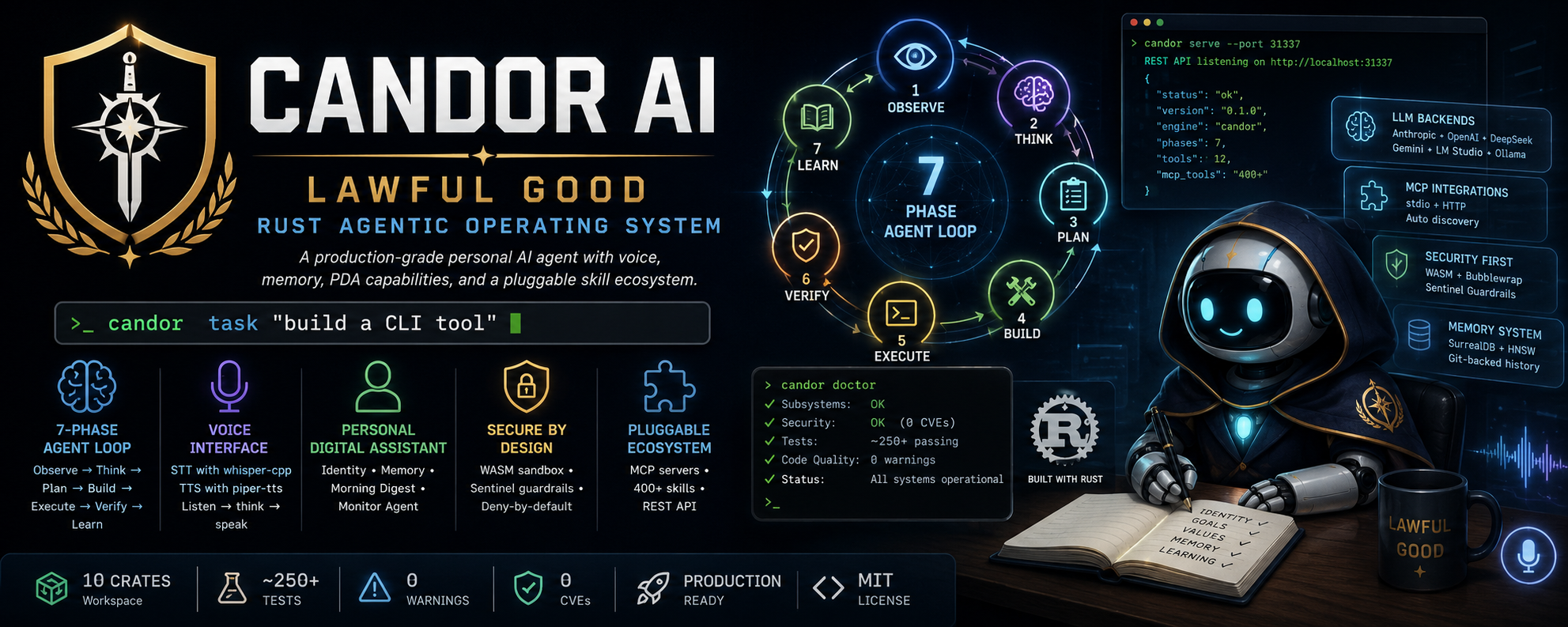



Candor AI — Lawful Good Rust Agentic Operating System
A production-grade personal AI agent with voice, memory, PDA capabilities, and a pluggable skill ecosystem.
# One-shot task
candor task "build a CLI tool"

# Interactive conversation
candor chat

# Voice-activated (whisper-cpp + piper-tts)
candor voice                        # One-shot
candor voice-interactive            # Listen → think → speak loop

# Personal Digital Assistant
candor pda init                     # Initialize ~/.candor/ identity & memory
candor pda digest                   # Morning briefing via TTS
candor pda monitor                  # Scan for stale work sessions

# Diagnostics
candor health                       # Subsystem health
candor doctor                       # Full diagnostic scan
candor serve --port 31337           # REST API daemon
Quick Install
# Via Cargo (Rust toolchain required)
cargo install candor-ai

# Via install script (auto-downloads pre-built binary)
curl -sfL https://raw.githubusercontent.com/iknowkungfubar/candor-ai/main/install.sh | sh

# Verify
candor doctor
Portfolio CLI note: This installs as
candor. Turintech portfolio convention usesturintech-candor-ai— create a symlink if desired:ln -s $(which candor) ~/.local/bin/turintech-candor-ai
Examples
The examples/ directory contains usage demos:
examples/quick_start.sh— Health check, one-shot tasks, interactive chat, PDA init, and REST API server examples
bash examples/quick_start.sh
Why Rust?
Most AI agent frameworks are written in Python (AutoGPT, LangChain, CrewAI). candor-ai is built in Rust for three reasons:
| Concern | Python frameworks | candor-ai (Rust) |
|---|---|---|
| Memory safety | GC pauses, buffer overflows possible | Compile-time guarantees, no GC |
| Distribution | Requires Python runtime + 500MB+ deps | Single 57MB binary, no runtime needed |
| Performance | GIL-bound, interpreted | Native speed, true parallelism |
| Sandboxing | Subprocess isolation (porous) | WASM runtime (wasmtime) — real capability-based security |
| Concurrency | asyncio (cooperative) | Tokio (preemptive, multi-threaded) |
Bottom line: candor-ai gives you an AutoGPT-class agent that installs with cargo install and runs as a single binary — no Python, no virtualenvs, no dependency hell.
How it compares
| Feature | candor-ai | AutoGPT | LangChain Agents | Rig (Rust) |
|---|---|---|---|---|
| Language | Rust | Python | Python | Rust |
| Install | cargo install |
git clone + pip |
pip install |
cargo install |
| Sandboxing | WASM + bubblewrap | Subprocess only | None built-in | None |
| Memory | SurrealDB (kv-mem) | JSON files | Vector store plugin | Plugin-based |
| Voice | STT/TTS built-in | Plugin only | None | None |
| PDA | Identity + git-backed memory | None | None | None |
| 7-phase loop | Observe→Think→Plan→Build→Execute→Verify→Learn | Think→Act→Observe | Prompt→Tool→Observe | Configurable |
| Guardrails | 6 rules + 10 doctrines | None | None | None |
| Binary size | 57MB | 500MB+ (Python + deps) | 200MB+ | ~15MB |
Features
📦 Memory Persistence
Memory is ephemeral in the default build (in-memory SurrealDB). All data is lost on process exit. Enable the persistent-memory feature flag for on-disk RocksDB storage at ~/.candor/data/.
cargo build --release --features persistent-memory
🧠 7-Phase Agent Loop
Observe → Think → Plan → Build → Execute → Verify → Learn
LLM-driven software engineering agent with the Ideal State Artifact (ISA) — a 12-section markdown document defining goals, criteria, and constraints for every task.
🎤 Voice Interface
- STT: Record mic via
arecord, transcribe viawhisper-cpp - TTS: Speak responses via
piper-tts(neural) orespeak-ng(fallback) - Interactive mode: Listen → think → speak — conversational loop with exit words
🧑 Personal Digital Assistant
- IDENTITY.md — who you are (name, goals, preferences, values)
- DA_IDENTITY.md — your DA's personality (name, voice, tone, directives)
- Git-backed memory — every write auto-commits, full history available
- Memory triage: WORK/slugs (ISA tasks), LEARNING/ (meta-patterns), KNOWLEDGE/ (entities)
- Morning Digest — daily briefing from identity + work state + TTS
- Monitor Agent — scans for stale sessions and knowledge gaps
🔒 Security
- WASM sandbox (wasmtime) + bubblewrap process isolation
- Sentinel guardrails: 6 deterministic rules, 10 doctrine principles
- Force-push blocked, secrets never logged, deny-by-default posture
- 17 security advisories fixed (wasmtime 30→36; lock now at 47.0.3)
- Zero CVEs — automated cargo audit in CI
🔧 Tools (12 built-in)
| Tool | Description |
|---|---|
read_file / write_file |
File I/O with line limits |
list_dir |
Directory listing |
search_code |
ripgrep search |
search_files |
File name search |
shell |
Sandboxed command execution |
run_tests |
Cargo test runner |
git_branch / git_commit / git_push / git_status |
Git operations (sentinel-gated) |
🔌 Integrations
- LLM backends: Anthropic, OpenAI, DeepSeek, Gemini, LM Studio, Ollama — auto-detected from env vars
- MCP servers: stdio + HTTP transports, auto tool discovery
- MCP skills: 400+ bioinformatics skills, browser automation
- REST API: axum server on port 31337
Architecture
┌──────────────────────────────────────────────────────────┐
│                     OrchestratorEngine                      │
│  Observe → Think → Plan → Build → Execute → Verify → Learn  │
├─────────┬─────────┬─────────┬─────────┬─────────┬──────────┤
│  Graph   │ Sandbox │Cognitive│ Memory  │ Sentinel│   PDA    │
│  Runner  │(WASM +  │ Engine  │(Surreal │ Inter-  │ Identity │
│(petgraph)│  bwrap) │         │  DB)    │ ceptor  │ + Memory │
├─────────┼─────────┼─────────┼─────────┼─────────┼──────────┤
│  Tools   │   MCP   │  Local  │  Skills │ Recovery│ Voice    │
│ (12 tools)│ Client  │ Backend¹│ System  │  Nodes  │ STT/TTS  │
└─────────┴─────────┴─────────┴─────────┴─────────┴──────────┘
11 Crate Workspace
| Crate | Purpose | Tests |
|---|---|---|
candor-core |
Shared types, AgentState, ISA, errors | 14 |
candor-graph |
Petgraph runner, lifecycle hooks, recovery | 17 |
candor-sandbox |
wasmtime + bubblewrap, circuit breaker | 12 |
candor-cognitive |
LLM inference, embeddings (hash-based), 4 backends | 29 |
candor-memory |
SurrealDB with HNSW vector index | 12 |
candor-sentinel |
Guardrails: rules + doctrine | 25 |
candor-orchestrator |
7-phase agent, ISA climbing, skills | 58 |
candor-tools |
12 tools: fs, search, shell, test, git | 27 |
candor-mcp |
MCP client, JSON-RPC 2.0, auto-discovery | 8 |
candor-ai |
CLI + REST API + PDA + Voice | 27 |
candor-telemetry |
OpenTelemetry tracing | 1 |
Total: ~250+ tests, 0 clippy warnings, 0 compiler warnings, 0 CVEs.
¹ Local Backend: Requires --features local-inference at build time. The default build uses mock responses for local inference. See Feature Flags below.
Built with Rust edition 2024. See crates.io for the published package.
Feature Flags
Candor uses Cargo feature flags to gate optional functionality. The default build gives you a fully functional agent with cloud LLM backends, all 12 tools, WASM sandboxing, PDA, and voice.
| Feature | Default | Description |
|---|---|---|
local-inference |
off | Enables mistral.rs for on-device GGUF model inference |
persistent-memory |
off | Switches SurrealDB from in-memory (ephemeral) to on-disk RocksDB storage at ~/.candor/data/ |
# Build with local inference
cargo build --release --features local-inference

# Build with persistent memory
cargo build --release --features persistent-memory

# Build with both
cargo build --release --features "local-inference,persistent-memory"
Memory note: The default build stores all memory in-memory only — data is lost when the process exits. For persistent storage, enable persistent-memory.
Configuration
# LLM backends (auto-detected, checked in this order)
export ANTHROPIC_API_KEY="sk-ant-..."
export OPENAI_API_KEY="sk-..."
export DEEPSEEK_API_KEY="sk-..."
export GEMINI_API_KEY="..."
export LM_STUDIO_URL="http://localhost:1234/v1"
export OLLAMA_URL="http://localhost:11434/v1"

# Model override
export CANDOR_MODEL="gpt-4o"

# MCP servers
export MCP_SERVERS="http://localhost:3000"

# Audio (voice features)
export CANDOR_AUDIO_DEVICE="default"
export CANDOR_RECORD_SECONDS="5"
export CANDOR_TTS_MODEL="/path/to/piper-model.onnx"
export CANDOR_TTS_VOICE="en-us"

# TOML config file (loaded by Figment, overridden by env vars):
#   ./candor.toml          (project-local)
#   ~/.candor/config.toml  (user-global)
Performance
| Metric | Value |
|---|---|
| Clean dev build | ~36s |
| Release build | ~3m15s |
| Binary size | 57MB stripped |
| State append (100 msgs) | 3.2 µs |
| Context compaction | 6.4 µs |
| Token limit check | 94 ps |
| ISA validation (10 criteria) | 41 ns |
| Test suite | ~250+ all passing |
Development
git clone https://github.com/iknowkungfubar/candor-ai
cd candor-ai

# Dependencies for voice features (optional)
sudo pacman -S whisper-cpp espeak-ng alsa-utils  # Arch
# brew install whisper-cpp espeak-ng portaudio     # macOS
# apt install whisper-cpp espeak-ng alsa-utils     # Debian/Ubuntu

# Build and test
cargo build --release
cargo test --workspace
Contributing
Contributions are welcome! Please read CONTRIBUTING.md for detailed guidelines on our development process, coding standards, PR workflow, and code of conduct.
License
MIT — see LICENSE
Reviews (0)
Sign in to leave a review.
Leave a reviewNo results found