qonqrete
Health Uyari
- License — License: AGPL-3.0
- Description — Repository has a description
- Active repo — Last push 0 days ago
- Low visibility — Only 8 GitHub stars
Code Basarisiz
- rm -rf — Recursive force deletion command in qonqrete.sh
Permissions Gecti
- Permissions — No dangerous permissions requested
This tool is a local-first, file-based AI coding agent that automates software development. It operates inside hardened containers to plan, write, and review code based on a user-defined task file.
Security Assessment
The overall risk is rated as High. The core functionality relies heavily on executing shell commands and managing system resources via Docker or Podman. The automated scan flagged a failure due to a recursive force deletion command (`rm -rf`) found in the primary shell script, which poses a significant risk of unintended data loss if improperly handled or triggered by an error. The tool requires network requests to interact with external AI APIs (e.g., providing your OpenAI API key). No hardcoded secrets were found, and it does not request explicitly dangerous host permissions. However, because it autonomously executes shell scripts, manages containers, and modifies local files, the attack surface is substantial.
Quality Assessment
The project is licensed under AGPL-3.0, which is a strong open-source standard. It is highly active, with its most recent code push happening today, and it offers well-documented IDE integrations for VS Code and JetBrains. However, community trust and visibility are currently very low. With only 8 GitHub stars, the project has not yet undergone widespread peer review or community testing, making it difficult to assess its reliability in real-world scenarios.
Verdict
Use with caution. While actively maintained and promising, the low community adoption and the presence of destructive shell commands require strict human oversight before deploying in any sensitive environment.
The first 100% file-based Local-First AgenticAI dev "construction yard", with its own memory & context, planning, writing and reviewing your code in safe sandboxes on your own machine.
QonQrete - The First 100% File-Based Local-First Secure Agentic AI System



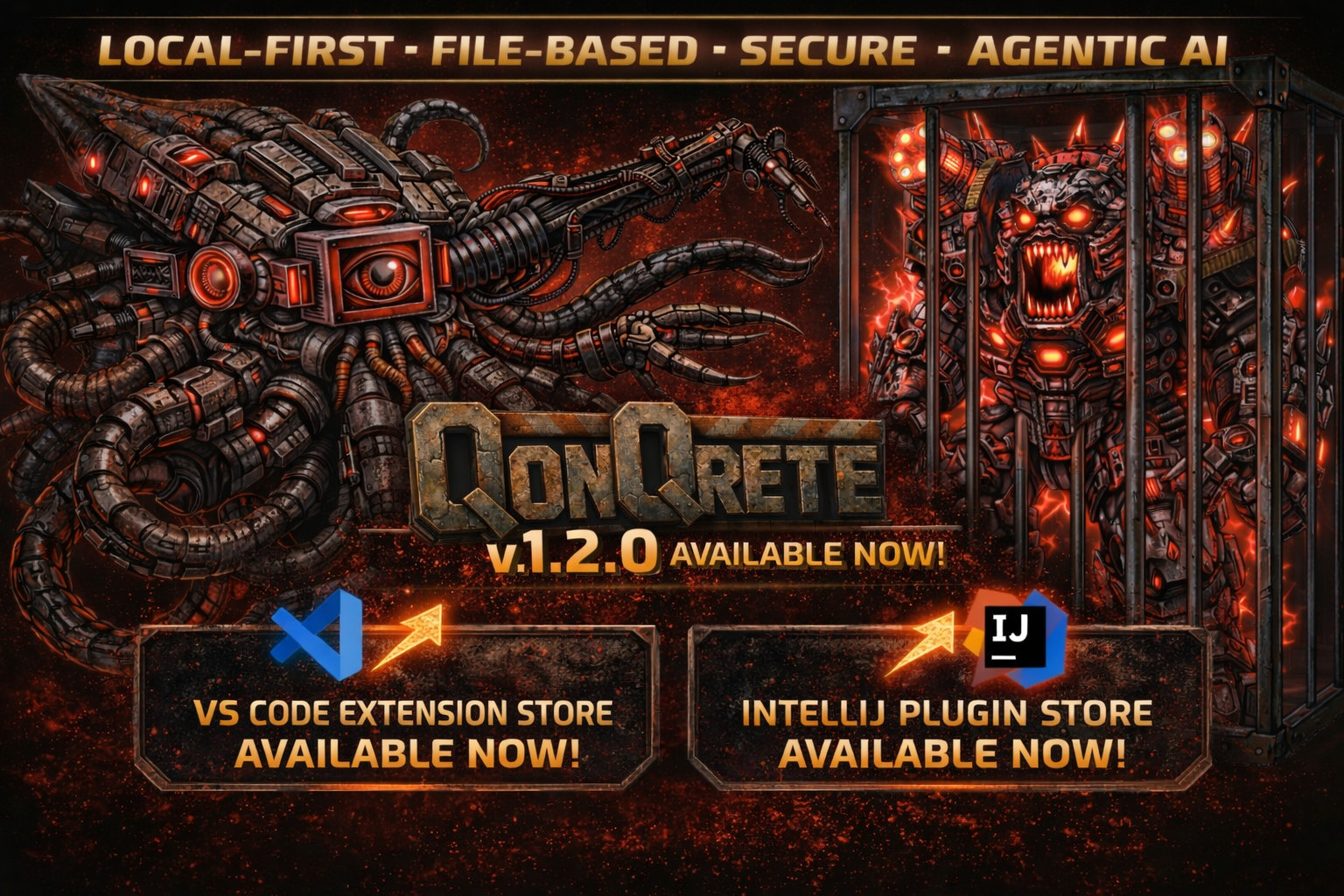
QonQrete is a local-first, file-based AI software construction system that runs a structured multi-agent build loop inside a hardened container. It plans work into briqs, generates code in a Qage, reviews the result, and iterates with either user-gated cheQpoints or fully autonomous cycles.
Version
Current repository version: v1.2.0
Canonical source of truth: VERSION
What this repository contains
This repository currently ships three things:
- QonQrete core CLI/runtime
qonqrete.shqrane/worqer/worqspace/
- VS Code extension in
vscode-extension/ - IntelliJ / JetBrains plugin in
intellij-plugin/
The IDE integrations let you trigger the existing CLI workflow from inside the IDE. They do not replace the core runtime.
v1.2.0 — Workspace Deployment & Hassle-Free Bootstrap
QonQrete is a deterministic AI coding agent that builds software inside hardened containers. It takes a high-level task, decomposes it into briqs, generates code, reviews the result, and optionally continues into more cycles — all locally, all file-based, all yours.
Quick Start (IDE)
VS Code
- Install QonQrete from the VS Code Marketplace
Ctrl+Shift+P→ QonQrete: Deploy to WorkspaceCtrl+Shift+P→ QonQrete: Create tasq.md — describe what to buildCtrl+Shift+P→ QonQrete: Run Tasq — auto-init on first run
IntelliJ / JetBrains
- Install QonQrete from the JetBrains Marketplace
Ctrl+Shift+A→ QonQrete: Deploy to WorkspaceCtrl+Shift+A→ QonQrete: Create tasq.mdCtrl+Alt+Q→ Run Tasq
What happens
my-project/
  tasq.md              ← you edit this
  .qonqrete/           ← runtime (hidden, gitignored)
    qonqrete.sh
    worqspace/
    qrane/
    worqer/
    ...
Quick Start (CLI)
# Prerequisites: Docker or Podman + AI API key(s)
export OPENAI_API_KEY='...'

# Build the runtime
chmod +x qonqrete.sh
./qonqrete.sh init

# Edit your task
vim worqspace/tasq.md

# Run
./qonqrete.sh run
./qonqrete.sh run --auto --mode security -b 6 -c 3
How It Works
User defines tasq.md
  → TasqLeveler enhances the task (cycle 1)
  → InstruQtor decomposes into briqs + generates QONTRACT
  → CalQulator estimates cost
  → ConstruQtor generates/modifies code in qodeyard/
  → InspeQtor reviews and produces reqap
  → Qontextor indexes context
  → Qompressor creates skeletons
  → Repeat for N cycles
All execution happens inside a hardened container with:
- Read-only root filesystem
- Dropped capabilities
- Resource limits (memory, CPU, PIDs)
- Non-root runtime
Architecture
qonqrete/
├── qonqrete.sh           # Host entrypoint
├── qrane/                 # Orchestrator
├── worqer/                # Agents (InstruQtor, ConstruQtor, InspeQtor, etc.)
├── worqspace/             # Config + runtime data
├── vscode-extension/      # VS Code integration
├── intellij-plugin/       # JetBrains integration
└── doc/                   # Documentation
Supported AI Providers
| Provider | Env Variable |
|---|---|
| OpenAI | OPENAI_API_KEY |
| Google Gemini | GOOGLE_API_KEY / GEMINI_API_KEY |
| Anthropic | ANTHROPIC_API_KEY |
| DeepSeek | DEEPSEEK_API_KEY |
| Qwen | QWEN_API_KEY |
| OpenRouter | OPENROUTER_API_KEY |
Container Engines
- Docker (default, auto-detected)
- Podman (auto-detected, macOS machine management included)
- MicroSandbox (experimental)
CLI Reference
./qonqrete.sh init                           # Build container image
./qonqrete.sh run                            # Fresh run
./qonqrete.sh run --auto                     # Autonomous mode
./qonqrete.sh run -b 6 -c 3                  # Sensitivity 6, 3 cycles
./qonqrete.sh run --mode security            # Security-focused mode
./qonqrete.sh run -a -n myproject            # Auto + save as qonstruction
./qonqrete.sh run -s                         # Seed from sqrapyard
./qonqrete.sh resume                         # Resume from previous qage
./qonqrete.sh clean                          # Interactive qage cleanup
./qonqrete.sh clean -A                       # Delete all qages
IDE Commands (v1.2.0)
Both VS Code and IntelliJ support identical commands:
| Command | Description |
|---|---|
| Deploy to Workspace | Install runtime into .qonqrete/ |
| Create tasq.md | Create starter template at project root |
| Configure Run | Set sensitivity, cycles, mode, engine |
| Run Tasq | Sync tasq → auto-init → execute |
| Run as QonQrete Tasq | Run any markdown as temp tasq |
| Resume Run | Continue from previous qage |
| Clean Qages | Delete old qage directories |
| Init Workspace | Manually build container image |
| Set AI Configuration | Configure providers, models, and API keys |
| Show Status | Display full status info |
Modes
| Mode | Focus |
|---|---|
program |
General programming (default) |
enterprise |
Enterprise applications |
security |
Security-focused development |
data |
Data processing and analysis |
devops |
DevOps and infrastructure |
web |
Web development |
Documentation
Project
- Website: qonqrete.sh
- Author: Ill Dynamics / WoNQ
- License: AGPL-3.0
Secure API Key Handling
API keys are never stored in plain-text settings files, terminal commands, or logs.
VS Code
Keys are stored in the OS keychain via VS Code's SecretStorage API. They are injected into the QonQrete process via the terminal's environment map — never in command text.
IntelliJ / JetBrains
Keys are stored in IntelliJ's PasswordSafe (encrypted credential store). They are injected via PtyCommandLine.environment — directly into the OS process environment table, never in shell text or temp files.
Environment variable precedence
- Real shell environment (
OPENAI_API_KEY=...in your terminal) — always wins - IDE secure storage — injected only if the env var is not already set
- Neither — the IDE prompts you to enter the key
Gemini / Google equivalence
GOOGLE_API_KEY and GEMINI_API_KEY are treated as equivalent. If either is set, the Gemini provider is considered configured.
AI Configuration Panel
Both IDEs include a "Set AI Configuration" command that lets you:
- Set the provider and model for each agent (TasqLeveler, InstruQtor, ConstruQtor, InspeQtor)
- Set API keys for each provider (stored securely)
- See at a glance which keys are set and which are missing
Changes are written directly to .qonqrete/worqspace/config.yaml.
After deploying QonQrete to a workspace, the IDE will prompt you to configure AI providers and API keys.
Cost Confirmation Gate (GateQeeper)
QonQrete can optionally prompt you to confirm a run after the CalQulator estimates cost.
In worqspace/config.yaml:
options:
  cost_confirmation_gate: false   # set to true to enable
When enabled, after CalQulator runs, QonQrete will display the cost estimate and ask:
GateQeeper: Cost estimate above. Proceed with this run? [y/N]
You must answer y or yes to continue. Any other answer cancels the run.
This is useful for preventing accidental expensive runs with high sensitivity or many cycles.
v1.2.0 Highlights
- One-click workspace deployment from both IDEs
- Auto-init builds container image on first run
- Root tasq.md at workspace root (synced to runtime automatically)
- Versioned container images (
qonqrete-qage:1.2.0) - Identical behavior in VS Code and IntelliJ
- No manual cloning, no manual init, no command line required
What changed between v1.0.4-stable and v1.1.9-stable
Core platform
- container runtime auto-detection for Docker / Podman / MSB
- enforced contract workflow via
qontract.d/ - stricter deterministic run behavior and anti-drift hardening
- resume / clean / qonstruction workflow
- sqrapyard seeding as an explicit opt-in flow
- QONTRACT fail-fast enforcement on later cycles
VS Code integration
- full VS Code extension with commands, sidebar, status bar, config UI, resume and clean flows
- shell detection / verification and honest run-state handling
- run
worqspace/tasq.mddirectly from the IDE - run any Markdown file temporarily as a QonQrete tasq
- qage browsing and manual packaging as
.vsix
IntelliJ / JetBrains integration
- IntelliJ plugin project with tool window, actions, settings, status widget, qage browser, and run controls
- manual packaging flow via Gradle
- local/manual installation path for JetBrains IDEs
Core principles
- Isolation by design — AI execution happens in a Qage container, not directly on the host.
- File-based communication — tasqs, briqs, reviews, skeletons, contracts, and logs are visible on disk.
- Structured iteration — QonQrete works in cyQles with planning, build, review, and checkpoint phases.
- Human control when wanted — autonomous mode exists, but user-gated cheQpoints remain first-class.
- Local-first supporting stack — several helper agents run fully locally with zero AI-token cost.
Architecture in one glance
qonqrete.sh— host entrypoint and runtime bootstrapqrane/— orchestrator, TUI, path handling, cost helpersworqer/— agent scripts and security/provider utilitiesworqspace/— config, task input, sqrapyard, qages, qonstructionsvscode-extension/— VS Code integrationintellij-plugin/— JetBrains integration
Main workflow
- Enhance —
tasqleveler(optional, cycle 1 only) - Plan —
instruqtorcreates briqs and contract files - Estimate —
calqulatorestimates token/cost usage - Build —
construqtorgenerates and updates code inqodeyard/ - Review —
inspeqtorvalidates and reviews results - Index / compress —
qontextorandqompressorrefresh context artifacts - Checkpoint — continue, tweaQ, or quit
Directory overview
qonqrete/
├── qonqrete.sh
├── qrane/
├── worqer/
├── worqspace/
│   ├── config.yaml
│   ├── pipeline_config.yaml
│   ├── caching_policy.yaml
│   ├── tasq.md
│   ├── sqrapyard/
│   ├── qonstructions/
│   └── qage_YYYYMMDD_HHMMSS/
├── doc/
├── vscode-extension/
└── intellij-plugin/
Supported AI providers
The current repo supports these providers through worqer/lib_ai.py and config:
- OpenAI
- Gemini
- Anthropic
- DeepSeek
- Qwen
localfor non-remote helper agents
Required environment variables depend on your selected providers:
export OPENAI_API_KEY='...'
export GOOGLE_API_KEY='...'        # or GEMINI_API_KEY
export ANTHROPIC_API_KEY='...'
export DEEPSEEK_API_KEY='...'
export QWEN_API_KEY='...'
export OPENROUTER_API_KEY='...'
System requirements
Container engine
QonQrete auto-detects container runtime support.
Supported runtime paths in the current repo:
- Docker
- Podman
- Microsandbox / MSB (experimental)
Tested platform notes from the repo/docs
- Linux + Docker / Docker Desktop
- macOS + Docker Desktop / Podman
- Windows 11 + WSL2 + Docker Desktop
- Git Bash / MSYS support exists, but WSL2 is still the cleaner Windows experience
Quickstart
1. Initialize the Qage image
chmod +x qonqrete.sh
./qonqrete.sh init
Optional engine forcing:
./qonqrete.sh init --docker
./qonqrete.sh init --podman
2. Write your task
Edit:
worqspace/tasq.md
3. Run
./qonqrete.sh run
Useful variants:
./qonqrete.sh run --auto
./qonqrete.sh run --user
./qonqrete.sh run -s
./qonqrete.sh run -a -n myproject
./qonqrete.sh run --mode security --briq-sensitivity 6 --cyqles 3
4. Resume
./qonqrete.sh resume
./qonqrete.sh resume -q qage_YYYYMMDD_HHMMSS
5. Clean
./qonqrete.sh clean
./qonqrete.sh clean -q qage_YYYYMMDD_HHMMSS
./qonqrete.sh clean -A
IDE integrations
VS Code extension
Location: vscode-extension/
Main capabilities in this repo snapshot:
- run canonical
worqspace/tasq.md - run any Markdown file as a temporary tasq
- sidebar control panel
- status bar state reporting
- init / run / resume / clean commands
- qage browsing
Manual build/package:
cd vscode-extension
npm install
npm run compile
npx vsce package
IntelliJ / JetBrains plugin
Location: intellij-plugin/
Main capabilities in this repo snapshot:
- tool window with run controls
- settings/config UI
- run, resume, clean, and qage browsing actions
- status widget / shell verification concepts
Manual build/package:
cd intellij-plugin
./gradlew buildPlugin
Important current-state note
As shipped in this repository, QonQrete is still fundamentally a repo-local workflow:
- the core runtime expects
qonqrete.shandworqspace/in the project - the bundled IDE integrations are built around that repo-local model
- a fully centralized “single engine outside all projects” bootstrap flow is not implemented in this repository snapshot
CLI reference
Usage: ./qonqrete.sh [COMMAND] [OPTIONS]

Commands:
  init
  run
  resume
  clean

Run options:
  -a, --auto
  -u, --user
  -t, --tui
  -m, --mode <name>
  -b, --briq-sensitivity <0-16>
  -c, --cyqles <1-50>
  -n, --qonstruction-name <name>
  -s, --sqrapyard
  -M, --msb
  -d, --docker
  -p, --podman
  -w, --wonqrete
Documentation map
- QUICKSTART.md — shortest path to first run
- DOCUMENTATION.md — full technical reference
- ARCHITECTURE.md — architecture and pipeline layout
- RELEASE-NOTES.md — version history and notable changes
- TERMINOLOGY.md — QonQrete vocabulary
Current limitations / honesty section
- The bundled IDE integrations are present and usable, but official store publishing is a separate distribution step.
- The repo snapshot does not implement a central per-user QonQrete engine installer / bootstrap flow.
- The committed
worqspace/config.yamlis a working configuration example, not a promise that every default value is ideal for every task. TUIandMSBremain experimental paths.- Qontrabender only becomes relevant when the active ConstruQtor provider is Gemini.
License
QonQrete is licensed under the GNU Affero General Public License v3.0 (AGPL-3.0).
See LICENSE.
Yorumlar (0)
Yorum birakmak icin giris yap.
Yorum birakSonuc bulunamadi