fumi
Health Warn
- License — License: NOASSERTION
- Description — Repository has a description
- Active repo — Last push 0 days ago
- Low visibility — Only 5 GitHub stars
Code Fail
- process.env — Environment variable access in backend/server.mjs
- network request — Outbound network request in backend/server.mjs
- process.env — Environment variable access in backend/test-smoke.mjs
- network request — Outbound network request in backend/test-smoke.mjs
- rm -rf — Recursive force deletion command in scripts/setup-waveshare.sh
Permissions Pass
- Permissions — No dangerous permissions requested
No AI report is available for this listing yet.
Open-source AI companion that lives on your desk. Built with ESP32-S3, touch, voice, and any AI model.
FUMI




An open-source AI companion that lives on your desk.

An open-source AI companion that lives on your desk.
FUMI is a Tamagotchi-inspired physical AI companion built around an ESP32-S3 display board.
It combines:
- animated character UI
- touch interaction
- hunger, energy, happiness, bond, and growth
- a small interactive game
- cloud AI chat
- push-to-talk voice input
- a provider-agnostic AI backend
FUMI is not locked to one model provider. The same firmware can talk to a backend configured for OpenAI, Anthropic Claude, xAI Grok, OpenRouter, Ollama, or another compatible API.
Development status: active / experimental. The firmware in this repository is the latest project source provided for this release. Hardware and provider support should be considered tested only where explicitly marked below.
Demo
What FUMI does
┌──────────────────────┐
│       FUMI           │
│  ESP32-S3 + LVGL     │
│                      │
│  Touch • Life • Voice│
└──────────┬───────────┘
           │ HTTPS
           ▼
┌──────────────────────┐
│     FUMI Backend     │
│                      │
│ /brain     /voice    │
└──────────┬───────────┘
           │
     ┌─────┼──────────────┐
     ▼     ▼              ▼
   OpenAI Claude          Grok
     │     │              │
     └─────┼──────────────┘
           ▼
      OpenRouter
        Ollama
   Compatible APIs
Browser demo
The repository includes demo/index.html, which lets you test /brain from a browser without the physical device. If device authentication is enabled, enter the same optional device token in the demo.
Run the backend:
cd backend
cp .env.example .env
# Configure the provider and model in .env
npm run dev
Then open demo/index.html and enter your backend URL.
Important: the browser demo proves the backend path works. It is not a substitute for an end-to-end hardware demo.
Hardware demo
The repository includes the real prototype demo at docs/assets/fumi-demo.mp4.
Do not publish media that exposes passwords, API keys, private SSIDs, or private conversations.
The physical FUMI
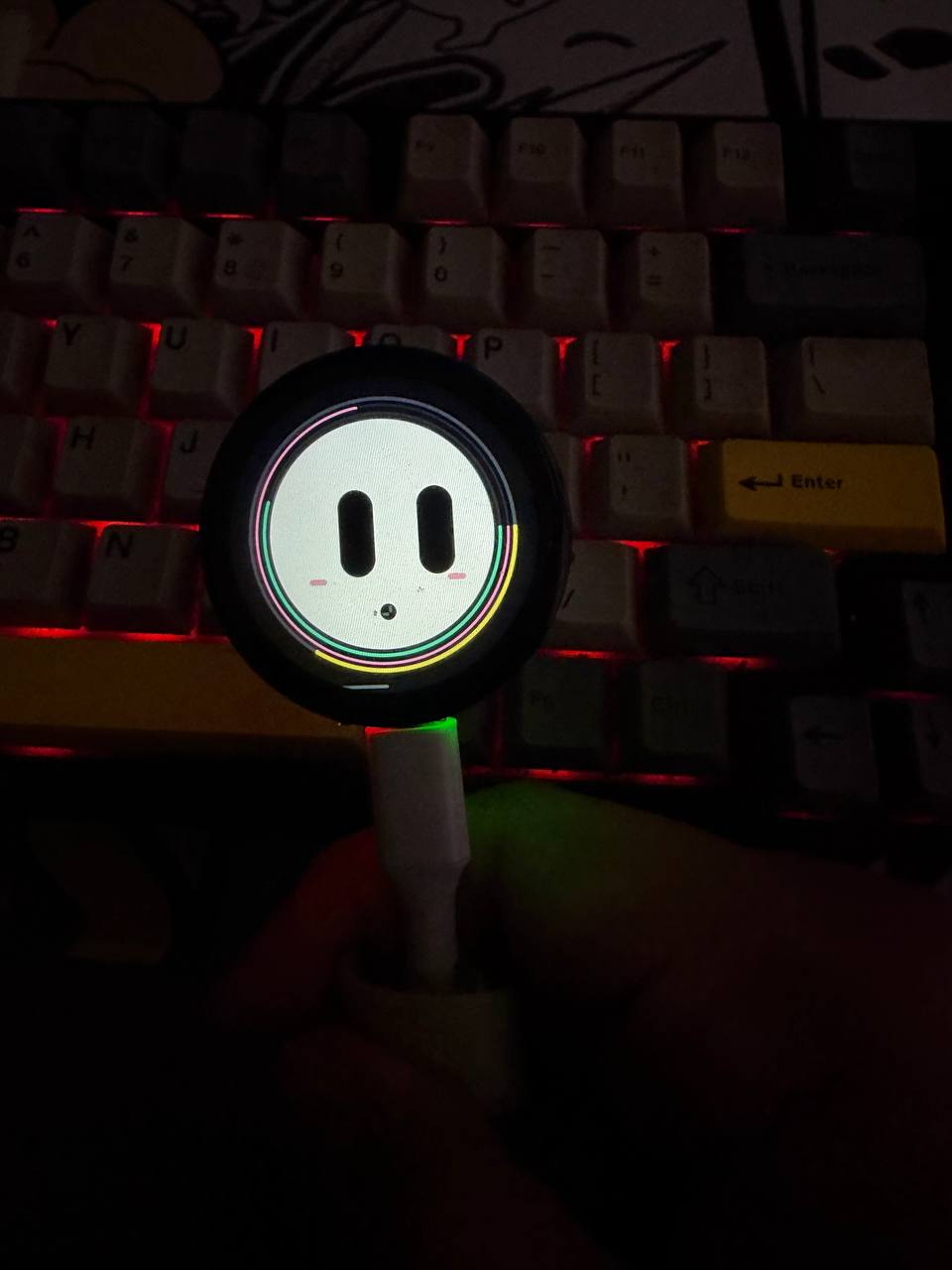
▶ Watch the real FUMI prototype demo
Supported AI providers
The backend uses an adapter-style provider configuration.
| Provider | Backend setting |
|---|---|
| OpenAI | LLM_PROVIDER=openai |
| Anthropic Claude | LLM_PROVIDER=anthropic |
| xAI Grok | LLM_PROVIDER=xai |
| OpenRouter | LLM_PROVIDER=openrouter |
| Ollama | LLM_PROVIDER=ollama |
| OpenAI-compatible APIs | LLM_PROVIDER=openai-compatible |
Set the model ID supported by your account:
LLM_PROVIDER=anthropic
LLM_MODEL=your-supported-claude-model
or:
LLM_PROVIDER=xai
LLM_MODEL=your-supported-grok-model
Model names, availability, pricing, and capabilities change over time. Use the model ID currently supported by your provider account.
Voice architecture
Voice input and text generation are separate.
The reference backend currently uses OpenAI speech-to-text for /voice, then sends the transcript to the selected text model.
For example:
FUMI microphone
      │
      ▼
   WAV upload
      │
      ▼
speech-to-text
      │
      ▼
 transcript
      │
      ▼
selected text model
      │
      ▼
 FUMI response
This means you can use Claude or Grok for FUMI's personality/answer while using a separate speech provider.
Repository structure
FUMI/
├── firmware/
├── backend/
├── demo/
├── docs/
│   └── assets/
├── scripts/
├── .github/
├── CONTRIBUTING.md
├── SECURITY.md
├── CHANGELOG.md
├── LICENSE
└── README.md
Firmware setup
The firmware requires the upstream Waveshare driver files and the libraries shipped with its Arduino example. Run the dependency setup script first; it fetches the official source and generates the local Arduino sketch folder. Install any bundled libraries listed by the upstream example into your Arduino libraries folder before compiling.
Windows PowerShell:
powershell -ExecutionPolicy Bypass -File .\\scripts\\setup-waveshare.ps1
macOS / Linux:
bash scripts/setup-waveshare.sh
Then open firmware/build/LVGL_Arduino/LVGL_Arduino.ino in Arduino IDE. Edit the generated local file firmware/build/LVGL_Arduino/fumi_config.h with your Wi-Fi credentials and backend URLs.
Arduino IDE
Recommended development baseline:
- Arduino IDE 2.3.10
- ESP32 by Espressif Systems 3.3.12
- Board:
ESP32S3 Dev Module - CPU:
240MHz (WiFi) - Flash Mode:
QIO 80MHz - Flash Size:
16MB (128Mb) - Partition Scheme:
Huge APP (3MB No OTA/1MB SPIFFS) - PSRAM:
OPI PSRAM - Arduino Runs On:
Core 1 - Events Run On:
Core 1 - USB Mode:
Hardware CDC and JTAG - Upload Mode:
UART0 / Hardware CDC - USB CDC On Boot:
Disabled
Configuration
Copy:
firmware/fumi_config.h.example
to:
firmware/fumi_config.h
Then fill in:
#define FUMI_WIFI_SSID_CONFIG "YOUR_WIFI_SSID"
#define FUMI_WIFI_PASSWORD_CONFIG "YOUR_WIFI_PASSWORD"
#define FUMI_BRAIN_URL_CONFIG "https://your-backend/brain"
#define FUMI_VOICE_URL_CONFIG "https://your-backend/voice"
fumi_config.h is ignored by Git.
Backend
Requires Node.js 20.6+.
cd backend
cp .env.example .env
npm install
npm run check
npm test
npm run dev
Health:
curl http://localhost:8787/health
Chat:
curl -X POST http://localhost:8787/brain -H "Content-Type: application/json" -d '{"message":"Hey FUMI, introduce yourself."}'
The backend preserves FUMI's original state-event contract (event, hunger, happiness, energy, bond, affection, playfulness, sleeping, expression, and age_seconds) and returns action, expression, and message. The same /brain route also supports a plain message for the browser demo. The backend returns a simple contract that the firmware can consume:
{
  "ok": true,
  "reply": "Hello!",
  "action": "talk",
  "expression": "normal",
  "provider": "openai",
  "model": "your-model"
}
Security
Never put model-provider API keys in the ESP32 firmware.
The intended architecture is:
ESP32
  │
  │ device request
  ▼
Your backend
  │
  │ provider API key stays here
  ▼
AI provider
Before exposing a backend publicly, add authentication/device pairing, rate limiting, usage limits, and restrictive CORS.
See SECURITY.md.
Contribute to FUMI
FUMI is an open-source project, and contributions from makers and developers are welcome.
New to the project? Start here:
- Read the contribution guide
- Improve the setup guide — help first-time builders get started.
- Document the hardware setup — help makers understand the components and connections.
- Improve bug reporting — help us make bug reports easier to reproduce.
You can contribute through documentation, reproducible bug reports, firmware improvements, backend development, or UI and animation work.
Before opening a pull request, please read the contribution guidelines and test your changes where possible.
Found a problem or have an idea? Open an issue and tell us what you found.
Project status
FUMI is presented as a complete open-source reference build in this repository:
- animated FUMI UI
- touch interaction
- hunger, energy, happiness, bond, and growth
- mini-game
- Wi-Fi AI backend
- push-to-talk voice pipeline
- selectable text-model providers
- backend device authentication
- multiple speech-to-text provider adapters
- local model support through Ollama / OpenAI-compatible endpoints
- GitHub release automation
- documented Waveshare dependency manifest
- public demo assets and release documentation
Hardware demos and dependency files in this repository should always match the actual hardware build being released.
License
MIT. See LICENSE.
FUMI is an independent open-source project and is not affiliated with or endorsed by OpenAI, Anthropic, xAI, OpenRouter, Ollama, or Waveshare.
Reviews (0)
Sign in to leave a review.
Leave a reviewNo results found