agentmind
Health Warn
- License — License: MIT
- Description — Repository has a description
- Active repo — Last push 0 days ago
- Low visibility — Only 5 GitHub stars
Code Warn
- process.env — Environment variable access in bin/cli.js
- process.env — Environment variable access in scripts/smoke-codex.mjs
- network request — Outbound network request in scripts/smoke-codex.mjs
- process.env — Environment variable access in scripts/smoke-launcher.mjs
- fs module — File system access in scripts/smoke-launcher.mjs
Permissions Pass
- Permissions — No dangerous permissions requested
No AI report is available for this listing yet.
A live window into your agent's mind.
AgentMind
A live window into your agent's mind.
Watch every thought, tool call and reply your coding agent makes — in real time, on your laptop, with zero cloud.


Why?
Claude Code, Codex CLI and friends do a lot between you pressing Enter and
the final reply: read files, run shell commands, reason out loud, retry,
backtrack. The terminal only shows you the polished, redacted top layer.
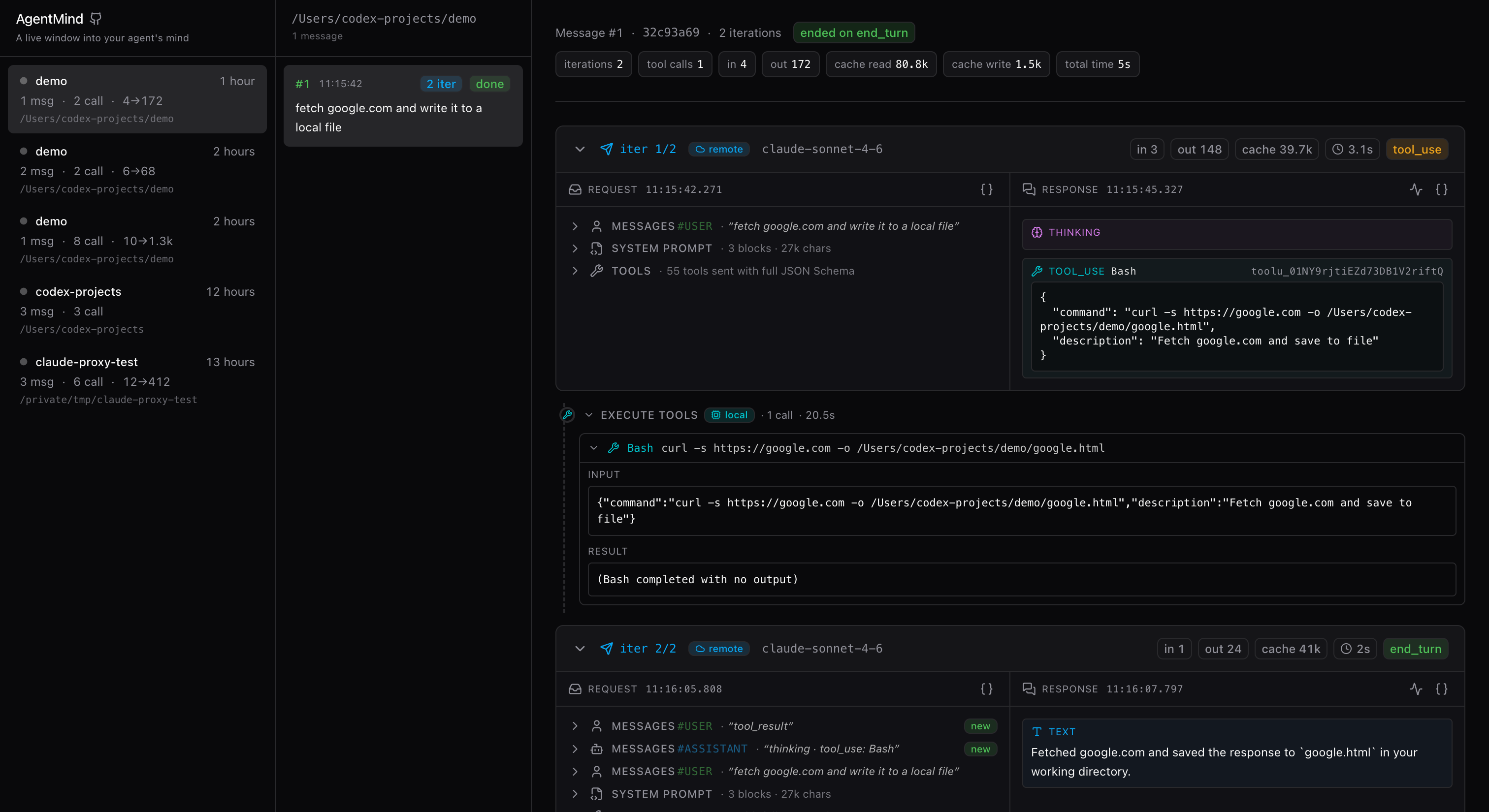
AgentMind sits between your agent and the LLM, so it sees the full
unredacted truth — every request payload, every SSE chunk, everytool_use/tool_result pair, every thinking block — and lays it out as a
three-pane inspector you can read like a code editor.
Use it to:
- Debug "why did my agent do that?" — see the exact tool args, the
thinking that led there, the previous turn'stool_resultit was
reacting to. - Audit context bloat — the request shows the full system prompt, every
tool's JSON Schema, every cached message, and how much each iteration
inherits. - Learn how good agents are built — flip through Claude Code's real
prompts and tool definitions, side-by-side with the responses they produce. - Replay a project offline — everything is captured as plain JSONL on
your disk; no telemetry, no account, no cloud.
Quick start
npx agentmind-cli claude       # launch Claude Code through AgentMind
npx agentmind-cli codex        # or any codex args: …codex exec "ship the PR"
That's it. AgentMind boots the dashboard, injects the right env / config
so your agent talks to the proxy, and hands the terminal off to the
agent's TUI. Every prompt you type shows up in the dashboard as a new
project — live, while the agent is still streaming. When the agent
exits the dashboard keeps running so you can browse the captured trace.
Hit Ctrl+C to stop AgentMind.
Both agents reuse their existing logins —
claude loginfor
Claude Code,codex loginfor Codex CLI. No API key wrangling. The
proxy sniffs the auth flavor (ChatGPT OAuth vssk-…) and forwards
to the correct upstream automatically.Anything after the subcommand is forwarded verbatim to the agent, so
wrappers likenpx agentmind-cli codex --model gpt-5 --resumework.
Want it permanently on PATH? npm i -g agentmind-cli once, then drop
the npx prefix everywhere below.
Just want the dashboard?
npx agentmind-cli --no-agent              # dashboard on http://127.0.0.1:8088
npx agentmind-cli --no-agent --port 9090  # custom port
Then point any agent at http://127.0.0.1:8088 — see
Manual setup below.
Projects are keyed by (cwd, agent) — running both Claude and Codex in
the same directory produces two distinct projects so each one's
conversation chain stays coherent. The sidebar tags every project with
a small agent chip (Claude = peach, Codex = lavender) so a mixed inbox
stays scannable at a glance.
Flags (must come BEFORE the subcommand):
| Flag | Default | Notes |
|---|---|---|
--port <n> |
8088 |
Listen port (and the URL we hand the agent) |
--data <dir> |
~/.agentmind |
Where the JSONL projects live |
--no-agent |
off | Skip launching an agent — dashboard only |
--no-open |
off | Skip the auto-open browser step (--no-agent only) |
Run agentmind-cli --help for the full reference.
The three panes
- Projects (left) — one card per
cwdyou ran an agent in. Cards
show the working directory, how long ago you were there, message count,
total LLM round-trips, and a compact token tally. - Messages (middle) — one card per prompt you typed. Each card shows
how many iterations the agent ran to satisfy it and whether it finished
cleanly. - Conversation (right, the centerpiece) — one expandable card per
HTTP round-trip:- REQUEST — system prompt, full tool JSON Schemas, the
messages
array. New messages added this iteration are taggednew, so context
growth is obvious. - EXECUTE TOOLS — the in-between segment that runs locally
between two API calls. Tool name, arguments, duration, success/error. - RESPONSE —
thinking,text,tool_useblocks rendered as the
model emitted them, with token counts and stop reason.
- REQUEST — system prompt, full tool JSON Schemas, the
Live streaming
Open a card while the agent is mid-thought — the RESPONSE panel fills in
as SSE chunks arrive (token-by-token text, tool args growing one delta at a
time), and the REQUEST panel refreshes when the round-trip is sealed.
A pulsing streaming badge and a live-ticking duration timer make the state
unambiguous.
What gets stored, where
All capture is local-first JSONL — never leaves your machine.
~/.agentmind/
└── projects/
    └── <projectId>.jsonl     # projectId = sha256(cwd, agent).slice(0,16)
One file per (cwd, agent) pair — every claude run in the same
directory appends to the Claude file for that cwd, every codex run
to the Codex file. Pre-0.2.0 single-cwd files are migrated to the new
scheme on first boot. Each line is one JSON record:
type |
When written | Purpose |
|---|---|---|
project |
first time a cwd is seen |
project metadata |
message |
once per user prompt | groups iterations |
interaction |
twice per HTTP round-trip (start + final) | last-wins merge on interactionId |
API keys in captured headers are redacted to sk-…NNNN — you can safely
share a JSONL with a teammate without leaking your key.
Privacy & safety
- Local only. AgentMind binds to
127.0.0.1. The only outbound
traffic is the proxied call your agent was going to make anyway —api.anthropic.comfor Claude Code,api.openai.comorchatgpt.com/backend-api/codexfor Codex CLI (we route by the
bearer-token shape, not by config). - No telemetry. Not now, not later. The only network calls are the ones
you can see in the inspector. - Read-only on disk. Captured JSONL is append-only; AgentMind never
edits or deletes files you didn't ask it to. The one exception is the
one-shot legacy migration at startup, which rewrites pre-0.2.0 files
into the new(cwd, agent)layout — seemigrateLegacyinsrc/server/storage.ts.
Supported agents
| Agent | Status |
|---|---|
| Claude Code | First-class — agentmind-cli claude |
| Codex CLI | First-class — agentmind-cli codex |
| Claude SDK / API direct callers | Works — see Manual setup |
| OpenCode | Roadmap |
| Codex Desktop / Claude Desktop | Not yet (no documented proxy hook) |
Anything that speaks the Anthropic Messages API (POST /v1/messages)
or the OpenAI Responses API (POST /v1/responses) is captured.
Adding a third protocol is one ProtocolAdapter away — seesrc/server/adapters.ts.
Manual setup
Most users don't need this — npx agentmind-cli claude /npx agentmind-cli codex handles the env/config wiring transparently.
Reach for manual setup only if you're running the dashboard with--no-agent and want to start the agent yourself.
Claude Code — one env var:
ANTHROPIC_BASE_URL=http://127.0.0.1:8088 claude
Codex CLI — add a custom provider to ~/.codex/config.toml:
model_provider = "agentmind"

[model_providers.agentmind]
name = "AgentMind"
base_url = "http://127.0.0.1:8088/v1"
requires_openai_auth = true
wire_api = "responses"
supports_websockets = false
requires_openai_auth = true keeps Codex's normal auth selection
(codex login OAuth or OPENAI_API_KEY) but routes through ourbase_url. supports_websockets = false is required because Codex
prefers wss://…/responses first and AgentMind only speaks HTTP/SSE.
Tech stack
- TanStack Start (Vite-based SSR) · React 19 · TanStack Router
- Tailwind v4 · shadcn/ui · lucide-react · @uiw/react-json-view
- undici for upstream HTTP forwarding with full SSE pass-through
- pnpm · TypeScript 5.7
Project layout
src/
├── routes/                       file-based routes
│   ├── __root.tsx                three-pane shell + header
│   ├── projects.$pid.tsx         project column wiring
│   └── projects.$pid.messages.$mid.tsx
│                                 message detail (the inspector)
├── components/
│   ├── ProjectsSidebar.tsx       left pane (projects)
│   ├── MessagesPane.tsx          middle pane (prompts)
│   ├── MessageDetail.tsx         right pane wrapper
│   ├── InteractionCard.tsx       one HTTP round-trip card
│   ├── RequestPanel.tsx          request rendering + diff badges
│   ├── ResponsePanel.tsx         response rendering (thinking/text/tool_use)
│   ├── ActionExecutionSegment.tsx local tool execution between calls
│   └── ui/                       shadcn primitives + JSON dialog
├── lib/
│   ├── anthropic-types.ts        Anthropic Messages API schema
│   ├── openai-responses-types.ts OpenAI Responses API schema (Codex)
│   └── api.ts                    typed fetch + subscribeLive helper
└── server/                       pure node, no React
    ├── adapters.ts               protocol adapters (one per agent)
    ├── middleware.ts             Connect middleware (mounted in vite.config.ts)
    ├── proxy.ts                  generic forwarder + SSE tee (per adapter)
    ├── liveRegistry.ts           in-memory live-streaming sessions
    ├── grouping.ts               (cwd, agent)-based project/message inference
    ├── projectId.ts              sha256(cwd, agent) ↔ projectId
    ├── aggregate.ts              raw capture → display model
    ├── interaction-view.ts       per-protocol view extractors
    ├── sse.ts                    Anthropic SSE parser
    ├── responses-sse.ts          OpenAI Responses SSE parser
    ├── prod-entry.ts             production CLI entrypoint (bundled into dist/)
    └── storage.ts                JSONL persistence + one-shot legacy migration

bin/cli.js                        global `agentmind-cli` entry
                                  (subcommands: `claude`, `codex`, `--no-agent`)
scripts/smoke-codex.mjs           e2e capture smoke (Codex + Anthropic + migration)
scripts/smoke-launcher.mjs        PATH-shim launcher smoke
Development
pnpm install
pnpm dev          # http://127.0.0.1:8088 with HMR (uses vite)
pnpm typecheck    # strict tsc --noEmit
pnpm build        # produces dist/ — what npm publishes
pnpm start        # run the production bundle locally (no vite)
pnpm smoke        # build + end-to-end smoke (Codex + Anthropic + launcher)
The published package ships a prebuilt dist/ — end users runningnpx agentmind-cli never touch vite, tsx, or any dev dependency. The CLI
boots a plain node:http server in under 100ms.
Optional env vars (testing/dev only — not user-facing):
| Var | Default | Effect |
|---|---|---|
AGENTMIND_DATA_DIR |
~/.agentmind |
Override storage directory |
AGENTMIND_UPSTREAM_ANTHROPIC |
https://api.anthropic.com |
Override Anthropic upstream (test harness) |
AGENTMIND_UPSTREAM_OPENAI |
https://api.openai.com |
Override OpenAI API-key upstream (test harness) |
AGENTMIND_UPSTREAM_OPENAI_CHATGPT |
https://chatgpt.com/backend-api/codex |
Override ChatGPT-OAuth upstream (test harness) |
AGENTMIND_UPSTREAM |
(unset) | Legacy alias for AGENTMIND_UPSTREAM_ANTHROPIC |
AGENTMIND_VERBOSE |
1 |
Set to 0 to silence per-request logs |
Roadmap
- OpenAI Responses API capture (Codex CLI) — v0.2.0
- Codex CLI: action segments (function_call → function_call_output pairing) — v0.2.0
- Default
agentmind-clito launching Claude Code — v0.2.1 - Codex CLI: helper-call filtering (compaction summariser)
- OpenCode CLI adapter
- Cross-project search & filters
- Diff view between adjacent iterations' transcripts
- Shareable "trace bundles" (export a sanitized project as a tarball)
Contributing
Issues and PRs welcome at imsobear/agentmind.
If you're hunting for something to do, the roadmap items above all have
clean entry points — happy to mentor you through any of them.
License
MIT
Reviews (0)
Sign in to leave a review.
Leave a reviewNo results found