Minimize-Cursor-Cost
Health Uyari
- License — License: Apache-2.0
- Description — Repository has a description
- Active repo — Last push 0 days ago
- Low visibility — Only 6 GitHub stars
Code Basarisiz
- rm -rf — Recursive force deletion command in install.sh
Permissions Gecti
- Permissions — No dangerous permissions requested
Bu listing icin henuz AI raporu yok.
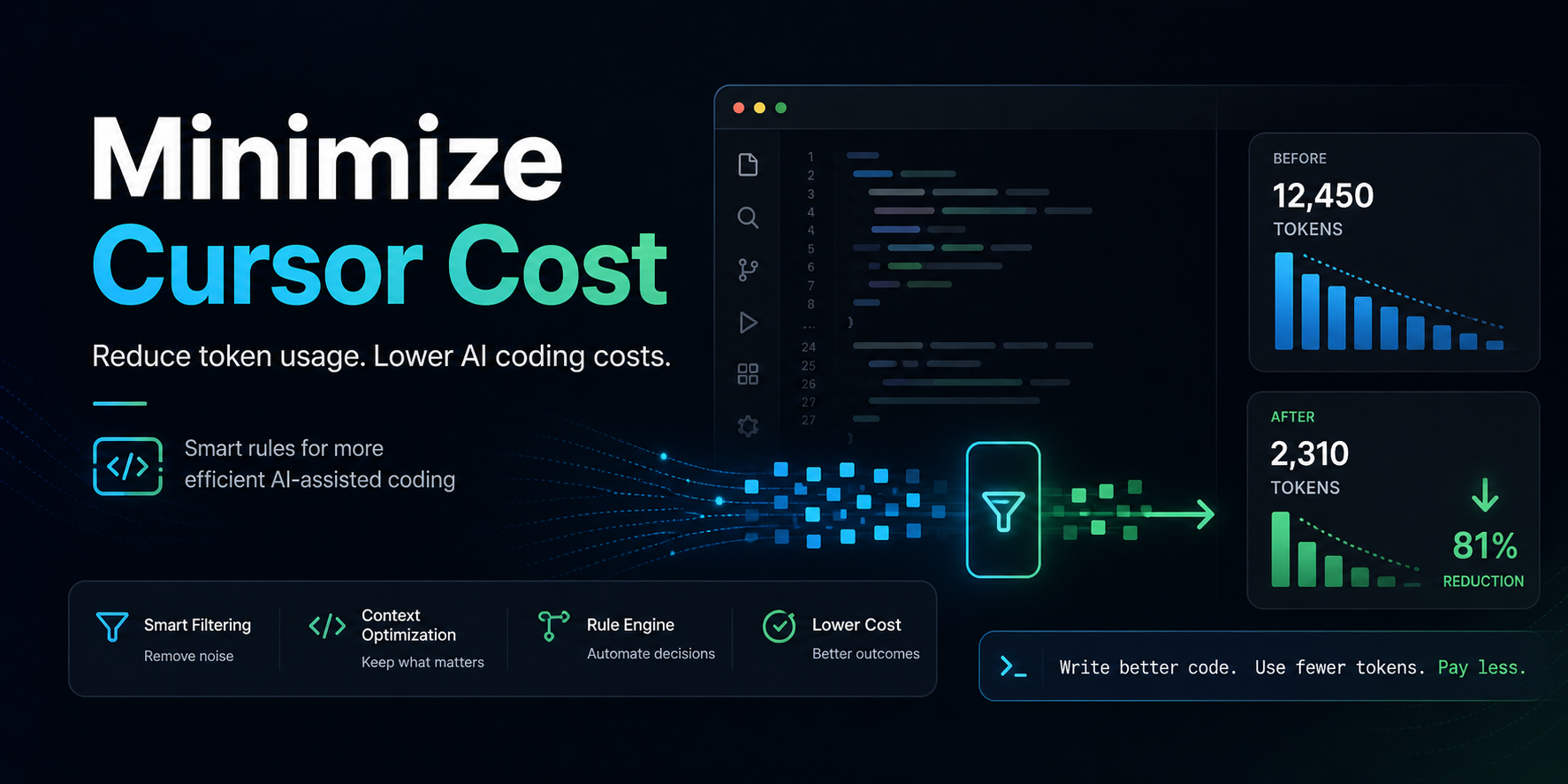
Drop-in AI rules for Cursor and Claude Code that cut project token usage by 50%+.
Minimize-Cursor-Cost
Drop-in AI rules for Cursor, Claude Code, Windsurf, and other AI IDEs,
designed to reduce token usage without reducing accepted-change quality.
No fluff in your AI's responses. No tutorials when you asked for a fix. No
full-file rewrites when a 5-line patch will do. No re-reading the same file
six times in a single chat.




TL;DR
# macOS / Linux / WSL
curl -fsSL https://raw.githubusercontent.com/inboxpraveen/Minimize-Cursor-Cost/main/install.sh | bash
# Windows
irm https://raw.githubusercontent.com/inboxpraveen/Minimize-Cursor-Cost/main/install.ps1 | iex
The default installs only Cursor's two core rules plus prompt templates. Choose
tool and stack adapters explicitly when you need more.
What's included
lean-cursor/
├── CLAUDE.md                           # Auto-loaded by Claude Code on session start
├── .cursorrules                        # Cursor — legacy fallback rules
├── .cursor/
│   └── rules/
│       ├── core.mdc                    # 🔥 Always-active response discipline
│       ├── agent-efficiency.mdc        # 🔥 Always-active tool-call discipline
│       │
│       ├── python.mdc                  # *.py
│       ├── typescript.mdc              # *.ts, *.tsx, *.js, *.jsx
│       ├── go.mdc                      # *.go
│       ├── rust.mdc                    # *.rs
│       ├── java-kotlin.mdc             # *.java, *.kt, *.kts
│       ├── csharp.mdc                  # *.cs, *.csproj, *.sln
│       ├── ruby.mdc                    # *.rb, Gemfile, Rakefile
│       ├── php.mdc                     # *.php
│       │
│       ├── react.mdc                   # *.tsx, *.jsx (component layer)
│       ├── nextjs.mdc                  # app/, pages/, middleware.ts, next.config.*
│       ├── vue.mdc                     # *.vue
│       ├── svelte.mdc                  # *.svelte, +page.*, +layout.*
│       ├── mobile.mdc                  # Swift, Kotlin Android, RN, Flutter
│       ├── data-science.mdc            # *.ipynb, notebooks/, ML files
│       │
│       ├── sql.mdc                     # *.sql + migrations
│       ├── html-css.mdc                # *.html, *.css, *.scss, Tailwind
│       ├── shell.mdc                   # *.sh, *.ps1, Makefile
│       ├── yaml-config.mdc             # Docker, K8s, Terraform, GH Actions
│       ├── markdown.mdc                # *.md, *.mdx
│       └── tests.mdc                   # *.test.*, *.spec.*, test_*.py
│
├── PROMPT_TEMPLATES.md                 # Copy-paste prompt patterns
├── .cursorindexingignore.example       # Optional generated/vendor exclusions
└── SETUP_GUIDE.md                      # Per-stack quickstarts + troubleshooting
How the rules reduce cost
The first version of this project focused on response-side savings —
diffs over rewrites, no preamble, scoped explanations. That covers about half
of the waste.
The other half lives in agent mode, where the AI uses tools (read files,
search, run commands) and pipes the results back into context. A singleread_file of a 1,000-line file can cost more than the entire response. A
"let me look around the repo first" instinct can burn 5–10k tokens before any
work happens.
This release adds rules that attack agent-mode waste directly:
agent-efficiency.mdc— bans re-reading files, re-listing directories,
and serial tool calls when parallel works.- Search-before-read discipline — use
grepfor known symbols instead of
reading whole files speculatively. - No build/test/lint after every edit — only on risky changes or on user request.
- Stop-when-done — no "for safety" verification rounds, no summary of what
the diff already shows. - Targeted reads for files > 500 lines — never load the whole file just to
find one function.
The adaptive rules now optimize cost per accepted change, including retries and
verification. Current savings will be published after the new benchmark reaches
the required sample size.
Previous benchmark (pre-adaptive rules)
| Task | No rules | Previous pack | Historical reduction |
|---|---|---|---|
| Simple bug fix (response) | ~600 tokens | ~120 tokens | 80% |
| Feature addition (response) | ~1,200 tokens | ~380 tokens | 68% |
| Code review (response) | ~900 tokens | ~280 tokens | 69% |
| Bug fix (your prompt, templated) | ~200 tokens | ~70 tokens | 65% |
| Agent: locate + edit one function | ~7,000 tokens | ~2,200 tokens | 69% |
| Agent: multi-file refactor | ~25,000 tokens | ~9,500 tokens | 62% |
These figures came from the previous 20-task token-I/O sample and are retained
only as historical results; they do not measure the adaptive rules. New results
must pass the cost-per-accepted-change benchmark, which
includes failed runs, correction turns, verification, and quality regressions.
The biggest single win is still diff output vs full-file rewrite: a
200-line file rewrite costs ~2,000 tokens, the patch for the same change costs
~200.
Supported languages & stacks
| Language / stack | File rule |
|---|---|
| Python | python.mdc |
| TypeScript / JavaScript | typescript.mdc |
| Go | go.mdc |
| Rust | rust.mdc |
| Java / Kotlin (+ Android) | java-kotlin.mdc |
| C# / .NET | csharp.mdc |
| Ruby (+ Rails) | ruby.mdc |
| PHP (+ Laravel/Symfony/WP) | php.mdc |
| SQL (+ migrations) | sql.mdc |
| HTML / CSS / SCSS / Tailwind | html-css.mdc |
| Shell / Bash / PowerShell | shell.mdc |
| Markdown / MDX | markdown.mdc |
| Framework / domain | File rule |
|---|---|
| React | react.mdc |
| Next.js (App + Pages) | nextjs.mdc |
| Vue (2 + 3) | vue.mdc |
| Svelte / SvelteKit | svelte.mdc |
| Mobile (Swift, Kotlin Android, React Native, Flutter) | mobile.mdc |
| Data science / Jupyter / ML | data-science.mdc |
| Docker / K8s / Terraform / GH Actions | yaml-config.mdc |
| Tests (Jest, Vitest, pytest, RSpec…) | tests.mdc |
Don't see your stack? See Adding your own language rules below — it's three lines of YAML.
Installation
Option 1 — One-liner (recommended)
# macOS / Linux / WSL
curl -fsSL https://raw.githubusercontent.com/inboxpraveen/Minimize-Cursor-Cost/main/install.sh | bash
# Windows (PowerShell 5+ or 7+)
irm https://raw.githubusercontent.com/inboxpraveen/Minimize-Cursor-Cost/main/install.ps1 | iex
Defaults install PROMPT_TEMPLATES.md, core.mdc, andagent-efficiency.mdc for Cursor. Existing files are skipped, so customized
rules and CLAUDE.md project notes survive reinstalls.
Selective examples:
curl -fsSL https://raw.githubusercontent.com/inboxpraveen/Minimize-Cursor-Cost/main/install.sh |
  bash -s -- --tool cursor --rules typescript,react,tests --with-index-ignore

bash install.sh --tool claude
bash install.sh --tool legacy
bash install.sh --tool all --rules all
.\install.ps1 -Tool cursor -Rules 'typescript,react,tests' -WithIndexIgnore
.\install.ps1 -Tool claude
.\install.ps1 -Tool legacy
.\install.ps1 -Tool all -Rules all
--tool cursor installs .mdc rules without duplicate legacy/Claude
adapters. --tool claude installs CLAUDE.md; --tool legacy installs.cursorrules. --rules accepts core, all, or comma-separated rule names.
Both scripts clone to a temporary directory and remove it on exit.
Option 2 — Manual
The repo's top-level assets/, install.*, LICENSE, README.md, andCONTRIBUTING.md are not meant to be installed — only the contents oflean-cursor/ go into your project. The rm -rf / Remove-Item line at the
end wipes the temp clone, including the assets/ folder.
macOS / Linux / WSL:
git clone https://github.com/inboxpraveen/Minimize-Cursor-Cost lean-cursor-tmp
cp lean-cursor-tmp/lean-cursor/PROMPT_TEMPLATES.md .
# Cursor:
cp -r lean-cursor-tmp/lean-cursor/.cursor .
# Or Claude Code:
cp lean-cursor-tmp/lean-cursor/CLAUDE.md .
# Or a legacy .cursorrules client:
cp lean-cursor-tmp/lean-cursor/.cursorrules .
rm -rf lean-cursor-tmp                             # removes the clone, incl. assets/
Windows (PowerShell):
git clone https://github.com/inboxpraveen/Minimize-Cursor-Cost lean-cursor-tmp
Copy-Item lean-cursor-tmp\lean-cursor\PROMPT_TEMPLATES.md  .
# Cursor:
Copy-Item lean-cursor-tmp\lean-cursor\.cursor . -Recurse
# Or Claude Code:
Copy-Item lean-cursor-tmp\lean-cursor\CLAUDE.md .
# Or a legacy .cursorrules client:
Copy-Item lean-cursor-tmp\lean-cursor\.cursorrules .
Remove-Item lean-cursor-tmp -Recurse -Force                # removes the clone, incl. assets\
Choose one adapter unless the same repository is intentionally used by
multiple clients.
Option 3 — Pick & choose
Just download the .mdc files you want from lean-cursor/.cursor/rules/
and drop them into your project's .cursor/rules/.
Setup (2 minutes — the highest-ROI step)
If you installed the Claude adapter, open CLAUDE.md and fill in the
Project-Specific Notes section at the bottom:
### Stack
- Language: Python 3.11
- Framework: FastAPI
- Database: PostgreSQL via SQLAlchemy

### Key paths
- Entry point: src/main.py
- Types: src/schemas/
- Shared utilities: src/utils/

### Known shortcuts
- Use `get_db()` for all DB session injection
- All API errors go through `src/core/exceptions.py`
- Auth checks via `requireUser()` in `src/auth/guard.ts`
This eliminates entire clarification loops. Every "where do I…?" question
the AI doesn't have to ask is 200–600 tokens saved per turn.
How it works
Three layers
1. CLAUDE.md — Installed with --tool claude or all; auto-loaded by
Claude Code and holds concise behavior plus project context.
2. .cursor/rules/*.mdc — Installed with --tool cursor or all.
Scoped rules fire only for matching files. .cursorrules is a legacy adapter,
installed separately to avoid duplicate always-on context in Cursor.
3. PROMPT_TEMPLATES.md — The human side. Copy the relevant template
before each prompt to eliminate padding and produce tighter outputs.
Always-active core rules
- Responses start with the answer — no preamble, no sign-off
- Edits are diffs by default, not full-file rewrites
- Max 2 alternatives when options exist, with a stated recommendation
- One clarifying question at a time, not a list
- Scope guard: > 3 files unprompted → AI pauses and asks where to start
- Agent mode: never re-read files, batch independent calls, no speculative exploration
- Build/test/lint: only on risky changes or on user request — not after every edit
Adding your own language rules
Duplicate any .mdc file and adjust the glob:
---
description: Elixir file rules
globs: ["**/*.ex", "**/*.exs"]
alwaysApply: false
---

# Elixir Rules
- Show only changed functions
- Match existing pattern-matching style
- Don't introduce new GenServers unless asked
- Don't add @moduledoc unless siblings have them
Drop it in .cursor/rules/. Done — Cursor picks it up on the next prompt.
If you write rules for a stack that's not yet covered, please consider
contributing them back.
Compatibility
| Tool | Support |
|---|---|
| Cursor | ✅ .cursor/rules/*.mdc (.cursorrules only as legacy fallback) |
| Claude Code | ✅ CLAUDE.md (auto-loaded) |
| Windsurf | ✅ Reads .cursorrules |
| Cline / Roo | ✅ Reads .cursorrules and CLAUDE.md as context |
| GitHub Copilot | Partial — CLAUDE.md works as a manual reference; ignores .cursorrules |
| Aider | ✅ Pass CLAUDE.md via --read CLAUDE.md |
| Continue.dev | ✅ Add files via customRules config |
FAQ
Q: Will this work on an existing project with custom rules?
Yes. Installers skip every existing rule and top-level adapter. CustomizedCLAUDE.md project notes are preserved rather than replaced.
Q: Will the AI feel "less helpful" after I install this?
You'll lose: emoji-laden congratulations, "Great question!", multi-paragraph
recaps of what you already know, and the model rewriting your whole file when
you asked it to fix a typo. You'll keep: the actual code and answers.
Q: Does this work outside Cursor?
Yes — CLAUDE.md is supported by Claude Code natively, Windsurf reads.cursorrules, and most other AI IDEs accept project-level rule files. The.mdc glob format is Cursor-specific, but the rule content is just
markdown — you can paste it into any system prompt.
Q: Will rules conflict with my organization's coding standards?
The rules in this repo are about AI behavior (don't ramble, don't rewrite
files), not about code style (where braces go). They're orthogonal to your
linter / formatter / style guide.
Q: How do I measure my own savings?
Most providers show token usage in their dashboard (Anthropic Console,
OpenAI usage page, Cursor settings). Track a week before installing, a week
after, controlling for the same kinds of tasks.
Q: One of the rules is wrong for my project. How do I override?
Either edit the .mdc file directly (it's in your repo now), or add a more
specific rule with a narrower glob — Cursor's later/more-specific rules win.
Q: Does this affect the quality of generated code?
The rules are designed to preserve quality, but any hard context or verification
limit can cause regressions. The benchmark requires acceptance rate to remain
flat while tokens per accepted change decrease.
Contributing
PRs welcome — especially new language/framework rules. See CONTRIBUTING.md.
The bar for a new rule file: it should remove a real, recurring source of
token waste in that ecosystem. "Don't add if __name__ == '__main__' unless
asked" is good. "Use 4 spaces" is not (that's a linter's job).
License
Yorumlar (0)
Yorum birakmak icin giris yap.
Yorum birakSonuc bulunamadi