noeta
Health Uyari
- License — License: Apache-2.0
- Description — Repository has a description
- Active repo — Last push 0 days ago
- Low visibility — Only 5 GitHub stars
Code Gecti
- Code scan — Scanned 12 files during light audit, no dangerous patterns found
Permissions Gecti
- Permissions — No dangerous permissions requested
Bu listing icin henuz AI raporu yok.
Open-source runtime for AI agents. Self-hostable, provider-neutral, event-sourced. Build and run agents like Claude Code — but yours to own.
Noeta
English · 简体中文
Documentation · Quickstart · SDK reference · Configure a provider
Open-source, self-hostable runtime for AI agents — durable, inspectable, and provider-neutral.
Noeta runs the agent loop — tools, sub-agents, MCP, human-in-the-loop — on top
of a durable event log. That one design choice buys three things a normal
in-process agent library can't give you:
- A task survives a crash and resumes exactly where it left off.
- A task can pause for hours or days waiting on a human, a timer, or a
sub-task, then wake exactly once when the condition is met. - Every step is recorded — each LLM turn, tool call, and approval — so you
can inspect, audit, and replay what the agent actually did.
It talks to Anthropic and any OpenAI-compatible model behind one internal
protocol, so you're never locked to a vendor. And it runs the whole stack
offline with no API key, so you can try it in thirty seconds.
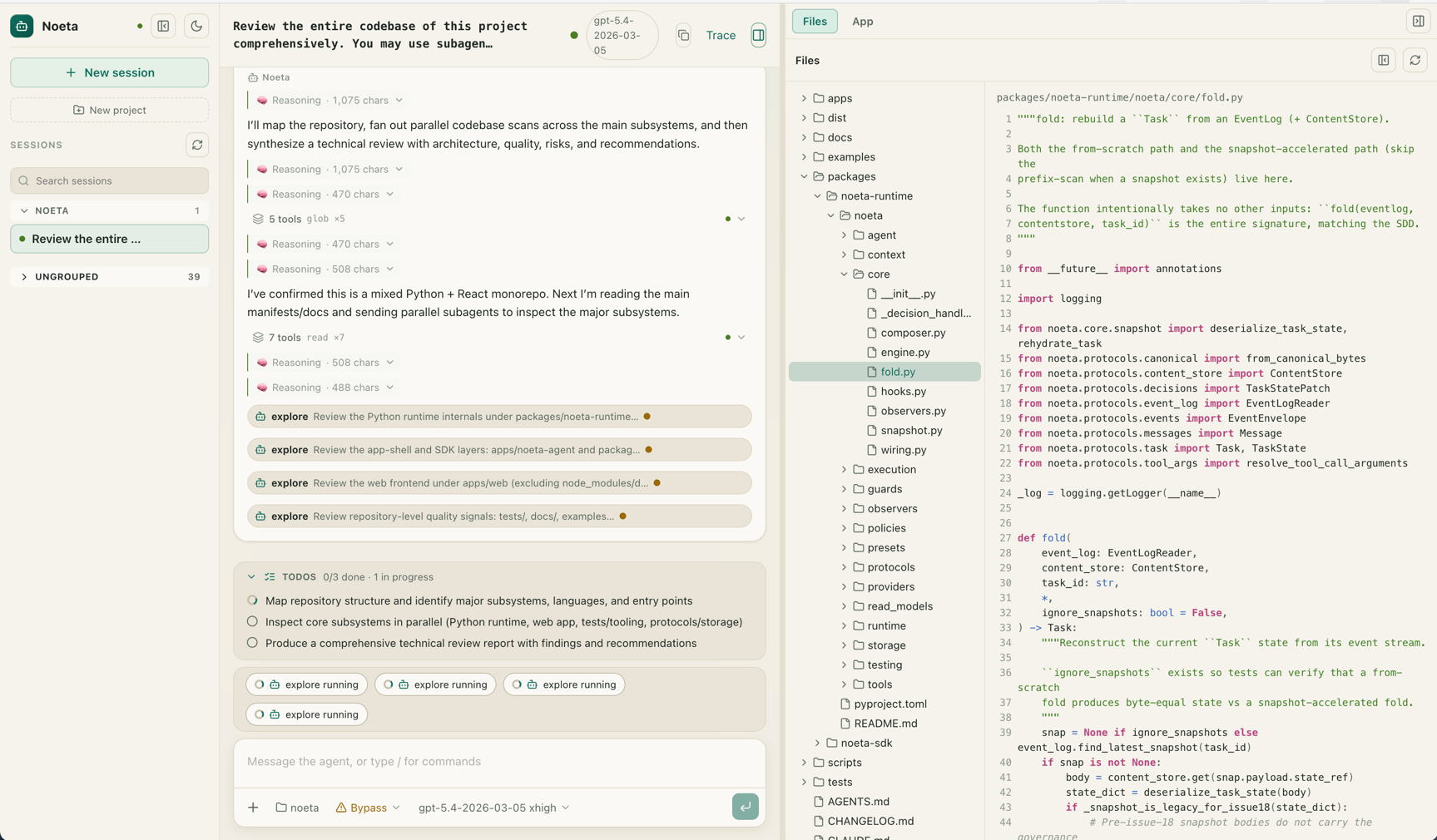
The bundled coding-agent web app — one command (python -m noeta.agent) boots the agent and this UI.
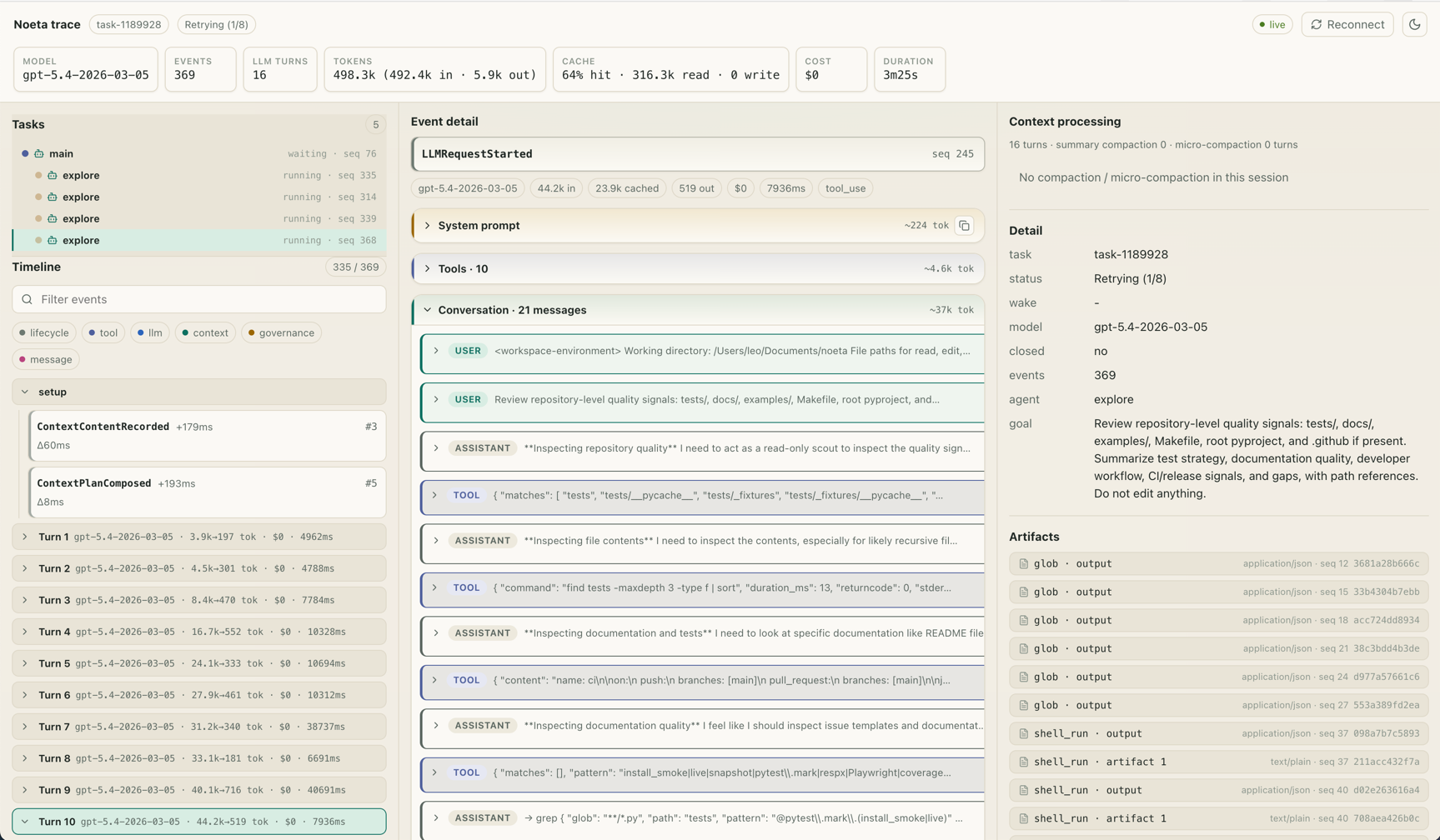
Every task has a full trace — each event, LLM turn, and token/cache stat, read straight from the event log.
Why Noeta
- Survives crashes — a task's state is never held in memory across runs. It
is rebuilt (folded) from an append-only event log on demand. Kill the
process mid-task; a fresh one folds the log back to the exact point and
finishes the work — exactly once. - Fully inspectable — every event, LLM turn, tool call, and token/cache
stat is a recorded event. The trace view (and the raw log) answers why a
step happened — which tool ran on whose authority, what got compacted away —
not just what. - Long-horizon by design — a task can suspend to wait on a human approval,
a structured question, a timer, or a sub-task, and is woken exactly once when
the condition fires. Waiting costs nothing while it sleeps. - Provider-neutral — Anthropic and any OpenAI-compatible endpoint sit
behind one internal protocol. Swapping vendors is wiring, not a rewrite, and
the recorded history isn't bound to any vendor's shape. - Bring your own agent — the runtime hosts and schedules; you supply the
policy, tools, and context. A ReAct policy and a full coding agent ship
in-tree, but nothing forces you to use them. - Runs offline out of the box — a deterministic
stubprovider runs the
whole stack with no API key and no network, so install, storage, and wiring
are provable on a fresh checkout (and in CI).
Quickstart
pip install noeta-agent        # pulls the SDK + runtime
python -m noeta.agent          # boots the offline stub coding agent + bundled web UI
No API key needed — the default stub provider is a deterministic LLM double.
Open the printed URL and send a message. The same boot, as a program:
from noeta.agent.backend.lifecycle import BackendConfig, serve_backend

# Defaults are fully offline: the two-turn stub provider, :memory: storage.
# port=0 binds an OS-assigned port. Workspace is the current directory.
config = BackendConfig(port=0)
server, url, shutdown = serve_backend(config)
try:
    assert url.startswith("http://")
finally:
    shutdown()
Next steps: the quickstart tutorial
walks the guided path (install → run → open the web UI → read a trace). To wire
a real Anthropic or OpenAI-compatible model, see
configure a provider.
To build your own agent on the SDK — define a @tool, assemble Options, callquery() — start with
your first agent and the
runnable examples/.
How it works
One idea sits underneath everything: state is a fold over a log, not a thing
held in memory.
Every step an agent takes — each LLM turn, tool call, approval, suspend — is
appended to a per-task event log. The task's current state is folded
(replayed) from that log whenever it's needed. Nothing durable lives in process
memory between runs.
Because the log is the single source of truth, the hard parts stop being
separate features and become the same mechanism:
- Resume is just a re-fold — reopen the log, fold it, keep going.
- Crash recovery is a re-fold by a different process.
- Suspend / wake is a task parked on a condition, matched and re-enqueued
exactly once. - Compaction is a recorded event — a summary is overlaid at compose time;
the original messages stay in the log, so it's auditable and reproducible.
Large objects (tool outputs, files, snapshots) live in a content-addressed
store the log points into. Tool side effects can run on the host or, when you
don't trust the agent, inside a sandboxed container — the log looks the same
either way. See event sourcing
and wake & resume for the full picture.
Use only the layer you need
Noeta ships as three packages, each pulling in the ones below it:
| Package | You get | Analogous to |
|---|---|---|
noeta-runtime |
The pure engine — event log, fold, scheduler, tools, policies. Embed it in-process. | — |
noeta-sdk |
The client facade you import: query(), Client, Options, @tool. |
Claude Agent SDK |
noeta-agent |
The batteries-included coding agent + web UI + HTTP/SSE server. | Claude Code |
Install noeta-sdk to build your own agent (import noeta.sdk); installnoeta-agent to run the bundled product. The only public surface isnoeta.sdk — the engine underneath is a transitive dependency you never touch.
How it compares
Both Noeta and the Claude Agent SDK give you an agent loop, tools, MCP, and
sub-agents. The difference is the spine underneath: the SDK records a
conversation; Noeta records events, and state is folded from them. That
ledger is what makes crash recovery, durable wake, reversible compaction, and
full audit land on one mechanism instead of four.
See the full comparison
against the Claude Agent SDK, LangGraph, and Temporal.
Documentation
Full documentation is rendered at initxy.github.io/noeta. The same files live under docs/ for source browsing.
| Layer | Start at | Read it when |
|---|---|---|
| Tutorials | Quickstart | You're new and want it running. |
| How-to guides | Configure a provider | You have a specific task to get done. |
| Concepts | Event sourcing | You want to understand the design. |
| Reference | SDK reference | You need exact API facts. |
Deeper cuts: the architecture overview,
troubleshooting, and the
ADRs recording why each cross-module decision is the way it is
(vocabulary lives in CONTEXT.md).
Status & scope
Noeta is an early, pre-1.0 preview. It runs, it is tested, and the core is
stable — but some edges are intentionally bounded:
- Concurrency & recovery are shipped, with limits. Single-host
multi-worker pools, multi-host coordination on shared Postgres
(lease fencing, database-clock expiry), durable exactly-once wake, and
mid-step crash recovery all work today. Still bounded: multi-host fencing is
Postgres-only (SQLite / in-memory stay single-host), and a crashed step's
side effects are surfaced for review, not automatically undone — see
known limitations. - Human-in-the-loop is end-to-end — approvals, structured questions, and
timer wake all work; what's missing is out-of-band notification (webhook /
inbox) when a task starts waiting on a human. - The web app is a small Vite MPA with vanilla ES modules; no framework
migration is planned for the preview.
Contributing
Development setup and repository layout live inCONTRIBUTING.md; working conventions (human or agent)
start at the root AGENTS.md router.
License
Apache License 2.0 — see LICENSE.
Yorumlar (0)
Yorum birakmak icin giris yap.
Yorum birakSonuc bulunamadi