revelix
Health Uyari
- License — License: MIT
- Description — Repository has a description
- Active repo — Last push 0 days ago
- Low visibility — Only 8 GitHub stars
Code Uyari
- network request — Outbound network request in .github/ISSUE_TEMPLATE/bug_report.yml
- process.env — Environment variable access in bin/revelix.mjs
Permissions Gecti
- Permissions — No dangerous permissions requested
Bu listing icin henuz AI raporu yok.
Revelix — reverse engineer anything, natively, with AI. 131-tool MCP server, CLI and web UI: Ghidra decompiler built in (180 CPUs), Rust, .NET, Java/Android, iOS, Python, WebAssembly, Go, firmware, 300+ formats; code-signature checks, SBOM (CycloneDX, SPDX, OSV), MITRE ATT&CK, YARA rule generation, IOCs. No Java, no Python.
The open reverse-engineering platform built for humans and AI agents.
Decompile, explore and explain any binary — native code, Rust, .NET, Java/Android, iOS, Python, WebAssembly, Go, firmware and 300+ file formats — from one engine, served as an MCP server, a command line and a web interface.



▶ Watch the 2-minute demo · Website · Quick start · Use with AI · All 131 tools · 🇫🇷 Version française
Real software, real output. Every image on this page — and the demo video, a real recorded session with the mouse, the keyboard and the tools at work — was produced by Revelix itself on open-source programs (the Termux Android app, GPL-3.0; Rollup's Rust native module, MIT; esbuild, MIT) and on a harmless obfuscated PowerShell script written for the demo, by
scripts/media.ts. Nothing is mocked.
Why Revelix?
- One engine, three faces. Every capability is a single tool definition served identically to an AI (MCP), to your terminal (
revelix …) and to a local web UI. 131 tools, one behaviour. - Real decompilers, zero heavy dependencies. The Ghidra decompiler runs compiled to WebAssembly with 180 SLEIGH processor variants; a C#, Java, Python, Hermes, BEAM, WebAssembly, ActionScript and Rust decompiler sit beside it. No Java, no Python, no IDA licence:
npm installand go. - Made for AI agents. A compact default profile (49 tools +
find_tools/call_toolto reach the rest), every result stamped with an evidence id (ev_…) the model can re-read, content from targets flagged as untrusted, progress and cancellation over MCP. - Rust decompilation that checks itself. Panics rebuilt with
file:line,&strliterals,match, labelled loops, inferred structs — and each function is verified against the binary (calls, literals, positions, flow) and labelled complete, partial or fallback. - Safe by default. Samples are parsed, never executed. Network, execution, device access and writes are off until you allow them (
revelix policy). Everything stays on your machine. - Fluid. Starts in about 0.1 s, analyses a 6 MB library in about 2 s, decompiles in parallel workers, and opens nested files straight from archives, APKs and firmware.
Quick start
Requires Node.js 22.18 or newer (Windows, Linux, macOS).
git clone https://github.com/isneoz1/revelix && cd revelix
npm install
node bin/revelix.mjs doctor          # checks every engine (≈ 2 s)
node bin/revelix.mjs app.exe         # open any file: identity, protections, next steps
node bin/revelix.mjs ui              # local web interface
Prefer a global command? npm install -g github:isneoz1/revelix (or the package attached to the latest release), then simply revelix app.exe.
Three commands to remember: revelix <file> (summary + suggested next steps), revelix help <tool>, revelix tools.
Use it with your AI (MCP)
revelix setup                    # shows the configuration for each detected client
revelix setup claude --write     # writes it (a backup of the previous file is kept)
Supported out of the box: Claude Code, Claude Desktop, Cursor, VS Code, Windsurf, Gemini CLI, Codex CLI, OpenCode, Zed, Cline, LM Studio, and any project via .mcp.json (already present in this repository). Then just ask:
“Open termux.apk, list the native methods and explain what
createSubprocessdoes.”
“Which API names does this DLL resolve with GetProcAddress?”
“Decompile this Rust binary's project code and tell me where it panics.”
Details, profiles, the HTTP transport and the security model: docs/MCP.md.
See it
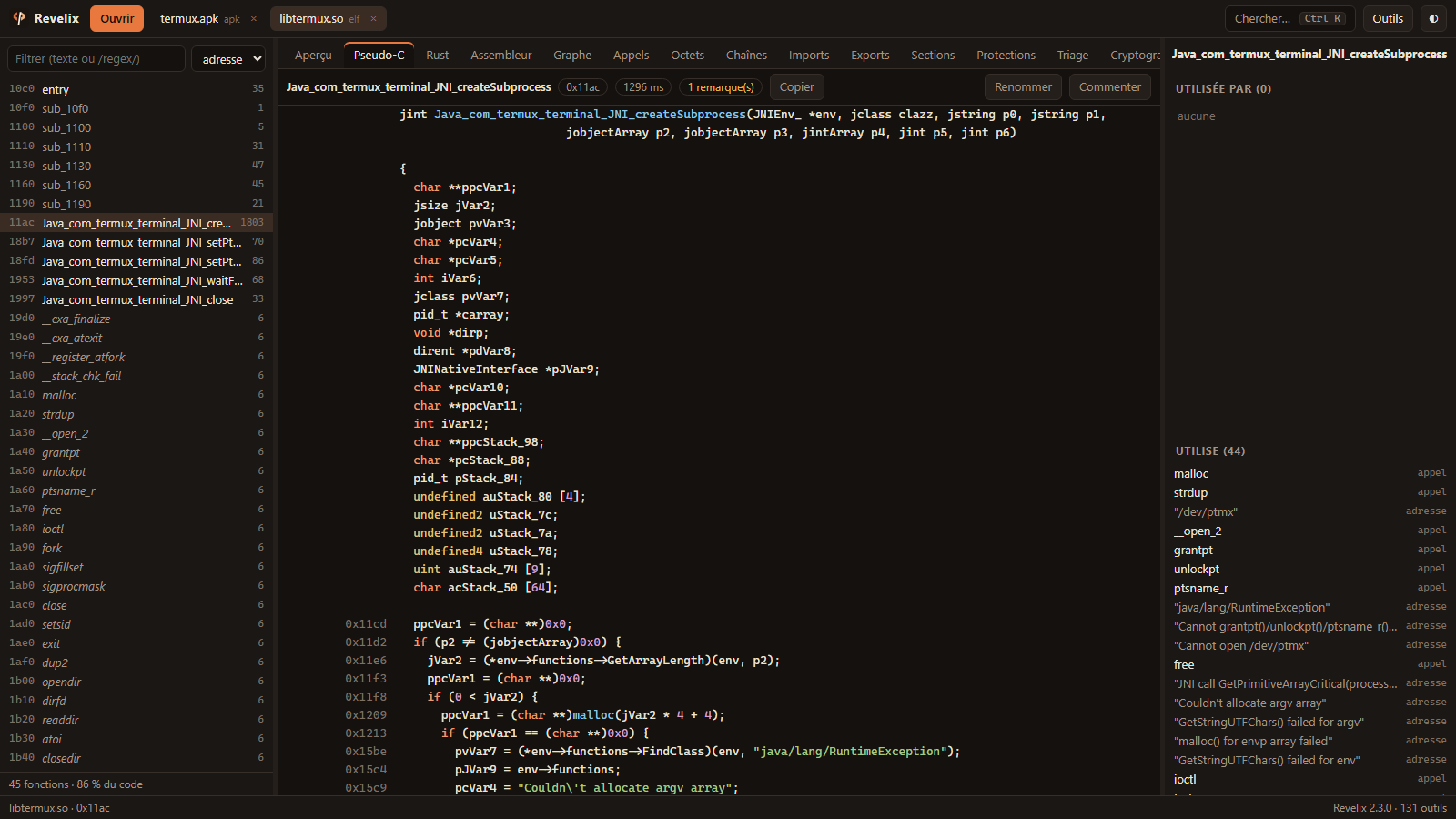 Readable C. Exact JNI signature recovered from the APK's DEX, real strings, named imports. |
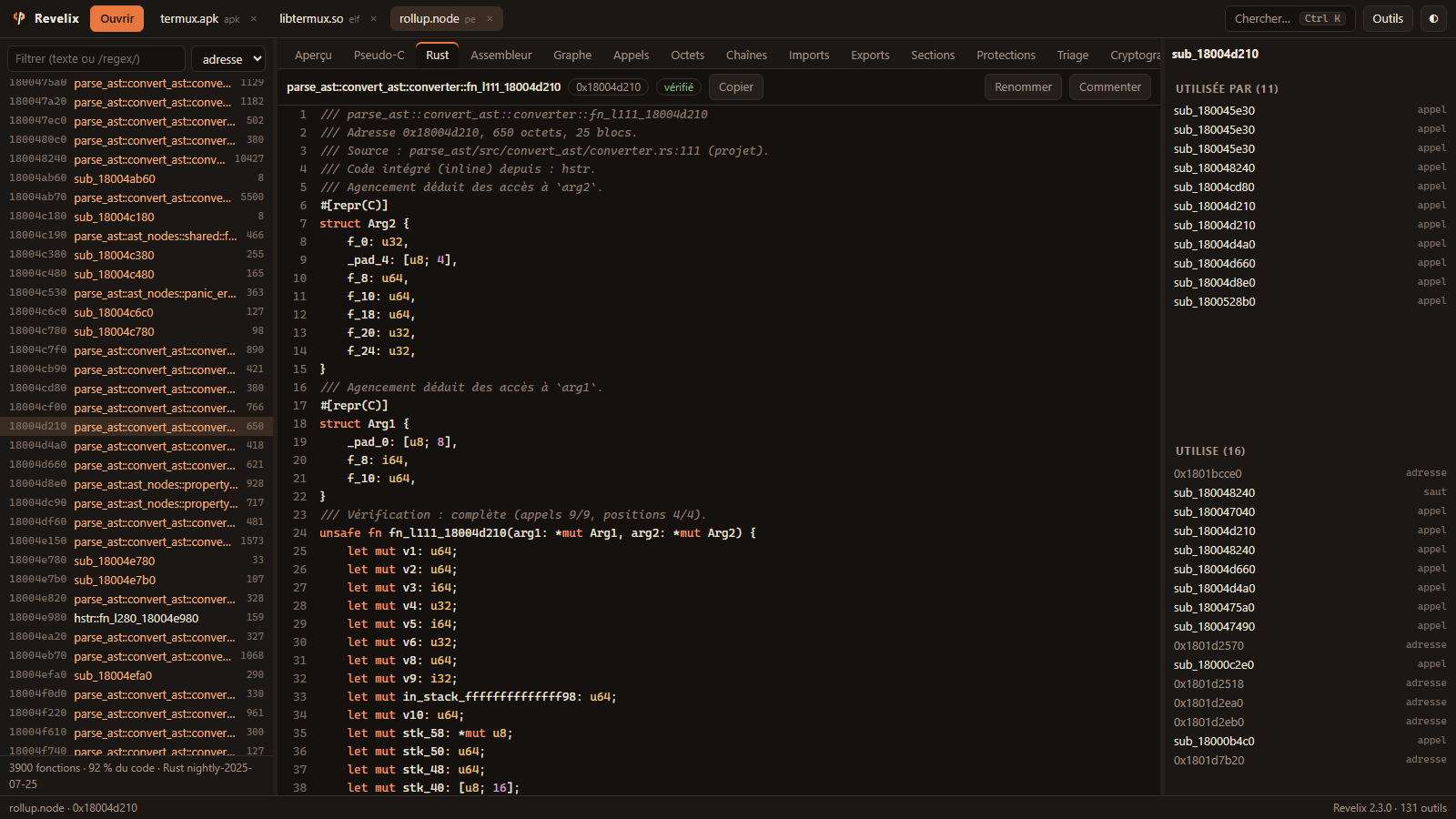 Rust, verified. Source file and line, inferred structs, checks passed. |
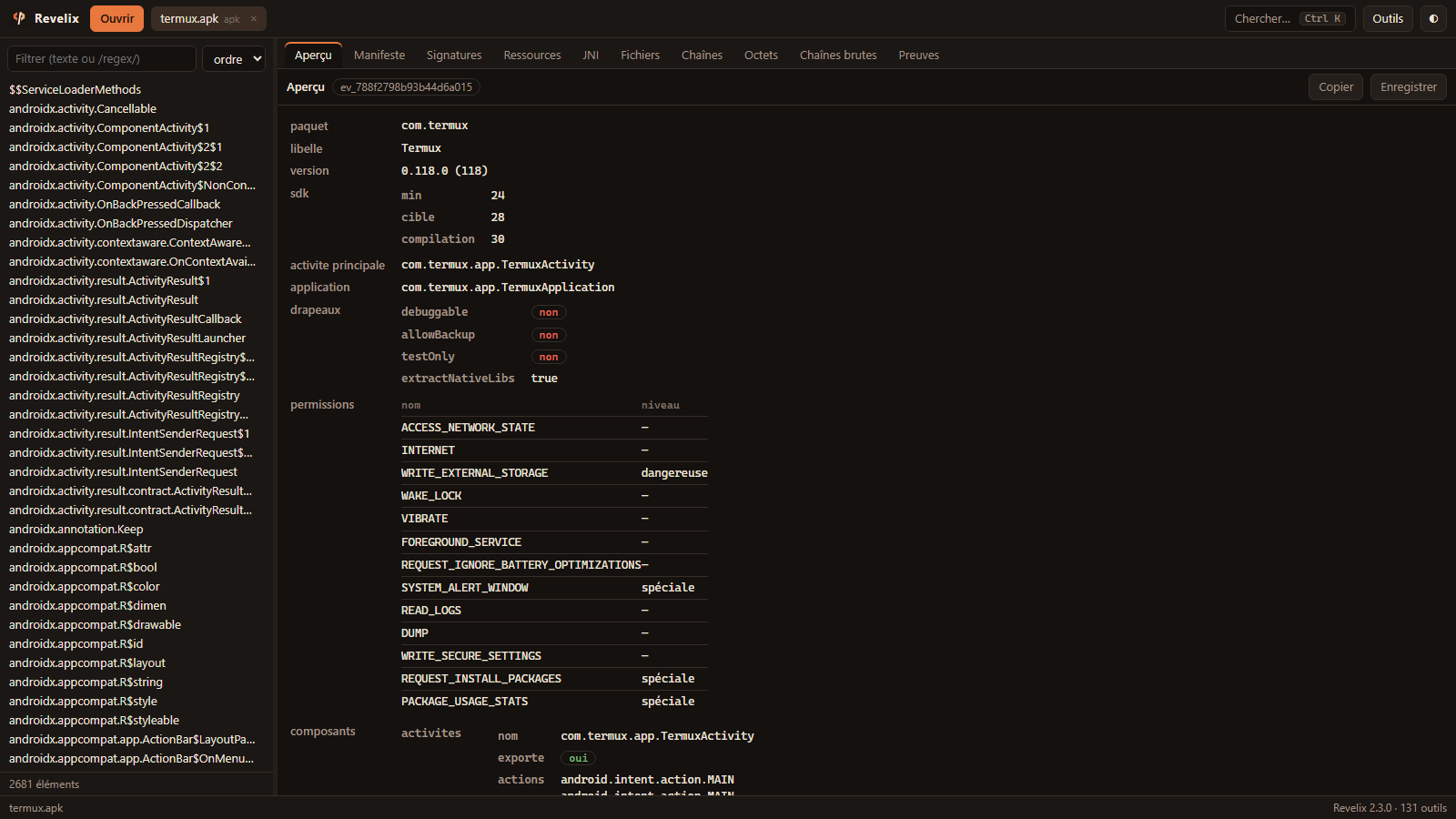 Android & iOS. Manifest, permissions, components, signatures, JNI map. |
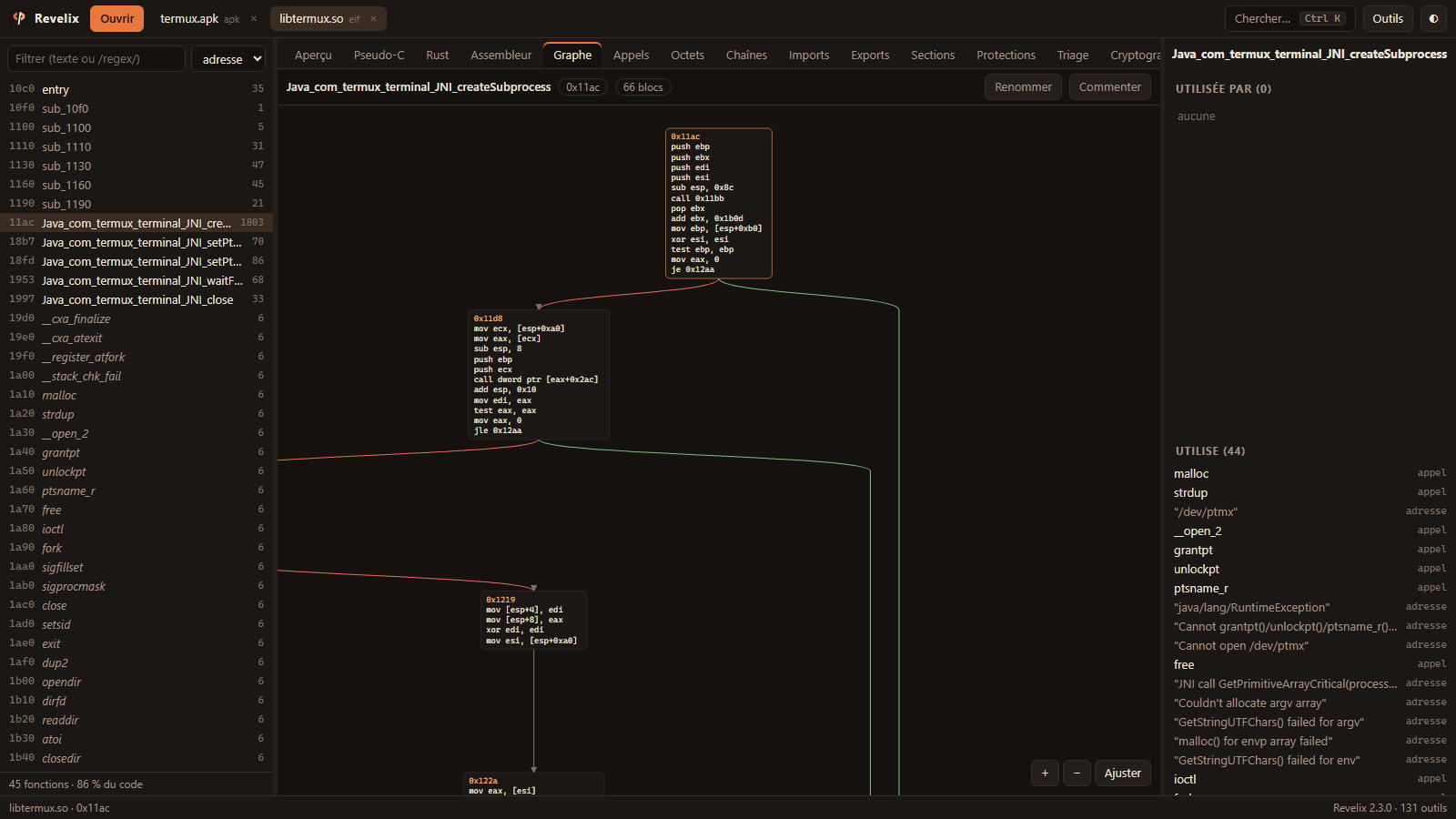 Graphs. Control flow and call graphs for every function. |
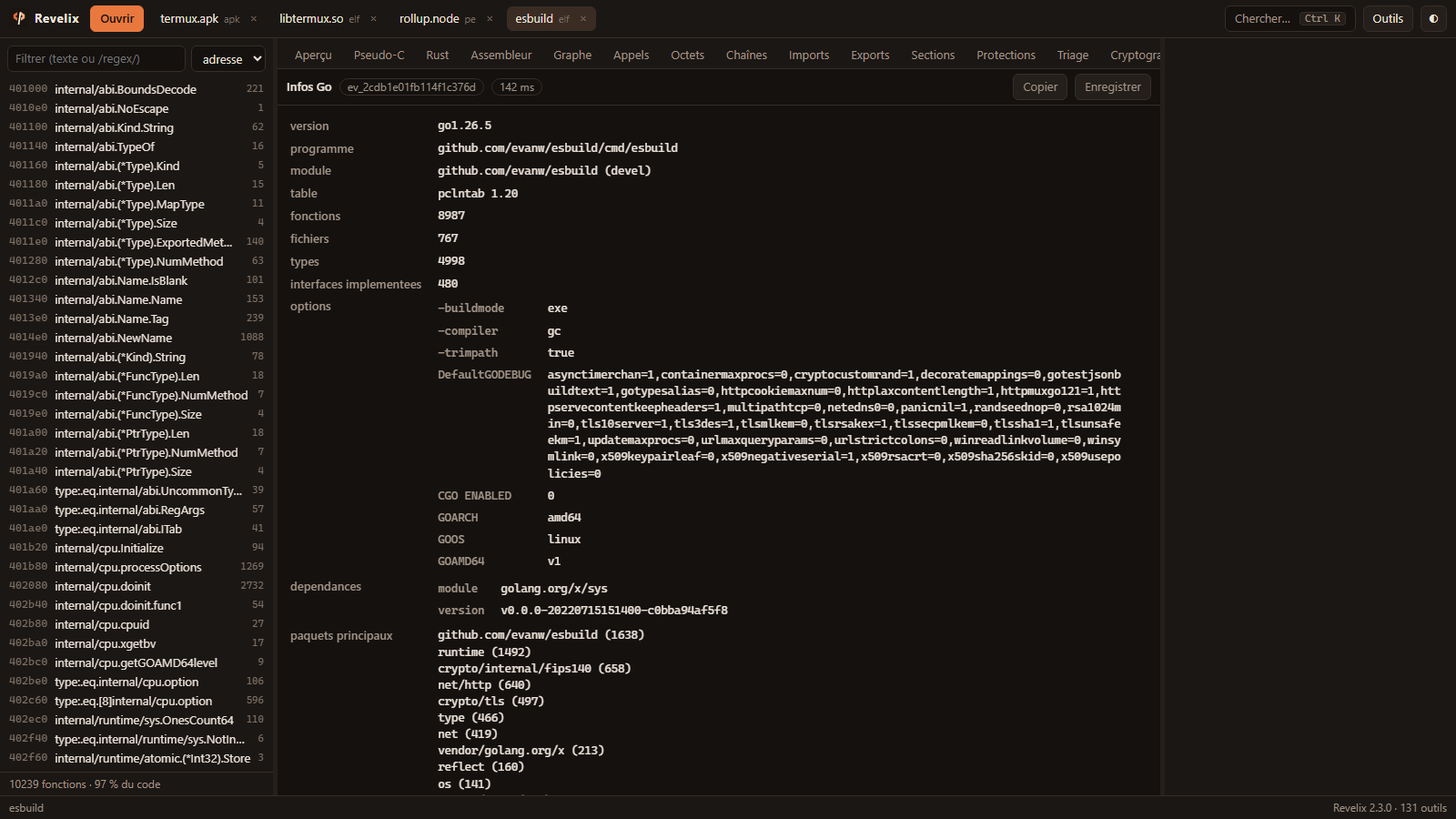 Go. Version, modules, functions by package. |
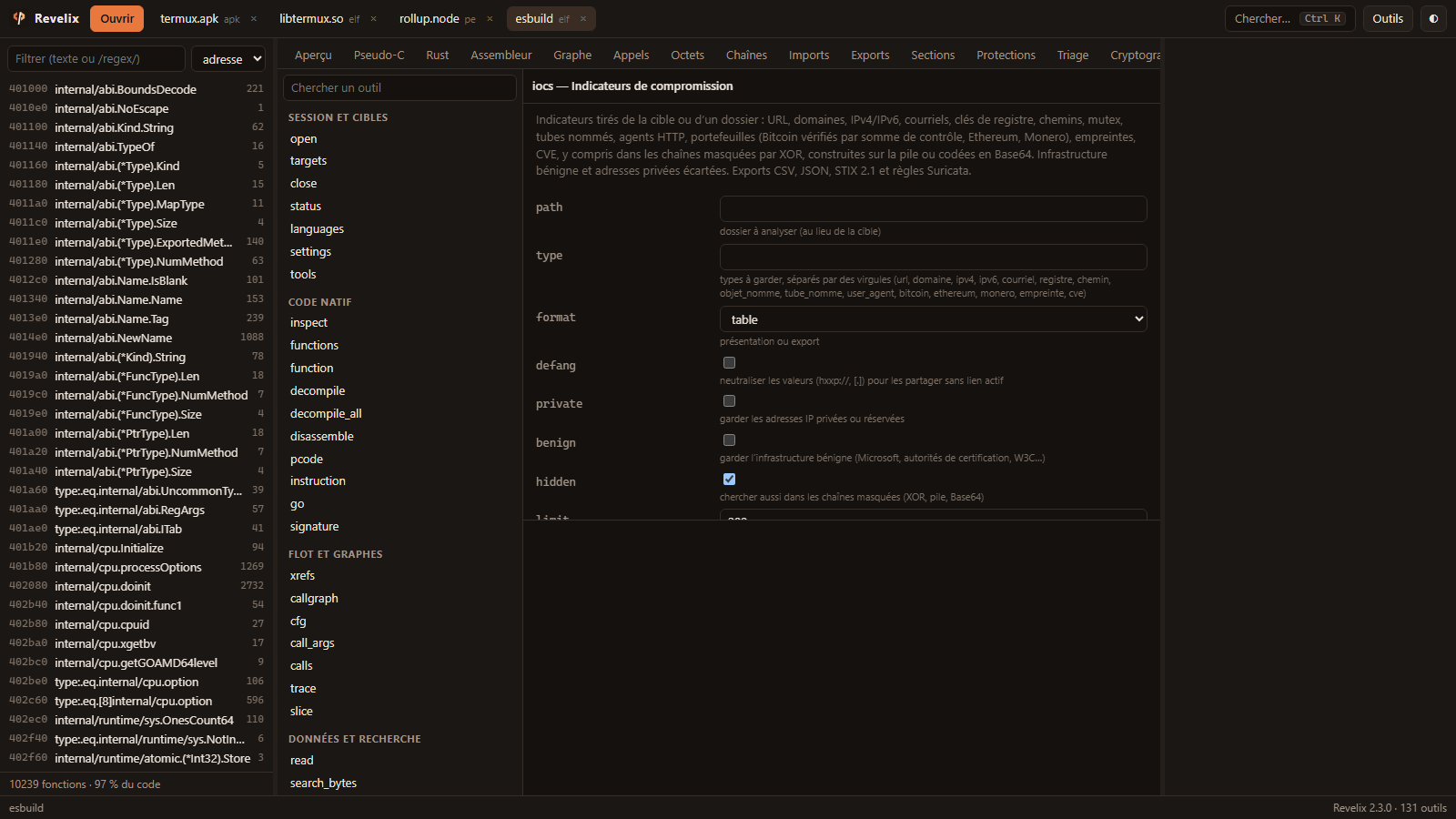 131 tools in the UI, the CLI and over MCP. |
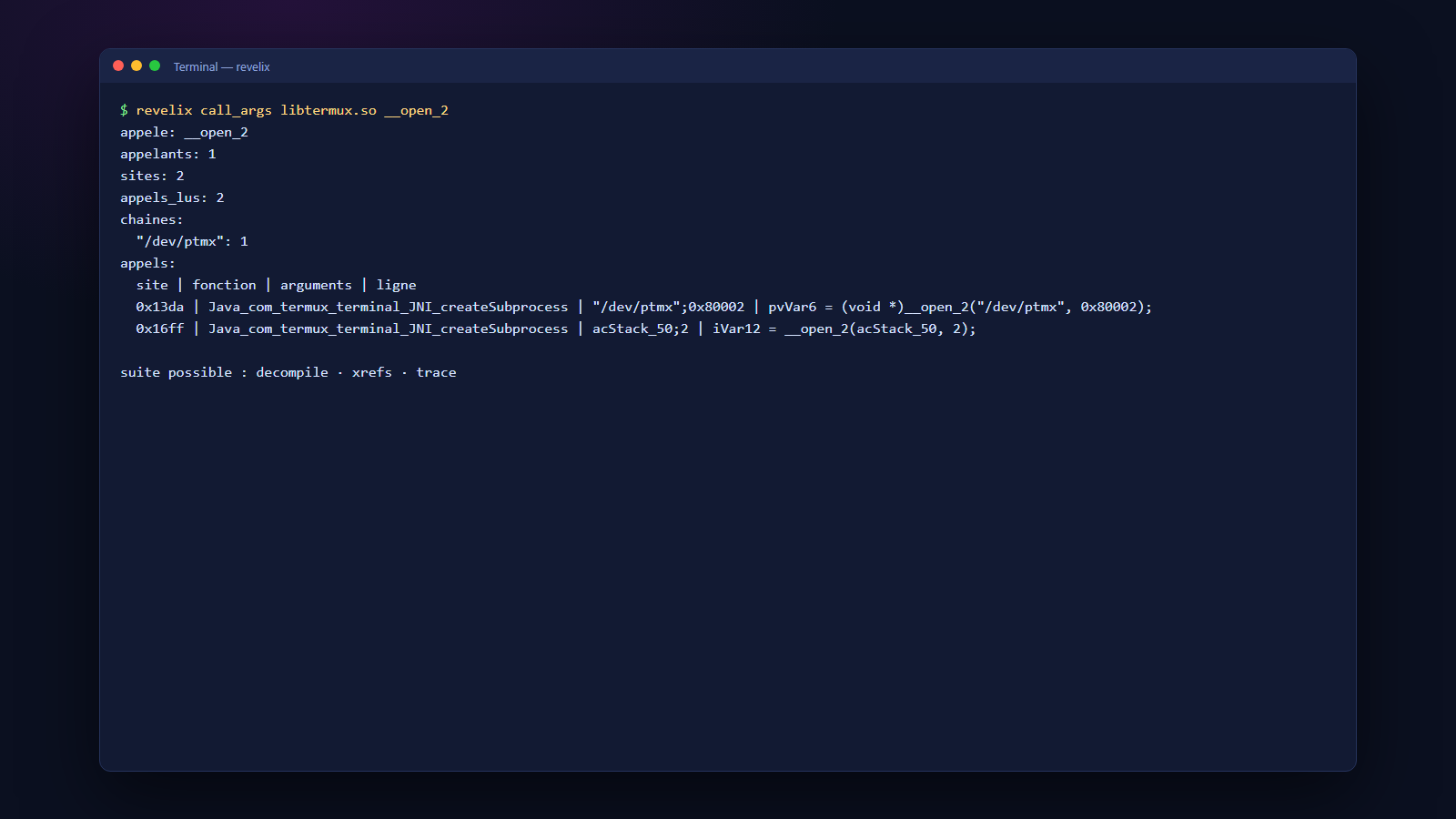 What does each call receive? call_args |
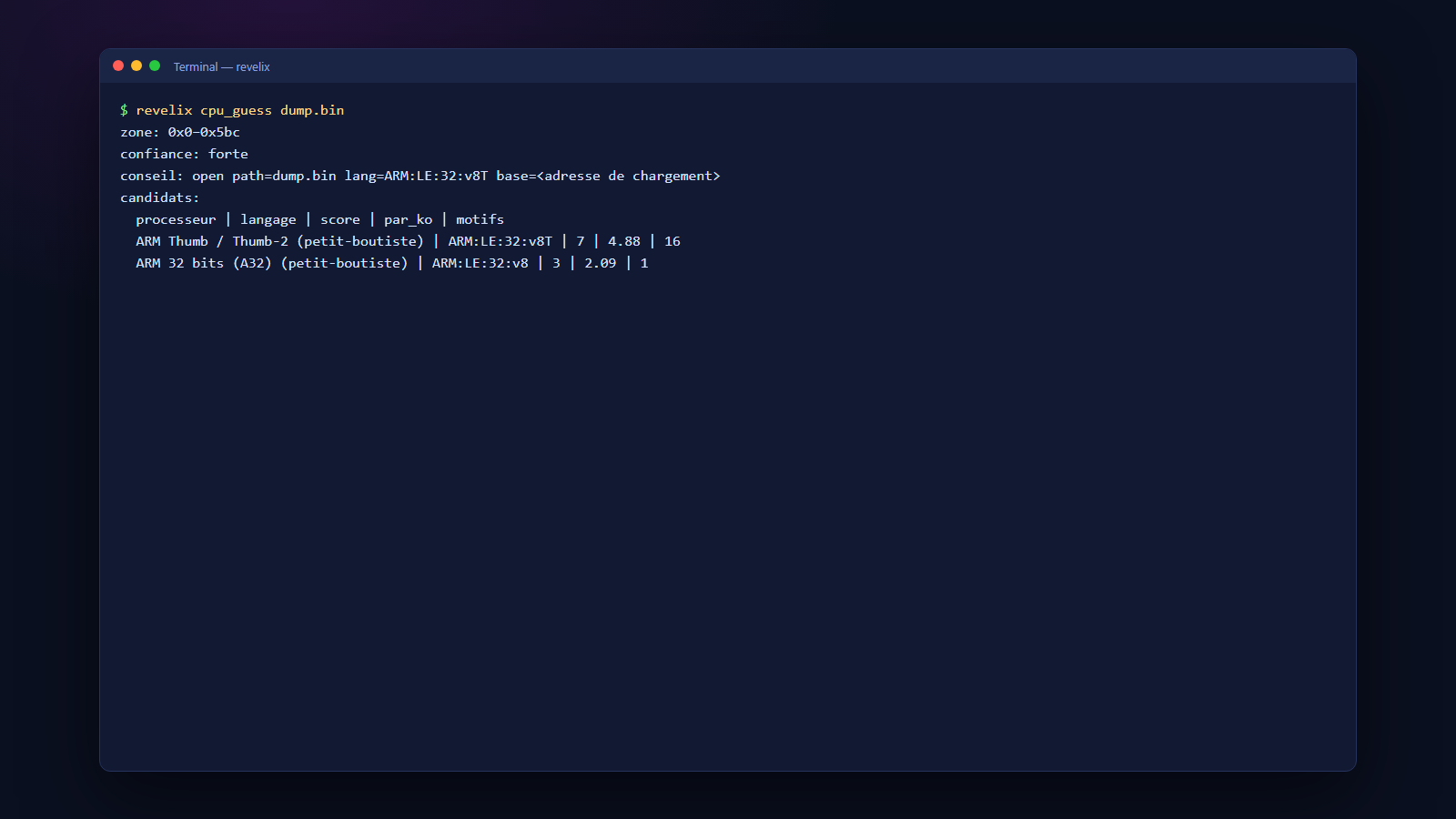 Raw firmware? cpu_guess finds the processor. |
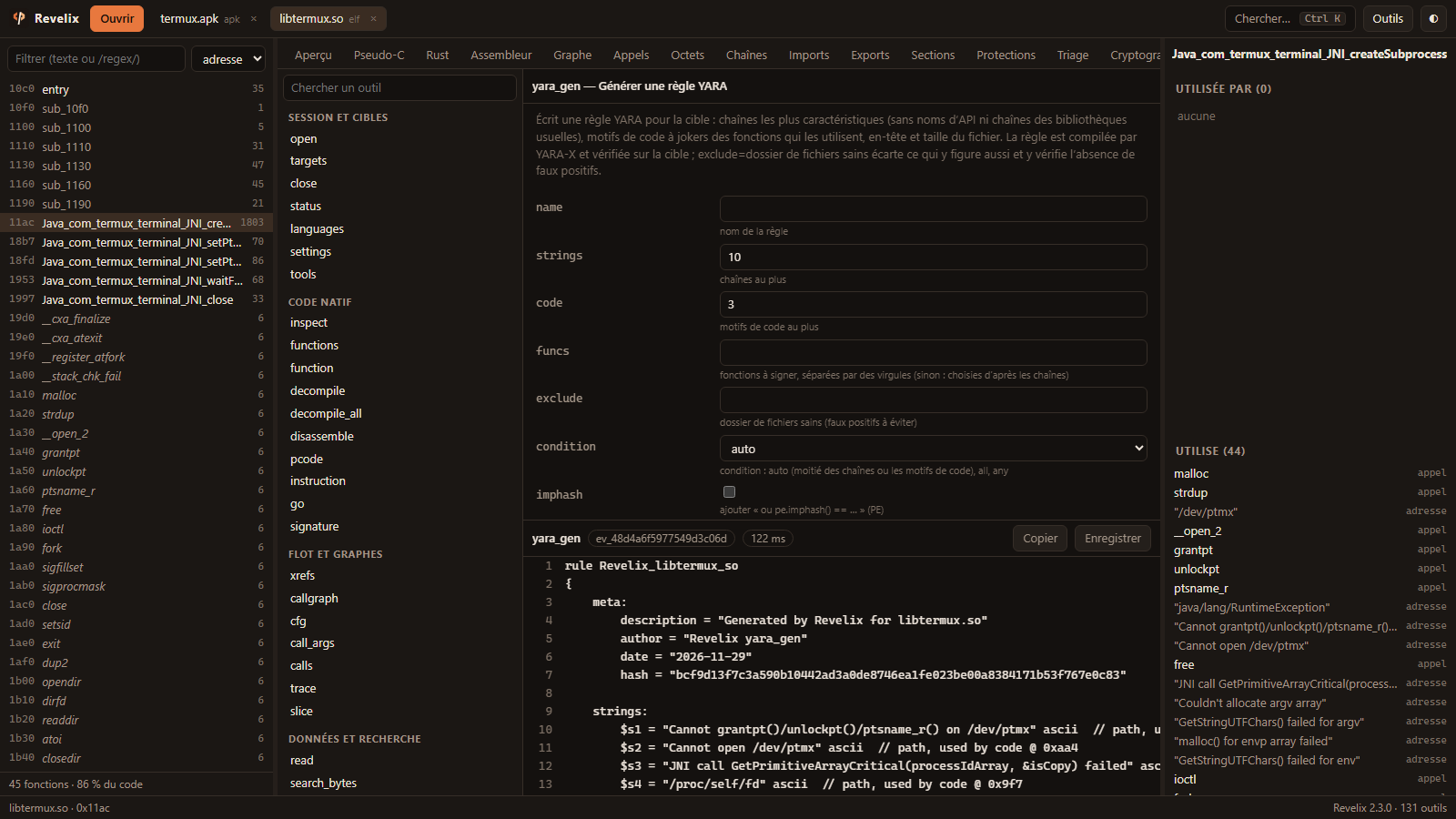 A YARA rule in one click. yara_gen, compiled and checked by YARA-X. |
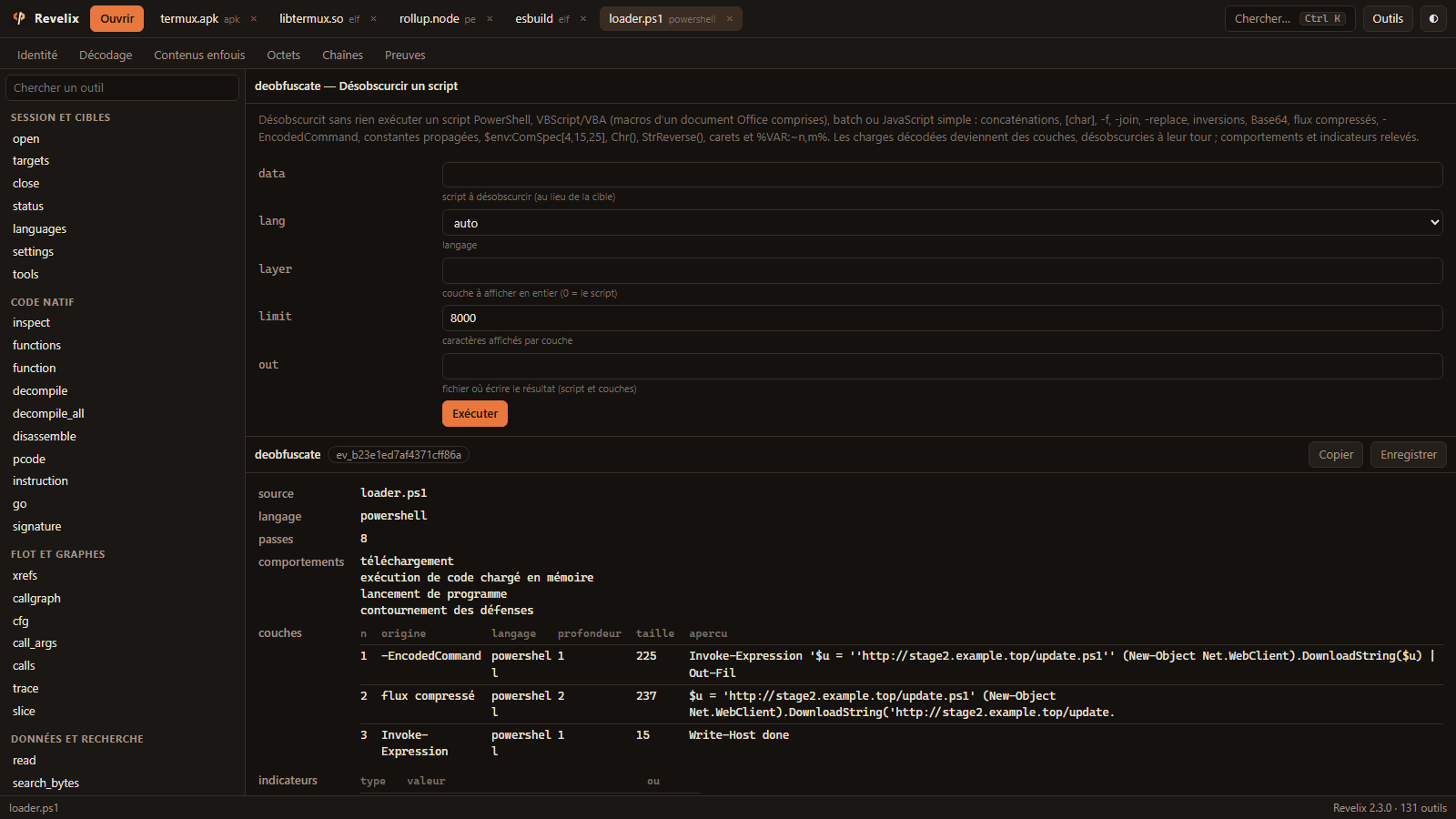 Obfuscated PowerShell, unwrapped. deobfuscate, layer by layer, nothing executed. |
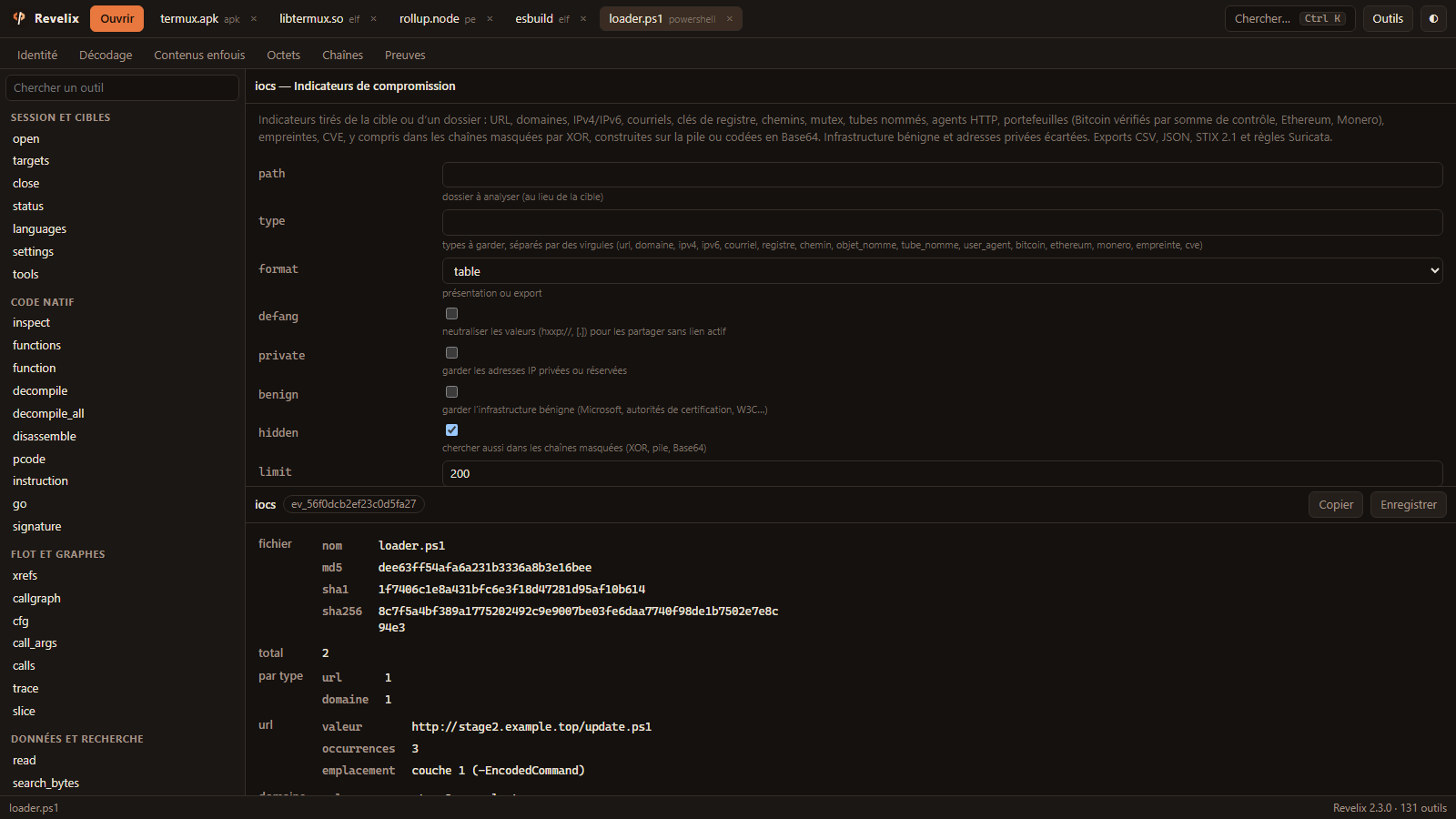 Indicators, even hidden ones. iocs → STIX 2.1, Suricata, CSV. |
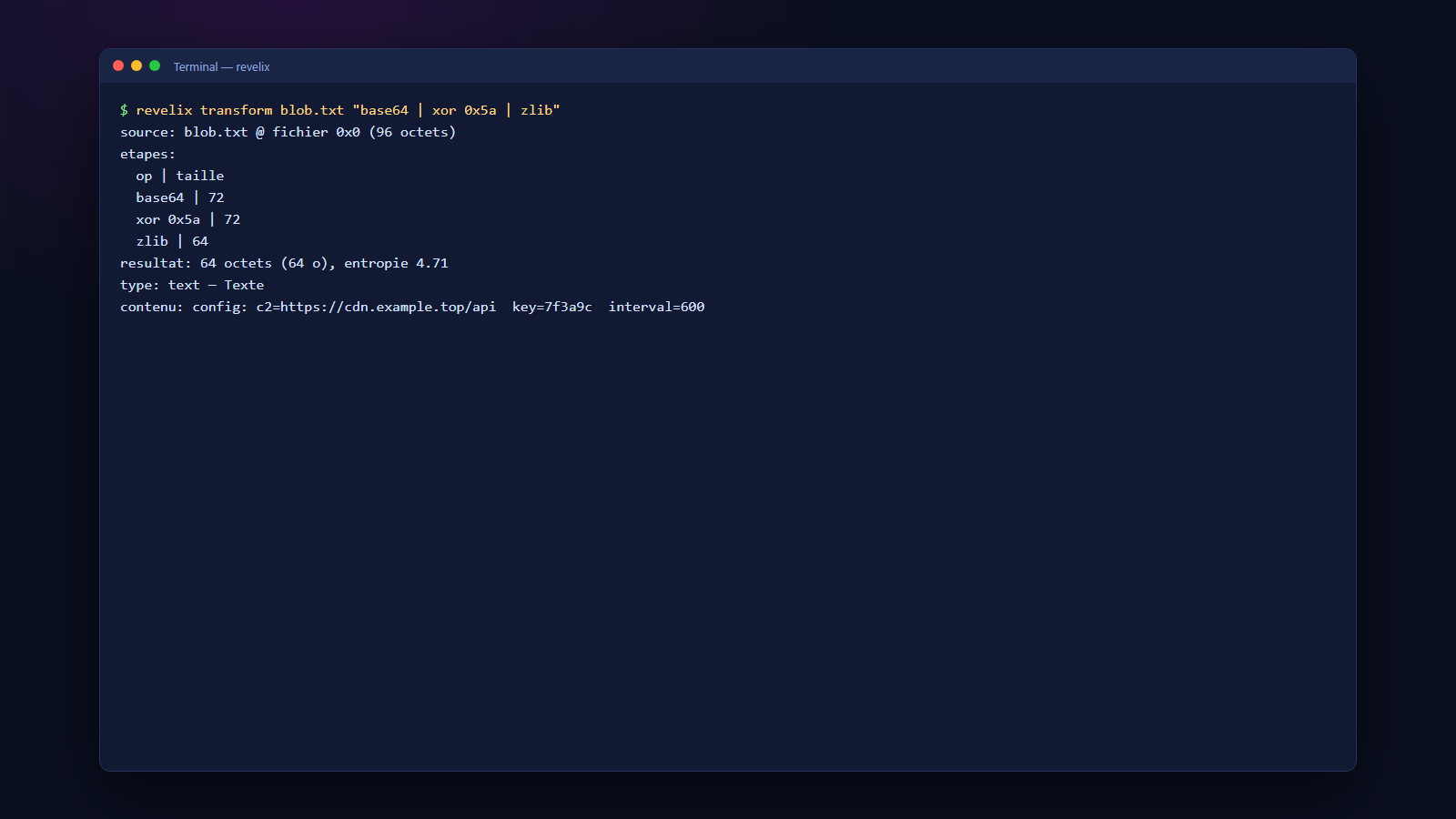 CyberChef-style chains. transform: Base64, XOR, AES, ChaCha20, zlib… |
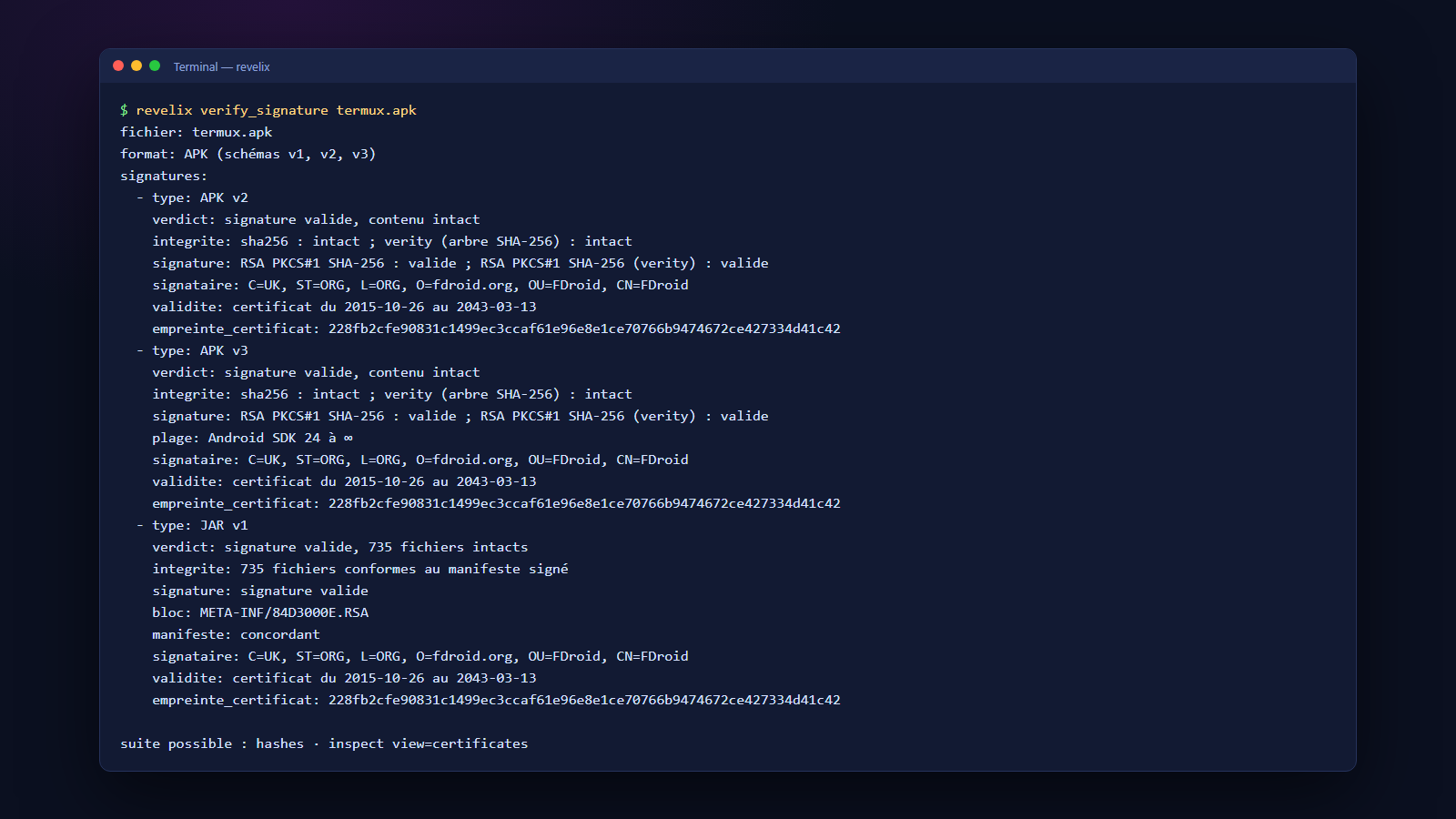 Signed — and still intact? verify_signature: APK v1–v3.1 with verity, Authenticode, Apple, JAR, kernel modules. |
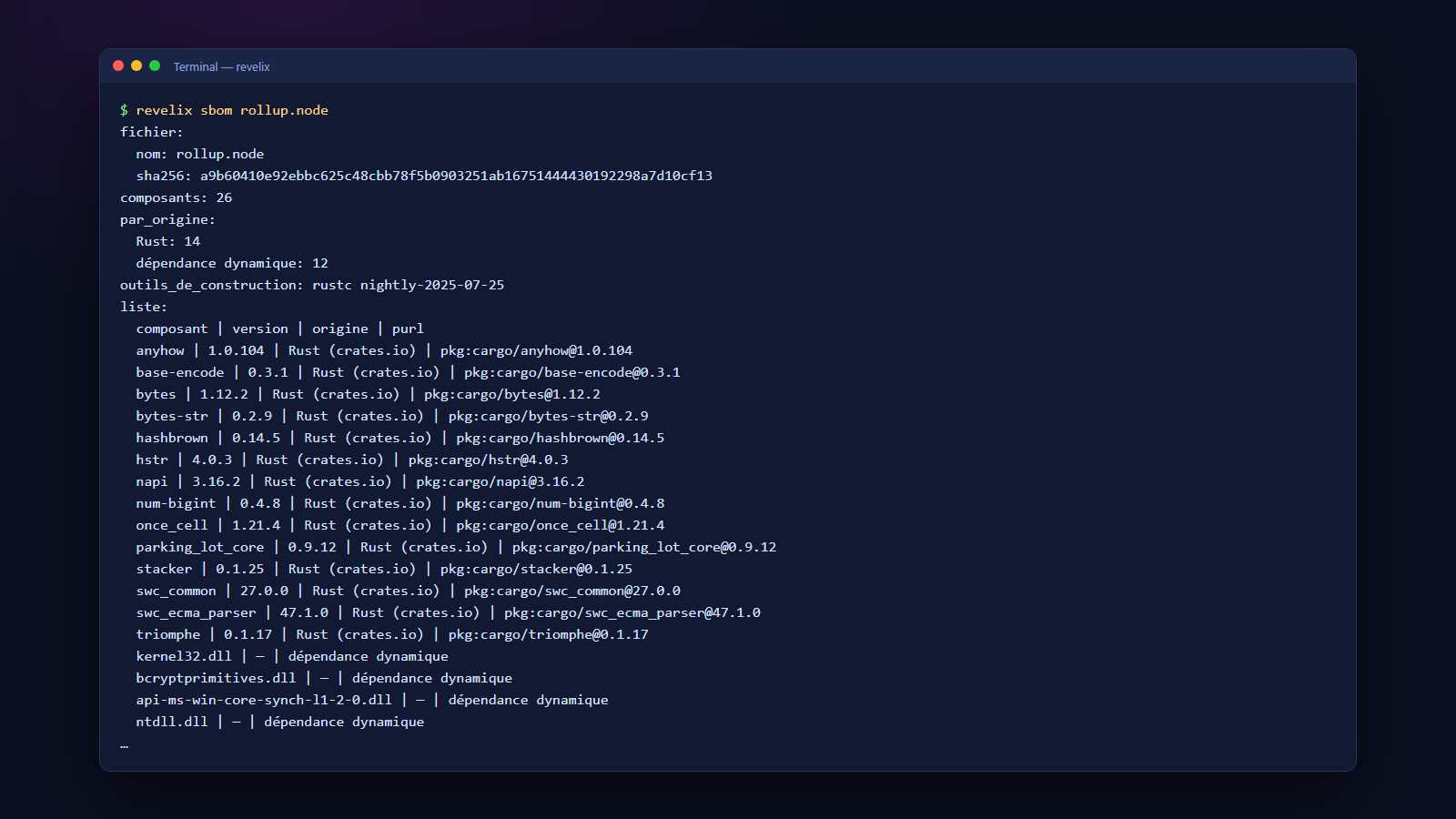 What is inside? sbom → CycloneDX 1.5, SPDX 2.3, known vulnerabilities from OSV.dev. |
What it does
| Area | Highlights |
|---|---|
| Native code | PE, ELF, Mach-O, COFF, raw images, 180 processor variants (x86/x64, ARM/Thumb, AArch64, MIPS, PowerPC, RISC-V, SPARC, 68k, AVR, MSP430, LoongArch, Xtensa, 6502, Z80…). Function discovery, jump tables, cross-references, position-independent i386 code, pseudo-C, assembly, p-code, CFG/call graphs, C++ RTTI classes, emulation of any function, Z3 solver, assembler and patching. |
| Rust | rust_info (rustc version, crates, source files), rust_decompile with verification levels, rust_project rebuilds a whole source tree with Cargo.toml. |
| .NET | C# decompiler (no-loss checked on 41,653 methods), IL, resources, P/Invoke, portable PDB. |
| Java & Android | Vineflower embedded + fallback decompiler, DEX/APK/AAB, manifest, permissions, v1–v3 signatures, JNI map with exact C prototypes applied to the native libraries. |
| iOS & macOS | IPA/app bundles, entitlements, provisioning, Objective-C classes, compiled NIBs, Assets.car. |
| Bytecode | Python 2.7–3.14 (source rebuilt), WebAssembly (MVP→GC/exceptions), Hermes, BEAM/Erlang, Lua 5.1–5.4 & LuaJIT, LLVM bitcode, Flash/ActionScript 3, EVM, IL2CPP metadata, Dart and V8 snapshots, OCaml bytecode (disassembly). |
| Go | Version, build settings, modules, functions by package, types. |
| Firmware & file systems | Recursive extraction: UEFI, vendor headers, squashfs, ext2/3/4, XFS, F2FS, exFAT, APFS, HFS+, UBI/UBIFS, JFFS2, YAFFS, CPIO, Android sparse/super/boot images, UPX unpacking… |
| Archives & documents | ZIP, 7z, RAR, TAR, CAB, ISO, WIM, DMG, VHD(X)/VMDK/QCOW2, PDF objects and scripts, Office/OLE macros, MSI. |
| Data & forensics | Parquet, Avro, ORC, Arrow, HDF5, SQLite, LevelDB, ESE; EVTX, registry hives, Prefetch, LNK, USN, minidumps, browser and macOS artefacts, plists, protobuf without schema… |
| Network & web | pcap/pcapng (flows, DNS, TLS SNI, HTTP), HAR, mitmproxy, Fiddler, QUIC qlog, OpenAPI; JavaScript beautify/deobfuscate/debundle (webpack, Metro, Browserify). |
| Hunting & triage | YARA-X, crypto constants, secrets, stack strings, XOR/ADD-hidden text, CPU guessing for raw code, protections (ASLR, NX, RELRO, CFG, CET…), capabilities mapped to MITRE ATT&CK techniques (only when the API really implies them: reading another process is not injection), api_hashes for Windows APIs resolved by hash (ROR13, Metasploit block_api, CRC32, DJB2, FNV… over 20,600 APIs). |
| Trust & supply chain | verify_signature checks code signatures for real: Authenticode (file hash recomputed, CMS signature, certificate chain, RFC 3161 timestamp, nested signatures), Apple code signing (every page against the CodeDirectory, then the CMS), Linux kernel modules, APK v2/v3/v3.1 (chunked SHA-256 and verity digests) and JAR/APK v1 (like jarsigner, section by section) — and says whether the file was modified after signing, for one file or a whole folder. sbom inventories what is embedded (Rust crates incl. cargo-auditable, Go modules even when the build-info header is gone, .NET references, Maven/AndroidX/Kotlin, npm, PyPI, NuGet, native libraries recognised by their version strings, dynamic dependencies, build tools) and exports CycloneDX 1.5 or SPDX 2.3; vulns=true asks OSV.dev (names and versions only) and gives the closest fixed version for each branch. |
| Detection engineering | yara_gen writes YARA rules (distinctive strings + wildcarded code, compiled and checked by YARA-X, false positives removed against a goodware folder); signature builds the shortest unique byte pattern (IDA, x64dbg, C, YARA) and finds it in another version; iocs extracts URLs, domains, IPs, registry keys, mutexes, pipes, wallets (checksums verified), hashes and CVEs — exported to CSV, JSON, STIX 2.1 and Suricata rules; hashes gives MD5/SHA/CRC, ssdeep and TLSH, imphash, authentihash, Rich hash, build IDs, and clusters similar files. |
| Decoding & recovery | transform chains CyberChef-style operations (Base64/32/58/85, XOR, RC4, AES, DES/3DES, ChaCha20, Salsa20, TEA/XTEA, 20 decompressors, auto layer detection) and opens the result as a new target; deobfuscate unwraps PowerShell, VBScript/VBA macros and batch without running them; find_keys recovers AES key schedules, RSA/EC/Ed25519 private keys, certificates and wallet keys from memory dumps; infer_struct rebuilds C structures from pointer accesses and applies them to the pseudo-C. |
| Interop | Import PDB, DWARF, dSYM and linker .map files (MSVC, IDA, GNU ld, lld, ld64); export names and comments to IDA, Ghidra, Binary Ninja, rizin/radare2, x64dbg or CSV. Federate other MCP servers. |
The complete list, with every parameter: docs/REFERENCE.md · one line per tool: docs/OUTILS.md.
Command line
revelix app.exe                                   # open & summarise (any format)
revelix decompile app.exe main                    # pseudo-C
revelix call_args app.exe GetProcAddress          # arguments at every call site
revelix read app.exe 0x140000000 --type IMAGE_DOS_HEADER
revelix rust_decompile app my_crate::run          # Rust
revelix android app.apk --view jni                # native methods + exact C prototypes
revelix unpack firmware.bin                       # what is inside
revelix extract_firmware firmware.bin --out out   # everything, recursively
revelix cpu_guess dump.bin                        # which CPU is this raw code for?
revelix stack_strings malware.exe                 # strings built on the stack
revelix export_names app.exe --format idapython   # names & comments for IDA
revelix yara_gen sample.exe --exclude goodware/   # YARA rule, checked against clean files
revelix iocs sample.exe --format stix --out iocs.json   # indicators as a STIX 2.1 bundle
revelix deobfuscate loader.ps1                    # PowerShell / VBScript / batch, layer by layer
revelix transform blob.bin "base64 | xor 0x5a | zlib"   # CyberChef-style decoding chain
revelix signature app.exe sub_401000 --in app-v2.exe   # unique byte pattern, found again in v2
revelix infer_struct app.exe sub_401000 --apply   # rebuild the struct, get param->field in C
revelix find_keys memory.dmp                      # AES schedules, private keys, certificates
revelix hashes sample.exe --with variant.exe      # ssdeep + TLSH similarity
revelix verify_signature setup.exe                # Authenticode: intact? who signed? when?
revelix sbom app.apk --vulns                      # embedded components + known vulnerabilities
revelix sbom app --format cyclonedx --out app.cdx.json   # CycloneDX 1.5 (or --format spdx)
revelix api_hashes shellcode.bin                  # APIs resolved by ROR13 / CRC32 / DJB2 hashes
revelix help <tool>                               # help for any tool
Add --json for machine-readable output. The interface and tool output are in French; an English localisation is welcome (see CONTRIBUTING.md).
Security and privacy
- Untrusted input by design. Files are parsed by memory-safe readers with bounds checks; fuzzed with more than 150,000 hostile inputs without an internal error or hang.
- Nothing runs, nothing leaves. Execution, network, device access and file writes are separate permissions, off by default (
revelix policy allow exec|network|device|write). - AI-safe output. Content extracted from targets is marked as untrusted data in MCP results, so agents do not follow instructions hidden in binaries.
- Verifiable releases. Every release package carries build provenance signed by GitHub Actions through Sigstore — check it with
gh attestation verify revelix-<version>.tgz --repo isneoz1/revelix— and its SHA-256 beside it. CodeQL and the OpenSSF Scorecard run on every change; actions are pinned by commit and dependencies watched by Dependabot. - Report a vulnerability: SECURITY.md (private reporting through GitHub). Citing Revelix: CITATION.cff.
Quality
| Check | Result |
|---|---|
| Automated tests | 104 tests (npm test) on Linux, macOS and Windows in CI — none skipped: CI fetches the real files they need (Rust standard library, Newtonsoft.Json) from their official archives |
| End-to-end scenario | 292 tool calls on real files: 289 results, 3 expected refusals checked word for word, 0 failure |
| C# decompiler | 0 lost calls/fields/strings on 41,653 methods |
| Hermes / BEAM / WebAssembly | 0 losses on 72,116 / 13,983 / 2,432 functions |
| Python | 4 imperfect functions out of 51,147 |
| Rust decompiler | verification levels reported per function (calls, literals, positions, flow) |
| CPU guessing | 49 / 49 real binaries, 0 false positive on random data |
| Fuzzy hashes | TLSH: 80 / 80 hashes and 3,160 / 3,160 distances identical to Trend Micro's reference test set; ssdeep: published vectors, two independent formulations agreeing on 1,200 inputs |
| Crypto & decoding | FIPS-197 (AES-128/192/256), RFC 8439 (ChaCha20), eSTREAM (Salsa20), RC4, TEA, XTEA, DES vectors |
| Code signatures | Authenticode valid on Newtonsoft.Json, node.exe and msedge.exe, one flipped byte detected; Apple ad hoc signatures: 2,305 / 2,305 pages checked; three F-Droid APKs: schemes v1, v2 and v3 intact, verity digests included (735, 1,248 and 1,610 files); reference signatures made with OpenSSL for kernel modules and JAR files (intact, altered, manifest completed or forged) |
| SBOM & API hashes | CycloneDX 1.5 and SPDX 2.3 exports structurally valid (required fields, identifiers, references) on Rust, Go, Android and .NET targets; published ROR13 and Metasploit hash values reproduced; no confident API-hash match on cmd.exe |
| Robustness | ≈ 150,000 fuzzed inputs, 0 internal error; 2.2 tools: 543 more calls; 2.3 tools: 3,940 calls on corrupted copies of real PE, ELF, Mach-O, APK and Go/Rust binaries and of the reference signatures — 0 internal error, 0 call over 4 s, once the Mach-O cases they revealed were fixed |
How each number is measured: CONTRIBUTING.md.
Honest limits
A decompiler cannot give back the original source: names, comments and types erased by the compiler stay lost unless debug information exists. Revelix does not open StuffIt 5, ACE, cromfs, Pack200, mruby, YARV, GDScript or the PHP opcache yet; s390x code is identified but not disassembled; GUI observation is Windows-only. Signature checks are offline: certificate revocation is not queried, and Windows system files signed through a catalogue (.cat) are reported as such rather than verified. Binaries protected by commercial virtualisation stay hard to read.
Documentation
| Document | Content |
|---|---|
| docs/REFERENCE.md | every tool and parameter |
| docs/MCP.md | AI clients, profiles, HTTP transport, evidence |
| docs/ARCHITECTURE.md | how it works inside |
| docs/PARITE.md | mapping with the 263 tools of the original REA |
| CONTRIBUTING.md | development, tests, adding a tool |
| CHANGELOG.md | versions |
| THIRD_PARTY_NOTICES.md | embedded engines and licences |
Credits
Revelix is an independent MIT-licensed rewrite inspired by REA — Reverse Engineer Anything. It embeds the Ghidra decompiler and SLEIGH specifications (Apache-2.0), Vineflower, YARA-X, Z3, iced and a port of TLSH (Apache-2.0); ssdeep-compatible hashing is an independent implementation. Full list: THIRD_PARTY_NOTICES.md.
License: MIT. Use it only on software you are allowed to analyse.
Yorumlar (0)
Yorum birakmak icin giris yap.
Yorum birakSonuc bulunamadi