second-brain-health-check
Health Warn
- No license — Repository has no license file
- Description — Repository has a description
- Active repo — Last push 0 days ago
- Low visibility — Only 9 GitHub stars
Code Fail
- process.env — Environment variable access in dist/dashboard/generate.js
- exec() — Shell command execution in dist/fluency/reference-integrity.js
- process.env — Environment variable access in dist/fluency/reference-integrity.js
Permissions Pass
- Permissions — No dangerous permissions requested
No AI report is available for this listing yet.
Your Claude Code setup has 45 things that could be better. This finds them in 2 seconds.
MemoryOS
Your Claude Code setup has 45 things that could be better. This finds them in 2 seconds.



Open-source context engineering scanner for Claude Code
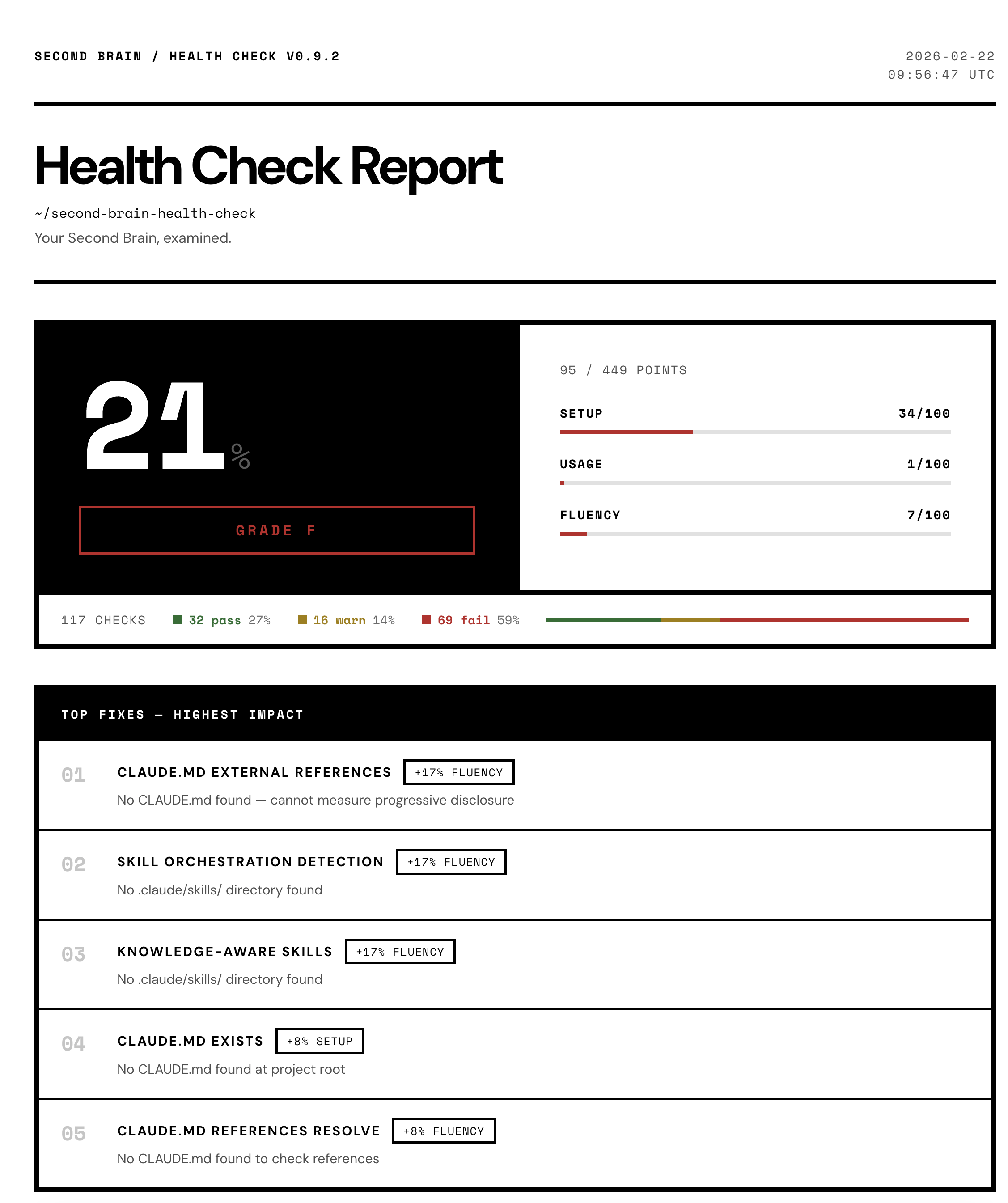
Scores your Claude Code setup across 45 check layers and 3 dimensions. Returns adaptive reports with Context Engineering pattern mapping, prioritized fixes with time estimates, and an HTML dashboard. Free tools run locally with zero network calls. Paid tools unlock progress tracking, context analysis, conversation import, and AI-powered upgrades.
Install
One command setup
npx @iwo-szapar/second-brain-health-check setup
Interactive onboarding (~2 minutes):
- Asks for your API key (or skip for free tier)
- Configures the MCP server in Claude Code
- Asks about your role, experience, and goals
- Runs the first health check and opens the dashboard
Manual MCP setup
claude mcp add second-brain-health-check -- npx @iwo-szapar/second-brain-health-check
Then ask Claude: "Run a health check on my project."
Tools
Free Tools
No API key required. Run locally, zero network calls.
check_health
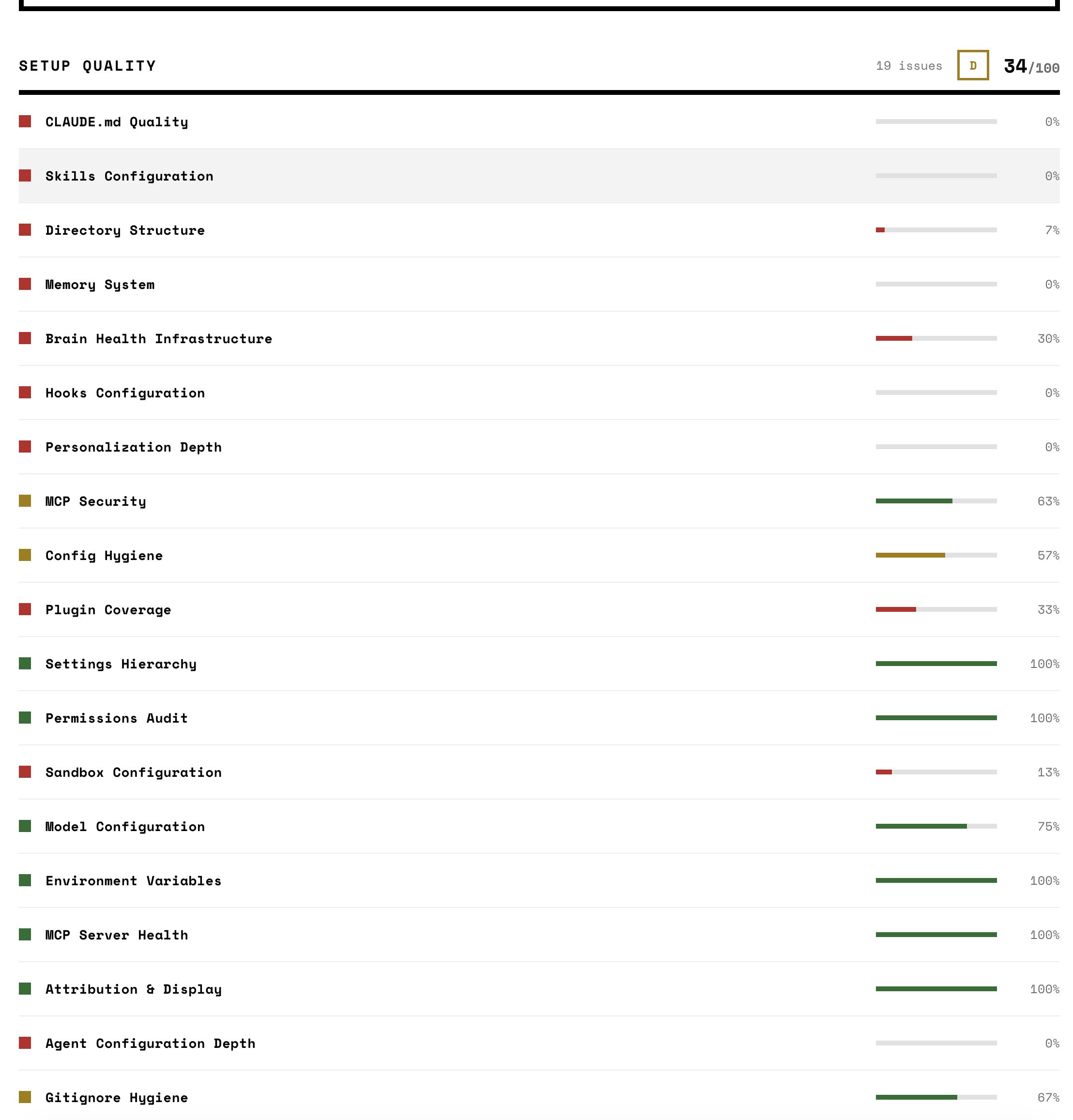
Full 45-layer scan across setup quality, usage activity, and AI fluency. Adapts the report to your brain's maturity level.
> Run a health check

> Check my setup health in quick mode

> Run health check in Spanish
Parameters:
| Parameter | Default | Options |
|---|---|---|
path |
current directory | Path to project root |
mode |
full |
full (45 layers), quick (~100ms detection only), manifest (full + YAML output) |
language |
en |
en, es, de, fr, pl, pt, ja, ko, zh, it, nl, ru, tr, ar |
workspace_type |
-- | solo, team, enterprise |
use_case |
-- | development, content, operations, research, mixed |
get_fix_suggestions
Prioritized action plan for your weakest area. Each fix includes a time estimate and point value.
> What should I fix first in my setup?

> Give me fix suggestions focused on setup quality
Parameters:
| Parameter | Default | Options |
|---|---|---|
path |
current directory | Path to project root |
focus |
auto |
auto (picks weakest), setup, usage, fluency |
language |
en |
Same as check_health |
generate_dashboard
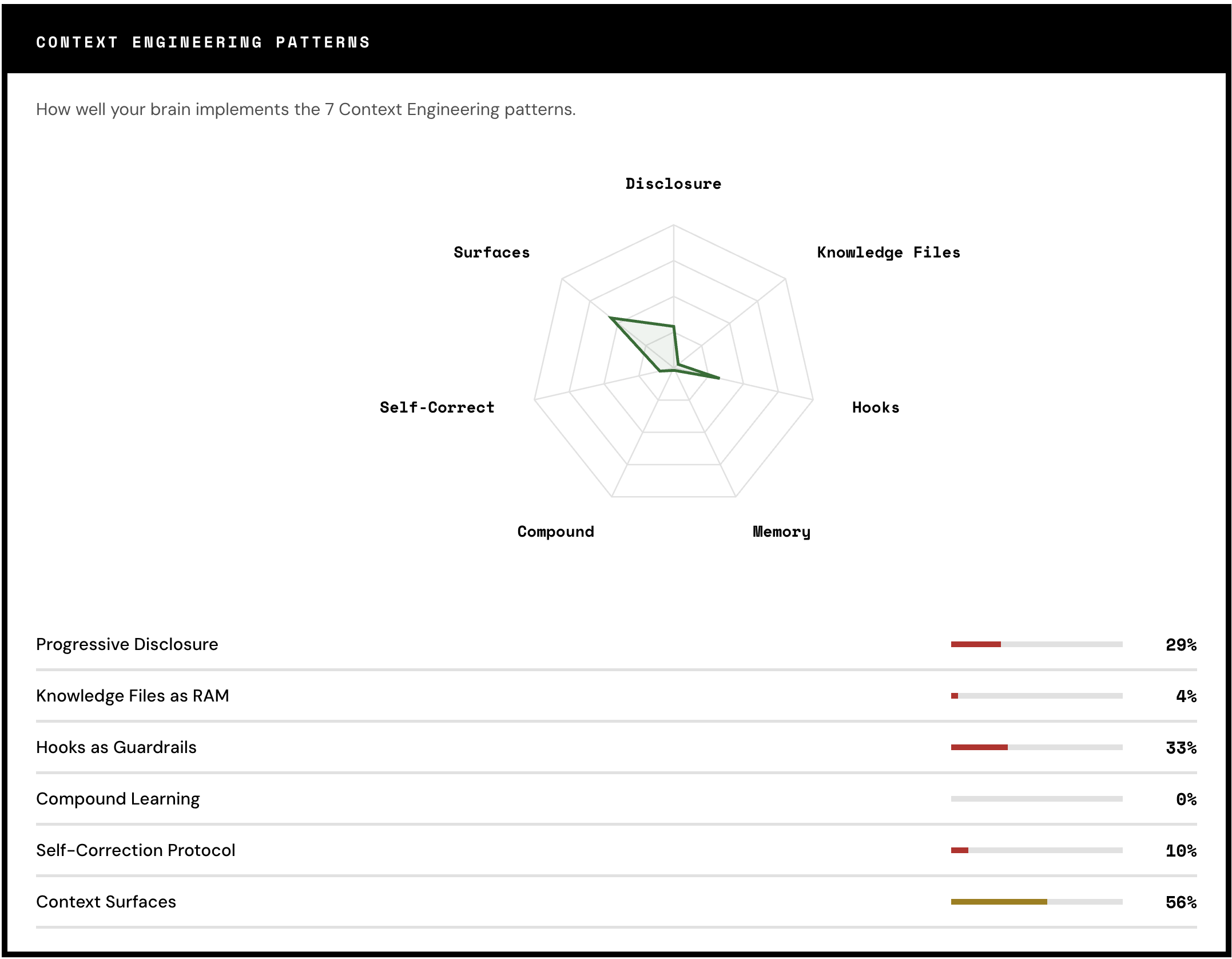
Self-contained HTML dashboard with score visualizations, CE radar chart, and guided fixes. Opens in your browser.
> Generate a health check dashboard

> Generate dashboard and save to ~/reports/brain.html
Parameters:
| Parameter | Default | Options |
|---|---|---|
path |
current directory | Path to project root |
output |
health-check-report.html |
Output file path |
generate_pdf
PDF report via headless Chrome. Requires Chrome or Chromium installed.
> Generate a PDF health check report
Parameters:
| Parameter | Default | Options |
|---|---|---|
project_path |
(required) | Absolute path to project |
Paid Tools
Require an API key. Set SBK_TOKEN in your environment or run setup to configure.
weekly_pulse
Track progress over time. Shows score deltas, CE pattern trends, streak detection, and targeted suggestions.
> Show my weekly pulse

> Show my progress over the last 30 days
Parameters:
| Parameter | Default | Options |
|---|---|---|
period |
since_last |
since_last, 7d, 30d |
path |
current directory | Path to project root |
context_pressure
Analyze how much of your 200K token context window is consumed by fixed overhead -- CLAUDE.md, MEMORY.md, knowledge files, MCP definitions, skills, hooks, and settings.
> Check my context pressure

> How much of my context window am I using?
Parameters:
| Parameter | Default | Options |
|---|---|---|
path |
current directory | Path to project root |
audit_config
Audit your configuration for dead references, conflicts, security issues, unused items, and performance problems.
> Audit my config

> Run a security audit on my setup
Parameters:
| Parameter | Default | Options |
|---|---|---|
path |
current directory | Path to project root |
check_categories |
all 5 | references, conflicts, security, unused, performance |
What each category checks:
- references -- Dead file paths in CLAUDE.md, missing hook scripts
- conflicts -- Duplicate CLAUDE.md files, overlapping MCP servers, unmatched hooks
- security --
.envin.gitignore, API key patterns in config files, wildcard permissions - unused -- Skills with zero invocations in session logs
- performance -- Oversized CLAUDE.md (>300 lines), MEMORY.md (>180 lines), too many MCP tools (>30)
import_context
Import conversation history from ChatGPT or Claude exports into organized memory files. Scan first to preview, then import to create files.
> Scan my ChatGPT export at ~/Downloads/conversations.json

> Import my ChatGPT conversations, only coding-related ones from 2025
Parameters:
| Parameter | Default | Options |
|---|---|---|
source_type |
(required) | chatgpt_export (conversations.json) or claude_export (directory) |
source_path |
(required) | Path to export file or directory |
mode |
scan |
scan (preview only) or import (write files) |
output_dir |
memory/imported/ |
Where to write imported files |
max_conversations |
unlimited | Limit conversations processed |
min_messages |
3 |
Skip short conversations |
date_after |
-- | ISO date filter (e.g. 2024-01-01) |
date_before |
-- | ISO date filter |
categories |
all | coding, writing, research, planning, data, creative, operations |
merge_existing |
false |
When true, writes to memory/semantic/ instead |
language |
en |
Output language |
upgrade_brain
Identify missing and outdated files in your setup and generate personalized upgrades. Runs health check and inventory locally, then calls the Factory API for template matching and personalization. Requires SBK_TOKEN env var (MemoryOS subscriber benefit).
> Upgrade my brain

> Show me what files I'm missing (dry run)

> Upgrade brain, high impact only
Parameters:
| Parameter | Default | Options |
|---|---|---|
path |
current directory | Path to project root |
high_only |
false |
Only show HIGH impact files |
category |
all | agent, skill, memory, config, docs |
dry_run |
false |
Preview the diff without applying |
CLI
# First-time setup (interactive)
npx @iwo-szapar/second-brain-health-check setup

# Run health check (prints report + opens dashboard)
npx @iwo-szapar/second-brain-health-check

# Scan a specific directory
npx @iwo-szapar/second-brain-health-check /path/to/project

# Text report only (no browser)
npx @iwo-szapar/second-brain-health-check --no-open

# Generate PDF report
npx @iwo-szapar/second-brain-health-check --pdf
What It Measures
Three dimensions. 45 check layers. ~459 raw points, normalized to /100 each.
SETUP QUALITY      32 layers    ~284 pts
A (85%+) | B (70%+) | C (50%+) | D (30%+) | F (<30%)

USAGE ACTIVITY      7 layers    ~125 pts
Active (85%+) | Growing (70%+) | Starting (50%+) | Dormant (30%+) | Empty (<30%)

AI FLUENCY          6 layers     ~60 pts
Expert (85%+) | Proficient (70%+) | Developing (50%+) | Beginner (30%+) | Novice (<30%)
Adaptive Reports
Reports shift based on brain maturity:
| Brain State | Condition | Report Style |
|---|---|---|
| Empty | No CLAUDE.md | 3-step getting-started guide (~20 min) |
| Minimal | Small CLAUDE.md, no .claude/ | Growth mode: top 3 fixes, celebrates what exists |
| Basic | CLAUDE.md + .claude/ | Growth mode |
| Structured | Has skills or hooks or memory | Full report with all dimensions |
| Configured | Has skills + hooks + memory | Full report with CE patterns |
Context Engineering Patterns
All 45 layers map to 7 CE patterns:
| Pattern | What It Measures |
|---|---|
| Progressive Disclosure | CLAUDE.md layering, knowledge files, settings hierarchy |
| Knowledge Files as RAM | Knowledge base architecture, directory structure |
| Hooks as Guardrails | PreToolUse/PostToolUse hooks, rules system |
| Three-Layer Memory | Episodic/semantic separation, session logs |
| Compound Learning | Review loops, compound evidence, workflow maturity |
| Self-Correction | Health infra, memory evolution, cross-references |
| Context Surfaces | MCP servers, plugins, interaction config, context pressure |
HTML Dashboard
Security and Privacy
- Runs entirely locally -- zero network calls on free tier
- Zero telemetry on free tier
- Reads file structure and config metadata only -- never reads your code, emails, or documents
- Secret detection reports "found/not found" only -- actual key values are never shown
- Home directory boundary -- cannot scan outside
$HOME - Path validation via Zod (no null bytes, length limits)
- File count limit: 5,000 per directory scan
- Recursion depth: 3-4 levels max
- All user content escaped in HTML output
- stdio transport only
Paid tools: weekly_pulse, context_pressure, audit_config, and import_context make zero network calls (they only read local files). upgrade_brain sends anonymized scores and file inventory to the Factory API for template matching -- no file contents are sent.
Free vs Paid
| Free | Paid | |
|---|---|---|
check_health |
45-layer scan | Same |
get_fix_suggestions |
Prioritized fixes | Same |
generate_dashboard |
HTML dashboard | Same |
generate_pdf |
PDF report | Same |
weekly_pulse |
-- | Score deltas + trends |
context_pressure |
-- | Token budget analysis |
audit_config |
-- | Config audit (5 categories) |
import_context |
-- | ChatGPT/Claude import |
upgrade_brain |
-- | AI-powered file generation |
| Score tracking | Local .health-check.json |
Local + server (benchmark-ready) |
| Network calls | Zero | upgrade_brain only |
Get access: iwoszapar.com/memory-os
Documentation
| Document | Purpose |
|---|---|
| SCORING.md | Every check, threshold, regex, and point value |
| CHANGELOG.md | Version history |
What Is Context Engineering?
Prompt engineering optimizes a single LLM call.
Context engineering optimizes the persistent system surrounding those calls --
the files, hooks, memory, and skills that shape every session.
Your CLAUDE.md, .claude/ directory, skills, hooks, memory files, MCP servers, and planning artifacts form a persistent context layer. MemoryOS scores that layer -- not your prompts.
Troubleshooting
Migrating from @iwo-szapar/memoryos
The old package @iwo-szapar/memoryos is deprecated. If you see Memoryos [tool_name] (capital M) in your tool output, you're on the old package.
Claude Code CLI:
claude mcp remove memoryos
claude mcp remove second-brain-health-check
npm cache clean --force
claude mcp add second-brain-health-check -- npx @iwo-szapar/second-brain-health-check@latest
VS Code (Claude extension):
The VS Code extension reads .mcp.json in your project root (not .claude.json). Create or edit .mcp.json:
{
  "mcpServers": {
    "second-brain-health-check": {
      "type": "stdio",
      "command": "npx",
      "args": ["@iwo-szapar/second-brain-health-check@latest"],
      "env": {
        "SBK_TOKEN": "your_sbk_token_here"
      }
    }
  }
}
Claude Desktop / Cowork:
Claude Desktop stores MCP config in a separate file (not .claude.json or .mcp.json):
- macOS:
~/Library/Application Support/Claude/claude_desktop_config.json - Windows:
%APPDATA%\Claude\claude_desktop_config.json - Linux:
~/.config/Claude/claude_desktop_config.json
Open that file, find the old "memoryos" entry under "mcpServers", and replace it with:
"second-brain-health-check": {
  "command": "npx",
  "args": ["@iwo-szapar/second-brain-health-check@latest"],
  "env": {
    "SBK_TOKEN": "your_sbk_token_here"
  }
}
Then restart the app.
Which config file does what:
| Client | Config File | Scope |
|---|---|---|
| Claude Code CLI | .claude.json |
Per-project (in project root) or global (~/.claude.json) |
| VS Code extension | .mcp.json |
Per-project (in project root) |
| Claude Desktop / Cowork | claude_desktop_config.json |
Global (see paths above) |
Windows: path errors
If you see Path "c:\Users\..." is outside the home directory, the drive letter casing doesn't match. Fixed in v0.17.2+. Update with:
npm cache clean --force
Then re-run the tool. The server picks up the latest version on next invocation.
Stale npx cache
If fixes don't take effect after updating, npx may be serving a cached old version. Signs: error messages reference UPGRADE_BRAIN_API_KEY (removed in v0.17.2), or tool output lacks the [MemoryOS vX.Y.Z] version prefix.
npm cache clean --force
npx clear-npx-cache
How to check your version
Every tool response starts with [MemoryOS v0.17.5] (or your installed version). If you don't see this prefix, you're on v0.17.4 or older.
MemoryOS by Iwo Szapar. MIT License.
Reviews (0)
Sign in to leave a review.
Leave a reviewNo results found