memo
Health Warn
- License — License: MIT
- Description — Repository has a description
- Active repo — Last push 0 days ago
- Low visibility — Only 5 GitHub stars
Code Pass
- Code scan — Scanned 12 files during light audit, no dangerous patterns found
Permissions Pass
- Permissions — No dangerous permissions requested
No AI report is available for this listing yet.
Persistent semantic memory for AI agents — 100% local on Apple Silicon (MLX) or Linux/Ubuntu (CPU). Markdown source of truth, sqlite-vec + BM25 hybrid search, a codegraph-backed knowledge graph, MCP server + CLI. No cloud, no keys.
memo — MCP semantic memory server with MLX embeddings
Local-first semantic memory for AI agents — with time-travel, contradiction radar, and automatic synthesis.



What is memo?
memo is an MCP server for semantic memory. It gives any AI agent (Claude Code, Devin, Cursor, Cline) a persistent, searchable knowledge base that:
- Runs 100% locally (macOS + Apple Silicon via MLX, or Linux/CPU)
- Uses hybrid search (vector embeddings + full-text search)
- Stores memories as plain Markdown (version-controllable, human-readable)
- Syncs across machines via serverless git
- Detects & resolves contradictions automatically
- Time-travels to any date (audit trail)
No Ollama, no Qdrant, no cloud APIs, no keys.
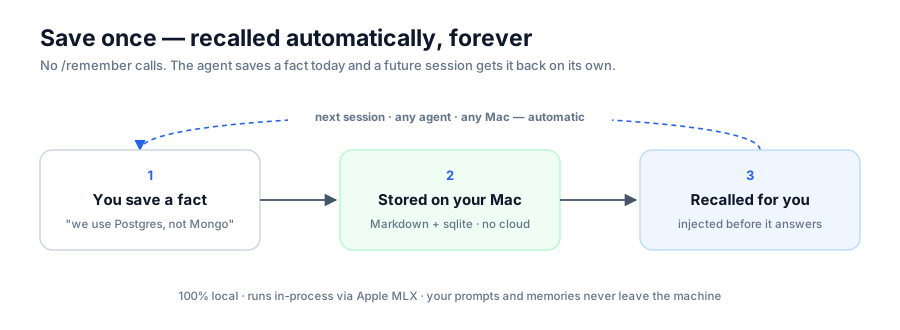
memo gives any MCP-aware agent (Claude Code, Codex, Devin, OpenCode, Cursor, Cline, Continue, …) a long-term memory that runs entirely on your own machine — macOS on Apple Silicon via Apple MLX, or Linux / Ubuntu on a CPU sentence-transformers backend (pipx install "mlx-memo[cpu]", see docs/ubuntu.md). Each memory is a plain Markdown file; embeddings live in a single sqlite file; the embedder, reranker, and LLM run in-process — no Ollama, no Qdrant, no cloud API, no keys. Your prompts and memories never leave the machine.

What makes memo different
| Capability | memo | mem0 | letta | cognee | engram | basic-memory | cipher |
|---|---|---|---|---|---|---|---|
| 100% local (no cloud API) | ✅ | ⚠️ | ⚠️ | ⚠️ | ✅ | ✅ | ⚠️ |
| Time-machine (rewind corpus to any date) | ✅ | ❌ | ⚠️ | ❌ | ❌ | ⚠️ | ⚠️ |
| Contradiction radar (detect + resolve conflicts) | ✅ | ⚠️ | ⚠️ | ❌ | ⚠️ | ❌ | ❌ |
| Synthesis pipeline (auto-infer cross-cluster insights) | ✅ | ❌ | ✅ | ⚠️ | ❌ | ❌ | ⚠️ |
| Cross-Mac git sync (shared corpus, no server) | ✅ | ❌ | ⚠️ | ❌ | ✅ | ✅ | ⚠️ |
| Cloud sync (opt-in replication) | ✅ | ✅ | ✅ | ✅ | ✅ | ✅ | ✅ |
| TUI (terminal UI) | ✅ | ❌ | ⚠️ | ❌ | ✅ | ❌ | ✅ |
| Obsidian as source-of-truth | ✅ | ❌ | ⚠️ | ❌ | ❌ | ✅ | ❌ |
| Knowledge graph + entity extraction | ✅ | ✅ | ❌ | ✅ | ❌ | ✅ | ⚠️ |
| Eval regression gate (pre-commit wireable) | ✅ | ⚠️ | ⚠️ | ⚠️ | ❌ | ❌ | ❌ |
| Multi-modal (images, audio OCR) | ✅ | ⚠️ | ⚠️ | ✅ | ❌ | ❌ | ❌ |
| MCP surface profiles (token economy) | ✅ | ❌ | ❌ | ⚠️ | ⚠️ | ✅ | ❌ |
| Passive capture (auto-extract from transcripts) | ✅ | ⚠️ | ✅ | ✅ | ✅ | ❌ | ⚠️ |
| Session timeline (context before/after) | ✅ | ❌ | ❌ | ❌ | ✅ | ⚠️ | ⚠️ |
✅ first-class · ⚠️ partial, config-gated, or add-on · ❌ absent. Verified mid-2026 against each project's docs/repo: mem0, letta (formerly MemGPT), cognee, engram, basic-memory, cipher. Closest comparators: basic-memory (local-first + Obsidian + MCP — memo's exact thesis) and cipher (memory layer for coding agents).
Why it pays for itself — in tokens
memo is built to spend fewer tokens, not more.
- ~90% smaller MCP surface. The default
agentprofile exposes 13 tools / ~1.2k schema tokens, versus 124 tools / ~15k tokens for the full surface — that overhead is paid every session, in every client. memo trims it to almost nothing. - Recall injects the answer instead of re-deriving it. Ambient recall surfaces the top memory before the agent answers, on a tight ~160-token budget. The agent stops re-explaining what it already figured out last week.
On a ~200-memory corpus, memo roi estimates ~80k tokens of model work avoided per session. The number is corpus-specific; it grows as memo learns more.
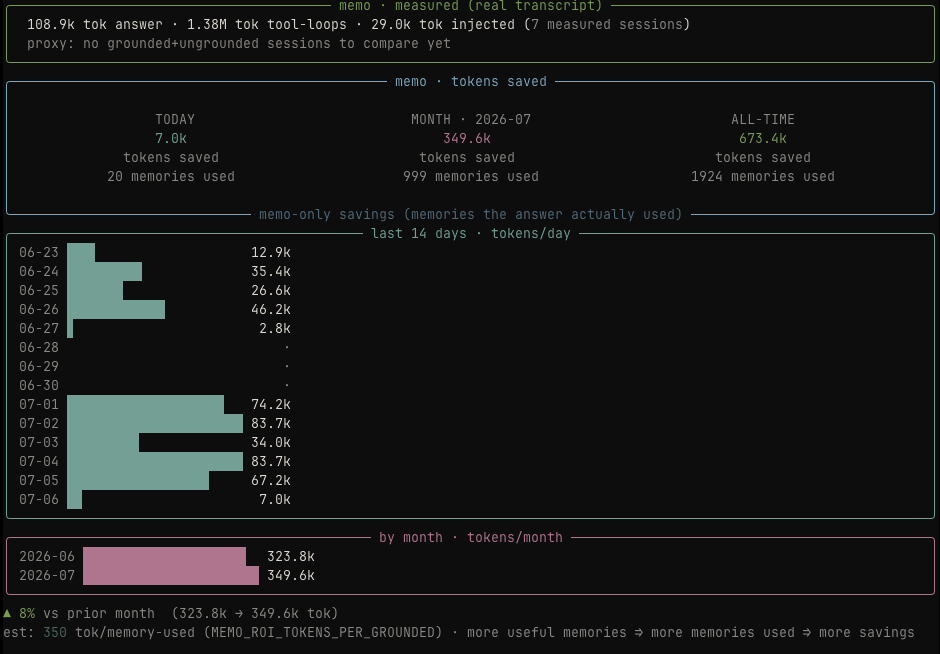
memo tokens tracks the savings in real-time:
| Technique | How to enable | Typical saving |
|---|---|---|
| Compact recall format | export MEMO_RECALL_FORMAT=compact |
~65% per injection |
| Trivial prompt gate | On by default | ~25% fewer injections |
| Context file compression | memo compress-context CLAUDE.md |
30–40% smaller context |
Use cases
- Continuity across sessions. Decide "we use Postgres, not Mongo" today; tomorrow, in a fresh session, the agent recalls it on its own — recall injects the decision before it answers, so you never re-explain it.
- Shared memory across agents. Save something while working in Claude Code; Codex, Cursor, or Cline pick it up later. They all read the same local store over MCP.
- Memory that follows you across Macs. Start on the laptop, continue on the desktop. The corpus travels over serverless git sync and the agent starts with the same context on both.
- Preferences and conventions that stick. "Tests first", "commit messages in English", "don't touch the auth module" — say it once, the agent applies it every future session.
- Contradiction radar. Change your mind on an old decision and memo flags the now-stale version — the agent won't reintroduce what you already discarded.
- Time-machine / audit. "What did we know about this bug last month?" Rewind the corpus to any date and see the state of knowledge at that point.
- Instant project onboarding. A cold agent gets the project's durable decisions, facts, and preferences up front via the session-start briefing.
- Fewer tokens, not more. Instead of re-deriving what you solved last week, recall injects the answer on a tight budget — and the default MCP surface is 13 tools, not 124.
Requirements
- macOS on Apple Silicon (M1–M4) — MLX is the load-bearing piece and the only path with the reranker + LLM features (ask / synthesize / dream).
- Linux / Ubuntu / Intel Mac — supported as a standalone install via a CPU
sentence-transformersbackend (search + recall + save, no MLX). One command:pipx install "mlx-memo[cpu]". See docs/ubuntu.md for what works and the trade-offs. - ~8 GB free disk for the default model set (the installer downloads it).
- Optional: an Obsidian vault. Without one, memo defaults to
~/Documents/memo/.
Python ≥ 3.13 is required if you install without uv. The
curl | bashinstaller handles this automatically — it detectsuvand uses its managed Python if no system Python ≥ 3.13 is on PATH.
Install — one step
curl -fsSL https://raw.githubusercontent.com/jagoff/memo/master/install.sh | bash
The installer auto-detects uv (preferred) or falls back to pipx. It downloads MLX models, and wires memo into every agent client it finds (Claude Code, Codex, Devin, Devin Desktop, OpenCode).
Prefer a manual install? Any of these expose the same two binaries — memo (CLI) and memo-mcp (MCP server):
uv tool install mlx-memo          # recommended
pipx install mlx-memo
brew tap jagoff/memo && brew install mlx-memo
Keep memo isolated as its own tool (uv tool / pipx / Homebrew). Don't vendor it inside another project's
.venv.memo doctor --strict-runtimeverifies the install.
On Linux, or just want to try it without installing anything? Run the Docker
image (CPU backend, cross-platform — search/recall/save; the reranker + ask/synthesize/dream verbs are Apple-Silicon-only):
docker run --rm ghcr.io/jagoff/memo:latest memo doctor
Details in docs/docker.md.
First install downloads ~8 GB of MLX models (5–15 min); later installs hit the HuggingFace cache. Full installer knobs and "move to a new Mac" steps: docs/reference.md › Install.
Migrating from another Mac? Install first, then restore your corpus:
curl -fsSL https://raw.githubusercontent.com/jagoff/memo/master/install.sh | bash
memo sync bootstrap [email protected]:yourname/memo-sync.git   # restore from git
Hand it to your agent
memo installs itself if you hand the repo (or just the install line) to an AI agent:
curl -fsSL https://raw.githubusercontent.com/jagoff/memo/master/install.sh | bash
memo doctor --strict-runtime     # verify runtime is healthy
After install, tools surface as mcp__memo__memo_* (memo_save, memo_search, memo_ask, memo_get, memo_graph, memo_unified_briefing, plus capture/session/version helpers on the default profile). Per-client setup (Claude Desktop, Cursor, Cline, Continue, manual JSON) is in docs/reference.md › MCP setup.
Quick start
memo doctor                                            # self-check: models, vault, sqlite-vec
memo save 'MLX prefill ~30% faster than Ollama on M3 Max' --title 'MLX bench' -t mlx -t bench
memo search 'how fast was the MLX benchmark'           # search by meaning, not just keywords
memo list --limit 5                                    # most recent
memo ask 'what changed in the embedder this month?'   # RAG — cites memories by id
Core features
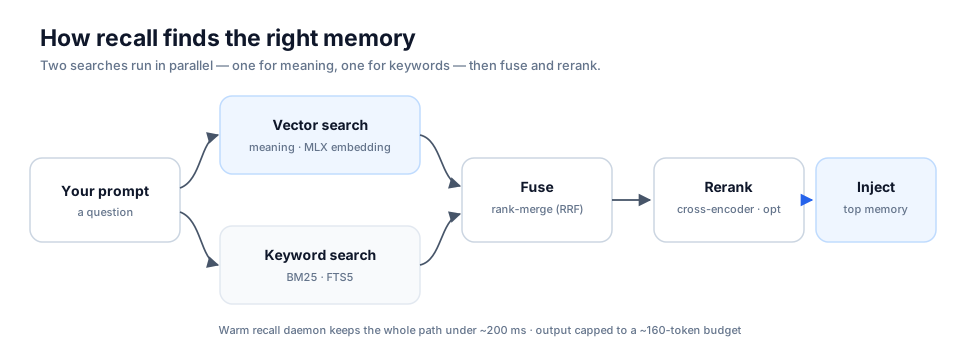
- Ambient recall — every prompt silently consults memory and injects top hits as context. Warm recall daemon keeps it under <200 ms. No
/remembercalls. - Auto-capture — a
Stophook extracts durable insights from each exchange through a quality gate. The corpus grows on its own. - Session briefing —
SessionStartsurfaces open loops, a memory of the day, and one-line crash recovery.
Key capabilities
🕰️ Time-machine
Rewind the corpus to any past date and query it as it was then:
memo as-of ask "what was the deployment strategy?" --date 2026-02-01
memo as-of search "redis config" --date 2026-01-15
memo diff --from 2026-01-01 --to 2026-03-01    # what changed
No other agent-memory system offers this. Full historical reconstruction via reverse-replay of history.db.
⚡ Contradiction radar
memo contradict scan                  # detect conflicting facts corpus-wide
memo contradict triage                # resolve interactively: fuse / newer-wins / dismiss
The LLM classifies each candidate pair. Results persist in contradictions.db; resolved conflicts inform future saves.
🔮 Synthesis & autonomous maintenance
Synthesis
memo synthesize # generate cross-cluster insights (LLM)
MEMO_SYNTHESIS_ENABLED=1 runs synthesis automatically during memo maintain, creating type=synthesis memories from inferred cross-cluster patterns. Memories are cited with their source cluster.
Dream — 7-phase autonomous maintenance
memo dream runs nightly (03:00 AM by default) as a fully autonomous pipeline that synthesizes insights, resolves contradictions, decays old memories, and optimizes the corpus — with zero user intervention:
memo dream run                 # run once (foreground)
memo dream status              # show receipt + changes made
memo dream if-due              # no-op unless > 24h since last run (for cron)
The 7 phases: (1) Orientation (inventory corpus), (2) Signal gather (mine transcript labels), (3) Heal (resolve conflicts + consolidate duplicates), (4) Prune (archive 365d+ untouched, decay idle >30d), (5) Enrich (synthesize cross-cluster insights, extract entities), (6) Optimize (prune low-quality, evict if full, compress context), (7) Prewarm (cache top-100 query embeddings for <200ms recall next session).
Every phase logs to a receipt (~/.memo-state/dream/last.json): timestamp, duration, phase counts (resolved, consolidated, archived, synthesized, etc.), and any errors. Failures never silently vanish — they live in the receipt. A failed phase doesn't stop the pipeline; subsequent phases run anyway.
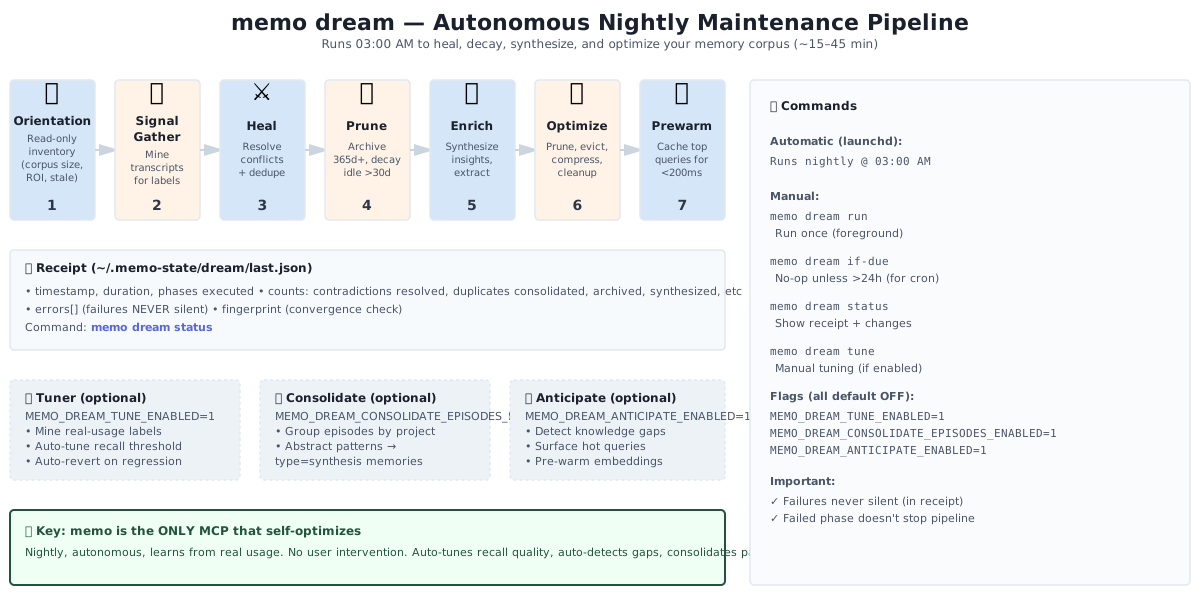
Optional self-improvement (all default OFF):
- Tuner (
MEMO_DREAM_TUNE_ENABLED=1) — mines ground-truth labels from real usage, auto-tunesMEMO_RECALL_MIN_SIM, auto-reverts if eval baseline regresses.memo dream tune. - Consolidate (
MEMO_DREAM_CONSOLIDATE_EPISODES_ENABLED=1) — abstracts recurring cross-session work into synthesis memories.memo dream consolidate. - Anticipate (
MEMO_DREAM_ANTICIPATE_ENABLED=1) — surfaces unmet gaps + hot queries, pre-warms their embeddings.memo dream anticipate.
memo is the only MCP memory system that self-optimizes: auto-tuning recall quality, auto-detecting gaps, consolidating patterns — all from real usage, all nightly, all without asking.
🌐 Cross-Mac git sync
memo sync bootstrap [email protected]:yourname/memo-sync.git   # wire a shared corpus
memo sync once                                                # push/pull now
Pull-rebase-before-push. flock-based single owner per machine. Async debounced hooks keep the corpus current without blocking.
📚 Obsidian vault as source-of-truth
MEMO_MEMORIES_IN_VAULT=1 memo init                # store memories inside your vault
memo migrate --into-vault                          # non-destructive migration
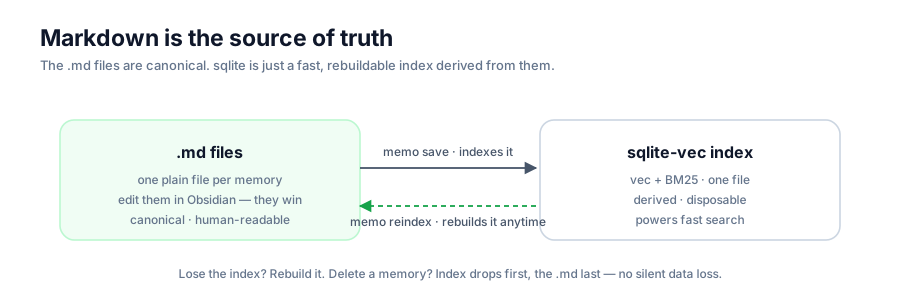
Human edits in Obsidian win on the next memo reindex. The sqlite index is always rebuildable from the .md files.
🕸️ Knowledge graph
memo graph neighbors "MLX"             # what's related
memo graph path "embedder" "reranker"  # how two concepts connect
memo entities                          # list extracted entities
memo links --id abc123                 # backlinks + outlinks
Entity extraction uses a dependency-free regex backend. For code-heavy corpora, memo can merge a codegraph symbol graph as the graph's primary layer (opt-in, MEMO_GRAPH_USE_CODEGRAPH) — callers, callees, and imports become first-class edges, so recall and memo graph path reason over real code structure, not just text similarity. The merged graph also powers the memo_graph MCP tool and the entity-centric "Knowledge map" briefing.
🏥 Health scoring & eval gates
memo health                                         # grounded rate, ROI, usefulness verdict
memo eval recall --labels eval/regression_labels.json --k 5
memo eval recall --gate                             # exit non-zero if precision drops
memo eval recall --update-baseline                  # snapshot current best
Wire --gate into a pre-commit hook to catch retrieval regressions before they ship. memo feedback records per-source 👍/👎 votes that teach the retriever which memories to surface (or hide) for similar queries.
🖼️ Multi-modal ingestion
memo ocr-image screenshot.png                         # one-shot macOS Vision OCR
MEMO_VLM_CAPTION_ENABLED=1 memo ingest ~/Vault --include-orphan-images
memo ingest ~/Vault --include-audio                   # mlx-whisper, optional
memo search "whiteboard diagram"                      # finds OCR/caption/transcript text
The old placeholder memo multimodal store was removed; images and audio now
become searchable by flowing OCR, VLM captions, and whisper transcripts through
the normal text index.
Daemons
memo runs four background daemons:
| Daemon | Command | Purpose |
|---|---|---|
| recall-daemon | memo recall-daemon start |
Warm MLX embedder over socket (<200 ms recall) |
| idle-daemon | auto-started by memo-mcp |
Auto-capture for MCP-only clients (Devin, OpenCode) |
| ingest-daemon | memo ingest-daemon start |
Bulk vault ingestion |
| maint-daemon | memo maint-daemon start |
Background cleanup + synthesis |
All 108 visible CLI commands
Click to expandCore: save search ask get edit rename delete list
Recall & Hooks: recall recall-hook briefing continuity prewarm capture-tick capture-stop
Session & History: history as-of diff record-history session resume reflect mine-history episodes
Maintenance: reindex maintain dream consolidate synthesize dedupe cross-dedup retier contradict invalidate temporal compress-context
Analysis & Quality: health stats doctor lint analytics eval roi tokens token-savings usefulness gaps outcome profile
Knowledge Graph: graph entities entity extract-entities links version related
Advanced Search: embed rerank contextual chat chat-ask repo
Import / Export / Sync: import export backup restore sync ingest
Visualization: tui dashboard map logs hook-log
Setup & Config: init config install-mcp install-watcher uninstall-watcher install-slash install-statusline install-recall-hook install-shell-wrapper install-shims startup-banner migrate migrate-vault update watch release
Daemons: recall-daemon ingest-daemon maint-daemon embed-daemon idle-daemon
Other: backend-native collaborative feedback query mandate sleep-cycle ocr-image provenance mcp-command codex-badge debug-recall http-api mine-git token-gate
MCP surface profiles
| Profile | Tools | Schema tokens | Use when |
|---|---|---|---|
agent (default) |
13 | ~1.2k | Standard agent work — max token economy |
core / slim |
33 | ~2.8k | Constrained clients (Codex, OpenCode), admin-lite |
full / default |
124 | ~15k | Power users, debugging |
Set via MEMO_MCP_PROFILE=full or in each client's MCP env config.
Non-MCP clients: memo http-api serves the same operations as a localhost REST API (plain JSON).
Retrieval architecture
Hybrid search: vec leg (MLX embedding on Apple Silicon, CPU sentence-transformers on Linux) + BM25 leg (FTS5/Tantivy, diacritic-folding for Spanish) fused via Reciprocal Rank Fusion → optional MLX cross-encoder rerank (Apple Silicon).
Markdown is the source of truth. The .md files are canonical; sqlite is a rebuildable index. A hand-edit in Obsidian wins on the next memo reindex. delete() removes the index first, then the file — no silent data loss.
Embedding models:
| Model | Dims | Disk | Use |
|---|---|---|---|
Qwen3-Embedding-0.6B-4bit |
1024 | ~0.6 GB | Default (fast, good) |
Qwen3-Embedding-4B-4bit |
2560 | ~3 GB | Higher recall quality |
Qwen3-Embedding-8B-4bit |
4096 | ~5 GB | Maximum quality |
Switch with MEMO_EMBEDDER_MODEL + MEMO_EMBEDDER_DIMS (requires memo reindex --rebuild).
Documentation
| Topic | Where |
|---|---|
| Full install detail, installer knobs, new-Mac migration | docs/reference.md › Install |
Per-client MCP setup + the /memo slash command |
docs/reference.md › MCP setup |
| MCP profile tools and advanced domains | docs/reference.md › MCP tools |
| Ambient memory, recall daemon, capture & recall tuning | docs/reference.md › Ambient memory |
| Time-machine, session briefing, semantic map | docs/reference.md › Surfaces |
Full CLI reference + live dashboard (memo tui) |
docs/reference.md › CLI |
Stable/common MEMO_* flags, model profiles, upgrading the embedder |
docs/reference.md › Configuration |
| Architecture, sync tiers, design notes | docs/reference.md › Design & comparison |
Contributors: git clone https://github.com/jagoff/memo && cd memo && uv pip install -e '.[dev]'. See CONTRIBUTING.md.
License & provenance
MIT — see LICENSE. Forked philosophically from mem-vault (storage layout + frontmatter schema); the MLX backend pieces are ported from obsidian-rag. memo is one of three sovereign systems in a wider stack (Memflow, Synapse) — the integration is opt-in everywhere; single-Mac users see zero behaviour change.
Reviews (0)
Sign in to leave a review.
Leave a reviewNo results found