jamjet
Health Uyari
- License — License: Apache-2.0
- Description — Repository has a description
- Active repo — Last push 0 days ago
- Low visibility — Only 5 GitHub stars
Code Gecti
- Code scan — Scanned 12 files during light audit, no dangerous patterns found
Permissions Gecti
- Permissions — No dangerous permissions requested
This tool is a performance-first, agent-native AI runtime designed for production-grade orchestration. It provides durable graph execution and human-in-the-loop workflow capabilities, using a Rust core to run agents authored in Python, YAML, or Java.
Security Assessment
The automated code scan reviewed 12 files and found no dangerous patterns, hardcoded secrets, or dangerous permission requests. The tool is designed to handle concurrency, state, and scheduling, which inherently means it processes and manages data. Given the clean security scan and the permissive open-source Apache 2.0 license, the overall security risk is currently rated as Low.
Quality Assessment
The project appears to be in its early stages but is under active development, with its most recent push happening today. The codebase is well-documented, featuring clear instructions, quickstart guides, and active CI pipelines. However, the repository currently has very low community visibility, evidenced by only 5 GitHub stars. Consequently, the community trust level is low, meaning the tool has not yet been broadly battle-tested by a wide user base.
Verdict
Use with caution — the code appears safe and clean, but its low visibility means it has not yet been widely battle-tested in production environments.
Durable, agent-native AI runtime with native MCP + A2A support. Built in Rust, authored in Python
⚡ JamJet
The agent-native runtime — durable, composable, built for production.








jamjet.dev · Quickstart · Concepts · API Reference · Examples · Blog · Discord



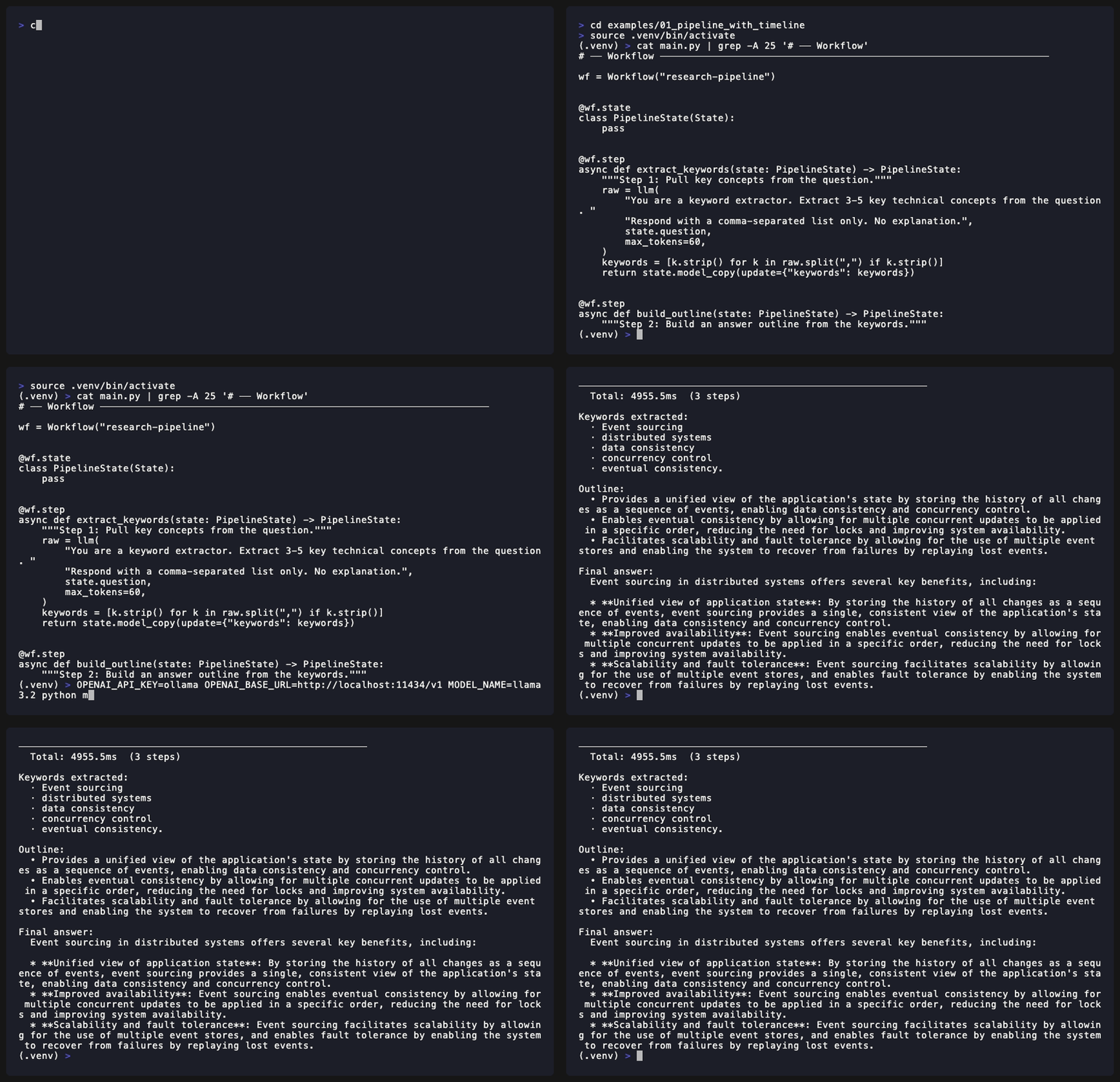
JamJet is a performance-first, agent-native runtime for AI agents. It is not another prompt wrapper or thin agent SDK — it is a production-grade orchestration substrate for agents that need to work, not just demo.
The runtime core is Rust + Tokio for scheduling, state, and concurrency. The authoring surface is Python, Java, Go (planned), or YAML. All compile to the same IR graph and run on the same engine.
Why JamJet?
| Problem | JamJet's answer |
|---|---|
| Agent runs lose state on crash | Durable graph execution — event-sourced, crash-safe resume |
| No way to pause for human approval | Human-in-the-loop as a first-class workflow primitive |
| Agents siloed in their own framework | Native MCP + A2A — interoperate with any agent, any framework |
| Slow Python orchestration at scale | Rust core — no GIL, real async parallelism |
| Weak observability, no replay | Full event timeline, OTel GenAI traces, replay from any checkpoint |
| No standard agent identity | Agent Cards — every agent is addressable and discoverable |
| Hard-coded agent routing | Coordinator Node — dynamic routing with structured scoring + LLM tiebreaker |
| Can't use agents as tools | Agent-as-Tool — wrap any agent as a callable tool (sync, streaming, conversational) |
| No governance or guardrails | Policy engine — tool blocking, approvals, autonomy enforcement, audit log |
| Agents with unchecked access | OAuth delegation — RFC 8693 token exchange, scope narrowing, per-step scoping |
| PII leaking into logs | Data governance — PII redaction (mask/hash/remove), retention policies, auto-purge |
| No tenant isolation | Multi-tenant — row-level partitioning, tenant-scoped state, isolated audit logs |
| Locked into one language | Polyglot SDKs — Python, Java (JDK 21), Go (planned), YAML — same IR, same runtime |
| Can't run without a server | In-process execution — pip install jamjet and run immediately |
Quickstart
Requirements: Python 3.11+
Fastest path — pure Python, no server
pip install jamjet
from jamjet import task, tool

@tool
async def web_search(query: str) -> str:
    return f"Search results for: {query}"

@task(model="claude-haiku-4-5-20251001", tools=[web_search])
async def research(question: str) -> str:
    """You are a research assistant. Search first, then summarize clearly."""

result = await research("What is JamJet?")
print(result)
No server. No config. No YAML. Just pip install and run.
Full runtime path — durable execution
pip install jamjet
jamjet init my-first-agent
cd my-first-agent
jamjet dev
In another terminal:
jamjet run workflow.yaml --input '{"query": "What is JamJet?"}'
Hello World
YAML
# workflow.yaml
workflow:
  id: hello-agent
  version: 0.1.0
  state_schema:
    query: str
    answer: str
  start: think

nodes:
  think:
    type: model
    model: claude-haiku-4-5-20251001
    prompt: "Answer clearly and concisely: {{ state.query }}"
    output_key: answer
    next: end

  end:
    type: end
jamjet validate workflow.yaml
jamjet run workflow.yaml --input '{"query": "What is JamJet?"}'
Python — @task (simplest)
from jamjet import task, tool

@tool
async def web_search(query: str) -> str:
    return f"Search results for: {query}"

@task(model="claude-haiku-4-5-20251001", tools=[web_search])
async def research(question: str) -> str:
    """You are a research assistant. Search first, then summarize clearly."""

result = await research("What is JamJet?")
The docstring becomes the instruction. The function signature is the contract. That's it.
Python — Agent
from jamjet import Agent, tool

@tool
async def web_search(query: str) -> str:
    return f"Search results for: {query}"

agent = Agent(
    "researcher",
    model="claude-haiku-4-5-20251001",
    tools=[web_search],
    instructions="You are a research assistant. Search first, then summarize.",
)

result = await agent.run("What is JamJet?")
print(result)
Python — Workflow (full control)
from jamjet import Workflow, tool
from pydantic import BaseModel

@tool
async def web_search(query: str) -> str:
    return f"Search results for: {query}"

workflow = Workflow("research")

@workflow.state
class State(BaseModel):
    query: str
    answer: str | None = None

@workflow.step
async def search(state: State) -> State:
    result = await web_search(query=state.query)
    return state.model_copy(update={"answer": result})
All three levels compile to the same IR and run on the same durable Rust runtime.
Performance
JamJet's IR compilation is 88× faster than LangGraph's graph compilation:
| Operation | JamJet | LangGraph |
|---|---|---|
| Compile / graph build | ~0.006 ms | ~0.529 ms |
| In-process invocation | ~0.015 ms | ~1.458 ms |
Measured with Python 3.11, single-tool workflows. JamJet compiles a lightweight IR dict; LangGraph builds a NetworkX graph.
MCP tool call
nodes:
  search:
    type: tool
    server: brave-search        # configured in jamjet.toml
    tool: web_search
    arguments:
      query: "{{ state.query }}"
      count: 10
    output_key: results
    next: summarize
A2A delegation
nodes:
  delegate:
    type: a2a_task
    agent_url: "https://agents.example.com/research-agent"
    input:
      query: "{{ state.query }}"
    output_key: research
    next: end
Eval with self-improvement
nodes:
  check:
    type: eval
    scorers:
      - type: llm_judge
        rubric: "Is the answer accurate and complete?"
        min_score: 4
    on_fail: retry_with_feedback   # injects feedback into next model call
    max_retries: 2
    next: end
Coordinator — dynamic agent routing
from jamjet.coordinator import DefaultCoordinatorStrategy

strategy = DefaultCoordinatorStrategy(registry=my_registry)

# Discover agents by skill, score them, route to the best fit
candidates, _ = await strategy.discover(
    task="Analyze quarterly revenue data",
    required_skills=["data-analysis", "finance"],
    trust_domain="internal",
)
rankings, spread = await strategy.score(task, candidates, weights={})
decision = await strategy.decide(task, rankings, threshold=0.1)
# decision.selected_uri → "jamjet://org/finance-analyst"
Agent-as-Tool — wrap agents as callable tools
from jamjet.agent_tool import agent_tool

# Sync: quick, stateless
classifier = agent_tool(agent="jamjet://org/classifier", mode="sync",
                        description="Classifies documents by topic")

# Streaming: long-running with early termination on budget
researcher = agent_tool(agent="jamjet://org/researcher", mode="streaming",
                        description="Deep research with progress", budget={"max_cost_usd": 2.00})

# Conversational: multi-turn iterative refinement
reviewer = agent_tool(agent="jamjet://org/reviewer", mode="conversational",
                      description="Peer review with feedback", max_turns=5)
Auto-routing — compiler inserts Coordinator automatically
from jamjet.workflow.graph import WorkflowGraph

graph = WorkflowGraph("pipeline")
graph.add_agent_tool("process", agent="auto", mode="sync", output_key="result")
# ↑ "auto" expands at compile time into: Coordinator → AgentTool
ir = graph.compile()
# IR now has 2 nodes: _coordinator_process → process
Agentic design patterns
JamJet supports the six major multi-agent orchestration patterns. Here's when to use each:
| Pattern | JamJet primitive | When to use | Example |
|---|---|---|---|
| Single Agent | Agent with @task |
Simple prototypes, single-purpose tasks | Chatbot, classifier |
| Sequential Pipeline | WorkflowGraph with edges |
Ordered steps where each depends on the previous | ETL, document processing |
| Parallel Fan-Out | ParallelNode |
Independent tasks that can run concurrently | Multi-source research, batch classification |
| Loop & Critic | LoopNode + EvalNode |
Quality-critical tasks needing iterative refinement | Code review, content generation |
| Coordinator (Dynamic Routing) | CoordinatorNode |
Route to the best agent at runtime based on capability, cost, latency | Support ticket routing, task delegation |
| Agent-as-Tool | agent_tool() wrapper |
One agent needs to call another as a function | Orchestrator invoking specialists |
Choosing the right pattern
Is it a single task?
  → Single Agent

Does order matter?
  → Sequential Pipeline

Can tasks run independently?
  → Parallel Fan-Out

Does output need quality checks?
  → Loop & Critic

Do you need to pick the best agent at runtime?
  → Coordinator

Does one agent need to invoke another?
  → Agent-as-Tool
Coordinator vs static routing
Static (ConditionalNode) |
Dynamic (CoordinatorNode) |
|
|---|---|---|
| Candidates | Declared in YAML | Discovered from registry at runtime |
| Selection | Expression-based rules | Structured scoring + optional LLM tiebreaker |
| When agents change | Redeploy workflow | Automatic — new agents discovered |
| Observability | Branch taken logged | Full scoring breakdown + reasoning in event log |
| Best for | Fixed, known routes | Dynamic environments, multi-tenant, research |
How JamJet compares
As of March 2026. All frameworks evolve — check their docs for the latest.
| Capability | JamJet | Google ADK | LangChain | AutoGen | CrewAI |
|---|---|---|---|---|---|
| Simple agent setup | ✅ 3 lines (@task) |
✅ 5 lines | 6+ lines | 10+ lines | 8+ lines |
| In-process execution | ✅ pip install + run |
✅ native | ✅ native | ✅ native | ✅ native |
| Durable execution | ✅ event-sourced, crash-safe | ❌ ephemeral | ❌ ephemeral | ❌ ephemeral | ❌ ephemeral |
| Dynamic agent routing | ✅ Coordinator with scoring + LLM tiebreaker | ✅ transfer_to_agent() |
❌ | ❌ | ❌ |
| Agent-as-Tool | ✅ sync, streaming, conversational | ✅ AgentTool (sync only) |
❌ | ❌ | ❌ |
| Human-in-the-loop | ✅ first-class primitive | 🟡 callbacks | 🟡 callbacks | 🟡 conversational | 🟡 manual |
| MCP support | ✅ client + server | ✅ client + server | 🟡 client only | 🟡 client only | 🟡 client only |
| A2A protocol | ✅ client + server | 🟡 client only | ❌ | ❌ | ❌ |
| Built-in eval | ✅ LLM judge, assertions, cost | ✅ 8 built-in criteria | ❌ | ❌ | ❌ |
| Built-in observability | ✅ OTel GenAI, event replay | ✅ Cloud Trace | 🟡 LangSmith (external) | ❌ | ❌ |
| Agent identity | ✅ Agent Cards, A2A discovery | ✅ Agent Cards | ❌ | ❌ | ❌ |
| Policy & governance | ✅ policy engine, audit log | 🟡 Model Armor plugin | ❌ | ❌ | ❌ |
| Multi-tenant isolation | ✅ row-level partitioning | ❌ | ❌ | ❌ | ❌ |
| PII redaction | ✅ mask/hash/remove, retention | 🟡 plugin | ❌ | ❌ | ❌ |
| Model independence | ✅ any model provider | 🟡 Gemini-first (LiteLLM escape) | ✅ any | ✅ any | ✅ any |
| Progressive complexity | ✅ @task → Agent → Workflow |
🟡 code or YAML | ❌ single API | ❌ | ❌ |
| Managed deployment | 📋 Planned | ✅ Vertex AI Agent Engine | ❌ | ❌ | ❌ |
| Runtime language | Rust core + Python/Java/Go | Python/TS/Go/Java | Python | Python | Python |
| Best for | Production multi-agent systems | Google Cloud AI agents | Rapid prototyping | Conversational agents | Role-based crews |
Architecture
┌──────────────────────────────────────────────────────────┐
│                     Authoring Layer                       │
│     Python SDK  |  Java SDK  |  Go SDK (planned)  |  YAML  │
├──────────────────────────────────────────────────────────┤
│                 Compilation / Validation                   │
│           Graph IR  |  Schema  |  Policy lint             │
├────────────────────────────┬─────────────────────────────┤
│      Rust Runtime Core     │      Protocol Layer          │
│  Scheduler  |  State SM    │  MCP Client  |  MCP Server   │
│  Event log  |  Snapshots   │  A2A Client  |  A2A Server   │
│  Workers    |  Timers      │                              │
├────────────────────────────┴─────────────────────────────┤
│                    Enterprise Services                     │
│  Policy  |  Audit  |  PII Redaction  |  OAuth  |  mTLS     │
├──────────────────────────────────────────────────────────┤
│                      Runtime Services                      │
│  Model Adapters  |  Tool Execution  |  Observability      │
├──────────────────────────────────────────────────────────┤
│                         Storage                           │
│           Postgres (production)  |  SQLite (local)        │
└──────────────────────────────────────────────────────────┘
Roadmap
| Phase | Status | Goal |
|---|---|---|
| 0 — Architecture & RFCs | ✅ Complete | Design docs, RFCs, repo scaffolding |
| 1 — Minimal Viable Runtime | ✅ Complete | Local durable execution, MCP client, agent cards, Python CLI |
| 2 — Production Core | ✅ Complete | Distributed workers, MCP server, full A2A client + server |
| 3 — Developer Delight | ✅ Complete | Eval harness, trace debugging, templates, Java SDK |
| 4 — Enterprise | 🔄 In Progress | Policy engine, tenant isolation, PII redaction, OAuth delegation, A2A federation auth, mTLS |
| 5 — Scale & Ecosystem | 📋 Planned | Go SDK, TypeScript SDK, hosted plane, agent marketplace |
Documentation
Full documentation at jamjet.dev
| Quickstart | Get running in 10 minutes |
| Core Concepts | Agents, workflows, nodes, state, durability |
| YAML Workflows | All node types, retry policies, conditions |
| Python SDK | Full Python SDK reference |
| Java SDK | Builders, records, @Tool annotation, agents |
| REST API | All endpoints, auth, request/response schemas |
| Enterprise Security | Tenants, PII redaction, OAuth, mTLS federation |
| MCP Integration | Connect to MCP servers, expose tools |
| A2A Integration | Delegate to and serve external agents |
| Eval Harness | Score quality, run regression suites, gate CI |
| Observability | OTel traces, metrics, Prometheus |
| Deployment | Docker, Kubernetes, PostgreSQL |
| CLI Reference | Full CLI reference |
Repository structure
jamjet/
├── runtime/                # Rust workspace (15 crates)
│   ├── core/               # Graph IR, node types, state machine
│   ├── ir/                 # Canonical Intermediate Representation
│   ├── scheduler/          # Durable task scheduler
│   ├── state/              # Event-sourced state, snapshots
│   ├── workers/            # Node executors (model, tool, http, eval, …)
│   ├── api/                # REST API, OAuth delegation, secrets backends
│   ├── agents/             # Agent Cards, registry, lifecycle
│   ├── models/             # LLM provider adapter layer
│   ├── timers/             # Durable timers, Postgres-backed cron
│   ├── policy/             # Policy engine, PII redaction
│   ├── audit/              # Immutable audit log
│   ├── protocols/
│   │   ├── mcp/            # MCP client + server
│   │   └── a2a/            # A2A client + server + federation auth + mTLS
│   └── telemetry/          # OTel instrumentation
├── sdk/
│   ├── python/             # Python SDK + CLI
│   │   └── jamjet/
│   │       ├── cli/        # jamjet CLI (Typer)
│   │       ├── eval/       # Eval dataset, runner, scorers
│   │       ├── agents/     # Agent definitions + strategies
│   │       ├── templates/  # Project scaffolding templates
│   │       └── workflow/   # Python workflow builder
│   ├── java/               # Java SDK (JDK 21, virtual threads, records)
│   │   ├── jamjet-sdk/     # Core SDK module
│   │   └── jamjet-cli/     # CLI module
│   └── go/                 # Go SDK (planned — Phase 5)
Contributing
Contributions are welcome — bugs, features, docs, and code.
- Open an issue for bugs or feature requests
- Check issues tagged
good first issuefor easy entry points - For large changes, open an issue first to discuss the approach
- Read CONTRIBUTING.md for setup instructions
Community
- GitHub Discussions: github.com/jamjet-labs/jamjet/discussions
- GitHub Issues: github.com/jamjet-labs/jamjet/issues
License
Apache 2.0 — see LICENSE.
Yorumlar (0)
Yorum birakmak icin giris yap.
Yorum birakSonuc bulunamadi