Chisle
Health Gecti
- License — License: MIT
- Description — Repository has a description
- Active repo — Last push 0 days ago
- Community trust — 249 GitHub stars
Code Basarisiz
- process.env — Environment variable access in benchmarks/aggregate.js
- fs module — File system access in benchmarks/aggregate.js
- fs module — File system access in benchmarks/normalize-pi.js
- os.homedir — User home directory access in benchmarks/replay-compress.js
- process.env — Environment variable access in benchmarks/replay-compress.js
- fs module — File system access in benchmarks/replay-compress.js
Permissions Gecti
- Permissions — No dangerous permissions requested
Bu listing icin henuz AI raporu yok.
Cut your AI coding agent's token bill on three axes: terse prose, YAGNI-first code, and tool-output compression. Claude Code, Pi, Cursor, Codex, Gemini + 4 more. Zero deps, published benchmarks including the runs it loses.

Chisle
Your AI talks less, builds less, reads less, and says more. Like a senior dev who bills by the syllable.
The only tool in this class that publishes the runs where it lost.




44% of a bare model on coding work · 41% on the long ones · one command
chisle.jaypokale.me is the site version of this README, with fewer words
"Add debounce to a search input that currently fires an API call on every keystroke." Same model, same prompt, one difference: the injected ruleset. Both answers below are the verbatim committed output from benchmarks/results/raw/:
| bare agent: 142 lines, 1506 tokens | Chisle: 35 lines, 602 tokens |
|---|---|
|
Opens with "Let me show you the most common approaches", then ships a reusable generic …then Option 2 and Option 3, a comparison table, and a caveats section. |
Asks which framework, then answers the question that was actually asked: Then two lines on why it works, and "use |
Not golfed, boring. Same behaviour, one less abstraction, no second file, and it names the dependency you might already have instead of reinventing it.
Most efficiency tools compress one thing. Chisle compresses three:
| axis | what | how |
|---|---|---|
| Output: prose | filler, hedging, manufactured structure | zero-fluff ruleset, injected per session |
| Output: code | speculative abstractions, unrequested boilerplate | YAGNI efficiency ladder |
| Input: context | oversized tool output flooding the window | Claude PostToolUse / Pi tool_result: scrub, elide, dedup, plus prevention rules |
Where each one attaches to a session:
flowchart LR
    subgraph S["Session start"]
        H1["Ruleset injection<br/>once per active session"]
    end
    subgraph T["Every turn"]
        H2["Mode tracking<br/>Claude + Pi"]
    end
    subgraph L["Every tool call"]
        H3["PostToolUse / tool_result<br/>scrub → elide → dedup"]
    end

    H1 --> M(["Model"])
    H2 --> M
    M -->|writes| O["Output:<br/>terser prose,<br/>YAGNI-first code"]
    M -->|calls a tool| TOOL[["Bash / grep / web / extension tools"]]
    TOOL -->|raw output| H3
    H3 -->|"compressed, rebuilt into<br/>the tool's own shape"| M

    RE["Read / Edit / Write"] -.->|"never touched,<br/>exact bytes feed later edits"| M

    style M fill:#1f2937,stroke:#d78a3c,color:#e6edf3
    style O fill:#14532d,stroke:#2da44e,color:#e6edf3
    style H3 fill:#1f2937,stroke:#2da44e,color:#e6edf3
    style RE fill:#3f1d1d,stroke:#cf3b3b,color:#e6edf3
The loop on the right is the input axis: tool output is billed again on every later request in the session, so shrinking it once pays repeatedly. Read, Edit, and Write are deliberately outside it.

Every "be concise" tool has a worst day, the day it makes the model write more than no tool at all. Across 20 measured tasks over two suites, the specialists had that day 6 and 8 times, blowing up to 424% of the baseline. Chisle had it once, capped at 173%, and that one failure was root-caused, fixed in the ruleset, and re-validated live at 93%, with the whole investigation committed to the repo. Think of it as downside insurance for your token bill: not always the single cheapest answer, always the smallest worst case, from the only tool in this class that publishes its own failures. Why not caveman or ponytail? →
Install
One command. Auto-detects your agents (Claude Code, Pi, Cursor, Windsurf, Cline, Kiro, Codex, Gemini, Copilot) and wires each one. --uninstall puts everything back.
npx chisle
# or via curl
curl -fsSL https://raw.githubusercontent.com/JayPokale/Chisle/main/install.sh | bash
# Windows
irm https://raw.githubusercontent.com/JayPokale/Chisle/main/install.ps1 | iex
Preview first with npx chisle --dry-run, scope with --only claude or --only pi, see everything with npx chisle --help. Remove with npx chisle --uninstall.
Requirements: Node ≥18 (installer / npx) · Claude Code or Pi for /chisle toggling and input-side compression. The always-on ruleset still ships to every other agent.
Upgrading
npx chisle@latest --update
That refreshes every agent that already has Chisle and installs it into none that don't. Two details it exists to handle:
- Plain
npx chisledoes not upgrade. Every install path skips what is already present, so an upgrade run reports success and changes nothing.--updatepairs the refresh with that check. @latestmatters.npx chislecan serve a cached copy of the package from a previous run, so the pin is what guarantees you get the new one.
Per-agent equivalents, if you prefer the native tool:
claude plugin update chisle@chisle    # Claude Code plugin install
pi install npm:chisle                 # Pi package
gemini extensions install https://github.com/JayPokale/Chisle
Project-scoped agents (Cursor, Windsurf, Cline, Kiro, Copilot) keep their rule file inside the repo, so run the update once per project that has one.
Not sure what you are running? npx chisle --list prints the agents it detects, and claude plugin list shows the installed plugin and its version.
Chisle checks npm on session start and mentions it once when a major version is out (cached 3 days, CHISLE_UPDATE_CHECK=0 to silence). Minor and patch releases stay quiet on purpose.
Upgrading to 3.0.0 from 2.x needs nothing: a lite/full/ultra value in CHISLE_DEFAULT_MODE or config.json is no longer meaningful, falls through to the default, and Chisle stays active. It says so once so the setting is not ignored silently. Replace it with on/off or delete it.
Claude Code plugin (marketplace)
claude plugin marketplace add JayPokale/Chisle   # register the marketplace
claude plugin install chisle@chisle              # enable the plugin
Pi package
pi install npm:chisle
The package loads the zero-dependency extension and chisle skill globally. Pi extensions run with your user permissions; review the source before installation. Project-local installs (pi install -l npm:chisle) load only after you trust that project.
Where the savings show up
Two places, both measured rather than estimated:
npx chisle --stats # what the compressor has saved, cumulative
chisle: tool-output savings

  saved:      88,967 chars  (~22,241 tokens)
  outputs:    18 compressed, 4,943 chars each on average
In Claude Code the statusline badge carries the same number live: [CHISLE] ⇣22k tok. Pi shows it in the footer for the current session.
This is the input axis only, and deliberately so. Chars elided have a real baseline, since the hook knows exactly what it cut. The output axis has none: there is no way to know what the model would have written without the ruleset, which is why that half is measured with A/B benchmark arms instead of a counter. A number that blended the two would be inventing the interesting half.
See what it would do, before it does it
npx chisle --dry-run    # prints every file it would touch, changes nothing
npx chisle --stats      # prints what it has saved, changes nothing
Want the savings measured on your own work rather than ours? Clone the repo and replay the compressor over local transcripts. It reads them locally, writes nothing, and reports the input the hook would have stripped:
git clone https://github.com/JayPokale/Chisle && cd Chisle
node benchmarks/replay-compress.js       # Claude Code
node benchmarks/replay-compress.js pi    # Pi; marginal over Pi's native truncation
Numbers
Nothing here is estimated. Every figure below is recomputed from committed raw data; the 2026-07-07 verification writeup re-derived the old claims from scratch, re-ran the whole suite against the competitors' installed plugins, and retired the one claim that didn't survive.
Output axis: vs caveman & ponytail, 20 live tasks
59+ live model runs across two suites (June 4-arm matrix on Haiku + Sonnet sweep; July re-verification run). Arms differ only in the injected system prompt. Billed output tokens vs the no-tool baseline:
| total bill (all 20 tasks) | average task | worst case | backfires | |
|---|---|---|---|---|
| caveman | 80% | 98% | 424% | 6 / 20 |
| ponytail | 68% | 91% | 227% | 8 / 20 |
| Chisle | 52% | 69% | 173% | 1 / 20 |
Chisle wins all four columns: it cut the total 20-task bill nearly in half while the specialists managed 20–32%, and it did so with the smallest worst day and a twentieth the backfire rate.
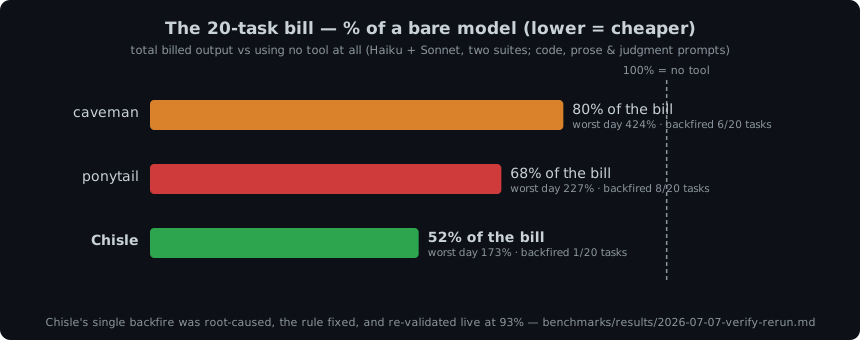
The bar is the whole 20-task bill; the badge is each tool's worst single day. caveman's worst day cost 4.2× a bare model; ponytail's, a tool whose entire job is writing less, 2.3×. Chisle's worst day was 1.7×, it happened once, and the fix is measured and merged.
In the July run all 24 answers, every arm, graded correct: nobody here buys token savings with wrong answers.
Code vs. explanation
Across all 20 cells, split by what the prompt actually asks for:
| n | caveman | ponytail | Chisle | |
|---|---|---|---|---|
| coding (wants working code) | 12 | 74% | 59% | 44% |
| non-coding (wants an explanation) | 8 | 103% | 104% | 87% |
Code is where the YAGNI ladder has something to bite on: an abstraction to skip, a stdlib call to reach for, a file not to create. Chisle bills 44% of a bare model there, a third less than ponytail, which is the closest thing to a dedicated lazy-code tool.
On explanation-only prompts the picture is worse for everyone. Both specialists land above 100%: a tool whose job is writing less made the model write more than using nothing at all. Chisle is the only arm that stays under water (87%), which is a smaller win than the coding number and worth saying plainly.
This does revise a claim the earlier Sonnet writeup made. On that suite's three prose prompts caveman was leaner (44% vs 52%), and that still holds for those cells. Pooled across all eight non-coding cells it does not: caveman is at 103%. The prose win was suite-specific, not general.
Task by task
Averages hide the interesting part, so here is every cell of the June suite, same six prompts, every arm, no cherry-picking:
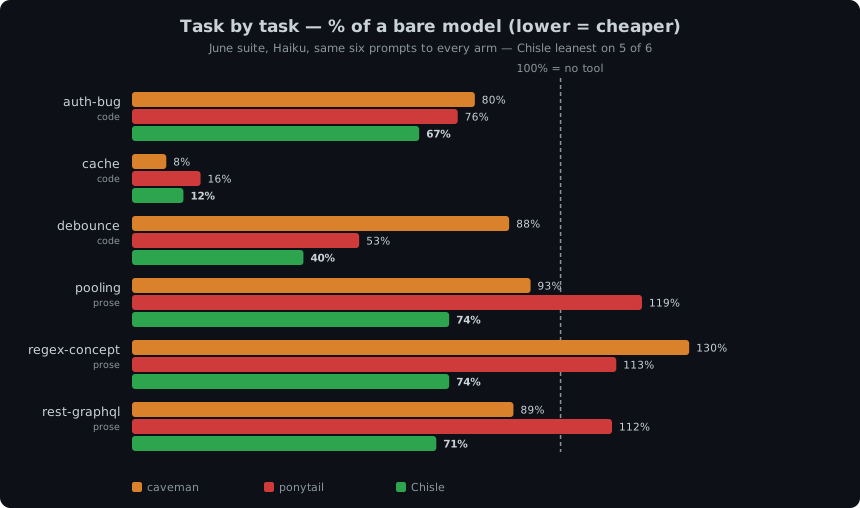
Chisle is leanest on 5 of 6. caveman takes cache (8% vs our 12%) by answering in prose where we still emit working code, which is the trade you would want on a task that asked for code. Note the two prose rows where ponytail lands above 100%: a tool built to write less made the model write more than using no tool at all. That is the failure mode the worst-case column above is really about.
The headline average is hiding the good part
Split the same 20 cells at their median baseline, short answers below and long answers above, and the tools separate sharply:
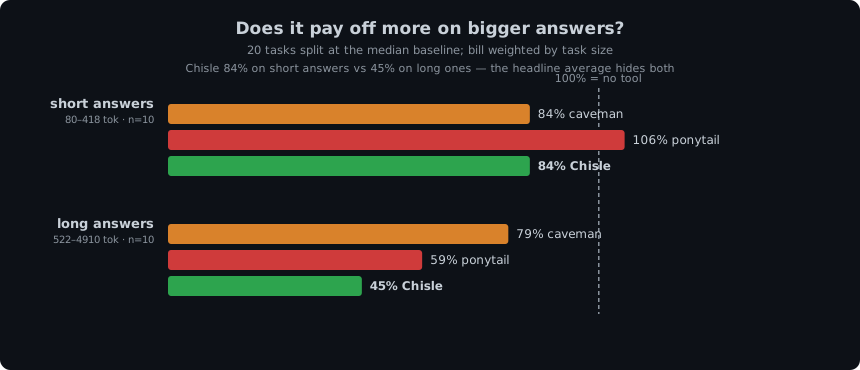
On short answers Chisle and caveman are level (84% each), because there is not much to cut in a three-line reply, and the ruleset overhead is proportionally at its worst. On long answers Chisle drops to 45% while caveman only reaches 79%. The 52% headline is the blend of the two, so it understates the case where it matters and overstates the case where it doesn't.
The effect is not driven by one lucky cell. Dropping the cache outlier (the row where the baseline invented 150 lines against a codebase it never saw) widens the gap on long answers: caveman degrades to 116%, worse than using no tool, while Chisle holds at 65%.
Two honest limits. Per-task rank correlation between baseline size and leanness is weak (Spearman ρ = −0.15), so this is a difference between aggregate bills, not a tidy per-task law. With n=10 a side, treat it as a strong signal rather than a settled result. And much of the widening gap comes from the specialists getting worse on long answers, not only from Chisle getting better.
Size or kind? Both, and they're tangled
Coding prompts average ~1129 baseline tokens against ~393 for explanation prompts, so "long" and "code" largely describe the same cells. Crossing the two separates them as far as 20 tasks allow:
| n | caveman | ponytail | Chisle | |
|---|---|---|---|---|
| coding · short | 5 | 62% | 116% | 70% |
| coding · long | 7 | 76% | 52% | 41% |
| non-coding · short | 5 | 104% | 98% | 96% |
| non-coding · long | 3 | 103% | 111% | 77% |
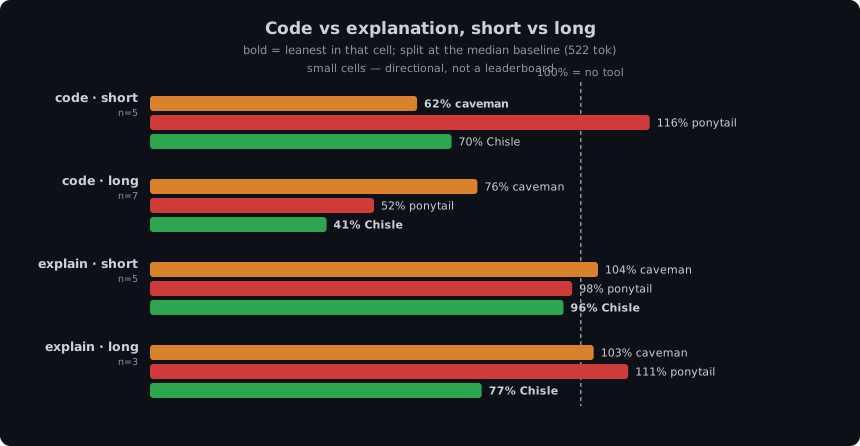
Size matters within each kind: coding goes 70% → 41% and non-coding 96% → 77%, so it isn't merely code in disguise. But the cells are thin, and the non-coding "long" bucket spans only 522–542 tokens, which is barely long at all.
The one row Chisle loses is short coding, where caveman takes it 62% to 70%. That is the honest shape of it: on a small code question there is little to skip, and the ruleset costs more than the ladder saves. The tool earns its keep on the long ones.
SUITE=large exists to fill the thin cells, see below.
These prompts were never designed to test this, which is the real caveat. To probe it directly:
SUITE=large bash benchmarks/run-live.sh <model> benchmarks/results/raw-large
Where each tool actually helps
| prose | code judgment | input/context | worst-case guard | publishes failures | |
|---|---|---|---|---|---|
| caveman | ✅ | ❌ | ❌ | ❌ 424% | ❌ |
| ponytail | ❌ | ✅ | ❌ | ❌ 227% | ❌ |
| headroom | ❌ | ❌ | ✅ proxy | n/a | ❌ |
| Chisle | ✅ | ✅ | ✅ hook | 173%, 1/20 | ✅ |
The row that matters is the last one. Every tool here looks good on its best day; the numbers above are the only ones in this class published alongside the run that went wrong. Full comparison →
Input axis: tool-output compression (Claude Code + Pi)
Measured over 171 real sessions (receipts): tool output is 67.5% of context content, and every byte of it is re-billed on every subsequent request in the session (median: 171 requests). A PostToolUse hook shrinks it before the model reads it: deterministic, zero LLM, zero network:
| tier | what it does | loss |
|---|---|---|
| scrub | strips ANSI escapes, collapses blank runs and line repeated N× |
none |
| elide | oversized output → head + tail, error-like lines salvaged from the cut | bounded, guarded |
| dedup | byte-identical repeat of a tool's previous output (same session) → one-line marker | none, the copy is already in context |
Replayed over the same 171 Claude Code sessions: ~61k tokens saved one-shot, ~46% off every eligible output: a floor, not an estimate, since each saved byte also stops being re-sent on every later request. Correctness rules: allowlist only (Bash, Agent, WebFetch, WebSearch, Grep, Glob, mcp__*), never Read/Edit, whose exact bytes feed later edits. Honest ledger: dedup scored 0 hits on this corpus (rtk-filtered at source); it's kept for the test-rerun case, kill-switchable, and labeled speculative until it earns a number.
Pi already truncates built-in output at 50KB/2,000 lines. Replay over 8,044 persisted Pi results measured the compressor's marginal saving after that truncation: 27.4% of tool-output chars (receipt + raw live Pi arm). Pi compresses bash, powershell, grep, find, ls, MCP, and explicitly allowlisted extension-tool results; read/edit/write remain untouched. CHISLE_COMPRESS_TOOLS supplies the same explicit override for runtime and replay. Runtime dedup only compares earlier turns, so concurrently completed sibling calls cannot dedup one another.
node benchmarks/replay-compress.js       # Claude Code
node benchmarks/replay-compress.js pi    # Pi
Outputs over 8k chars are elided, and the elided original spills to <config>/chisle-spill/ so the dropped middle stays reachable. The marker carries the path, so recovering one line is a targeted grep rather than a re-run of the command, which matters most when the command is not idempotent: a test run, a build, a git log at a moment in time. The newest 40 spills are kept, owner-readable only. stop chisle, CHISLE_COMPRESS=0, CHISLE_COMPRESS_SCRUB=0, CHISLE_COMPRESS_DEDUP=0, CHISLE_COMPRESS_SPILL=0. Every tier has an off switch.
Pi arm: where the output axis lost
Six tasks, Pi 0.85.1 on openai-codex/gpt-5.5, as % of the vanilla no-tool baseline. Lower is better, bold is the winner of the row:
| segment | vanilla | caveman | ponytail | Chisle |
|---|---|---|---|---|
| coding billed tokens | 100% | 87% | 49% | 73% |
| non-coding billed tokens | 100% | 43% | 76% | 39% |
| all billed tokens | 100% | 72% | 59% | 61% |
| all visible-answer tokens | 100% | 56% | 49% | 37% |
| all answer lines | 100% | 75% | 38% | 37% |
| tasks correct | 5/6 | 5/6 | 5/6 | 5/6 |
Chisle lost billed output here. ponytail used 63 fewer tokens over the six tasks. Publishing that is the point of this section.
The coding gap is one task. Chisle leads 4 of 6 tasks outright; auth-bug alone accounts for 283 of the 337-token coding gap. On that task Chisle produced the shortest answer of any arm (377 chars to ponytail's 632) and was the only arm to find the real defect: ponytail flipped > to >=, while Chisle identified the seconds-versus-milliseconds unit mismatch behind it. The grader scored every arm as failing regardless, which says more about that task than about the tools.
Six tasks, one model, one run. Raw events and per-task cells: benchmarks/results/raw-pi/.
Prevention: the context diet
The biggest context whale (whole-file Reads, 5.6M chars in the measured corpus) can't be compressed without breaking later edits. So the ruleset attacks it upstream, in every agent: grep for the symbol first, read only the matching region, narrow at the source (ls dir not ls -R, pipe long output through tail/grep), never re-read what's already in context.
What the output sounds like
"Why does this React component re-render?"
New object ref each render. Inline object prop = new ref = re-render.
useMemo.
"Add a cache for API responses."
@lru_cache(maxsize=1000)on the fetch fn. Skipped a custom cache class; add one whenlru_cachemeasurably falls short.
Usage
| Command | Effect |
|---|---|
| (nothing) | On automatically every session after install |
/chisle |
Re-activate if you'd stopped it |
/chisle off |
Deactivate |
stop chisle |
Deactivate (ruleset and input-side compression) |
normal mode |
Deactivate |
Natural language works too: "activate chisle", "chisle mode", "chislify this". Code symbols, function/API names, and error strings stay verbatim, so only the noise around them compresses.
How it works
Before writing code, the agent stops at the first rung that holds:
flowchart TD
    A[Request for code] --> R[Read the problem fully]
    R --> Q1{Does this need<br/>to exist at all?}
    Q1 -->|no| S1[Skip it. Say so in one line]
    Q1 -->|yes| Q2{Already in<br/>this codebase?}
    Q2 -->|yes| S2[Reuse it. Don't rewrite]
    Q2 -->|no| Q3{Stdlib<br/>does it?}
    Q3 -->|yes| S3[Use the stdlib]
    Q3 -->|no| Q4{Native platform<br/>feature covers it?}
    Q4 -->|yes| S4["CSS over JS, DB constraint<br/>over app code"]
    Q4 -->|no| Q5{Already-installed<br/>dependency?}
    Q5 -->|yes| S5[Use it. Never add a new dep<br/>for what a few lines do]
    Q5 -->|no| Q6{Can it be<br/>one line?}
    Q6 -->|yes| S6[One line]
    Q6 -->|no| S7[The minimum code that works]

    S1 & S2 & S3 & S4 & S5 & S6 & S7 --> OUT[Ship it + note what was skipped<br/>and when to add it]

    style Q1 fill:#1f2937,stroke:#d78a3c,color:#e6edf3
    style OUT fill:#14532d,stroke:#2da44e,color:#e6edf3
    style R fill:#1f2937,stroke:#8b949e,color:#e6edf3
The ladder runs after reading, never instead of it. Note the exit: every rung lands on the same obligation: say what you skipped, so "later" doesn't quietly become "never".
The ladder runs after reading the code, lazy about the solution and never about understanding. Lazy is not negligent: trust-boundary validation, data-loss handling, security, and accessibility are never on the chopping block.
Mark deliberate simplifications so "later" doesn't quietly become "never":
// chisle: global lock, per-account locks if throughput matters
// chisle: O(n) scan, index this when table exceeds ~10k rows
Config
On by default. After install, Chisle activates automatically every session, with no /chisle needed. Set off to stay dormant until you type /chisle:
# env var (highest priority)
export CHISLE_DEFAULT_MODE=off

# config file (persists across shells)
~/.config/chisle/config.json → { "defaultMode": "off" }
Resolution: env var → config file → on. Valid: off, on.
Prior art & what stacks with it
Chisle borrows the best published token-saving techniques and implements the ones that fit a zero-dep hook; the rest stack cleanly alongside it:
| technique | source | in Chisle? |
|---|---|---|
| Prose compression persona | caveman | ✅ + code judgment it lacks |
| YAGNI/lazy-code ruleset | ponytail | ✅ + prose discipline it lacks |
| Tool-output elision (head/tail) | headroom-style, proxy-free | ✅ hook, no proxy, works on subscription OAuth |
| ANSI strip / log crush / dedup | headroom transforms | ✅ scrub + dedup tiers |
| Command rewriting at the source | RTK-style PreToolUse (writeup) |
❌ stacks; RTK shrinks at source, Chisle catches what it can't reach (subagents, MCP, web) |
| MCP/codebase-graph indexing | context-mode, token-optimizer-mcp | ❌ stacks, orthogonal layer |
| CLAUDE.md dieting | community guides | ✅ /chisle-audit flags bloated docs/config prose |
Multi-agent
Ships to nine agents: Claude Code and Pi get both axes, live /chisle toggling, and a status badge; Cursor, Windsurf, Cline, Kiro, Codex, Gemini, and Copilot get the always-on ruleset. Per-agent static copies come from scripts/build-rules.js; Pi uses its package extension plus the Agent Skills standard. See docs/agent-portability.md.
FAQ
Doesn't injecting a persona every turn cost tokens?
Claude Code uses a ruleset at session start (~1.6k tokens) plus a ~50-token reminder per turn. Pi injects one persistent rules message only when project AGENTS.md does not already provide it; resume/reload does not duplicate it, and compaction restores it only if removed.
Worth reading the dissent before you take that on faith: @enc0ded measured 173 of their own sessions (#2) and found the injection overhead roughly cancelling the compressor's savings, because the ruleset was being re-sent on every resume and clear, not just at startup. That re-injection is fixed, which removes most of the overhead they measured, but their wider point stands: prose is only ~25% of what the model emits, so the ceiling on the output axis is lower than the headline suggests, and on a one-line throwaway prompt the overhead still exceeds the saving.
Will it golf my code into clever one-liners?
No. Boring over clever. Deletion beats addition; obfuscation isn't deletion.
Does it cut corners on safety?
Never. Input validation, data-loss handling, security, and accessibility are off the table. Lazy about solutions, not about reading the problem.
Can the output compressor eat a line I needed?
Designed not to: allowlist keeps Read/Edit exact, error-looking lines are salvaged from any elided region, dedup only fires on byte-identical same-session repeats, and every tier has a kill switch. If it still bites you, file an issue. That's a bug, not the design.
Should the star count worry me?
Everyone starts at zero. Run npx chisle --dry-run, see what it'd do, decide. And if the receipts convinced you, a star is how the next person finds them, and it's also the only payment a zero-dep MIT tool will ever ask for.
→ More FAQ and competitor comparison
Contributing
See CONTRIBUTING.md. Edit the skill (skills/chisle/SKILL.md) and the condensed rule body in scripts/build-rules.js, regenerate copies and chart, run the tests. CI enforces all three.
Built by Jay Pokale with Claude, Antigravity, and Codex as co-engineers: the input-compression hook, the benchmark verification, and several of the bug hunts documented in the changelog were pair-work.
npm test # 67 tests: flag safety, tracker, settings merge, installer, compressor
License
MIT. The shortest license that works.
Contributors
AI co-engineers (pair-work credited in commit trailers and the changelog):



Saved you tokens? ⭐ Star the repo. It costs zero tokens and keeps the benchmarks running.
Yorumlar (0)
Yorum birakmak icin giris yap.
Yorum birakSonuc bulunamadi