jentic-public-apis
Health Pass
- License — License: CC0-1.0
- Description — Repository has a description
- Active repo — Last push 0 days ago
- Community trust — 263 GitHub stars
Code Fail
- rm -rf — Recursive force deletion command in .github/scripts/generate-apis-index.sh
- process.env — Environment variable access in .github/workflows/auto-arazzo.yaml
- rm -rf — Recursive force deletion command in .github/workflows/import-openapi.yaml
- process.env — Environment variable access in .github/workflows/import-openapi.yaml
- rm -rf — Recursive force deletion command in .github/workflows/replace-openapi.yaml
- process.env — Environment variable access in .github/workflows/replace-openapi.yaml
Permissions Pass
- Permissions — No dangerous permissions requested
No AI report is available for this listing yet.
Directory of OpenAPI specifications for thousands of public APIs. Every API is machine-readable and scored for AI agents. CC0.
Jentic Public APIs


Join our community! Connect with contributors and users on Discord to discuss ideas, ask questions, and collaborate on the Jentic Public APIs repository.
Quick access API Index: 0 · 1 · 2 · 3 · 4 · 5 · 6 · 7 · 8 · 9 · A · B · C · D · E · F · G · H · I · J · K · L · M · N · O · P · Q · R · S · T · U · V · W · X · Y · Z
Explore the API Directory






Every API has a machine-readable OpenAPI spec in this repository, and most carry an AI-readiness score right alongside it (a scorecard.json next to the spec; see AI-Readiness Scoring below).
Popular APIs
| API | Category | OpenAPI spec |
|---|---|---|
| Payments | 📄 OpenAPI | |
| AI/ML | 📄 OpenAPI | |
| AI/ML | 📄 OpenAPI | |
| Developer Tools | 📄 OpenAPI | |
| Communications | 📄 OpenAPI | |
| Productivity | 📄 OpenAPI | |
| Productivity | 📄 OpenAPI | |
 Shopify Admin |
E-Commerce | 📄 OpenAPI |
| Finance | 📄 OpenAPI | |
| Communications | 📄 OpenAPI | |
| Developer Tools | 📄 OpenAPI |
Browse by category
The directory is organized into 22 categories. Below is a small sample from a few. Expand a section, then follow View all for every API in that category on jentic.com/apis.
🛠️ Developer Tools| API | OpenAPI spec |
|---|---|
| 📄 OpenAPI | |
| 📄 OpenAPI | |
| 📄 OpenAPI | |
| 📄 OpenAPI |
➡️ View all Developer Tools APIs →
🤖 AI/ML| API | OpenAPI spec |
|---|---|
| 📄 OpenAPI | |
| 📄 OpenAPI |
| API | OpenAPI spec |
|---|---|
| 📄 OpenAPI | |
| 📄 OpenAPI | |
| 📄 OpenAPI |
➡️ View all Payments · Finance APIs →
💬 Communications| API | OpenAPI spec |
|---|---|
| 📄 OpenAPI | |
| 📄 OpenAPI | |
| 📄 OpenAPI | |
| 📄 OpenAPI |
➡️ View all Communications APIs →
📋 Productivity| API | OpenAPI spec |
|---|---|
| 📄 OpenAPI | |
| 📄 OpenAPI | |
| 📄 OpenAPI | |
| 📄 OpenAPI |
➡️ View all Productivity APIs →
Fun & niche APIs
The directory goes well beyond the usual suspects. Here's a taste of the long tail:
| API | What it's for | OpenAPI spec |
|---|---|---|
| Reverse face search | 📄 OpenAPI | |
| Electronic music catalog | 📄 OpenAPI | |
| Beer check-ins & ratings | 📄 OpenAPI | |
| Pokémon data | 📄 OpenAPI | |
| Astronomy Picture of the Day | 📄 OpenAPI | |
| Open music metadata | 📄 OpenAPI | |
| Brewery directory | 📄 OpenAPI | |
| TV show schedules & data | 📄 OpenAPI | |
| Players, games & stats | 📄 OpenAPI | |
| Open chess platform | 📄 OpenAPI |
Looking for something else? Search the full API Directory →, or jump into the raw specs via the Quick access API Index above.
Overview
The agentic knowledge layer
AI agents depend on APIs. Their capabilities are defined by the APIs they know about, and their reliability is defined by the quality of that knowledge. Documentation was previously nice-to-have, but for AI it's a need-to-have. The goal of this project is to collate all knowledge about all the world's APIs into a communal, detailed, comprehensive, structured documentation catalog designed for use by AI. This allows AI to accurately generate API integration code, and it allows agents to plan and interact with APIs reliably, without intermediaries.
Open source and open standards
This communal effort requires a stable but extensible representation format that can describe all salient aspects of APIs and associated workflows in full detail. The OpenAPI specifications provide the de-facto standard for formal API descriptions, are widely adopted, supported by a vast ecosystem of associated tooling, and governed by the Linux Foundation. Importantly, the OpenAPI Initiative's most recent specification, Arazzo, allows complex multi-API workflows to be described in a declarative format.
The Jentic API Directory is an open-source catalog of API and workflow descriptions that builds upon these open standards to contribute API and workflow knowledge to AI agents. We will coordinate with the OpenAPI community, and propose an RFC containing various extensions to capture additional knowledge that is especially relevant in the context of AI agents (for example concerning authentication, rate limiting, pricing, governance and safety). If you have suggestions to improve the directory, we welcome discussion on our Discord and PRs on this repository.
AI-scale
Documenting all the world's API knowledge is made achievable by generative AI. Our starting point was OpenAPI documents provided by various vendors online (with special credit to the APIs.guru repository). On top of this, we have generated thousands Arazzo workflows using AI. We are growing this repository using AI agents to import (and improve) existing OpenAPI documents and to generate new OpenAPI specifications where no structured documentation previously existed. Our AI agents are also discovering novel Arazzo workflows that can be performed on top of that API knowledge. We will propose a scorecard evaluation to measure the quality of the generated documentation, allowing us to ensure that both the quantity and the quality of documentation increases as we progress.
We welcome all contributions from the community and from partners who want to accelerate this effort with their own resources and ingenuity. We will ensure that all contributions help the knowledge about each API and workflow in the repository to converge on the best canonical version.
Repository Focus
The repository focuses on:
- Standardized OpenAPI specifications for public APIs
- Arazzo workflows that define composable operations across one or more APIs
- Associated tooling, for example to help import and enrich documentation, or to convert it out into other formats (e.g., AI model provider's tool definition formats).
- Evaluations and scorecards to measure API knowledge completeness, accuracy and AI-readiness
- RFCs for extensions to open formats used in the repository, and any other proposals.
Project Stage
Note: This project is currently in ALPHA.
Documentation
- STRUCTURE.md - The standardized repository structure for the Jentic API Directory
- FEEDBACK-FILES.md - Documentation of feedback.json files that track API specification repairs
- CONTRIBUTING.md - Guidelines for contributing to the repository
- CODE_OF_CONDUCT.md - Community standards and expectations
- LICENSE.md - CC0 1.0 License for this repository
Repository Structure
This repository follows a standardized directory structure for organizing API specifications and workflows.
- API specifications are organized by vendor and version
- Workflows are organized to clearly show which APIs they reference
- Multi-API workflows demonstrate how different services can be orchestrated together
For detailed information, please refer to the structure documentation.
Run any of these APIs with Jentic One
The specs in this directory aren't just for reading. An AI agent can execute any of them through Jentic One, a self-hosted execution layer for AI agents. You register the APIs an agent may use and store the credentials once; the agent makes its calls through the credential-injecting Broker, which checks the agent's permissions, attaches the credential at execution time, and logs the call. Your agent never sees your keys, and nothing leaves your own infrastructure.
Stand up an instance and install the CLI by following the Jentic One Quickstart, then walk through making your first brokered call.
With a running instance, point the jentic CLI at any vendor in this catalog and call it. The same steps are available through the Jentic One UI, or by an agent calling the jentic CLI tools directly:
jentic catalog import stripe.com   # import an API from this directory (auto-promotes to live)
jentic search "create a payment"   # find the right operation
jentic inspect <operation>         # see its method, params, and schemas
jentic execute <operation> --json  # call it through the Broker
MCP-capable agents don't need the CLI in the loop. Jentic One also speaks MCP: a local jentic mcp server over stdio, or a Streamable HTTP endpoint at /mcp, exposes the same discover → execute loop as tools (search_apis, inspect_operation, execute), with every call still routed through the Broker. See connecting an agent for the MCP and raw-HTTP paths.
Any of the thousands of APIs in this repository can be imported and executed this way.
AI-Readiness Scoring
OpenAPI documents in this repository can be scored for AI-readiness using the Jentic API Scorecard CLI, with no signup, no API key, and no configuration needed.
For most APIs the score is already computed and stored in the repository as a scorecard.json file sitting next to the spec, so you can read it without running anything:
apis/openapi/{vendor}/{api-name}/{version}/
├── openapi.json      # the API spec
└── scorecard.json    # its AI-readiness score
URL format
Files follow a predictable raw URL pattern:
https://raw.githubusercontent.com/jentic/jentic-public-apis/refs/heads/main/apis/openapi/{vendor}/{api-name}/{version}/openapi.json
Running a score
Pass any spec URL directly to the CLI:
npx @jentic/api-scorecard-cli@latest score \
  https://raw.githubusercontent.com/jentic/jentic-public-apis/refs/heads/main/apis/openapi/swagger-api/petstore/1.0.27/openapi.json
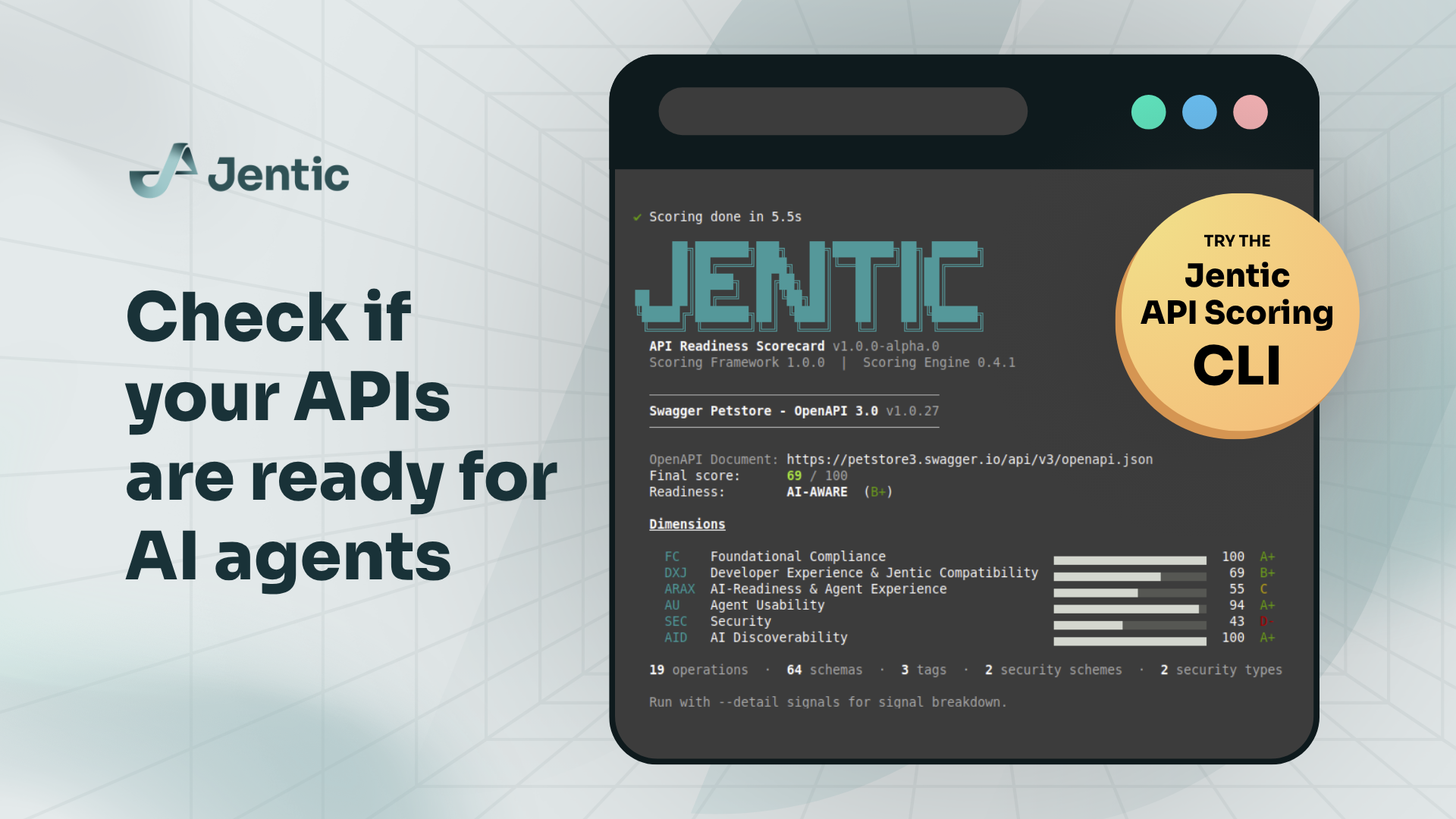
To learn more about the API Scoring Cli and Jentic API AI-Readiness Framework, visit the Jentic API Scorecard CLI repository.
Acknowledgments
The Jentic Public APIs project is built upon the foundation of open standards and community contributions. We extend our sincere gratitude to:
The OpenAPI Initiative and Linux Foundation - For creating, maintaining, and governing the OpenAPI Specification and Arazzo standards that form the backbone of this project. The OpenAPI Initiative's commitment to open standards, extensive ecosystem of tooling, and collaborative governance model directly enable our vision of a communal API knowledge layer. Special recognition goes to the technical steering committee and contributors who have developed these specifications to serve as the de-facto standard for API documentation, making structured, machine-readable API descriptions possible at scale.
APIs.guru - For providing the initial collection of OpenAPI specifications that helped bootstrap this repository. Their dedication to cataloging public APIs has been instrumental in our mission to create an open knowledge foundation for AI agents, and their pioneering work in API discovery laid important groundwork for projects like ours.
The broader API community - Including all the API providers, documentation authors, and open source contributors whose work makes comprehensive API knowledge possible. This project represents a continuation of the collaborative spirit that has driven API standardization and tooling development.
We are committed to contributing back to these communities through our proposed RFCs, quality improvements to existing specifications, and by demonstrating new applications of these open standards in the context of AI agents.
Contributing
We welcome contributions from the community! Whether you're enhancing existing API specifications, creating new Arazzo workflows, or improving documentation, your contributions help build the open knowledge foundation for AI agents.
Please read our Contributing Guidelines for more information on how to get started.
License
This project is licensed under the CC0 1.0 License - see the LICENSE.md file for details.
Disclaimer: API specifications and workflows in this repository are based on publicly documented third-party APIs, with some modifications such as repairs to OpenAPI specs or creation of new specs from public API documentation. All trademarks and service marks are the property of their respective owners. This repository does not grant rights to use the underlying APIs.
Star History
Reviews (0)
Sign in to leave a review.
Leave a reviewNo results found