Czip
Health Warn
- License — License: NOASSERTION
- Description — Repository has a description
- Active repo — Last push 0 days ago
- Low visibility — Only 9 GitHub stars
Code Pass
- Code scan — Scanned 12 files during light audit, no dangerous patterns found
Permissions Pass
- Permissions — No dangerous permissions requested
No AI report is available for this listing yet.
Infinite context without the infinite context window. Compresses agent sessions (Claude Code, Codex, Grok, Hermes) into a searchable HKP1 pack — full-history RAG, ~60x lower context cost, 0 deps.
czip — infinite context, without an infinite context window
🌍 English (primary) · Türkçe
When you carry a long agent session into a new chat, the entire history
reloads into context. A 4 MB session = a 4 MB token bill.
czip compresses an agent's full history into a persistent, searchable
pack (HKP1) — and the new session never unpacks it. It loads a
~1,500-token map, then retrieves only the message ranges it actually
needs.
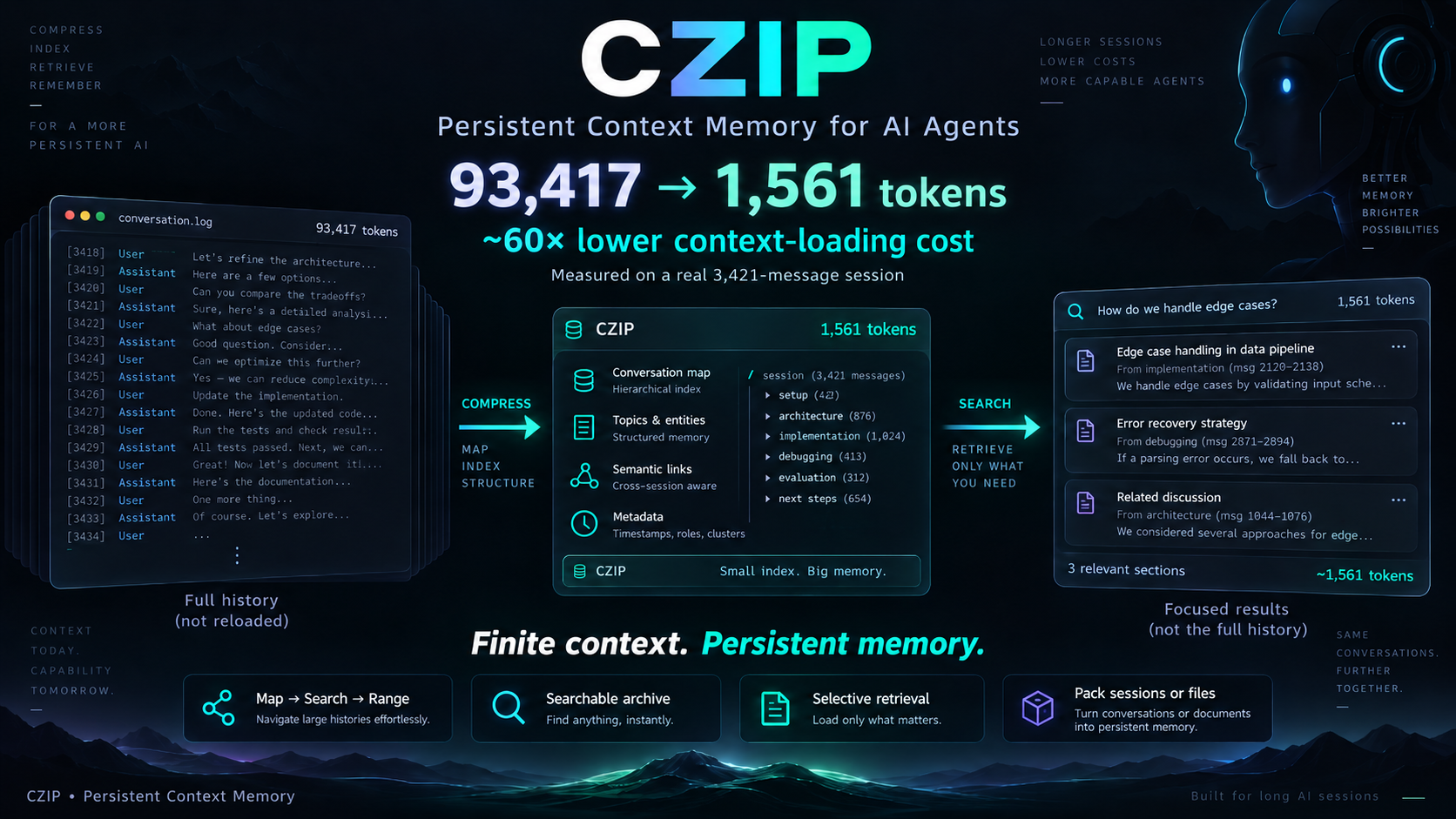
Headline
93,417 → 1,561 tokens. ~60× lower context-loading cost.
Measured on a real 3,421-message working session (tiktokeno200k_base).
czip does not make the model's native context window infinite.
It keeps long history persistent and searchable, and retrieves only the
relevant parts when needed — practically unbounded retrievable
history.
Finite context. Persistent memory.
v3 — the read cost was the real bottleneck
Compression ratio turned out to be the wrong metric: the pack file never
enters context at all. The cost is what the reading agent pulls out.
Measured on a real 3,421-message session:
| Read path | Tokens |
|---|---|
czip read (full index) |
93,417 |
czip map (RAG map) |
1,561 |
+ targeted czip search "<query>" |
+634 |
60× cheaper. map does not dump the transcript — it returns a work
map: role counts, tool histogram, user requests, recent messages, and a
search instruction. The reading agent then pulls exact ranges on demand:search → range.
Two ideas were measured and rejected with data:
- Codec tuning. LZMA2
pb=0 lc=4 dict=256MBgained only 1.2%.
bz2 was 27% worse. The currentpreset=9|EXTREMEis already at the
limit. - Instruction language. Same instruction: Turkish 39 tokens, English
34, Chinese 35 — and the instruction text is 0.1% of total cost.
The win is not in language, it is in JSON ceremony: rendering
recent messages asA> textinstead of JSON objects gained 47%.
v3 — duplicate elimination
Tool outputs are 71% of a typical pack, and 78% of them are exact
duplicates (8,571 outputs → 1,854 unique). Second copies are replaced
with [SAME-#N] markers.
12,217,023 → 479,724 B (previously 562,416) ratio 21.7x → 25.5x
Across five real sessions: 39.8 MB → 1.44 MB (15–35×), 2,590
duplicates eliminated.
v3 — merging (czip merge)
Detects sessions doing the same job and consolidates them into one
pack; optionally archives the sources (close + archive; messages are
never deleted, czip undo restores them).
The decision is made by Jev — and it actually matters: local
similarity wanted to merge two unrelated case files at 0.75, Jev
scored it 0.13 and rejected it; a true copy was approved at 0.97.
Scheduled-task boilerplate is filtered out (41 false matches → 20).
czip merge               # read-only candidate scan
czip merge auto --jev    # merge + archive sources
czip undo <file>         # restore
czip pack also warns after packing when "another session did this job
too" (the decision again belongs to Jev).
Numbers (from real sessions, evidence-backed)
| Session | Raw | Pack | Ratio |
|---|---|---|---|
| Game dev (1,117 msgs, 31 long tool outputs) | 4.27 MB | 237 KB | 18.0× |
| Code / research (210 msgs) | 997 KB | 119 KB | 8.4× |
| New session's context entry | instead of 4.27 MB | ~40 KB index + recent msgs |
Why never unpack?
Traditional compaction either rewrites the whole history into the new
session (expensive) or summarizes it (lossy). czip does neither: with
the map + on-demand range model, the new session sees every one of
1,117 messages as a single index line and fetches any message by number.
Dictionary tokens (␟3␞) look nothing like natural text — no collision
risk — and the round-trip is bit-exact (test suite: 210/210 messages,
bit-for-bit).
Install
git clone https://github.com/Jilazem/Czip && cd Czip
./install.sh
Installs: czip CLI (~/.local/bin) + Hermes plugin (/czip,/cunzip, /cmap, /csearch slash commands) + skill bridge + a
7-tool MCP server. After restarting Hermes, the slash commands appear
as real commands in new sessions.
Commands
English aliases work everywhere (pack = Turkish paketle, etc.);
Turkish remains the native naming:
czip pack <session_id|last|longest> [--full] [--jev]  → pack + 6-char id
czip read <id|last>           → WITHOUT UNPACKING: index + recent + status
czip map <id|last>            → RAG map (~1.5k tokens; the cheap read)
czip search <id|last> "query" → search inside a pack, find message indices
czip range <id|last> <a-b>    → exact messages, tokens resolved
czip merge [auto|<id1> <id2>] [--jev] [--days=7]
czip undo [<file>]            → restore archived sessions
czip list                     → registered packs: id | date | title
Carry-over flow in a new session:
czip map a37tvc               # which messages hold what
czip search a37tvc "edge case"
czip range a37tvc 1040-1060   # only the part you need
Features
- Tokenization — repeated blocks collapse into dictionary tokens;
raw duplication never enters the pack (the secret behind 18×). - Lossless mode —
--full: every byte comes back (8.4×). - State detection —
readreportsawaiting_user_replyplus the
last message's role, so the new session resumes exactly where the old
one stopped. - Privacy —
state.dbis always opened via a READ-ONLY URI; packs
are written only under~/.hermes/session-packs; nothing leaves the
machine; the engine has no delete/corrupt capability. - Optional Jev gate —
--jevasks an external LLM
(typesafe.ai System-One) in batches whether tool outputs above
1,200 B are needed; outputs containing error hints are never
questioned. Off by default — it sends sample content out, so it
requires an explicit flag + API key, and silently falls back to
static behavior on network failure.
Components
| File | Role |
|---|---|
hkp.py |
engine — pure stdlib (Python 3.9+, 0 deps): pack/read/search, CLI, state.db RO reader |
czip |
terminal entry point (one-line wrapper) |
plugin/ |
Hermes plugin — /czip, /cunzip slash commands |
mcp_server.py |
7-tool MCP server (compress/open/guide/messages/…) |
skills/ |
skill bridge — commands work even in old processes |
scripts/kapak.py |
Pillow script that renders the terminal cover |
tests/ |
synthetic round-trip + CLI + range tests (4/4) |
Format: HKP1
"HKP1" | meta_len (4B BE) | data_len (4B BE) | LZMA-9e(meta) | LZMA-9e(body)
Meta: title, dictionary, counters, format version, packing info.
Body: message record list (role, content, tool calls, reasoning,
timestamp) — resolved into readable text on demand.
Tests
python3 tests/test_roundtrip.py # 4/4: pack→read→range + stats
Limits
smartmode truncates tool outputs to 2000+2000 B head/tail slices
(and reports it); use--fullfor a bit-exact archive.- Pack files are plain-text LZMA — no encryption. Do not expose packs
from sensitive sessions to anyone with disk access. - The
state.dbschema varies with Hermes versions; the engine skips
missing columns via PRAGMA. --jevis an external service (off by default); avoid it under
data-protection policies.
Benchmarks
- Super-Context Proof (2026-09-29) — a
748,800-token corpus recalled at 100% (80/80) with 112-token prompts
via czip RAG; blind control 0% (0/40); 2-hop chains 30%.
Chart: PNG.
License
- Individual / non-commercial use: free and open.
- Commercial use: separate license required. Details: LICENSE
Versions before 2026-09-20 were released under MIT; those versions
remain MIT-licensed.
Reviews (0)
Sign in to leave a review.
Leave a reviewNo results found