causal-memory
Health Gecti
- License — License: Apache-2.0
- Description — Repository has a description
- Active repo — Last push 0 days ago
- Community trust — 47 GitHub stars
Code Gecti
- Code scan — Scanned 12 files during light audit, no dangerous patterns found
Permissions Gecti
- Permissions — No dangerous permissions requested
Bu listing icin henuz AI raporu yok.
Causal memory layer for AI agents — MCP server that records decision→outcome relationships. Survives compaction.
causal-memory
An agent memory system with a causal core — and the only one that models inhibition.
Facts, temporal state, and
decision → outcomecausal edges on one SQLite store,
powered by a hippocampus-style engine: typed spreading activation (excitatory
and inhibitory), Hebbian co-occurrence reinforcement, Q-value dynamics, and
immutable SWR consolidation. Agents recall what happened, when it was true,
why it worked — and what would happen if they acted differently.




Why
Every agent forgets why it made past decisions after a few context compactions.
It re-fixes the same bug the same wrong way, re-debates the same architecture
choice, relearns the same lesson.
This happens because causal information is the most fragile type under text
compaction. Real-LLM benchmark (grok-build's production compaction prompt):
| Compactions (k) | Textual recall | Causal-table recall |
|---|---|---|
| 1 | 100% | 100% |
| 2 | 85% | 100% |
| 3 | 55% | 100% |
| 5 | 45% | 100% |
The causal table survives because it lives outside the agent's context window —
compaction cannot touch it.
Demo
21 秒实操演示(真实记忆库,非 mock):行动前预警(intervention_query → DANGER 链)
→ 经验检索(search_causal)→ 反事实对比(counterfactual_query)→
写入闭环(record_decision → 立即可检索)。
下载视频 ·
预警场景截图 ·
品牌卡 ·
重新生成:scripts/render_demo.py
Benchmarks
CausalEval — the causal memory benchmark (primary)
Most agent-memory benchmarks (LoCoMo, LongMemEval, Memora) test fact recall
("what is the user's preference"). causal-memory's differentiators — typed
causal edges, inhibition, intervention prediction, cross-task transfer — are
invisible on those suites. CausalEval measures them.
Design: the causal graph is the answer key. Typed DAGs are generated
deterministically; conversations are narrated from the graph; gold answers are
derived from graph structure — zero hand annotation, zero ambiguity.
CausalEval v13 (soft supersession) — 140 questions, 20 graphs (same LLM,
same judge; v12 baseline was 70q/10 graphs; mem0 comparison ran on the 70q
protocol):
| Capability | causal-memory | v12 (70q) | mem0 (70q) | What it tests |
|---|---|---|---|---|
| C7 Update | 100% | 50% | 80% | Supersede old belief after falsification (soft superseded_by annotation) |
| C3 Counterfactual | 95% | 90% | 80% | Choosing between alternatives with known outcomes |
| C2 Intervention | 75% | 70% | 40% | Forward prediction: "if X again, what happens?" |
| C4 Inhibition | 80% | 90% | 50% | Distinguishing root-cause fix vs blast-radius limiter (prevented edges) |
| C1 Attribution | 85% | 90% | 90% | Backward causal chain → root cause |
| C5 Temporal-causal | 90% | 100% | 90% | Ordering on a causal chain |
| C6 Lesson transfer | 20% | 20% | 30% | Cross-task analogy via meta edges (open limitation) |
| Overall | 78% | 81% | 65% |
Key result: C7 update 50% → 100% (+50pp, 20/20 questions) and it holds at
doubled sample size. Soft supersession annotates superseded edges
(superseded_by) instead of hiding them — the falsification signal reaches
the answer model while the old lesson stays retrievable for counterfactuals
(C3 unharmed at 95%). The C6 gap (20% vs mem0 30%) is the remaining open
limitation; C1/C4/C5 dips vs v12 are within re-distillation variance and
new-graph difficulty (v12 and v13 do not share a distilled corpus).
Fact-recall benchmarks (not our strong suit)
On traditional fact-recall suites, causal-memory performs competitively but
does not beat mem0 — this is expected, because fact recall is mem0's
specialty and not where causal-memory adds value.
| Benchmark | causal-memory | mem0 | Note |
|---|---|---|---|
| LoCoMo (strict judge) | 79.1% | 91.6% | mem0's home turf |
| LongMemEval-S (full pipeline, deepseek-chat) | 76.4% @ 11.5K tok/q | 94.4% @ 6.8K tok/q (official) · 73.8% (ind. repro) | single-model stack vs platform stack; see docs/benchmarks/longmemeval.md |
| Memora MPA | 67.4% | 71.8% | −4.4pp |
| Compaction survival | 100% | 45% | External table = immune to compaction |
| Agent repeat-mistake | 33% | 67% | −34pp on trap-world |
Capability tests (322 across the workspace)
These test capabilities that no fact store (mem0, Zep, Letta) can offer.
| Capability | What it proves | Tests |
|---|---|---|
| Prevented-edge warning | prevented edge spreads −0.3 activation (GABA analogue) |
2 |
| Trace-cause attribution | Backward CSR traversal finds root cause | 2 |
| Multi-hop causal chain | Forward K-hop spreading reaches 2-3 hop outcomes | 2 |
| Inhibitory filtering | Prevented outcomes appear as negative, not false positives | 1 |
| Intervention comparison | Same outcome has +0.9 for "skip tests" and −0.3 for "add tests" | 4 |
| SWR consolidation | LTP strengthens replayed edges, LTD weakens unvisited, GC forgets dormant | 5 |
| Q-value dynamics | Good decisions rank higher; Bellman propagates to parents | 3 |
| Novelty entropy | Diverse experience triggers consolidation; uniform does not | 3 |
| Meta-edge mining | Cross-session pattern discovery (similar_to / repeated) | 3 |
| Hebbian co-occurrence | Repeated co-activation strengthens connection | 3 |
What makes it different
| Capability | causal-memory | mem0 | Zep | Letta | HeLa-Mem |
|---|---|---|---|---|---|
| Typed causal semantics (caused/enabled/prevented) | ✅ | ❌ | ❌ | ❌ | ❌ |
| prevented negative spread (inhibitory) | ✅ | ❌ | ❌ | ❌ | ❌ |
| Hebbian co-occurrence edges (excitatory) | ✅ | ❌ | ❌ | ❌ | ✅ |
| Immutable consolidation (delta + clone) | ✅ | ❌ | ❌ | ❌ | ❌ |
| Q-value dynamic utility | ✅ | ❌ | ❌ | ❌ | ❌ |
| Forward simulation (intervention_query) | ✅ | ❌ | ❌ | ❌ | ❌ |
| SWR offline consolidation (LTP/LTD/GC) | ✅ | ❌ | ❌ | ❌ | ❌ |
| Novelty-entropy consolidation trigger | ✅ | ❌ | ❌ | ❌ | ❌ |
| Meta-edge cross-session pattern mining | ✅ | ❌ | ❌ | ❌ | ❌ |
| Compaction survival evidence | ✅ +20.8pp | ❌ | ❌ | ❌ | ❌ |
| One graph unifying all memory types | ✅ | ❌ | ⚠️ | ❌ | ⚠️ |
| Write-time gatekeeping (raw → session_logs) | ✅ | ✅ | ❌ | ❌ | ❌ |
| Local ONNX embedding (offline) | ✅ | ✅ | ❌ | ❌ | ❌ |
Core innovation: the excitatory/inhibitory duality. HeLa-Mem (ACL 2026) builds
the excitatory side (Hebbian co-activation, positive spread). causal-memory adds
the inhibitory side (prevented edges spread negative activation — a GABA
analogue). A complete memory needs both: "what caused this" and "what prevents
this from happening again."
Architecture
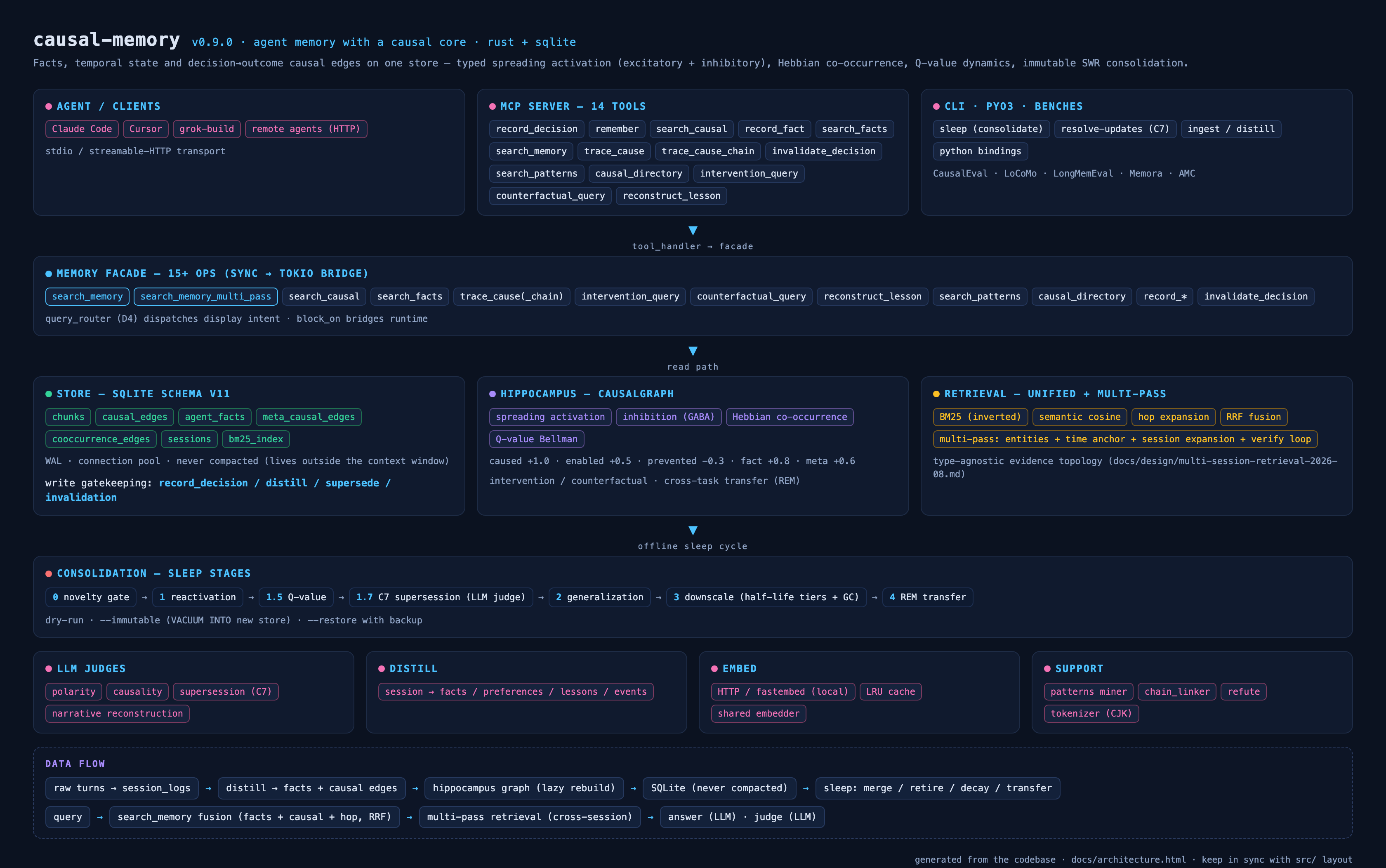
Interactive version: docs/architecture.html
  ┌───────────────────────────────────────────────┐
  │           causal-memory (Rust, MCP)            │
  │                                                │
  │  14 tools ← Agent (stdio / HTTP)                 │
  │    ↓                                           │
  │  Write-time gatekeeping                        │
  │    raw turns → session_logs (audit only)       │
  │    distill → facts + causal edges (searchable) │
  │    ↓                                           │
  │  Unified retrieval (RRF fusion)                │
  │    BM25 + semantic cosine → RRF merge          │
  │    Fact layer (BM25 + embeddings)              │
  │    ↓                                           │
  │  ┌──── Hippocampus engine ──────────────────┐  │
  │  │ CSR graph + spreading activation          │  │
  │  │  caused (+1.0)   enabled (+0.5)           │  │
  │  │  prevented (−0.3) ← GABA inhibitory       │  │
  │  │  fact (+0.8)     meta (+0.6)              │  │
  │  │  co_occurrence (Hebbian, dynamic)         │  │
  │  │                                            │  │
  │  │ DG: SimHash pattern separation             │  │
  │  │ CA3: K-hop spreading (forward + reverse)   │  │
  │  │ CA1: Novelty entropy trigger               │  │
  │  │ SWR: LTP/LTD/GC (immutable delta + clone)  │  │
  │  │ Q-value: Bellman dynamics (MemRL-style)    │  │
  │  └────────────────────────────────────────────┘  │
  │    ↓                                           │
  │  SQLite (causal.db) — never compacted          │
  └───────────────────────────────────────────────┘
The causal_edges table is never compacted — it lives outside the agent's context
window. That's the entire point.
Edge types
| Edge type | Spread coeff | Biological analogue | Meaning |
|---|---|---|---|
caused |
+1.0 | Glutamate (strong excitatory) | "Doing X caused Y" |
fact |
+0.8 | Semantic association | "User is/has Z" |
meta |
+0.6 | Cortical top-down | Cross-task pattern link |
enabled |
+0.5 | Weak excitatory | "Doing X enabled Y" |
co_occurrence |
dynamic | Hebbian LTP | "X and Y frequently co-occur" |
prevented |
−0.3 | GABA (inhibitory) | "Doing X prevented Y" |
no_effect |
0.0 | — | No causal relationship |
Quick start
git clone https://github.com/JingxuanC/causal-memory.git
cd causal-memory
cargo build --release
MCP integration (Claude Code, Cursor, grok-build, etc.)
{
  "mcpServers": {
    "causal-memory": {
      "command": "/path/to/causal-memory/target/release/causal-memory",
      "env": {
        "CAUSAL_MEMORY_DB": "~/.local/share/causal-memory/causal.db"
      }
    }
  }
}
HTTP transport (remote agents, multi-agent shared memory)
./target/release/causal-memory http --port 9938 # MCP Streamable HTTP
With local embeddings (no API key needed)
cargo build --release --features local-embed
# Uses BAAI/bge-small-en-v1.5 (384 dims, ~130MB, downloads once then offline)
With HTTP embeddings (OpenAI/ZhiPu/etc.)
export CAUSAL_MEMORY_EMBED_API=https://open.bigmodel.cn/api/paas/v4
export CAUSAL_MEMORY_EMBED_KEY=your-key
export CAUSAL_MEMORY_EMBED_MODEL=embedding-3
Python bindings (PyO3)
All 14 memory operations are also available as a Python package, built on the
same causal_memory::memory::Memory facade the MCP server uses:
cd crates/causal-memory-py
pip install maturin
maturin develop          # builds and installs into the active venv
from causal_memory import CausalMemory

mem = CausalMemory("~/.local/share/causal-memory/causal.db")  # or CausalMemory.in_memory()
mem.record_decision("used Redis mutex for cache stampede protection",
                    "deadlock under load", "caused", "concurrency")
print(mem.search_causal(query="cache stampede protection"))
print(mem.intervention_query("skip the test suite before shipping"))
Methods mirror the 14 MCP tools one-to-one and return the same text. Embedding
and LLM features use the same CAUSAL_MEMORY_EMBED_* / CAUSAL_MEMORY_LLM_*
environment variables; without them the bindings degrade gracefully to
BM25-only retrieval. Smoke tests: maturin develop && pytest tests/.
macOS note: always build the bindings through maturin. Plain
cargo build -p causal-memory-py --releasefails to link — the Xcode CLT
Python ships nolibpython3.9dylib (this is why the py crate sits outside
the workspacedefault-members).
Fourteen MCP tools
| Tool | When to call | What it does |
|---|---|---|
record_decision |
After acting on a decision | Logs decision → outcome as a causal edge with relation type |
remember |
After any meaningful exchange | Zero-friction alternative: paste conversation text, LLM auto-extracts facts/lessons/causal edges |
search_causal |
Before a non-trivial decision | BM25 + semantic retrieval of past causal episodes |
record_fact |
When learning a stable fact | Records flat facts with scope + confidence; idempotent |
search_facts |
When you need "what is" info | BM25 + semantic retrieval over the fact layer |
search_memory |
When unsure which type | Unified: facts + causal lessons fused by RRF |
trace_cause |
When something fails | Single-hop reverse: which decision caused this outcome |
trace_cause_chain |
Deep failure analysis | Multi-hop backward traversal through the causal graph |
invalidate_decision |
When a lesson is wrong | Soft-invalidate (hidden from search, kept for audit) |
search_patterns |
To recall cross-task lessons | Mined meta edges: similar_to / repeated / contradicts / refines |
causal_directory |
Pinned in system prompt | L0 compact pointer list of what the agent knows |
intervention_query |
Before taking an action | Forward simulation: predicts outcomes (safe/warning/danger) |
counterfactual_query |
When choosing between options | Contrastive: compares recorded outcomes of two alternatives |
reconstruct_lesson |
When you want the distilled lesson | Reconstructive retrieval: Markov-blanket subgraph → coherent narrative, with optional N-way calibration |
Sleep consolidation
causal-memory sleep --dry-run   # preview what would change
causal-memory sleep             # run consolidation cycle
Immutable SWR 2.0: produces a delta + clone (original graph untouched), with full
audit log. Triple-criterion GC (weak AND dormant AND zero-access). Triggers
automatically when novelty entropy exceeds threshold.
Causal distill pipeline
The distiller extracts structured memories from raw conversations:
Raw conversation → V3 extraction prompt (130 lines, 6 rules, 5 few-shot)
                   ↓
  Fact/Preference → agent_facts table (BM25 + embedding searchable)
  Lesson/Event    → causal edges (self-referential, searchable)
  Causal          → proper directed edge: decision → outcome
                    with relation type (caused/enabled/prevented)
Raw turns go to session_logs (audit/replay only) — they never enter the
retrieval pool. This write-time gatekeeping keeps BM25 precision high.
System layer coverage
All 16 designed layers have end-to-end validation (322 workspace tests):
| Layer | Benchmark | Tests |
|---|---|---|
| Fact layer | Memora / LoCoMo | — |
| Causal edges (caused/enabled/prevented) | Capability | 12 |
| Hippocampus spreading activation | Capability | — |
| SWR consolidation (LTP/LTD/GC) | Longitudinal | 5 |
| Q-value dynamics | Longitudinal | 3 |
| Novelty entropy trigger | Longitudinal | 3 |
| Sleep-wake cycle | Longitudinal | 1 |
| Meta-edge pattern mining | Advanced | 3 |
| Co-occurrence Hebbian | Advanced | 3 |
| Intervention query (forward sim) | Advanced | 4 |
| Trace cause chain | Capability | 2 |
| Inhibitory ablation | Inhibition | 2 |
| Distill / retrieval / facts | Memora / LoCoMo / LME | — |
| Compaction survival | Compact | — |
| Agent trap-world | Agent | — |
| Pipeline e2e | Migration / Pipeline | 2 |
Build & test
cargo build --release                    # Build binary
cargo test --workspace --no-fail-fast  # Run 322 tests
cargo test --features local-embed     # Run with ONNX embedding tests
cargo clippy --workspace -- -D warnings # Lint
Agent Memory Challenge (AMC/01)
causal-memory enters the Agent Memory Leaderboard
first evaluation cycle via an Add/Search integration server — a thin HTTP
frontend over the same Memory facade the MCP server runs (BM25 + semantic +
entity retrieval, RRF-fused; one store per user_id):
cargo build --release --bin causal-memory-amc
./target/release/causal-memory-amc --db-dir amc_data --port 8787 --write-mode raw
# --write-mode raw (no LLM, platform default) | distill (write-time LLM extraction)
# POST /add (store memory, user_id-isolated) · POST /search (ordered evidence) · GET /health
Docker route: docker build -t causal-memory-amc . && docker run -p 8787:8787 -v amc-data:/data causal-memory-amc.
Submission details, method description, and the participation checklist live indocs/benchmarks/amc-2026.md.
Test suite breakdown:
- 186 library unit tests (types, store, distill, patterns, hippocampus)
- 45 library integration tests (capability, longitudinal, advanced, pipeline)
- 91 CLI, benchmark-harness & MCP e2e tests
Research background
Full documentation map: docs/README.md — design docs,
benchmark protocols, evaluation reports, paper drafts, and the literature
survey.
This project is the engineering output of 17 research notes on agent memory
architecture (insights/01-17),
a teardown of 7 production agent frameworks, and deep analysis of 10+ memory
research papers. Key references:
- HeLa-Mem (ACL 2026) — Hebbian spreading activation (our closest competitor; we add the inhibitory side)
- Anthropic Dreams API — immutable consolidation pattern (aligned in SWR 2.0)
- mem0 — write-time gatekeeping architecture (adopted: session_logs separation)
- MemRL (arXiv:2601.03192) — Q-value memory dynamics (implemented)
- Graph World Models — causal-memory maps to "Graph as Reasoner"
Status
v0.9.0 — alpha.
What works (16/16 layers with end-to-end validation):
- ✅ 14 MCP tools (stdio + HTTP transport)
- ✅ Write-time gatekeeping (session_logs separation, V3 distill prompt)
- ✅ BM25 + semantic RRF unified retrieval
- ✅ Hippocampus engine: CSR spreading activation, DG SimHash, CA1 novelty, SWR 2.0
- ✅ 7 edge types: caused/enabled/prevented/fact/meta/co_occurrence/no_effect
- ✅ Causal distill: extracts typed causal edges (caused/enabled/prevented) from conversations
- ✅ Hebbian co-occurrence reinforcement
- ✅ Q-value Bellman dynamics
- ✅ Novelty-entropy consolidation trigger + sleep-wake cycle
- ✅ Meta-edge cross-session pattern mining
- ✅ Forward simulation (intervention_query) with prevented-edge warnings
- ✅ Benchmark harnesses: LoCoMo, LongMemEval, Memora, CausalEval, compaction, agent ablation, capability, longitudinal, advanced
- ✅ C7 LLM update-resolver (resolve-updates CLI + sleep stage 1.7 supersession)
- ✅ Vela-style half-life decay tiers (90d / 7d / legacy 0.99-per-day)
- ✅ Multi-session multi-pass retrieval (LongMemEval multi-session 42.9% → 57.9%, same-codebase)
- ✅ PyO3 Python bindings (crates/causal-memory-py)
- ✅ DSH native plugin (dsh-plugin/) + architecture visualization (docs/architecture.html)
- ✅ 368/368 tests passing + clippy clean
What's not done yet:
- ❌ TS bindings
- ❌ Forward-simulation prediction-accuracy benchmark (designed, not yet run)
- ❌ 7×24 production deployment validation
License
Apache-2.0. See LICENSE.
Yorumlar (0)
Yorum birakmak icin giris yap.
Yorum birakSonuc bulunamadi