jmac-memory-os
Health Warn
- License — License: MIT
- Description — Repository has a description
- Active repo — Last push 0 days ago
- Low visibility — Only 5 GitHub stars
Code Pass
- Code scan — Scanned 2 files during light audit, no dangerous patterns found
Permissions Pass
- Permissions — No dangerous permissions requested
No AI report is available for this listing yet.
Connect your models and chats together with one central git memory. Plain Markdown facts in a git repo you own — Claude Code, ChatGPT, Cursor, Codex and anything that uses APIs, Integrations or MCPs reading the same folder. No server, no database, no account.
JMac Memory OS — Git Memory
Connect your models and chats together with one central git memory.
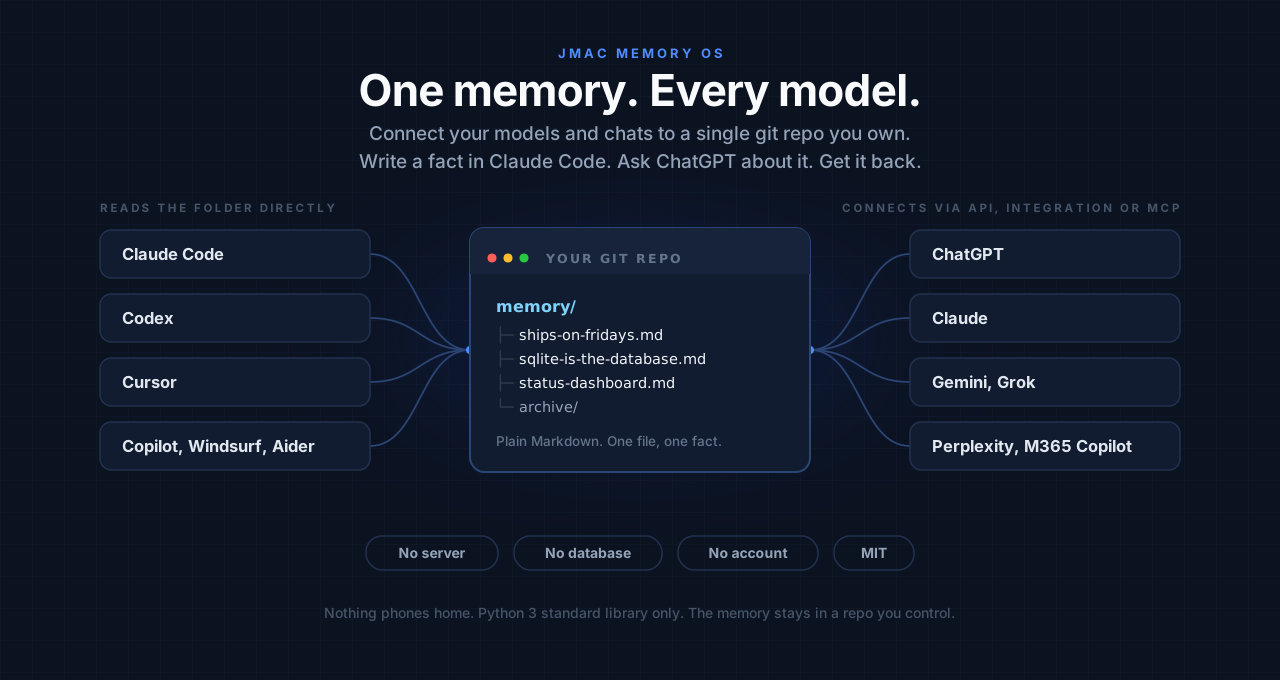
Your AI assistants forget everything between sessions. This gives them one
memory, in a git repo you own, that every one of them can read.
Write a fact in Claude Code. Ask ChatGPT about it. Get it back.
python3 bin/memos-init ~/my-memory --git
On Windows (PowerShell):
py bin\memos-init $HOME\my-memory --git # or: .\windows\Setup-Memory.ps1
That makes a repo. Push it to a private GitHub repo, connect your tools,
and they share one memory. No server, no database, no account with anyone,
no subscription. The memory is markdown files in your own git.
Why a git repo
Because nearly every AI client can already read one, and most can write to one.
The table below is read from vendor documentation on 21 September 2026. Claude Code
is the one row tested on a real repo. Vendors add and drop connector support often,
so check your own client before you build on a row.
| Client | Read | Write |
|---|---|---|
| Claude Code, Codex, Cursor, Gemini CLI, Copilot, Windsurf, Aider | Yes | Yes |
| ChatGPT | Yes | Yes |
| Claude, Gemini, Grok, Mistral Vibe, Perplexity, M365 Copilot | Yes, via connector | Yes, via connector |
| Amazon Q, DeepSeek Harness, Qwen Chat | Yes, via connector | Yes, via connector |
"Via connector" means you point the client at your repo with whatever it
supports: a GitHub integration, the GitHub API, or GitHub's hosted MCP server.
All three read the same folder. You host nothing.
Two with no connector surface in their documentation on that date: Meta AI and
the DeepSeek consumer app.
The format in one screen
memory/
  INDEX.md                  one line per live memory
  ships-on-fridays.md       one memory, one fact
  archive/
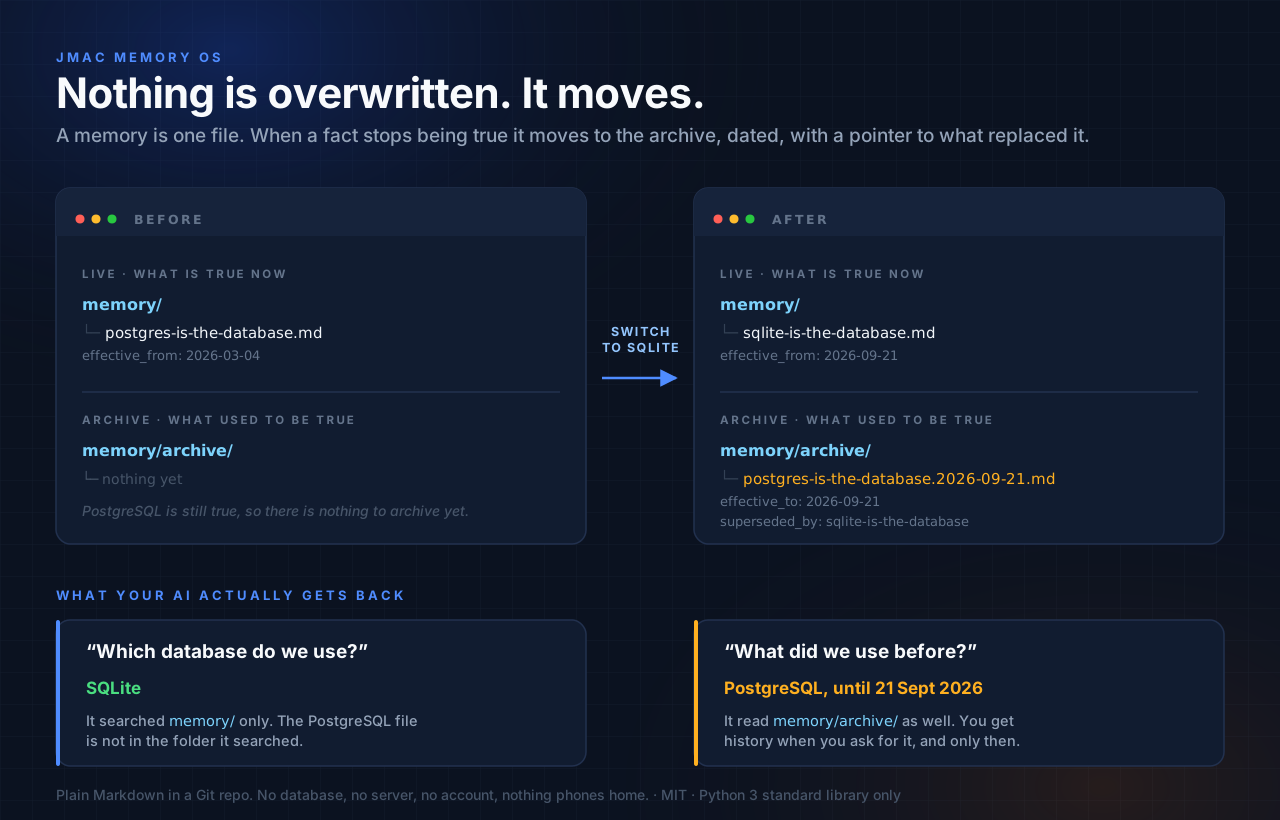
    postgres-is-the-database.2026-09-21.md
---
name: ships-on-fridays
type: project
description: releases go out Friday afternoon, never Monday
effective_from: 2026-04-02
source: standing rule from the 2026-04-02 planning call
---

Releases ship Friday between 14:00 and 16:00.

Never Monday — the on-call rotation changes Monday morning.
memory/ holds what is true now. memory/archive/ holds what used to be true.
That split is the whole trick. A client doing plain text search will not return
an archived fact, because the archived fact is not in the folder it searched. You
get history when you ask for it, and only then.
It is a folder rule, not a guarantee about every answer. A live memory that
explains what it replaced still contains the old value, so a search for that old
value can still match it. The archived file stays out; the live file's own
wording is up to you.
Full rules: SPEC.md. It is 150 lines and it is the entire format.
Reading it without any tool
python3 reader/read.py list
python3 reader/read.py recall deploy friday
python3 reader/read.py history postgres-is-the-database
python3 reader/read.py check
On Windows use py and --dir (works on every OS):py reader\read.py --dir $HOME\my-memory list. See clients/windows.md.
check is the one worth wiring into a pre-commit hook. It catches a memory
missing from the index, a filename that disagrees with its name, and a bad
type — the three things that break a reader.
Connecting your tools
One page each, with the exact text to paste:
What this is not
This is a file format and a 170-line reader. It does substring search over a
directory. At a few hundred memories that is genuinely all you need.
It does not rank results, resolve contradictions between two memories that
disagree, or answer "what did we believe in March" as a query. Those are
retrieval problems, and they start to matter somewhere in the low thousands of
memories. If you hit that, you have outgrown a flat file search and want a real
retrieval layer. There are several.
Built by John Mackenzie — jmactech.com ·
jmaclearning.com
Most people never get there. The format here is stable, documented and yours,
and nothing in it phones home.
Licence
MIT. Copy it, fork it, put it in your product.
"JMac Memory OS" is a trademark of John Mackenzie. The format is free
to use and implement; the name identifies this project.
Reviews (0)
Sign in to leave a review.
Leave a reviewNo results found