memex
Health Uyari
- License — License: AGPL-3.0
- Description — Repository has a description
- Active repo — Last push 0 days ago
- Low visibility — Only 5 GitHub stars
Code Gecti
- Code scan — Scanned 12 files during light audit, no dangerous patterns found
Permissions Gecti
- Permissions — No dangerous permissions requested
This tool extracts and records architectural decisions from GitHub pull requests, ADRs, and post-mortems. It indexes this context locally so engineering teams and AI agents can query past engineering decisions.
Security Assessment
Overall Risk: Medium. The codebase scans cleanly with no dangerous patterns or hardcoded secrets found across its 12 files. However, it requires an Anthropic API key for its AI extraction features, which is saved locally on your machine. Because it integrates tightly with GitHub artifacts to pull repository data, it inherently accesses potentially sensitive source code and developer discussions. The tool processes this data and makes network requests to both GitHub and the Anthropic API.
Quality Assessment
The project is actively maintained with a recent push and is properly licensed under AGPL-3.0. However, community trust is currently very low. It has only 5 GitHub stars, meaning it has not yet been widely tested or vetted by a broad user base.
Verdict
Use with caution — the code is clean and open source, but the project's low visibility and requirement to process proprietary code through a third-party AI API warrant careful review before adopting it in enterprise environments.
Institutional knowledge extraction for engineering teams — captures architectural decisions from PRs, post-mortems, and ADRs automatically.
Memex



Most architectural decisions are never written down. They live in a three-minute hallway conversation, a Slack thread that gets deleted, or a pull request where every review is just "LGTM".
Memex captures decisions at the moment they're made — extracting structured rationale from the GitHub artifacts that already exist (PRs, review threads, ADRs) without asking engineers to change how they work.
$ memex query "why did we move off MongoDB"

Results for: why did we move off MongoDB
──────────────────────────────────────────────────────────────────────

  #1  Migrate billing store to PostgreSQL  [0.91]
      ✅ High confidence
      Unbounded schema flexibility was causing silent data corruption
      in the billing pipeline. — Migrated billing store to PostgreSQL.
      knowledge/decisions/2024-11-14-migrate-billing-store-to-postgresql.md

  #2  ...
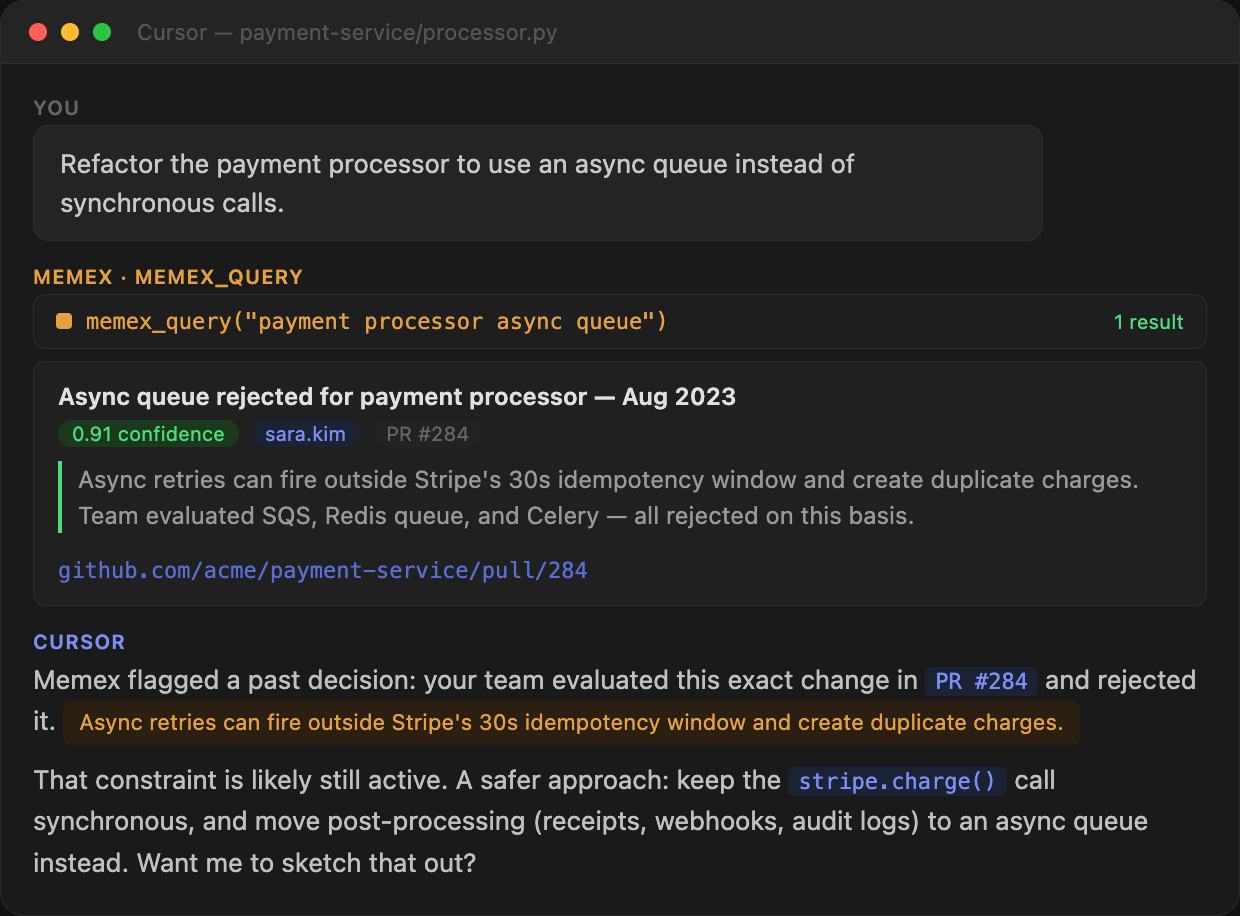
Or, surfaced automatically by an AI coding agent before it suggests an architecture change:
How it works
- GitHub Action — triggers on every merged PR, calls Claude to extract decision context, opens a
memex/pr-{N}branch with the structured.mdfile, and creates a PR for review - Local CLI —
memex indexembeds your knowledge files locally;memex queryruns semantic search over them - ADR parser — indexes existing ADR files automatically: on
memex init, viamemex index --include-adrs, and whenever a merged PR touches an ADR file - Low-confidence nudge — when a PR looks like it contains a decision but lacks rationale, Memex posts a single comment asking for one sentence of context; if the author replies, Memex re-runs extraction with the reply and writes the record
Installation
pip install memex-oss
Requires Python 3.12+.
Quickstart
1. Add your API key
memex configure
This prompts for your Anthropic API key, validates it, and saves it to ~/.config/memex/config.toml.
2. Bootstrap from your existing codebase
memex init
Scans your repo for architectural decisions already embedded in config files, package manifests, and infrastructure code. Also parses any existing ADR files found in docs/adr/, docs/decisions/, decisions/, or adr/. Writes initial knowledge records to knowledge/decisions/.
Use --dry-run to preview what would be extracted without writing any files.
3. Pull in decisions from your git history
memex update
Walks your git history and processes merged PRs it hasn't seen yet. Use --since 2024-01-01 to scope the scan, or --limit 50 to process the most recent N PRs.
4. Commit and push your knowledge records
Recommended for existing projects: before setting up the GitHub Action, commit and push everything
memex initandmemex updatewrote toknowledge/decisions/. This gives the Action a populated baseline and avoids re-extracting decisions that are already indexed.
git add knowledge/
git commit -m "memex: bootstrap knowledge records from existing codebase"
git push
5. Index and query
memex index          # embed all knowledge files (incremental — only re-embeds changed files)
memex query "why did we switch from SQS to Redis"
memex query --min-score 0.5 "why did we switch from SQS to Redis"   # broaden results
memex query --expand "why did we switch from SQS to Redis"          # AI-expanded search
GitHub Action setup
Add this to .github/workflows/memex.yml in any repo you want to capture:
name: Memex knowledge extraction

on:
  pull_request:
    types: [closed]
  issue_comment:
    types: [created]

permissions:
  contents: write
  pull-requests: write

jobs:
  extract:
    if: |
      (github.event_name == 'pull_request' && github.event.pull_request.merged == true) ||
      github.event_name == 'issue_comment'
    runs-on: ubuntu-latest
    steps:
      - uses: actions/checkout@v4
        with:
          token: ${{ secrets.GITHUB_TOKEN }}

      - uses: actions/setup-python@v5
        with:
          python-version: "3.12"

      - run: pip install memex-oss

      - name: Extract knowledge
        env:
          ANTHROPIC_API_KEY: ${{ secrets.ANTHROPIC_API_KEY }}
          GITHUB_EVENT_NAME: ${{ github.event_name }}
          PR_TITLE: ${{ github.event.pull_request.title }}
          PR_BODY: ${{ github.event.pull_request.body }}
          PR_URL: ${{ github.event.pull_request.html_url }}
          PR_NUMBER: ${{ github.event.pull_request.number || github.event.issue.number }}
          PR_AUTHOR: ${{ github.event.pull_request.user.login }}
          REPO: ${{ github.repository }}
          GH_TOKEN: ${{ secrets.GITHUB_TOKEN }}
          COMMENT_BODY: ${{ github.event.comment.body }}
          COMMENT_AUTHOR: ${{ github.event.comment.user.login }}
        run: python -m memex.action

      - name: Commit knowledge record and open PR
        env:
          GH_TOKEN: ${{ secrets.GITHUB_TOKEN }}
        run: |
          git config user.name "memex-bot"
          git config user.email "[email protected]"
          git add knowledge/ 2>/dev/null || true
          git diff --cached --quiet && exit 0
          PR_NUM="${{ github.event.pull_request.number || github.event.issue.number }}"
          BRANCH="memex/pr-${PR_NUM}"
          git checkout -b "$BRANCH" 2>/dev/null || git checkout "$BRANCH"
          git commit -m "memex: capture decision from PR #${PR_NUM}"
          git push origin "$BRANCH"
          gh pr create \
            --title "memex: capture decision from PR #${PR_NUM}" \
            --body "Knowledge record extracted from PR #${PR_NUM} by memex-bot." \
            --base "${{ github.event.pull_request.base.ref || github.event.repository.default_branch }}" \
            --head "$BRANCH" \
            2>/dev/null || true
Add ANTHROPIC_API_KEY as a repository secret. That's the only secret required.
Required repo setting: GitHub Actions cannot create pull requests by default. Go to your repo's Settings → Actions → General → Workflow permissions and enable "Allow GitHub Actions to create and approve pull requests", then save. Without this, the Action will push the branch but fail to open the PR.
When a decision is found, Memex opens a memex/pr-{N} branch and creates a PR targeting your base branch. No knowledge record lands on main without a review.
Knowledge record format
Every extracted decision is a plain markdown file committed to knowledge/decisions/:
---
title: "Switch event queue from SQS to Redis Streams"
date: 2024-11-14
author: "srajan"
source: "https://github.com/acme/api-core/pull/2847"
pr: 2847
repo: "acme/api-core"
confidence: 0.87
tags: []
---

# Switch event queue from SQS to Redis Streams

## Context

We've been hitting SQS's 256KB message size limit consistently as event
payloads grew with per-tenant metadata.

## Decision

Switched event queue from SQS to Redis Streams.

## Alternatives considered

- SNS fanout — filtering model doesn't support per-tenant routing

## Constraints

- SQS 256KB message size limit
- Redis already running for caching (ops overhead minimal)

## Revisit signals

- Revisit when moving to multi-region setup (Redis becomes SPOF)

---

_Extracted by Memex from [PR #2847](https://github.com/acme/api-core/pull/2847) · 2024-11-14_
Files are human-readable, git-diffable, and owned by your repo. There is no external database.
ADR-sourced records are tagged ["adr"] in frontmatter. When a PR body or review comment
references an ADR number (e.g. ADR-041), Memex automatically adds a related: link from the
PR's knowledge record to the corresponding ADR record.
ADR support
Memex understands Nygard-format ADRs (## Status, ## Context, ## Decision, ## Consequences headers).
ADR files are picked up in three ways — you don't need to do anything extra:
| When | How |
|---|---|
memex init |
Scanned automatically alongside repo manifests |
memex index --include-adrs |
On-demand parse + embed; safe to run multiple times |
| GitHub Action | Parsed inline when a merged PR adds or modifies an ADR file |
Memex looks in: docs/adr/, docs/decisions/, decisions/, adr/.
Confidence is derived from ADR status: Accepted → 0.85, Proposed → 0.70, Deprecated/Superseded → 0.60.
What gets extracted (and what doesn't)
Memex is deliberately conservative. The expected discard rate is 70–80% of PRs.
Extracted — PRs with real decision rationale:
- Architecture changes with alternatives discussed
- Technology migrations with reasoning
- Approach choices under constraints
Skipped silently — low-signal PRs caught by heuristics before any LLM call:
- Dependency bumps (
bump axios from 1.6.0 to 1.7.2) - Lockfile-only updates (
update dependencies) - Conventional commits (
chore:,fix:,style:, etc.) with no or minimal body — if the PR description explains the reasoning, Memex will still extract it
Nudge comment — borderline PRs (confidence 0.40–0.80): Memex posts a single comment asking for one sentence of rationale. If the author replies, Memex re-runs extraction with the reply appended. Posted at most once per PR.
To skip a specific PR from extraction, add the memex:skip label before merging.
CLI reference
memex configure            Prompt for API key and save to ~/.config/memex/config.toml
memex init [PATH]          Bootstrap knowledge from existing codebase (--dry-run to preview)
                           Also parses any ADR files found in standard ADR directories
memex update               Process merged PRs from git history not yet indexed
  --limit N                Process at most N recent PRs
  --since DATE             Only process PRs merged after DATE (YYYY-MM-DD)
  --repo OWNER/REPO        Target a specific repo (default: current repo)
memex index                Embed knowledge files and write vectors to .memex/index.json
  --force                  Re-embed all files, ignoring the incremental cache
  --include-adrs           Parse ADR files before embedding (safe to run repeatedly)
memex query QUESTION       Semantic search over indexed knowledge
  --top N                  Return top N results (default: 3)
  --min-score F            Hide results below this similarity score (default: 0.70)
  --expand                 Rewrite query via Claude Haiku before searching
memex serve                Start the MCP server (stdio) for AI coding agents
MCP server (AI agent integration)
memex serve exposes your knowledge index as an MCP server, making it available to AI coding agents (Claude Code, Cursor, Copilot, Windsurf) as a set of callable tools. The agent can query your team's decisions automatically before suggesting architectural changes — without you having to prompt it.
Three tools are exposed:
| Tool | Description |
|---|---|
memex_query(question, top, min_score) |
Semantic search — same as memex query but callable by the agent; default min_score is 0.5 so borderline matches are surfaced with their score |
memex_get_decision(id) |
Fetch the full text of a specific record by file path or title slug |
memex_list_recent(domain, limit) |
List recent decisions, optionally filtered by a domain keyword (e.g. "auth", "database") |
Setup
Run memex index first so the server has an index to query.
Create .mcp.json in your repo root (this file is git-ignored — paths are machine-specific):
{
  "mcpServers": {
    "memex": {
      "command": "/path/to/python3.12",
      "args": ["-m", "memex.mcp_server"],
      "cwd": "/path/to/your/repo"
    }
  }
}
Replace /path/to/python3.12 with the Python 3.12+ interpreter that has memex-oss installed (which python3.12 or which python3), and /path/to/your/repo with the absolute path to your repo.
Reload your editor and the three tools will appear in the agent's tool list automatically.
Querying your knowledge
memex query runs a local semantic search — no data leaves your machine.
memex query "why did we move off MongoDB"
Each result shows a similarity score [0.00–1.00], a confidence badge, the decision excerpt, and the file path.
Result relevance
By default, results below a 0.70 similarity score are hidden. This threshold exists to avoid surfacing clearly unrelated records. If you get "no relevant results found", you have two options:
Lower the threshold — cast a wider net:
memex query --min-score 0.5 "why did we move off MongoDB"
Expand the query — let Claude Haiku rephrase your question into richer search terms before embedding:
memex query --expand "how did we store v1 projects"
--expand is useful when your query is short or vague and you're not getting results you expect. It adds ~1 second of latency (one Haiku API call) and requires your ANTHROPIC_API_KEY to be set.
Example of what expansion does:
Input:  "how did we store v1 projects"

Expanded: how did we store v1 projects, v1 project storage architecture,
          legacy v1 project storage system, v1 project data persistence
          implementation, historical v1 project storage format,
          v1 project repository structure
The expanded string is embedded as a single query — the broader vocabulary increases the chance of matching records that describe the same concept using different words.
Rationale badges in results
Each result shows a rationale badge — a measure of how well-documented the original decision was in its source PR or ADR. This is independent of the similarity score (how well it matched your query).
| Badge | Meaning |
|---|---|
✅ Rationale: well-documented |
Clear reasoning captured — safe to rely on |
💡 Rationale: partial |
Some reasoning present — verify if critical |
⚠️ Rationale: limited |
Little reasoning in source — treat as a hint, not a fact |
A record can have a high similarity score (very relevant to your query) but limited rationale (the original PR didn't explain why). These two dimensions are independent.
How extraction works
Memex uses Claude (claude-sonnet-4-6) with Instructor for structured extraction, guaranteeing schema compliance with automatic retries.
Each extracted record includes a confidence score (0.0–1.0) reflecting how much rationale is actually present in the source PR — not a hallucinated guess. Memex never invents alternatives or constraints that aren't in the text.
Local semantic search uses fastembed (BAAI/bge-small-en-v1.5) — no second API key, no external service, no data leaves your machine during queries.
Confidence scores
The confidence field measures how much decision rationale is present in the PR or the commits — not whether the extraction is accurate. A low score means the PR described what changed but not why.
| Score | Meaning | Action |
|---|---|---|
< 0.40 |
Barely any rationale | Discarded silently |
0.40–0.80 |
Decision found but reasoning incomplete | Record written with ⚠️ Low confidence flag; nudge comment posted |
≥ 0.80 |
Clear reasoning captured | Record written normally |
What drives a low score
- No alternatives mentioned — the PR doesn't say what else was considered or ruled out
- No constraints stated — no mention of what shaped the decision (deadlines, existing infra, team skills)
- Vague context — "we needed a better solution" without explaining what was wrong with the current one
- Decision-only descriptions — the PR says what was done but not why
How to get higher confidence
You don't need to write an essay. One or two sentences covering these points is enough:
State the reason for the change:
"We were hitting SQS's 256KB message size limit as payloads grew."
Name what you considered and why you didn't choose it:
"We looked at SNS fanout but its filtering model doesn't support per-tenant routing."
Note the key constraints:
"Redis was already running for caching, so ops overhead was minimal."
Flag anything temporary:
"Redis becomes a SPOF for both caching and eventing — we'll revisit this when we move to multi-region."
A PR description with these four elements will consistently score above 0.75. A PR that only says "migrate X to Y" will score around 0.40.
Requirements
- Python 3.12+
ANTHROPIC_API_KEY— for extraction (GitHub Action) andmemex init/memex updateghCLI — installed automatically in GitHub Actions runners; needed locally formemex update- Git — for committing knowledge records from the Action
License
AGPL-3.0
Yorumlar (0)
Yorum birakmak icin giris yap.
Yorum birakSonuc bulunamadi