claude-anyteam
Health Uyari
- No license — Repository has no license file
- Description — Repository has a description
- Active repo — Last push 0 days ago
- Low visibility — Only 5 GitHub stars
Code Uyari
- process.env — Environment variable access in npm/bin/setup.js
- process.env — Environment variable access in npm/lib/detect.js
- network request — Outbound network request in npm/lib/detect.js
Permissions Gecti
- Permissions — No dangerous permissions requested
This tool is an adapter that integrates external AI models (like OpenAI Codex and Gemini) into Claude Code's Agent Teams feature, enabling multi-model collaboration within a single terminal session.
Security Assessment
Overall risk: Medium. The installer makes outbound network requests to detect installed tools and probes environment variables. As an agent orchestrator, it inherently requires the ability to execute shell commands to manage tmux sessions, route tasks, and spawn external CLI processes. No hardcoded secrets were found, and the tool does not explicitly request dangerous system permissions. However, the automated single-command install script (`npx --yes`) downloads and configures local environments, and the rule-based scan flagged warnings about environment variable access and network activity.
Quality Assessment
The project is brand new and currently has very low community visibility, sitting at only 5 GitHub stars despite having passing tests. The repository description mentions an MIT license in its badges, but a license file was not detected by the automated scan, which creates slight legal uncertainty. Maintenance appears active, with repository pushes occurring as recently as today.
Verdict
Use with caution — while it appears to be an actively maintained and functional integration tool, its low community adoption and automated system-level setup warrant a thorough manual code review before deploying in sensitive environments.
Native Claude Code teammates, any LLM. Codex today. Gemini, Kimi, GLM, DeepSeek next.

Native Claude Code teammates, any LLM.
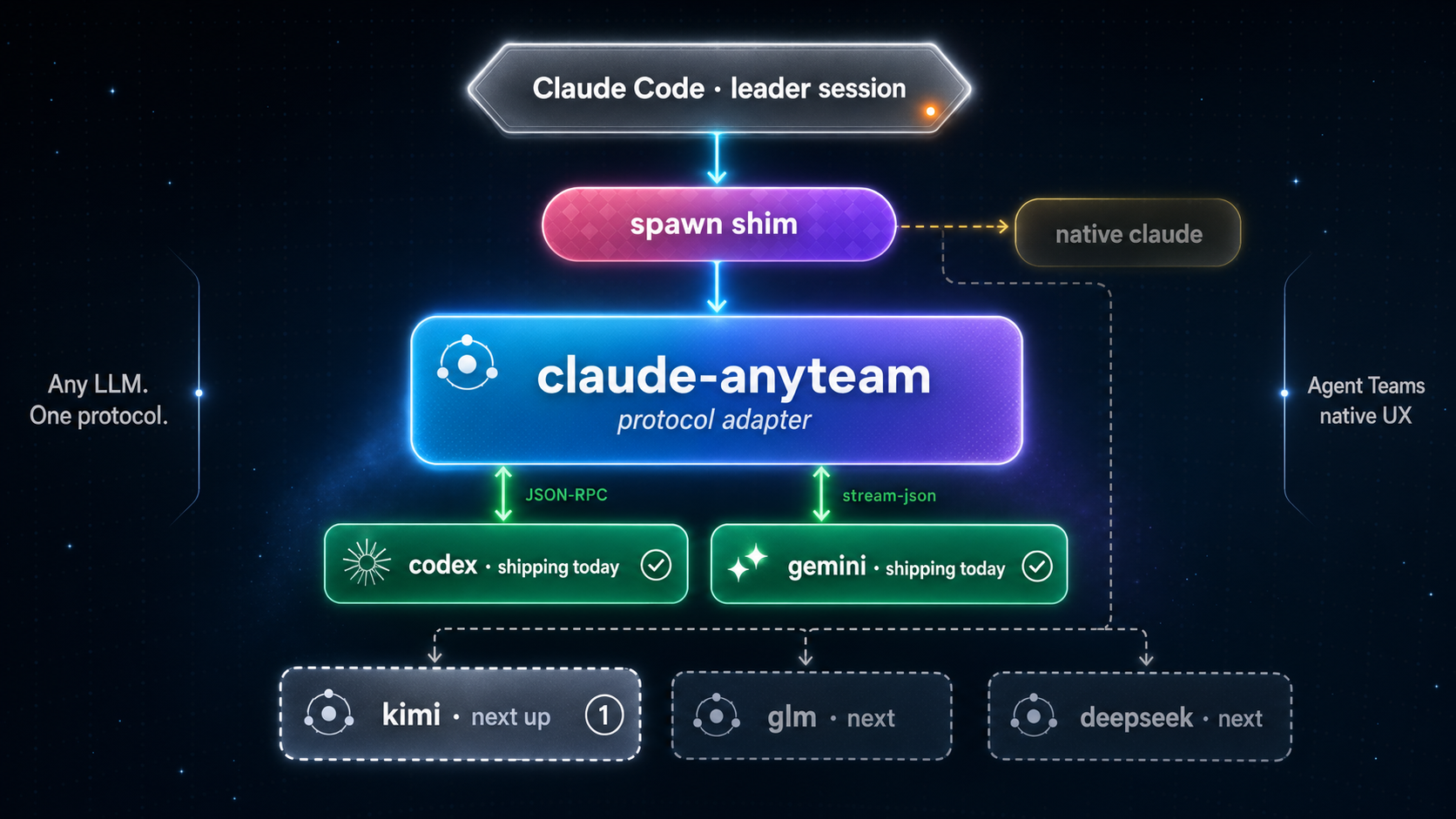
Codex and Gemini today. Kimi, GLM, DeepSeek next — on the same team-native architecture.





Quickstart · Architecture · Roadmap
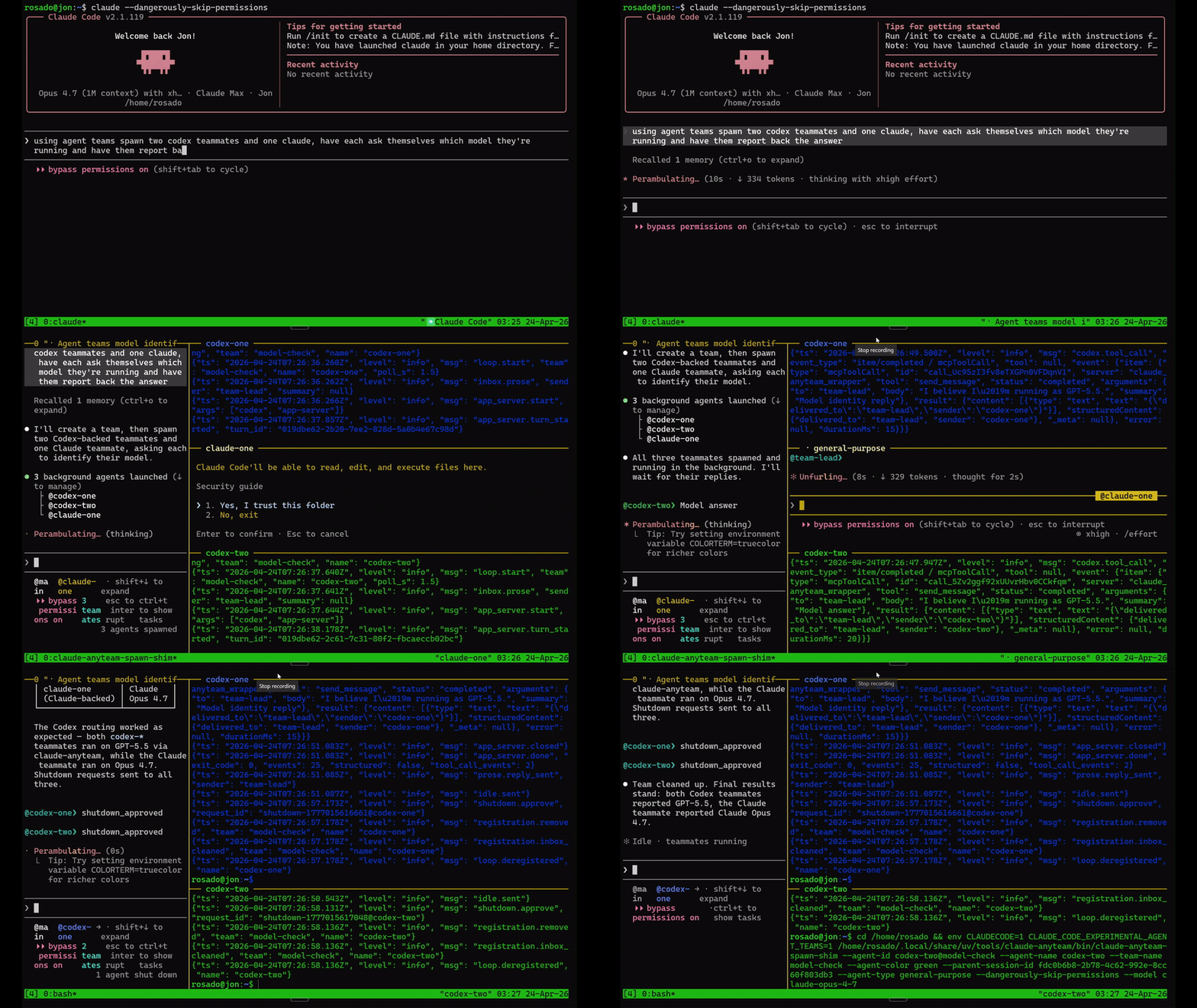
What it is
Claude Code's Agent Teams feature is built for multi-agent collaboration — but every teammate is a Claude instance. claude-anyteam makes it possible for any external model to join the same team, with the same native UX, without wrapping it inside a Claude LLM.
Your Claude Code session orchestrates. External models execute. No chat-wrapper overhead. No "Claude pretending to be Codex." Real models, real teammates.
Quickstart
npx --yes claude-anyteam
That's the entire install. The installer:
- Detects
python3and installsuvif missing (non-interactive, no shell profile edits) - Installs the
claude-anyteamPython tool viauv tool install - Runs
claude-anyteam install(verifies tmux/psmux, probes for the OpenAI Codex CLI and Gemini CLI, warns if either is missing or Codex is below 0.120, writes~/.claude/settings.json+~/.claude.json, records install-state for symmetric uninstall)
Restart Claude Code, enable Agent Teams mode, and create a teammate named codex-<anything> or gemini-<anything>:
codex-alice      → routed to claude-anyteam + Codex
codex-reviewer   → routed to claude-anyteam + Codex
gemini-alice     → routed to claude-anyteam + Gemini CLI
gemini-reviewer  → routed to claude-anyteam + Gemini CLI
alice            → native Claude (unchanged)
Codex- and Gemini-prefixed names appear in your TUI presence line exactly like native teammates. Single-terminal mode or tmux — both work.
Why it feels native
|
Real teammate protocol Not a chat wrapper. The adapter speaks Claude Code's agent-team protocol directly: mailbox I/O, atomic task claims, idle notifications, shutdown lifecycle. A Codex teammate is functionally indistinguishable from a native Claude teammate. |
Mid-task reactivity When a peer messages a working teammate, the adapter injects the message mid-turn via Codex's |
|
Cross-task memory Each new task forks from the previous task's Codex thread via |
Battle-tested parity 348 passing tests. Ten parity bugs caught by a live 4-teammate hunt (mixed Claude + Codex) and fixed. Zero accepted limitations on the protocol layer. |
Supported backends
| Backend | Teammate prefix | Status | Notes |
|---|---|---|---|
| Codex via OpenAI Codex CLI 0.120+ | codex-* |
✅ Supported today | App Server mode for mid-task steer and thread/fork; fresh-exec fallback with codex exec resume. |
| Gemini via Gemini CLI | gemini-* |
✅ Supported today | Default headless gemini --prompt ... --output-format stream-json, plus ACP via gemini-anyteam --backend acp; ACP supports `--trust default |
Coming next
| Coming next |
|---|
| ⏳ Kimi adapter |
| ⏳ GLM adapter |
| ⏳ DeepSeek adapter |
| ⏳ Generic CLI adapter template |
Codex and Gemini are shipping. Everything in "coming next" is on the same architectural surface — each new model is a new adapter binary + one line in the spawn shim's routing table. See docs/roadmap.md.
Requirements
- Python 3.12+
- Node 18+ (for the npm installer; not required at runtime)
- OpenAI Codex CLI 0.120+ on PATH for
codex-*teammates - Gemini CLI on PATH for
gemini-*teammates - Claude Code 2.1+ with Agent Teams mode
- Terminal multiplexer on PATH (tmux or psmux) — see configuration.md
Docs
- Install — how the installer wires Claude Code, alternative install methods, headless launches
- Architecture — how the adapter integrates with Claude Code's team protocol
- Roadmap — supported today vs coming next, contribution pointers
- Configuration — CLI flags, env vars, advanced modes
- Releasing — maintainer-facing tag-triggered publish flow
License
MIT
Yorumlar (0)
Yorum birakmak icin giris yap.
Yorum birakSonuc bulunamadi