hyperresearch
Health Gecti
- License — License: MIT
- Description — Repository has a description
- Active repo — Last push 0 days ago
- Community trust — 17 GitHub stars
Code Gecti
- Code scan — Scanned 12 files during light audit, no dangerous patterns found
Permissions Gecti
- Permissions — No dangerous permissions requested
This agent transforms Claude Code into an automated deep research pipeline. It uses a 16-step process to collect, search, and synthesize information from the web into a persistent, searchable local wiki.
Security Assessment
Overall Risk: Medium. Because the tool is explicitly designed to conduct automated web research, it inherently makes outbound network requests to fetch and scrape online sources. The automated code scan found no hardcoded secrets, no dangerous code patterns, and no requests for elevated system permissions. However, any tool that autonomously crawls the web and writes local files to build a "vault" should be granted access with caution, as the contents of those fetched sources are entirely dependent on external, uncontrolled websites.
Quality Assessment
This is a relatively new but actively maintained project. It is licensed under the permissive and standard MIT license, making it safe for commercial and personal use. While it currently has a modest community footprint with 17 GitHub stars, the repository saw code pushes as recently as today, indicating active and responsive development. The documentation is clear and detailed, though developers should be aware that its bold benchmark claims are currently based on internal testing with third-party validation still pending.
Verdict
Use with caution — the code is clean and actively maintained, but developers should monitor its autonomous web fetching and local file generation.
Agent-driven research knowledge base. Agents collect, search, and synthesize web research into a persistent, searchable wiki.

The Most Powerful Deep Research Harness




Hyperresearch turns Claude Code into a deep research agent. and currently leads the DeepResearch-Bench RACE leaderboard (benchmarked internally). A tier-adaptive 16-step pipeline produces adversarially-audited reports with full source provenance. Every fetched source lands in a persistent, searchable vault that compounds across sessions.
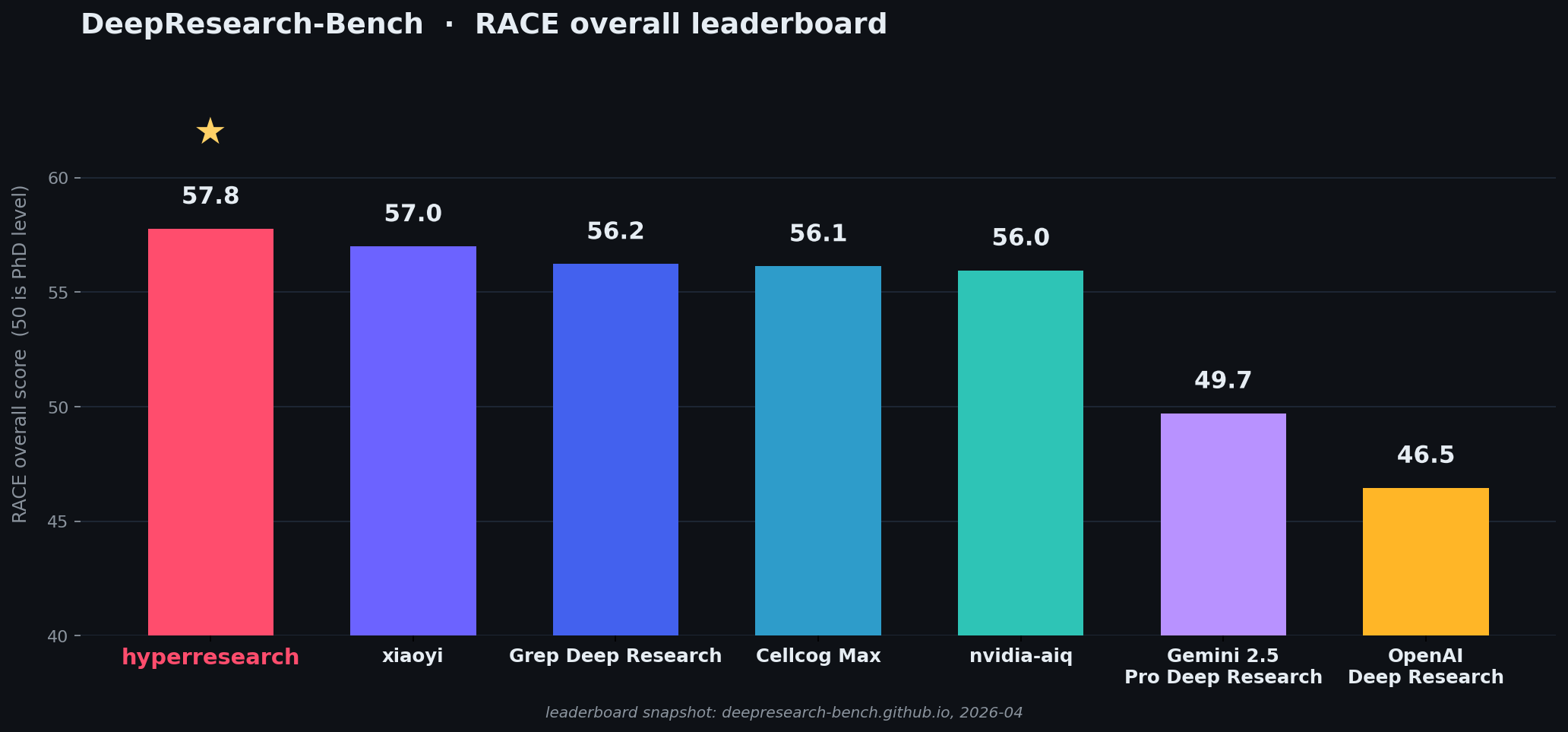
Forward-looking projection from a stratified pilot against the DeepResearch-Bench leaderboard snapshot (https://huggingface.co/spaces/muset-ai/DeepResearch-Bench-Leaderboard). Third party validation is pending.
Install
cd your-project
pip install hyperresearch && hyperresearch install
Then /hyperresearch <anything> in Claude Code.
Python 3.11–3.13. (3.14 not yet supported — use
pyenv install 3.13,uv venv -p 3.13, orpy -3.13 -m venv .venv.)Power users:
hyperresearch install --globalmakes/hyperresearchreachable from every Claude Code session anywhere, at the cost of ~15 lines in every session's system reminder. Per-project install (above) keeps unrelated CC sessions clean.
The 16-step research pipeline
The entry skill is a thin router. It bootstraps the canonical research query, then invokes one step skill per pipeline phase via Claude Code's Skill tool. Each step's procedure is loaded fresh into context only when needed defeating context-rot problems that makes long pipelines silently drop steps.
| # | Step | What it does | Tiers |
|---|---|---|---|
| 1 | Decompose | Canonical query → atomic items + coverage matrix + tier classification | both |
| 2 | Width sweep | Multi-perspective search plan + parallel fetcher waves (Haiku) | both |
| 3 | Contradiction graph | Pair contradictions across the corpus into ranked clusters | full |
| 4 | Loci analysis | Two parallel loci-analysts → scored loci with source budgets | full |
| 5 | Depth investigation | K parallel depth-investigators → interim notes with committed positions | full |
| 6 | Cross-locus reconcile | Reconcile committed positions → comparisons.md | full |
| 7 | Source tensions | Extract expert disagreements → source-tensions.json | full |
| 8 | Corpus critic | "What source would overturn this?" + targeted gap-fill fetch | full |
| 9 | Evidence digest | Top claims + verbatim quotes → evidence-digest.md | full |
| 10 | Triple draft | Per-angle source curation + 3 parallel draft sub-orchestrators (light: single draft) | both |
| 11 | Synthesize | Plan + outline + spawn synthesizer subagent → final_report.md | full |
| 12 | Critics | 4 adversarial critics in parallel → findings JSONs | full |
| 13 | Gap-fetch | Targeted fetch wave for critic-identified vault gaps | full |
| 14 | Patcher | Surgical Edit hunks applied to draft (tool-locked Read+Edit) | full |
| 15 | Polish | Hygiene + filler pass (tool-locked Read+Edit subagent) | both |
| 16 | Readability audit | Recommender writes JSON suggestions; orchestrator selectively applies | both |
Depth Modes
In your prompt, you can request one of two tiers and the rest of the pipeline scales accordingly. Full mode is default.
| Tier | Steps that run | Typical time |
|---|---|---|
light |
bounded factual queries, surveys, comparisons — 1 → 2 → 10 → 15 → 16 | ~30–40 min |
full |
deep argumentative analysis with adversarial review — all 16 steps | ~1.5–2.5 hours |
The two load-bearing principles
Patch, never regenerate. After step 11 produces the synthesized report (or step 10 for light tier), the only modifications are surgical Edit hunks. The patcher and polish auditor are tool-locked to
[Read, Edit]at the Claude Code allowlist level so they physically cannot Write a new draft. Per-hunk caps make "just rewrite it" mechanically impossible. Critic findings that don't fit a small hunk escalate as structural issues.Canonical research query is gospel. The verbatim user prompt is persisted to
research/query-<vault_tag>.mdonce and re-read by every subsequent step and every spawned subagent. Wrapper requirements (save paths, citation format, terminal sections) are a separate contract.
Subagent roster
| Agent | Model | Role |
|---|---|---|
hyperresearch-fetcher |
Sonnet | URL fetching via crawl4ai; runs 8–12 in parallel per wave |
hyperresearch-source-analyst |
Sonnet (1M ctx) | End-to-end digest of any single long source >5000 words |
hyperresearch-loci-analyst |
Sonnet | Reads the width corpus, returns 1–8 depth loci with rationale |
hyperresearch-depth-investigator |
Sonnet | Investigates one locus, writes one interim note with a committed position |
hyperresearch-corpus-critic |
Sonnet | "What source would overturn the current direction?" pre-draft gap analysis |
hyperresearch-draft-orchestrator |
Opus | One per draft angle; reads its curated source list and writes one draft |
hyperresearch-synthesizer |
Opus | Reads all 3 drafts, writes the final report (two-pass write, Read+Write locked) |
hyperresearch-dialectic-critic |
Opus | Counter-evidence the draft missed |
hyperresearch-depth-critic |
Opus | Shallow spots interim notes could fill |
hyperresearch-width-critic |
Opus | Topical corners the corpus supports but the draft ignores |
hyperresearch-instruction-critic |
Opus | Structural mismatches against the prompt's atomic items |
hyperresearch-patcher |
Opus | Tool-locked [Read, Edit]. Applies critic findings as surgical Edit hunks |
hyperresearch-polish-auditor |
Opus | Tool-locked [Read, Edit]. Cuts filler, strips hygiene leaks |
hyperresearch-readability-recommender |
Opus | Writes JSON suggestions for paragraph rhythm and list/table conversion |
The vault: persistent, searchable, compounding
Hyperresearch is not a one-shot report generator like most other Deep research harnesses. Every fetched source lands in a SQLite-indexed vault that every future research session can reuse.
hyperresearch search "ion-trap gate fidelity" -j           # Full-text search
hyperresearch search "quantum" --include-body -j           # Full-body search
hyperresearch note show <id1> <id2> <id3> -j               # Batch-read notes
hyperresearch graph hubs -j                                # Most-connected notes
hyperresearch graph backlinks <id> -j                      # Reverse links
hyperresearch lint -j                                      # Health check (broken links, missing tags)
Markdown is truth, SQLite is cache. Notes live as plain markdown with YAML frontmatter in research/notes/. The SQLite index is fully rebuildable. Delete it and hyperresearch sync reconstructs it from the markdown. The vault is inspectable in any editor, version-controllable in git, and readable without the tool installed.
PDFs fetch directly. hyperresearch fetch auto-detects PDF URLs (arXiv, NBER, SSRN, direct .pdf links) and extracts full text via pymupdf. Raw PDFs land in research/raw/<note-id>.pdf and the note's raw_file: frontmatter links back.
Provenance breadcrumbs. Every fetched source carries a --suggested-by link back to whatever surfaced it. The chain forms a rooted tree from seed fetches; the provenance lint rule catches disconnected components.
What's structurally enforced
- Verbatim prompt as gospel —
scaffold-promptlint blocks if the scaffold doesn't open with the user's exact prompt - Locus coverage — every step 4 locus must have a step 5 interim note; missing interims flag as errors
- Patch-only modification — steps 14, 15, 16 are tool-locked to
[Read, Edit]. They cannot regenerate the draft - Critical findings never silently skip —
patch-surgerylint surfaces any critical finding the patcher couldn't apply - Schema integrity —
tier,content_type, andtypeare SQLite CHECK-constrained vocabularies; corrupted frontmatter cannot poison the index - Hygiene leaks caught on the way out — scaffold sections, YAML frontmatter, and prompt echoes are stripped by step 15 before ship
Authenticated crawling
Fetch from LinkedIn, Twitter, paywalled sites or anything you can log into:
hyperresearch setup # Browser opens. Log into your sites. Done.
LinkedIn, Twitter, Facebook, Instagram, and TikTok automatically use a visible browser to avoid session kills.
Academic APIs before web search
For any topic with a research literature, hit academic APIs BEFORE web search. They return citation-ranked canonical papers; web search returns derivative commentary.
- Semantic Scholar —
https://api.semanticscholar.org/graph/v1/paper/search - arXiv —
https://export.arxiv.org/api/query - OpenAlex —
https://api.openalex.org/works - PubMed —
https://eutils.ncbi.nlm.nih.gov/entrez/eutils/esearch.fcgi
After the academic sweep, run web searches for context, news, non-academic angles, and at least one adversarial search ("criticism of X", "limitations of X").
What it doesn't do
- It doesn't replace your judgment on which sources matter. The agent picks, you steer.
- It can't fetch what's behind a paywall you haven't logged into.
- It runs on Anthropic models Opus + Sonnet + Haiku via the subagent roster. Costs scale with tier and corpus size. If anyone wants to port this to Codex, put up a PR!
- The lint gate catches structural failures (missing scaffold, broken provenance, unresolved CRITICALs). It cannot guarantee factual accuracy, that's still your call.
Requirements
- Python 3.11+
- Claude Code
License
Star History
Yorumlar (0)
Yorum birakmak icin giris yap.
Yorum birakSonuc bulunamadi