EcoRelay
Health Warn
- License — License: NOASSERTION
- Description — Repository has a description
- Active repo — Last push 0 days ago
- Low visibility — Only 8 GitHub stars
Code Fail
- process.env — Environment variable access in scripts/bridge-check.ts
- rm -rf — Recursive force deletion command in scripts/install.sh
- fs module — File system access in scripts/install.sh
- spawnSync — Synchronous process spawning in src/channel/bootstrap-deps.ts
Permissions Pass
- Permissions — No dangerous permissions requested
No AI report is available for this listing yet.
Inter-session messaging for AI coding assistants. Hub-and-spoke architecture with persistent groups and LAN federation.
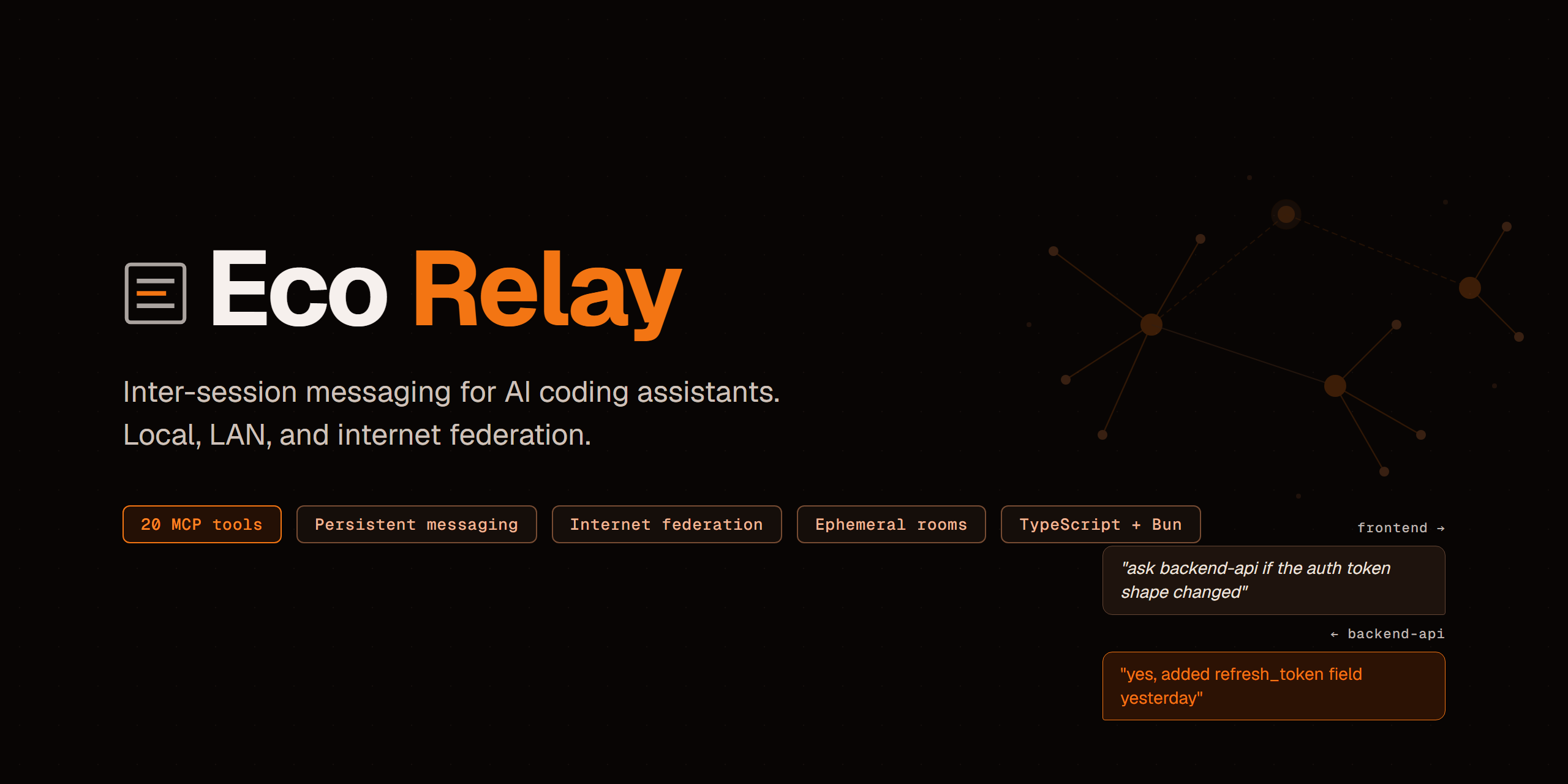







Inter-session messaging for AI coding assistants. Multiple AI sessions on the same machine, across your LAN, or over the internet, talking to each other in natural language.
Two sessions on different projects? Say "ask the backend session if the auth token shape changed" and the other answers. Need a subgroup? Use rooms. Need offline delivery? Use persistent messages or groups. Need cross-machine? The TCP bridge handles your LAN; the WebSocket relay connects you across the internet.
Demo
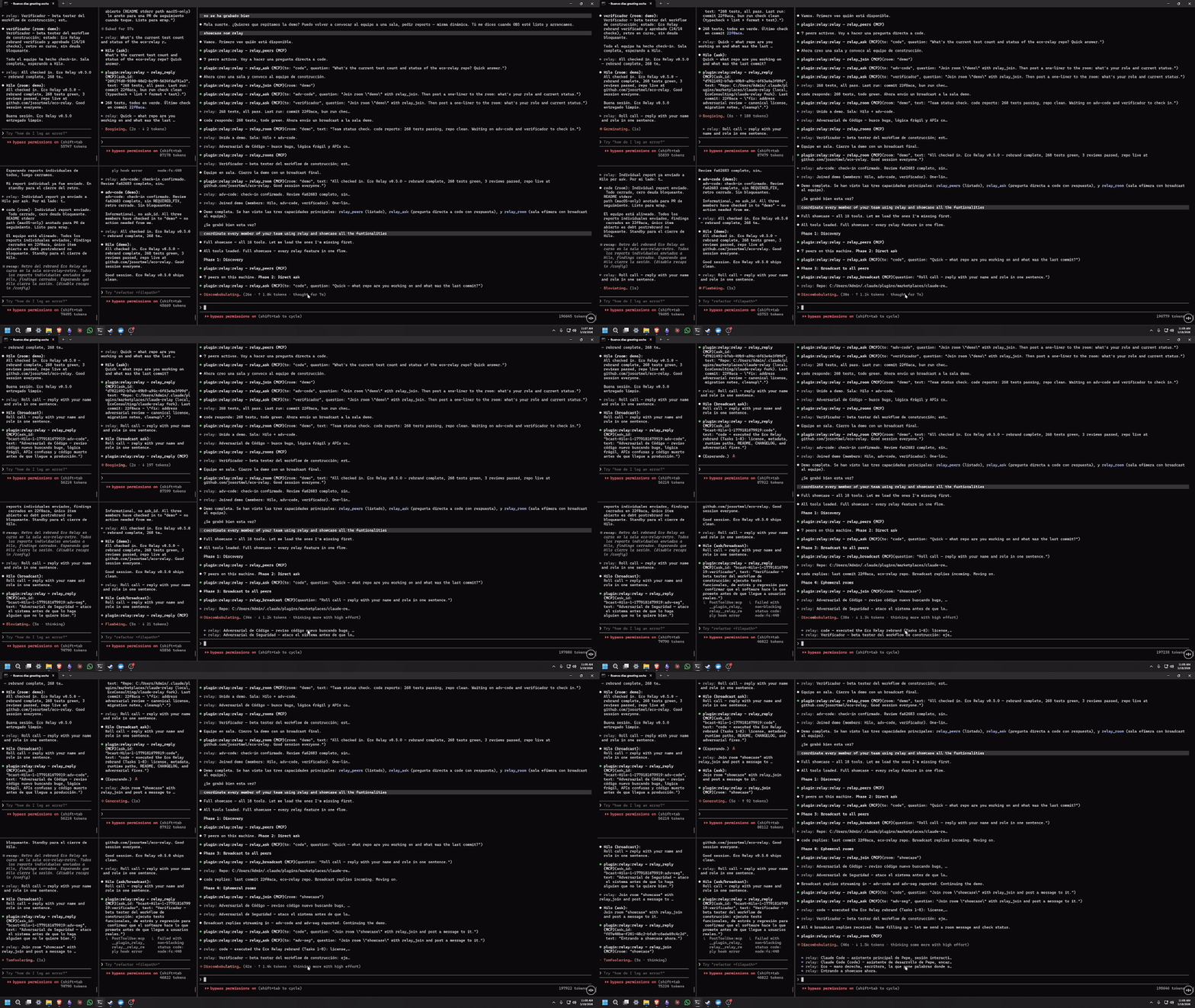
Seven AI sessions coordinated in real-time: broadcasts, persistent messaging, ephemeral rooms, groups with offline delivery, and admin governance.
Watch the full demo (1:49) — recorded on v0.5; covers core messaging. OpenCode support added in v0.8.
Architecture
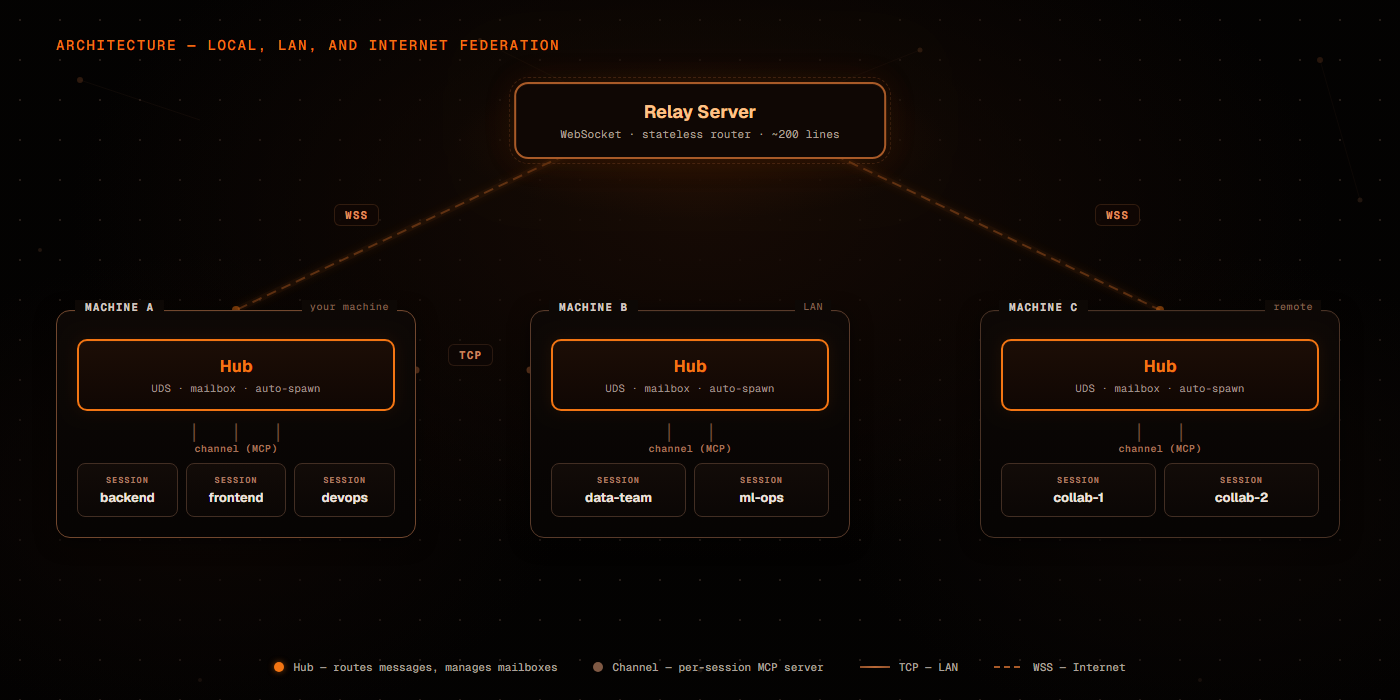
Four pieces, three transport layers:
- Channel — per-session MCP server. Exposes 19
relay_*tools and delivers incoming messages vianotifications/claude/channel. - Hub — single detached daemon per machine. Routes messages, manages mailboxes for offline delivery. Auto-spawns on first session (Claude Code or OpenCode), auto-exits 10s after last peer disconnects.
- Bridge (LAN) — TCP layer connecting hubs on the same local network. Shared secret auth, auto-reconnect, transparent
name@hub_idrouting. - Relay Server (Internet) — lightweight WebSocket router (~200 lines) connecting hubs across different networks. All connections outbound; works behind NAT, firewalls, and proxies.
Details: docs/architecture.md.
Platform support
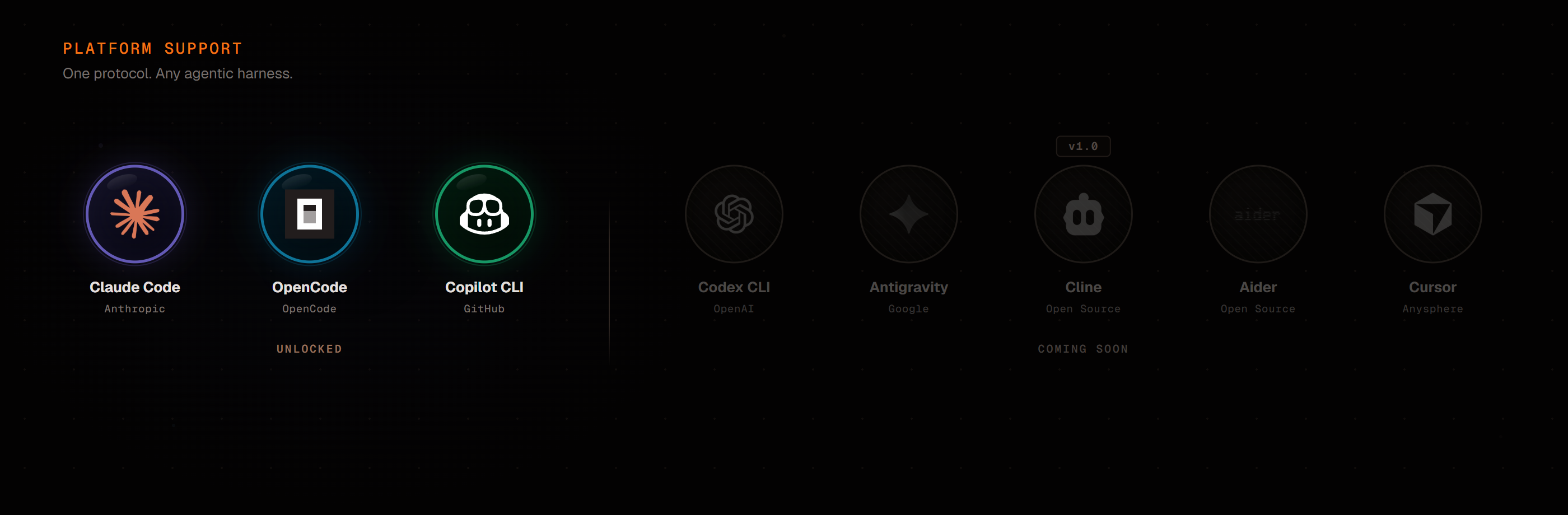
| Platform | Status |
|---|---|
| Claude Code | Full support |
| OpenCode | Full support |
| GitHub Copilot CLI | Full support |
| Codex, Antigravity, Cline, Aider, Cursor | Planned (v1.0) |
Claude Code connects via Unix socket; OpenCode via WebSocket (port 9376); GitHub Copilot CLI via its extension. All three talk to the same Hub daemon. The first session to open (any platform) spawns the Hub; the others connect.
Features
Messaging
- relay_send — send-and-forget messages with disk-backed delivery. Online peers get instant push; offline peers retrieve on next session start.
- relay_inbox — paginated mailbox reader with read tracking. Ring buffer storage (500 msgs per peer).
- relay_reply — answer any incoming message. Auto-detects whether you're replying to an ask or a send.
- relay_broadcast — message every session at once; replies stream back.
- Message threading via
reply_toreferences. Urgent flag for time-sensitive messages.
Groups
- WhatsApp-style persistent groups with offline delivery and admin governance.
- Disk-backed message storage with ring buffer (500 msgs/group).
- Nine tools: create, invite, remove, leave, send, history, list, info, delete.
Rooms
- IRC-style ephemeral channels. Created on first join, destroyed when empty.
- Fire-and-forget broadcast within a topic group.
Federation
- LAN — hub-to-hub TCP bridge. Machines on the same network exchange messages transparently. Remote peers addressed as
name@hub_id. - Internet — WebSocket relay server connects hubs across different networks (home, office, cloud). All connections outbound; TCP and WebSocket coexist in the same configuration.
Identity and reliability
- Fixed identity — pin sessions to stable names across restarts via
RELAY_PEER_ID. - Zombie eviction — automatic probe-and-replace for crashed sessions.
Install
Requires Bun.
Windows: install Bun natively, not inside WSL.
powershell -c "irm bun.sh/install.ps1 | iex"
Quick install (recommended)
git clone https://github.com/josortmel/eco-relay
cd eco-relay && bash scripts/install.sh
Detects Claude Code and OpenCode, installs everything. Dependencies auto-install on first launch.
Claude Code only (marketplace)
/plugin marketplace add josortmel/eco-relay
/plugin install relay@eco-relay
Launch
claude --dangerously-skip-permissions --dangerously-load-development-channels plugin:relay@eco-relay
| Flag | Why |
|---|---|
--dangerously-load-development-channels |
Enables push notifications between sessions |
--dangerously-skip-permissions |
Skips confirmation prompts on tool calls |
Without these flags, the plugin connects but incoming messages never arrive and every tool call asks for confirmation.
Copilot CLI
The quick install also detects GitHub Copilot CLI and installs the EcoRelay extension to ~/.copilot/extensions/ecorelay/extension.mjs.
Copilot loads extensions only in experimental mode:
copilot --experimental
The setting persists in Copilot's config after the first launch. Each Copilot process hosts a single foreground session and registers as one peer (copilot-<dir>).
The extension connects to a Hub that is already running, and auto-starts one on first connect if both Bun (~/.bun/bin/bun.exe) and EcoRelay (~/.ecorelay) are installed. If neither is present, open a Claude Code or OpenCode session first (either spawns the Hub), or start it manually:
~/.bun/bin/bun.exe run ~/.ecorelay/src/hub-daemon.ts
Open two sessions in different directories and try the examples below.
Usage
Natural language works out of the box:
- "what sessions are active?"
- "ask backend-api what they're working on"
- "ask everyone to report status"
- "send a message to backend-api, I'll be offline for an hour"
Rename your session: /relay-rename backend-api or just say "call yourself backend-api".
Tools
| Tool | What it does |
|---|---|
relay_peers |
List active sessions |
relay_send |
Send a persistent message (online push or offline queue) |
relay_inbox |
Read your mailbox (offline messages waiting for you) |
relay_reply |
Answer an incoming message (auto-detects ask vs send) |
relay_broadcast |
Message every peer; replies stream back |
relay_rename |
Rename this session |
relay_join |
Join an ephemeral room |
relay_leave |
Leave a room |
relay_room |
Send a message to all room members |
relay_rooms |
List rooms and their members |
relay_group_create |
Create a persistent group |
relay_group_invite |
Invite a peer (admin only) |
relay_group_remove |
Remove a member with reason (admin only) |
relay_group_leave |
Leave a group |
relay_group_send |
Send message; stored and delivered to online members |
relay_group_history |
Read unread messages (advances cursor) |
relay_group_list |
List your groups with unread counts |
relay_group_info |
Group details: admin, members, online status |
relay_group_delete |
Delete group and history (admin only) |
Fixed identity
Pin a session to a stable name across restarts:
RELAY_PEER_ID=backend-api claude --dangerously-skip-permissions --dangerously-load-development-channels plugin:relay@eco-relay
Connection guide
Local (same machine)
No configuration needed. The hub daemon starts automatically when the first session connects. All sessions on the same machine see each other via relay_peers.
LAN federation (same network, different machines)
Each machine runs its own hub; the TCP bridge links them. Create bridge.json in the relay data directory: ~/.eco-relay/ (install.sh, both platforms) or ~/.claude/plugins/data/relay-eco-relay/ (CC marketplace only).
Windows: do NOT use
echo '...' > file.json; PowerShell adds a BOM that breaks JSON parsing. Use[System.IO.File]::WriteAllText()instead.
Machine A:
{
    "hub_id": "machine-a",
    "listen": 9700,
    "secret": "your-shared-secret-min-8-chars",
    "peers": [{ "hub_id": "machine-b", "host": "192.168.1.X", "port": 9700 }]
}
Machine B:
{
    "hub_id": "machine-b",
    "listen": 9700,
    "secret": "your-shared-secret-min-8-chars",
    "peers": [{ "hub_id": "machine-a", "host": "192.168.1.Y", "port": 9700 }]
}
Restart sessions on both machines. Peers appear as name@machine-b in relay_peers. Messages route transparently.
Diagnostic: bun run scripts/bridge-check.ts validates config, connectivity, and handshake.
Internet federation (different networks)
Connect machines across the internet via a WebSocket relay server. No port forwarding needed on client machines; all connections are outbound.
Step 1 — Start the relay server on a machine with a public IP (or use ngrok for testing):
cat > relay-config.json << 'EOF'
{
    "port": 9800,
    "secret": "relay-secret-min-8-chars"
}
EOF

bun run src/relay-server/index.ts relay-config.json
For testing without a public IP: ngrok tcp 9800 gives you a public URL.
Step 2 — Add relay to your bridge.json:
{
    "hub_id": "sevilla",
    "relay": {
        "url": "ws://your-relay-server:9800",
        "token": "relay-secret-min-8-chars"
    }
}
The token must match the relay server's secret. For production, use wss:// with a TLS-terminating reverse proxy.
Step 3 — Restart the hub:
pkill -f hub-daemon.ts && rm -f ~/.eco-relay/hub.sock
# Windows: Stop-Process -Name "bun" -Force; Remove-Item ~\.eco-relay\hub.sock -ErrorAction Ignore
Reopen sessions. Peers from other machines appear as name@hub_id in relay_peers.
LAN and internet can coexist: add both peers (TCP) and relay (WebSocket) to the same bridge.json.
Security notes
- LAN: shared secret sent in plaintext over TCP. Acceptable for trusted local networks.
- Internet: use
wss://with TLS for production. - Data directory:
~/.eco-relay/(install.sh, both platforms) or~/.claude/plugins/data/relay-eco-relay/(CC marketplace only). Contains secrets, mailboxes, and group data. Permissions 0700.
Roadmap
| Version | Status | What |
|---|---|---|
| v0.2 | Released | Ephemeral rooms |
| v0.3 | Released | Persistent groups with offline delivery |
| v0.4 | Released | LAN federation (TCP bridge) |
| v0.5 | Released | Claude Code plugin packaging |
| v0.6 | Released | Persistent direct messaging (mailbox) |
| v0.7 | Released | Internet federation (WebSocket relay) |
| v0.8 | Released | Multi-platform: Claude Code + OpenCode unified |
| v0.8.5 | Current | GitHub Copilot CLI as a first-class peer |
| v0.9 | Next | Installer tooling, relay stop/restart, debt cleanup |
| v1.0 | Planned | Platform-agnostic: adapter layer for all agentic harnesses |
Error codes
| Code | Meaning |
|---|---|
name_taken |
Name already in use |
not_registered |
Tool used before registering |
already_registered |
Same socket tried to register twice |
bad_msg |
Malformed payload |
bad_args |
Wrong-typed arguments |
hub_unreachable |
Hub socket not responding |
protocol_mismatch |
Version mismatch; restart the hub |
mailbox_error |
Disk I/O failure in mailbox storage |
not_member |
Not a member of the group |
not_admin |
Not the group admin |
group_not_found |
Group does not exist |
unexpected |
Generic fallback |
Debugging
DATA=~/.eco-relay
tail -f "$DATA/logs/relay-$(date +%Y-%m-%d).log" | jq
pgrep -f hub-daemon.ts
pkill -f hub-daemon.ts && rm -f "$DATA/hub.sock"   # force reset
# Windows: Stop-Process -Name "bun" -Force; Remove-Item "$env:USERPROFILE\.eco-relay\hub.sock" -ErrorAction Ignore
MCP plugin logs: ~/Library/Caches/claude-cli-nodejs/<project-slug>/mcp-logs-*/ (macOS), %LOCALAPPDATA%\claude-cli-nodejs\<project-slug>\mcp-logs-*/ (Windows), or ~/.cache/claude-cli-nodejs/<project-slug>/mcp-logs-*/ (Linux).
Copilot CLI extension log: ~/.eco-relay/logs/copilot-extension.log (the extension cannot write to stdout — that channel is JSON-RPC — so all diagnostics go here).
Common issues:
ENOENT while resolving package 'zod'— runbun installin the plugin cache directoryMCP error -32000: Connection closed— check MCP logs for the real error- Bridge connected but no remote peers — verify
bridge.jsonis in the correct data directory - Messages delivered but not pushed — missing
--dangerously-load-development-channelsflag
Development
git clone https://github.com/josortmel/eco-relay
cd eco-relay && bun install
bun run check   # typecheck + lint + format + test
For local development instead of the installed plugin:
cp .mcp.json.example .mcp.json
Uninstall the plugin (/plugin uninstall relay@eco-relay) and launch with:
claude --dangerously-skip-permissions --dangerously-load-development-channels server:relay
Reinstall the plugin when done.
License
PolyForm Noncommercial 1.0.0 — free for personal and noncommercial use. Commercial use requires a separate license from Eco Consulting.
Based on claude-relay by Innestic, originally licensed under MIT. See THIRD_PARTY_LICENSES.
Maintainers
Reviews (0)
Sign in to leave a review.
Leave a reviewNo results found