Marvin
Health Warn
- License — License: MIT
- Description — Repository has a description
- Active repo — Last push 0 days ago
- Low visibility — Only 5 GitHub stars
Code Fail
- rm -rf — Recursive force deletion command in .codex/agents/tl.toml
- exec() — Shell command execution in .marvin/Planejamento/Manutencao/codigo/ingles/US-14-codigo-em-ingles/renomear/lex.mjs
Permissions Pass
- Permissions — No dangerous permissions requested
No AI report is available for this listing yet.
One AGENTS.md, N thin adapters, memory versioned inside the repo. Zero-dependency scaffold for working with AI coding agents.


Marvin
One AGENTS.md, N thin adapters, memory versioned inside the repo.
Scaffolds a project's knowledge base for working with AI agents — and survives switching tools.




English · Português
npx marvin-kb --tools=claude,codex
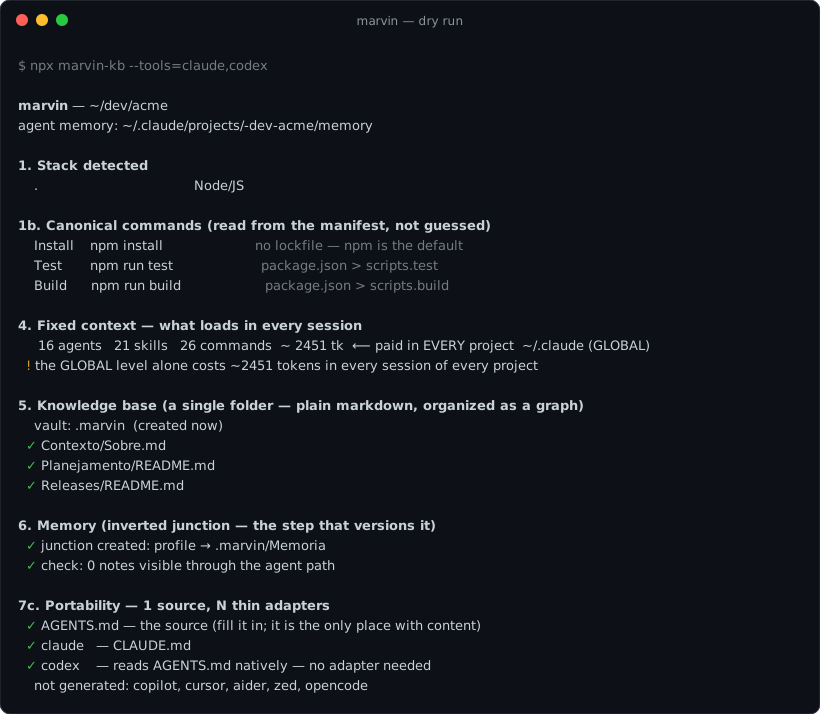
Not a framework. Nothing runs in the background. No dependencies. It's a ~1810-line Node
script that creates a structure and gets out of the way.
Why this exists. Not to invent anything — tools that do this already exist, and in
more mature forms. Marvin is a learning project: on paper it makes no sense to build what
the market already ships; in practice, building is how you understand why things are the
way they are. Use it if it fits; steal the ideas if it doesn't.
| 🧭 One source of truth | all durable content in AGENTS.md; each tool gets a 15-line pointer |
| 🧠 Memory in git | an inverted junction makes the agent's memory land inside .marvin/ |
| 🔁 Idempotent | run it twice, nothing duplicates or gets overwritten |
| 🔍 Diagnostics | fixed-context cost per session, empty "services", junk in the root, canonical commands read from the manifest |
| 🔌 Optional tools | graphify code graph, ponytail and playwright, recorded in .marvin/ferramentas.md — never required |
The package is
marvin-kb, the command ismarvin.marvinwas already taken on
npm, sonpx marvinwould fetch someone else's package — usenpx marvin-kb. Afternpm i -g marvin-kbthe command on your PATH is justmarvin.
Or clone it and run the file directly — it's a single script with no dependencies:
node /path/to/marvin/marvin.mjs --tools=claude,codex
- The problem
- How it solves it
- What it creates
- Where the knowledge base lands
- What it deliberately does NOT do
- Agent, skill, or command?
- Tools
- Diagnostics
- Flags
- Upgrading a project that's already set up
--graphify- Related: Anthropic's
claude-code-setup - Requirements · Tests · Contributing · License
The problem
Every AI tool wants your project context in its own format: CLAUDE.md,.cursor/rules/, CONVENTIONS.md, AGENT.md, AGENTS.md. Use more than one and you end
up with the same content in N places — and N copies diverge. By week three one of them
is lying, and the agent believes it.
Worse: agent memory usually lives in your user profile, outside the repository. Not in
git, not backed up, gone when the machine dies.
How it solves it
One source, N thin adapters. All durable content lives in AGENTS.md — the standard
that Codex, Cursor, Aider, Zed and opencode read. Each tool's file is a 15-line
pointer with no content of its own. Divergence becomes structurally impossible.
Memory inside the repository, via an inverted junction:
~/.claude/projects/<path>/memory ──junction──► .marvin/Memoria/
The tool writes to its own default path; the files are born inside the repository. Memory
as plain markdown inside the project, one source. Switch tools and the files stay —
only the auto-loading goes away.
What it creates
<project>/
├── AGENTS.md                   source of truth — all durable content
├── CLAUDE.md                   adapter (only if you pick claude)
├── .cursor/rules/projeto.mdc   adapter (only if you pick cursor)
├── .claude/
│   ├── agents/README.md        guide for writing your team
│   ├── skills/README.md        skill vs. agent vs. command: the discriminator
│   └── commands/retomar.md     /retomar: the entry point
└── .marvin/                    ← knowledge base, organized as a GRAPH
    ├── Contexto/               what the project IS
    │   ├── Sobre.md            root node — links to the flows
    │   ├── Fluxos/             one .md per flow; born when a flow gets analyzed
    │   ├── Arquitetura/        how it is built; structural decisions live here
    │   └── Design/             only when a front-end is detected
    ├── Planejamento/           what is being DONE: <Epic>/<Feature>/<US>/Sobre.md
    │   ├── Manutencao/         every node has the same Sobre.md: state, parent, Rumo
    │   └── Novos/
    ├── Fontes/                 support; Externas.md says what lives outside the repo
    ├── Releases/               <version>.md — index of what shipped, with evidence
    └── Memoria/
        └── onde_paramos.md     the only door; pointers to the active USs, nothing else
Two axes: what the project is (Contexto/) and what is being done to it
(Planejamento/). Every node is a Sobre.md with estado in the frontmatter, a link to
its parent and a Rumo section — one entry per change of direction. Decisions live in
the node that made them: a US decision in the US, a structural one in Arquitetura/.
Nothing moves folders when done: the US gets estado: concluida, its evidence, and a line
in Releases/. Links are edges: with --graphify, the knowledge base joins the code
graph, and graphify affected "<function>" answers which US and which code depend on it.
The generated Planejamento/README.md carries the rule that repeats before any US (AGENTS.md only points to it — a rule lives where it fires): map what the
activity touches, propose its team in layers (tl, po · dev-front, dev-back, qa ·scout, plus design/dba/sec/infra when the activity asks), propose the skills it
will repeat, and update the agents with what this activity taught — append, never rewrite.
Generated file and folder names are in Portuguese, matching the templates the script
ships. They are yours to rename — nothing in the script depends on the names except the
markers below.
Where the knowledge base lands — and why it isn't always .marvin
The script looks for an existing base by its markers (Memoria/, 08_Memoria/ or .obsidian/),
not by folder name. The rule:
| Situation | Result |
|---|---|
| New project | creates .marvin/ |
A base already exists in .docs/, Docs/ or docs/ |
reuses it, no duplicate |
A Docs/ exists that is not a base (product documentation) |
creates .marvin/ alongside and says: "living next to product Docs/ — untouched" |
The name says whose folder it is. In most repositories this tool runs in — a client's
code, an employer's, a team's — this base is your working material, not a project
deliverable. A generic .docs suggested the opposite and invited being committed along
with the product. .marvin makes its origin and its audience explicit.
.docs stays in the candidate list, so a project set up by an earlier version keeps
working with no migration — detection is by marker, not by name. And if the project'sDocs/ is already where knowledge lives, merging still beats separating: two bases that
can't see each other is the worst outcome.
Practical consequence: migrated projects tend to sit in Docs/, new ones in .marvin/.
That's the design, not an inconsistency. Only rename if the folder is 100% tooling —
and if you do rename it, rebuild the junction, because it still points at the old path
and goes orphaned silently:
# PowerShell — removes ONLY the link, never the content
[System.IO.Directory]::Delete("$env:USERPROFILE\.claude\projects\<path>\memory", $false)
git mv Docs .marvin
New-Item -ItemType Junction -Path "$env:USERPROFILE\.claude\projects\<path>\memory" `
         -Target "$PWD\.marvin\Memoria"
Then update the references to Docs/ in AGENTS.md, in the tool adapter, inretomar.md, and in the memory notes.
What it deliberately does NOT do
It doesn't write your agents, and it doesn't write the body of AGENTS.md. That
requires knowing the project's traps, and a generic agent is worse than no agent.PROMPT.md carries the prompt that guides this part.
The difference between an agent that helps and one that gets in the way isn't the role
description — it's the concrete trap written inside it. "you are a senior React dev" is
worth nothing; "`account.balance` is the opening balance, not the displayed one"
prevents a bug.
Same for skills: the script creates the folder and the guide, no skills.
Agent, skill, or command?
The scaffold ships the discriminator, because getting this wrong is common:
| Where the text loads | Who uses it | |
|---|---|---|
| Agent | its own clean context | spawned, isolated |
| Skill | the current context | whoever invokes it |
| Command | current context | you trigger it |
A fact the subagent must know → in the agent's
.md.
A procedure 2+ roles run → skill.
Something you trigger → command.
The catch: a subagent starts with a clean context. It doesn't read AGENTS.md, doesn't
read the adapter, and doesn't read skills — unless it has the Skill tool in its list. So
repeating a critical fact inside every agent that needs it isn't sloppiness, it's the
only way. What must not be repeated is procedure.
Cost rule: a new skill only after the procedure has run twice. Every skill's
description loads in every session — thirty skills become the problem skills were supposed
to solve.
Tools
| Flag | Generates | Confidence |
|---|---|---|
codex, opencode |
nothing — they read AGENTS.md natively |
high |
claude |
CLAUDE.md + /retomar |
high |
copilot |
.github/copilot-instructions.md |
high |
cursor |
.cursor/rules/projeto.mdc |
medium |
aider |
CONVENTIONS.md |
medium |
zed |
AGENT.md |
low |
GitHub Copilot's agent also reads AGENTS.md anywhere in the repo, but chat and code
completion don't — that's why the pointer file is generated anyway.
Medium and low confidence adapters ship with a warning at the top telling you to verify
the current convention. An adapter that doesn't load fails silently — worse than no
adapter at all.
Running again with a different list adds what's missing; nothing is removed.
Optional tools — the .marvin/ferramentas.md record
Some tools are not adapters but things a project chooses to use. marvin detects them
on PATH (playwright is offered by a web front in a package.json, not by PATH), asks
once (only with a terminal — without one it records não and warns), and writes the
answer to .marvin/ferramentas.md. Later runs read the record instead of asking. Flip it
with --use=<tool>; --no-questions records não even with a terminal. A comma list
turns several on at once (marvin --use=graphify,ponytail), and without a terminal, with
both detected, the warning suggests exactly that line.
| Tool | What it produces | Reach |
|---|---|---|
graphify |
graphify-out/graph.json — the code graph, see below |
any agent reads the JSON/markdown; only the hook is Claude-specific, and it is not installed |
ponytail |
a simplicity ladder for whoever implements — a ## Ferramentas section in AGENTS.md (confidence low: installed and read, not measured) and a role table in .claude/agents/README.md (dev yes; tl/po/scout no) |
plugin with hooks in Claude Code, Codex and Copilot CLI (each has its own install; marvin detects only the Claude one, telling installed — ~/.claude/plugins/installed_plugins.json — from active — ~/.claude/.ponytail-active); Cursor takes its hooks (~/.cursor/hooks.json) or its rule file, neither generated; everyone else copies the rule file from the ponytail repo |
playwright |
a ## Ferramentas section in AGENTS.md with the rule "a US that touches a screen closes only with Playwright evidence" (flow script + screenshot or playwright-cli snapshot); confidence low: not measured |
offered only when a package.json (root or sub-repo, depth ≤ 3) has a web front; installation is not detected; covers web/PWA only — not React Native/Expo without react-dom, nor Flutter |
Reach is the column that matters: it says who can consume what the tool produces.
A tool whose output only one agent reads is a decision, not a default.
AI availability — local onboarding
In 2.0.0, the activity guides roles, skills and eligible model/effort choices;
roles no longer prescribe a provider. Availability declarations and the glossary
support that decision without making marvin an inference engine.
With a terminal, marvin asks which tool runs the session, which AI options you have,
how you access each one, and whether you have configured it in that tool. Initial
study scope: Claude, Codex/OpenAI, MiniMax, DeepSeek, Gemini, Grok and Jev; additions
remain a human decision. One capable option can cover several roles.
Declarations go to <vault>/.local/disponibilidade.json, excluded by a local.gitignore even with --no-git. No credentials, authentication or inference calls.
Existing choices are never overwritten; edit that local JSON to change them and
reconfirm access before use. Declared configuration does not prove execution.
An absent inventory means unknown, not no access. Without a terminal or with--no-questions, marvin skips this onboarding; use flags for unattended setup:
marvin --tools=codex --executor=codex --ai=codex:subscription:yes
marvin --tools=opencode --executor=opencode --ai=deepseek:api:yes --ai=minimax:api:unknown
--executor declares the session tool; --tools generates adapters. Neither connects
providers. Access values: subscription, api, local, unknown; configuration
values: yes, no, unknown. --ai=none declares no available options. Dry-run
never asks AI questions or writes choices; declarations supplied by flags appear in
the plan. Invalid declarations fail before writing.
The generated Contexto/IA.md (IA.md in an old vault) holds the glossary procedure,
dated reference links and selection policy: activity/domain → roles → skills →
capabilities → eligible model/tool/effort. It is consulted by pointer, not loaded
as a full catalog every session. No fixed provider, automatic quota takeover or
measured savings are promised. Jev supports structured decisions rather than text
generation; a MiniMax text connection does not establish access to video.
Diagnostics
Beyond creating things, it points out problems that slip by:
- Real stack per directory — doesn't trust folder names
- Directories that look like a service but are empty — stops you from writing an agent
for code that doesn't exist - Junk in the root — a file with a strange name is a malformed shell command, not content
- Empty files tracked in git — almost always junk that slipped in via
git add -A - Fixed context — counts agents, skills and commands per level and estimates how many
tokens eachdescriptioncosts in every session. A heavy global level is paid in
every project, used or not. Also warns when more than 2 levels have agents — the most
specific one wins silently - Canonical commands — reads install/test/build from the manifest (
package.json,pyproject,go.mod,Cargo.toml,*.csproj,pubspec.yaml,Makefile) and takes the
package manager from the lockfile. An agent that guesses runsnpm installin a pnpm repo - What loads in every session —
AGENTS.md, the adapter (CLAUDE.md) and the memory
note, each measured and summed. Measured on three real projects,AGENTS.mdweighed more
than the note in all of them — the earlier version measured only the note. Past ~6 KB for
the note, or ~6000 tokens for the three, the warning comes with a destination: how a
flow works goes toContexto/Fluxos/, the state of a US goes to itsSobre.md, the log of
what was done is already ingit log.--checkprints the same account - Leftovers from old orchestration tools — only shows up if detected
The dashboard — marvin --status --html
--status is the text ruler. --html writes the same measurement as a page,.marvin/.status/index.html — a single file, no lib, no network, opens on file://
(the SessionStart hook regenerates it every time a session opens). Top to bottom, in the
order you need it:
- Fix — every inconsistency the status found, each linked to the file. If there is
nothing, one green line. This is the reason to open the page. - Four cards — fixed context, active USs, concluded USs, API-equivalent cost — each
with the delta since the previous commit. They are links to the section below. - In progress — the USs from the note with a state badge and their last Rumo.
- Trend — one chart, a tab per metric (fixed context, USs, graph age, cost); one point
per commit, fromhistorico.jsonl. - Tokens — per day and per model, read from the Claude Code transcripts of the project,
with cost per turn and per day next to the total. - Planning — the whole tree, Epic › Feature › US, as collapsible nodes (open where
something is active). Each node shows its state, its last Rumo, a link that opens theSobre.mdin a new tab, and ◎, which opens the network and focuses that node. - The network — the knowledge base as a graph (Epic → Feature → US → flows → the
code they touch), collapsed by default. Click a node: it gets a ring, its neighbours
stay lit, everything else fades; click the background to clear. Double-click opens the
file in a new tab.
The page is derived: it reads the nodes, it never writes them. To change a node, edit itsSobre.md (the link does that) — the next --status --html reflects it.
Light and dark follow the system; the tema button pins one (kept in localStorage).
Visual parameters (warm neutrals, monospace UI labels, tabular numbers, the .5rem grid on
panels) were read from animejs.com's stylesheet and translated to Marvin's own palette — no
font, no asset, no request leaves the file. The pixel-art hand walking the header is Thing,
drawn as SVG rects; prefers-reduced-motion turns it off.
About the cost card. Tokens are measured: every usage block of every assistant
message in ~/.claude/projects/<slug>/*.jsonl. The dollar figure is what those tokens
would cost at API list prices (dated table inside the script; cache read ≈ 0.1×, cache
write ≈ 1.25×). On a fixed plan (Max) your real spend is the subscription — the card tells
you how much of the API that subscription is buying, not what you paid. Cache read is
usually ~⅔ of it: every turn re-reads the whole context.
Flags
Every flag, with what it does--tools=<list> adapters to generate. default: claude
valid: claude, codex, copilot, cursor, aider, zed, opencode
running again with a different list ADDS what's missing
--check diagnoses the memory mount and exits non-zero if it is broken.
Writes nothing. Run it after moving or renaming the project
--dry-run print everything it would do, write nothing
--status dashboard, read-only: active USs with their last Rumo, progress per
Epic, last release, the fixed-context bill, graph age. Exits non-zero
when the note and the nodes disagree. Run it when you open a session
--curto only active USs and warnings, no header, always exit 0 — the
SessionStart hook the scaffold writes to .claude/settings.json runs it
--html also writes .marvin/.status/index.html — the knowledge base drawn as a
network (Epic → Feature → US → flows → the code they touch, colored by
state; inline force layout, no lib) — and records one point per
commit in historico.jsonl: the trend of fixed context, USs, graph age.
Both read the Claude Code transcripts of the project and show the tokens
actually SPENT, per model — measured — plus an estimated cost (dated
price table) and how much of each turn is the fixed context
--us <path> opens a US: Novos|Manutencao/<Epic>/<Feature>/<US>. Creates the
Sobre.md chain that is missing and adds the pointer to the note
--refinada the US is born `estado: refinada` — refined, in the queue, NOT in the
note. /refinar uses it; --status groups refined USs into ilhas by file
--fechar read-only: what changed in git (uncommitted + today's commits) and is
in NO active US's "Código tocado" — the map is incomplete or the work
leaked. /fechar runs it
--release <v> closes the cycle: every US with estado: concluida that is in no
Releases/*.md goes into Releases/<v>.md (Evidência required) and
leaves the note. No tag, no commit — it prints the git tag to run
--migrar old layout (08_Memoria/, 10_Decisoes/) → graph layout. Backs up,
moves, rewrites paths; what takes judgment is listed at the end
--clean-legacy removes old orchestrator leftovers
--no-git skips git init and .gitignore
--graphify builds a code graph for structural queries (needs graphify on PATH)
indexes gitignored sub-repos separately, so a monorepo does not
end up with a graph that is missing all of its code
--graphify-label names the graph communities with the `claude` CLI on PATH.
Off by default: one call at a time, so it costs minutes and quota
--graphify-rebuild rebuilds an existing graph (the default never overwrites one)
--graphify-git-hook writes .git/hooks/post-commit so the graph refreshes itself.
Never overwrites a post-commit you already have
--use=<tool> records `sim` for an optional tool without asking (alias: --usar=)
--no-questions records `não` for every optional tool, even with a terminal
--help, -h usage; exits without writing
The three triggers
A rule that lives in a file depends on someone remembering it. Four commands fire it:
| When | Command | What it does |
|---|---|---|
| opening a session | SessionStart hook → marvin --status --curto --html (also regenerates the dashboard), then /retomar |
reads the note, follows the pointers, checks against git log; then offers two doors: develop the ilha of the moment, or refine |
| refining | /refinar → marvin --us <path> --refinada |
tl + po turn an annotation into a US with Pronto quando and Código tocado, born refinada: in the queue, not in the note. No code |
| starting work | /us <path> → marvin --us |
creates the Sobre.md chain and the pointer; the agent then maps, proposes the team and the skills |
| autonomous round | /continuar, in a new chat, triggered by the owner |
takes the first US in the note that is not stuck, works until the Pronto quando or until it gets stuck, and records in the Rumo what it decided alone. No commit; the owner validates from the diff |
| releasing | marvin --release <v> |
writes Releases/<v>.md from the concluded USs and takes them out of the note |
| closing | /fechar |
Rumo entry per US touched, note rewritten as pointers, agents updated in layers, --status, and whether it is time for a new chat |
/retomar and /fechar are the pair; --status is the ruler between them.
Ilhas. --status groups the refined and active USs by the file they share in Código
tocado: an ilha is what one development session attacks in sequence, without changing files
midway. A file touched by 3+ USs is núcleo and leaves the grouping (otherwise it swallows
everything into one ilha) — it gets tl on the diff, always. One ilha at a time, one
development session at a time: it orders, it does not parallelize. Born from a real project
that tried "one team, one branch, one worktree per ilha" and undid it the same day — three
hand-kept state files had diverged before the first ilha ran.
The version stamp. .marvin/ferramentas.md carries marvin_montado: (written once) andmarvin: (the last run). A base scaffolded by an older version gets one line at session start
— base montada com 1.5.0, este é 1.8.0 — and step 10 says what came in since. A base stamped by a newer marvin is never downgraded: the run warns
you to update instead. That guard only holds from this version on — an older marvin already
installed keeps downgrading the stamp until it is updated.
The graph, working for you
Measured on four real projects: in 23,745 agent turns the graph was queried twice — both in
tests. "Query, never hook" had become "never": a structural question does not show up as a
question while you work. So the script asks, at the moments it already owns:
| When | What the graph answers |
|---|---|
marvin --us (second run, with Código tocado filled) |
Impacto — who depends on what the US touches (2 levels), and which other USs go through the same code. Written into the US as a derived section |
marvin --status |
Collision — two active USs touching the same function, or one touching code that depends on the other's. Spread — a US across 4+ communities |
marvin --fechar |
Drift — code that changed today and is in no active US's Código tocado; covers the root and every repos/<x> sub-repo |
All deterministic, no LLM. graphify did the extraction; marvin ties the answer to the node.
After moving or renaming the project folder
The junction survives the folder it points at. Move or rename the project and it keeps
pointing at the old path, while your agent creates a real, empty directory at the new
one. Nothing warns you: the agent writes memory, and none of it reaches the repository.
marvin --check
Read-only, and the exit code is the message — so it works in a hook, in CI, or as a shell
alias. It also lists orphan junctions left behind by projects that moved. To repair, runmarvin normally: an empty directory sitting where the link belongs is removed and the
junction recreated. If there are notes in it, they're copied and counted first — never
deleted before the count checks out.
Try it safely first. The script writes into your repository and creates a junction
in ~/.claude/projects/, outside it. --dry-run lists every operation — every folder,
every file, the junction, and git init — and writes nothing:
node /path/to/marvin/marvin.mjs --dry-run
Every disk-mutating call goes through a single shim, so a write that skipped --dry-run
would be a bug, not a gap. A dry run that lies is worse than no dry run.
The older Portuguese names (--ferramentas=, --limpar-legado, --sem-git) still work as
aliases. Renaming a flag without an alias would break anyone with a script already wired
up — which is exactly the problem the script now handles.
Upgrading a project that's already set up
Every write is guarded by if (!fs.existsSync(...)) — that's what makes the script
idempotent. The side effect: a file that already exists is frozen at the version that
created it. Set a project up in July, run the August version, and you get nothing,
because the script says "already exists" and moves on.
Running it again now checks, in each file it generates but doesn't overwrite, whether the
blocks newer versions added are present — and reports the missing ones. It rewrites
nothing: the file is yours and may have been edited on purpose.
There is no version file. The check reads the actual content, because a stored version
number would be one more derived artifact — and derived artifacts go stale silently.
--graphify — queries, no hook
Optional and never a dependency. Builds graphify-out/graph.json with
graphify to answer structural questions:
what calls what, type hierarchy, cross-package dependencies. That's where a graph beatsgrep — which gives you the name, but not the relationship.
Without it on PATH the step warns and skips, changing nothing else.
How the graph is built, what it answers, and why there is no hookThe knowledge base joins the same graph. graphify only indexes .md through an LLM
(measured: 93 K tokens for three tiny files, non-deterministic, and it dropped the doc→code
edge itself as "out-of-scope"). So marvin writes the doc side by regex — relative links
become references, pai: becomes child_of, the backticked paths under Código tocado
become touches on the code node — and appends it straight into graph.json, before the
report step. Zero LLM, zero cost, same result every run; a function that no longer exists
becomes a warning, never a ghost node. The payoff is the query nobody could answer before:graphify affected "calcularEstorno" → the US that touches it and the code that calls it.
Should you use it?
Only if you ask structural questions often — "what calls this", "what breaks if I change
this interface", "which packages depend on which". If your questions are "where is X" or
"which file has Y", grep and glob are cheaper and always fresh. Read the measured numbers
at the end of this section before deciding.
Installing and using it
It's a Python tool, so it installs outside npm. Either works:
uv tool install graphifyy
pipx install graphifyy
Confirm it's on PATH — if this fails, the --graphify step will skip:
graphify --version
Then build the graph from the project root:
npx marvin-kb --graphify
Ask it structural questions:
graphify query "what calls the payment service"
What it builds
One flag runs the whole pipeline, and all of it is local AST — no API key, no cost:
graphify-out/
├── graph.json        the graph — this is what `graphify query` reads
├── graph.html        open in any browser, no server needed
├── GRAPH_REPORT.md   communities, hubs, freshness
└── repos/            one extraction per sub-repo (monorepos only)
Monorepos are why this is more than one command. Sub-repositories usually sit in the root.gitignore, because each is versioned on its own. Graphify respects .gitignore, so
extracting from the root alone indexes everything except your code. Measured on a monorepo
with four sub-repos: 2,783 of its 2,854 nodes came from .claude/ and none from the
product — and nothing along the way said so. Marvin finds the sub-repos the root ignores,
indexes each on its own, and merges them into one graph. It looks two levels down, so a
parent folder holding repos/<x> works too, and it writes a .graphifyignore that keeps.agents/ (a mirror of .claude/) out of the extraction. A path in a US's "Código tocado"
can carry the repo prefix (repos/web/src/a.ts) or not: without it, the one repo that has
the file wins, and a file present in two is reported as ambiguous and linked to neither.
Community naming is the one part that needs an LLM, so by default they stay Community 0,Community 1. Two flags cover the rest:
| flag | what it does |
|---|---|
--graphify-label |
names the communities with the claude CLI on your PATH — no API key, but graphify pins it to one call at a time, so it costs minutes and quota |
--graphify-rebuild |
rebuilds a graph that already exists. The default never overwrites one |
In a monorepo, graphify update . is the wrong refresh command — it re-extracts the root
only and throws the sub-repos away. Marvin writes that warning into the generated CLAUDE.md,
naming the sub-repos, so the agent doesn't wreck the graph by following graphify's own
instructions. The right refresh is marvin --graphify --graphify-rebuild.
Versioning the derived output. By default graphify-out/ (and .marvin/.status/ from--status --html) go into .gitignore. If you want them in git, runmarvin --track=grafo,status (--untrack= undoes it). The choice is recorded asversiona: grafo=sim, status=não in the header of .marvin/ferramentas.md and read on later
runs; the flag wins over the record, and with neither Marvin keeps ignoring them and says it
assumed so. With sim, Marvin never adds the line — and if it is already in .gitignore it
warns you to remove it, but never edits the file for you.
Refreshing it automatically
The graph ages with every commit and never says so. --graphify-git-hook closes that gap by
writing a post-commit that refreshes it in the background, so git commit returns
immediately.
It is not graphify hook install. That one rebuilds the root of the repository it's
installed in — which in a monorepo is exactly the path that drops the sub-repos from the
graph. It would automate the bug. Marvin's hook runs the refresh that fits the project:graphify update . in a single repo, the full cycle in a monorepo.
Three things worth knowing before you turn it on:
- It is never installed by default, and it never overwrites a
post-commityou already
have — that file often holds someone's lint, changelog or CI. If one exists, Marvin prints
the line to add by hand and touches nothing. - It is not versioned. Hooks live in
.git/, so it is per-clone and does not reach your
team. Everyone who wants it runs the flag. MARVIN_SKIP_GRAPH_HOOK=1 git commit …skips it once. Deleting the file uninstalls it.
The same moment is the right trigger for the other derived thing that goes stale — the
memory. The generated CLAUDE.md says to update onde_paramos.md at the commit, and only
when the commit changes the state of the project. A typo commit asks for nothing. That note is
overwritten, never appended: the history is the git log.
After changing code, refresh it before trusting an answer — it does not warn you when it's
stale:
graphify update .
Running marvin --graphify again does not rebuild an existing graph (running twice must not
overwrite), but it does compare the graph's timestamp against the whole tree and tell you if
it went stale.
What it deliberately does NOT do:
- It doesn't run
graphify claude install. That command installs aPreToolUsehook
answeringMANDATORY: you MUST run graphify before readingon everyReadandGrep—
and its freshness check only looks at the target file's mtime: it relaxes on the file
you just edited and hardens everywhere else, includinggrep, which is how you'd
discover the change. A stale graph carrying MANDATORY authority is worse than no graph. - It doesn't version the graph.
graphify-out/goes into.gitignore. A committed
derived artifact is how it goes stale silently — and it generates merge conflicts too. - It doesn't index markdown. Runs with
--code-only: local AST only, no LLM key and no
cost. Graphify's.mdpass requires paid extraction.
In exchange, the step compares the graph's mtime against the whole tree and warns when
it's stale — the check the original hook lacks. A warning, never an order.
Measured gain (195-file Python repo, 2,640 nodes): 9.3× by graphify's own
benchmark — not the 71× advertised — and that 9.3× is against reading the entire
repository. Against targetedgrep, the graph only pays off on structural questions:
locating a file costs it ~1,650 tokens versus ~18 for a glob.
Related: Anthropic's claude-code-setup
Anthropic ships an official plugin,claude-code-setup,
that scans a codebase and recommends Claude Code automations — MCP servers, skills, hooks,
subagents, slash commands. It is read-only: it advises, it writes nothing.
The two answer different questions. That one answers "what should I adopt?". Marvin answers
"where is the skeleton?" — it writes AGENTS.md, the tool adapters and the vault, mounts
agent memory inside the repository, and gets out of the way. It is also not Claude-only:AGENTS.md is the source and each tool gets a thin adapter.
Use both. Ask that plugin what to adopt; run Marvin for the structure that holds it.
Marvin does say something about roles, but only what it can derive: the generated.claude/agents/README.md names the stacks it found and tells you how many roles that
implies — one per boundary in a polyglot repo or a monorepo; with a single boundary,dev-front and dev-back can be one dev and the rest of the base holds just the same.
The same suggestion is printed in the terminal (read-only) while the folder has no agent
yet. It counts sub-repos ignored by the root only when run with --graphify. It never writes the agents themselves. An agent without the scars of this codebase is fixed
context in every session that gives nothing back.
Likewise for long, unattended execution: Superpowers
is a separate plugin that runs a plan through one fresh subagent per task, with a review after
each. It complements Marvin rather than competing with it, but it keeps its own specs and plans
in docs/superpowers/, so use it for the execution and keep the decisions in theSobre.md of each US. Marvin neither detects nor configures it, so it is not in the
Optional tools table.
Agent Skills is a portable set of lifecycle
skills (spec, plan, build, test, review, security) for Claude Code, Codex, Cursor and others.
Its spec and plan overlap the Sobre.md, po and tl, and it writes them in its own files, so the
same rule applies: keep the decisions in the US. Where it is clearly stronger is security
(security-and-hardening: threat model, secrets, SSRF, dependency checks). It is worth reading when a
US calls for sec. Marvin neither detects nor configures it.
Requirements
Node 18+. No dependencies.
Windows — uses a junction, which needs no admin rights. Primary platform.
Linux — tested on node:20-alpine. Node ignores the 'junction' type outside Windows
and creates a directory symlink, which behaves identically: writing through the profile
path lands in the repository. Verified end to end, including memory migration (5 notes
copied, counted, profile replaced by the link) and idempotency.
macOS — covered by CI. It takes the same code path as Linux, and the workflow runs the
suite on macos-latest at every push.
A note on language
The script's output is in English. The generated templates are in Portuguese — they are
the files you'll rewrite for your own project anyway, so treat them as a starting shape
rather than final text.
Tests
node teste.mjs
354 checks, no dependencies. It covers the invariants that protect other
people's disks — --help, --dry-run and --check write nothing, running twice doesn't
duplicate, existing memory is copied and counted before the profile is replaced by the
link, and a junction broken by a moved folder is repaired instead of merely reported.
The dry-run plan is checked too: on an already-set-up project it must promise nothing.
The test is hermetic: it redirects HOME/USERPROFILE to a temp directory, so running
it never creates a junction in your real profile. CI runs it on Linux, Windows and macOS.
One declared gap: the migration's abort branch (copied fewer notes than the source) is
not tested — forcing a partial copy needs mocking or directory permissions. It's written
down in the test header rather than faked. A test that pretends to cover is worse than a
declared gap.
Contributing
See CONTRIBUTING.md. The short version: run node teste.mjs, and
read the four invariants in AGENTS.md before changing behaviour.
License
MIT.
Reviews (0)
Sign in to leave a review.
Leave a reviewNo results found