odysseus
Health Warn
- License — License: MIT
- Description — Repository has a description
- Active repo — Last push 0 days ago
- Low visibility — Only 8 GitHub stars
Code Fail
- rm -rf — Recursive force deletion command in install.sh
Permissions Pass
- Permissions — No dangerous permissions requested
No AI report is available for this listing yet.
Local-first control plane for coding agents, Git worktrees, and tmux sessions
Odysseus


The free, local delivery system for coding agents.
Describe an engineering outcome. Odysseus plans or queues the work, runs Codex
or Claude in isolated Git worktrees, verifies the result, and preserves the
exact artifact until you decide how to deliver it.
Free · MIT · No account · No database · No mandatory cloud · Laptop, workstation, or private VM/VPS
Try the complete local workbench without installing anything permanently:
uvx --from git+https://github.com/jpolec/odysseus odysseus start --open
Odysseus uses the Codex or Claude CLI authentication you already have. The
software has no license or seat fee; your chosen agent, model API, CI, and
infrastructure can still have their own costs.
Quick start · Complete usage guide ·
Feature guides ·
Product comparison · tmux guide ·
Project decisions ·
Outcome control-plane plan ·
Use cases · Roadmap ·
Changelog · Version and capabilities ·
Security ·
Release proof · Production proof ·
Protocol and API
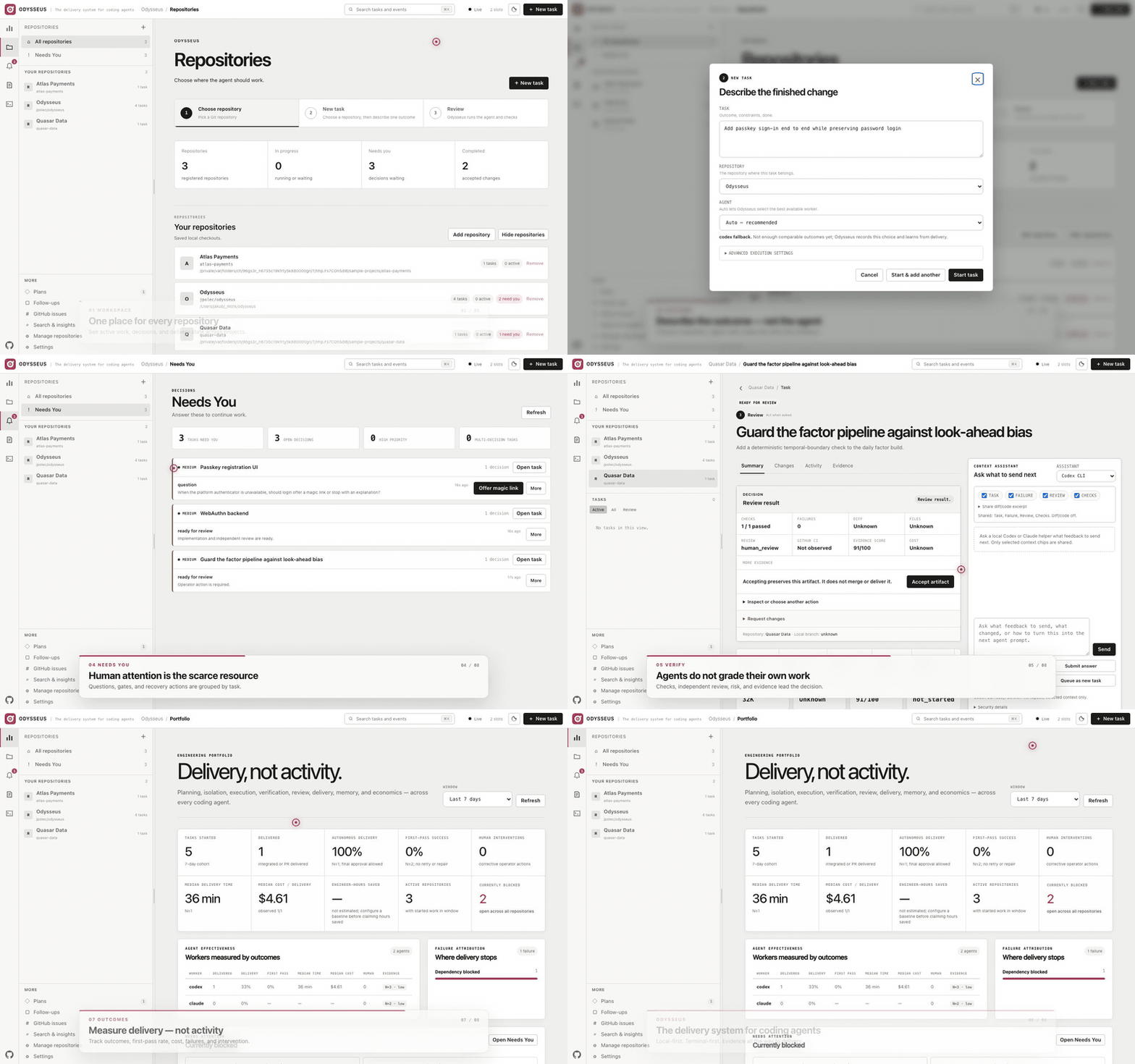
Animated 15-second preview — click it for the full 45-second product tour.
Repository → outcome → plan → attention → evidence → delivery. It is recorded
from the real web interface against disposable demo state and spends no model
tokens.
One outcome in. Evidence and an exact artifact out.
describe the outcome
        ↓
plan or queue the change
        ↓
isolated worktree → Codex / Claude → project checks
        ↓
independent review + optional CI
        ↓
Needs You only when a decision is required
        ↓
accept the artifact → integrate locally or open a PR
        ↓
record delivery, cost, failures, and human intervention
Completed is not accepted. Accepted is not integrated. Integrated is not
delivered. Odysseus keeps those states separate so an agent cannot silently
turn “I am done” into a change in your source checkout.
What Odysseus does best
- Delivery, not session management. A task carries its plan, dependencies,
worktree, agent thread, checks, review, artifact, integration state, and
measured outcome from one interface. - Evidence, not “the agent says done.” Configured checks, independent
evaluation, CI evidence, diff risk, and Context Receipts support decisions. - Your control plane, on your infrastructure. State is inspectable JSON and
append-only NDJSON. Run it locally or on a private VM/VPS; keep using your
terminal and authenticated agent CLIs.
Learn one capability at a time
The README stays focused on the first successful delivery. Short numbered
guides explain the deeper guarantees without turning setup into an architecture
manual:
The feature guide index grows only when a capability
is shipped and proven; planned architecture remains in the
roadmap.
A look inside
Click any image for the full-size interface.
| Start with the outcome | Approve and follow the task graph |
|---|---|
 |
 |
| Only decisions need you | Review evidence before delivery |
 |
 |
What it solves
- Parallel agents colliding with your files. Every autonomous task gets its
own branch and Git worktree; the source checkout stays untouched. - Agent work becoming a black box. Messages, reasoning summaries, tool
calls, tokens, diffs, checks, evaluation, and CI stay visible and replayable. - Agents grading their own implementation. Checks and an independent review
gate are separate from the worker that changed the code. - Thirty runs competing for attention. Questions, permissions, failures,
and review gates are grouped by task in one Needs You queue. - Starting over after a failure. Feedback and CI logs return to the same
saved agent thread, branch, and worktree with bounded retries. - Ambiguous “done.” Accept preserves an exact artifact. A separate action
integrates it locally or creates a pull request. - Vendor lock-in. Codex, Claude, and custom lanes are replaceable workers;
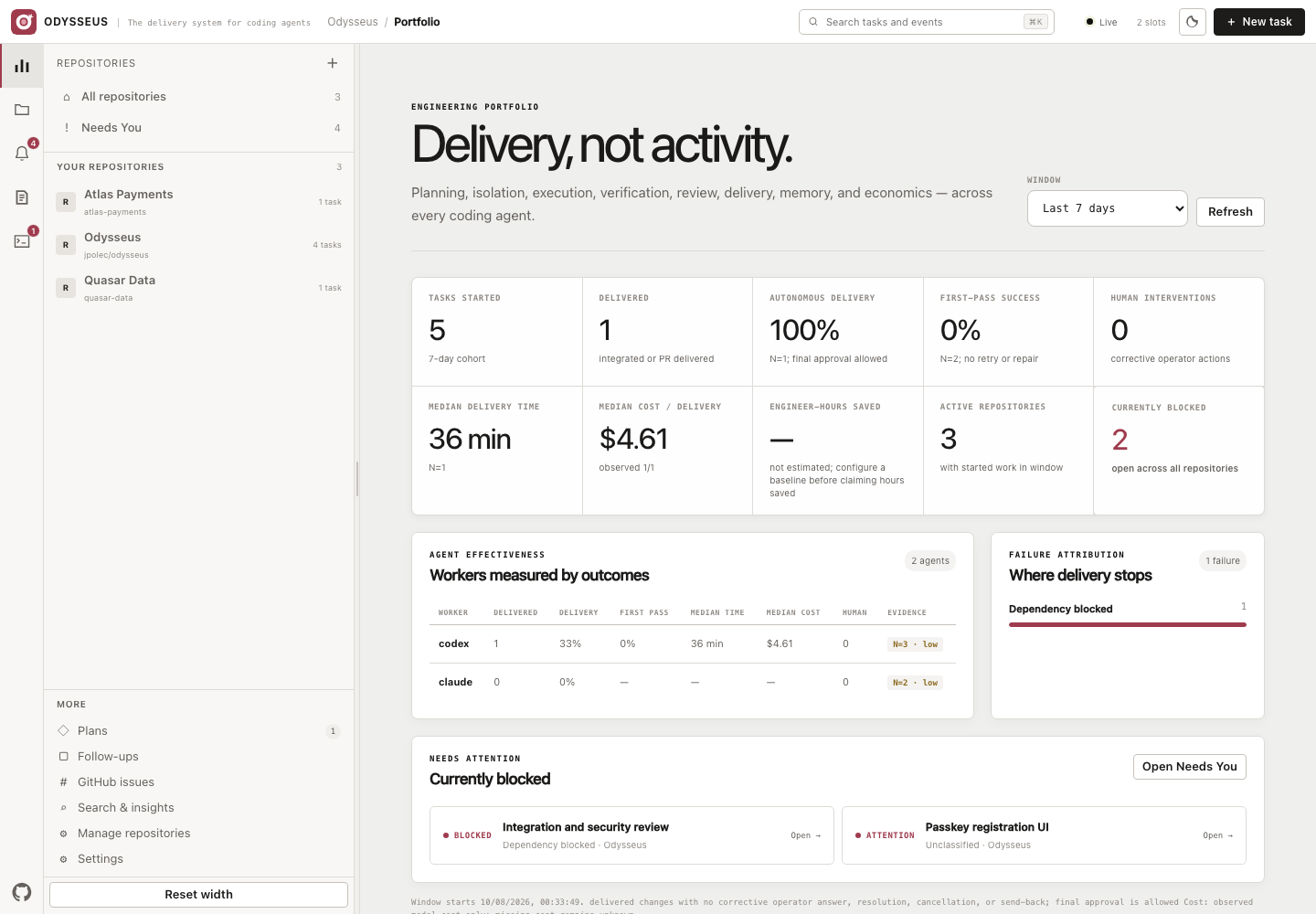
the delivery record belongs to Odysseus and remains local. - No feedback loop. The Engineering Portfolio measures delivery, first-pass
success, cost, failure attribution, and human intervention with sample size.
Who it is for
- Codex and Claude CLI users who want to delegate several changes without
surrendering their terminal or source checkout. - Solo developers and tech leads coordinating work across multiple local
repositories. - Operators who want an always-on private coding box and a mobile-friendly
decision surface through SSH or Tailscale. - Teams that value explicit evidence, reproducible state, and controlled
delivery more than an opaque hosted “done” signal.
Quick start
Requirements: Python 3.10+, Git, and Codex CLI and/or Claude Code. Docker is
optional and only required for isolated execution. tmux and fzf are needed for
terminal controls; authenticated gh is needed for GitHub issue intake and
draft pull requests.
Run directly with uvx—nothing is added permanently to your environment:
uvx --from git+https://github.com/jpolec/odysseus odysseus start --open
Or install the command persistently with pipx:
pipx install git+https://github.com/jpolec/odysseus
odysseus doctor
odysseus start --open
The Python package has no runtime dependencies. uvx/pipx install the CLI,
web assets, bundled generic Skills, and demo. The tmux key bindings remain an
optional TPM plugin because they must be loaded by tmux itself.
The shell installer is the third option:
curl -fsSL https://raw.githubusercontent.com/jpolec/odysseus/main/install.sh | bash
odysseus start --open
Review install.sh before piping it if that is your preference.
It resolves the latest stable GitHub release, installs that exact tag under~/.local/share, atomically switches a current link, preserves the previous
release, backs up mutable state, links only the command into ~/.local/bin,
and runs doctor. It never silently installs main. An equally simple
checkout-based development install is:
git clone https://github.com/jpolec/odysseus.git
cd odysseus && ./install.sh
Manage a versioned shell installation without replacing the running release in
place:
odysseus version
odysseus update --check
odysseus update
odysseus rollback

# explicitly opt into main
odysseus update --edge
Updates are validated against a copy of your state before the atomic switch.
Install, update, and rollback refuse to run while the server or a live agent
worker owns the state directory. Backups carry a SHA-256 digest and state
identity; restore extracts and validates off to the side before replacing any
live record. Rollback preserves worktrees and runtime directories. A normal
update never crosses a state-schema downgrade; the matching recovery path is
the explicit odysseus rollback --restore-state. You can audit state directly
with odysseus state verify. Package installs stay owned by their
package manager: use pipx upgrade odysseus-agents; uvx resolves its tool
environment for each invocation.
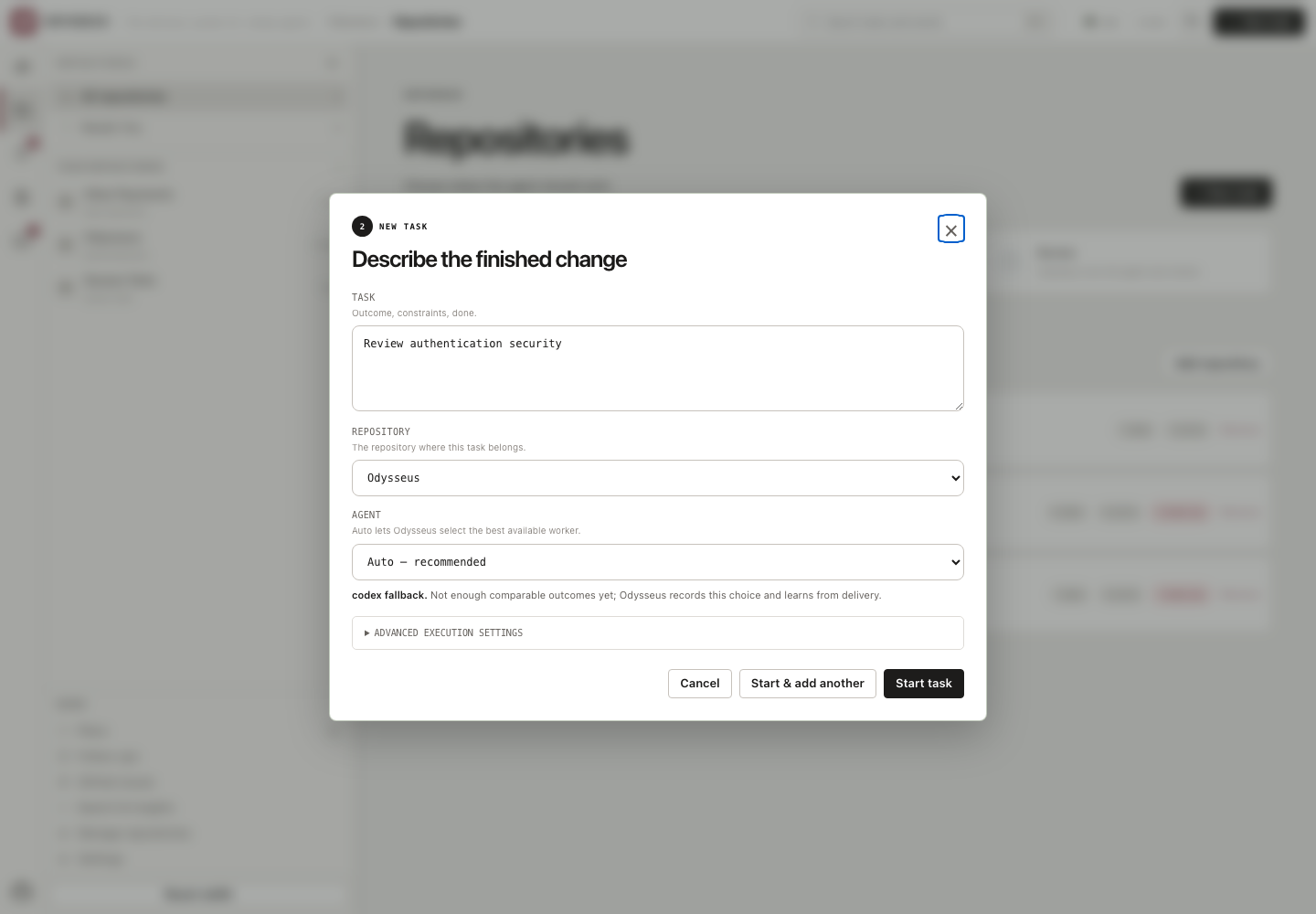
Without --open, visit http://127.0.0.1:8741/. The first screen shows the
same three numbered steps used everywhere else: choose one repository, describe
one finished outcome, then follow and review the result. Select Start task
after step 2. Agent choice, checks, limits,
Skills, execution environments, planning, Context Receipts, and repository history remain available as
progressive depth instead of blocking the first run. See START.md
for the complete five-minute path.
Submitting clears the request immediately and shows Starting. Start task
opens the live run; Start & add another leaves a fresh composer so several
tasks can be queued quickly. queued means Waiting to start because all
configured agent slots are busy. Open Settings—or click the slot count in
the title bar—to change parallel capacity, default agents, retries, budgets,
CI behavior, and direct-API assistant models. API keys are never saved in the
browser or Odysseus state.
Starting the same state twice does not create a second scheduler. If Odysseus
is already listening on the selected port, start --open reports and opens
that instance. If the selected port is occupied by another service, the CLI
automatically tries the next port and opens the address it
actually selected (8742, 8743, and so on).
To explore a populated delivery system without spending model tokens:
odysseus demo
Open http://127.0.0.1:8742/. The disposable state demonstrates multiple
repositories, a planned task DAG, Needs You, merge risk, artifact composition, a failed CI
repair loop, tool telemetry, checks, evaluation, search, and outcome metrics.
See each workflow
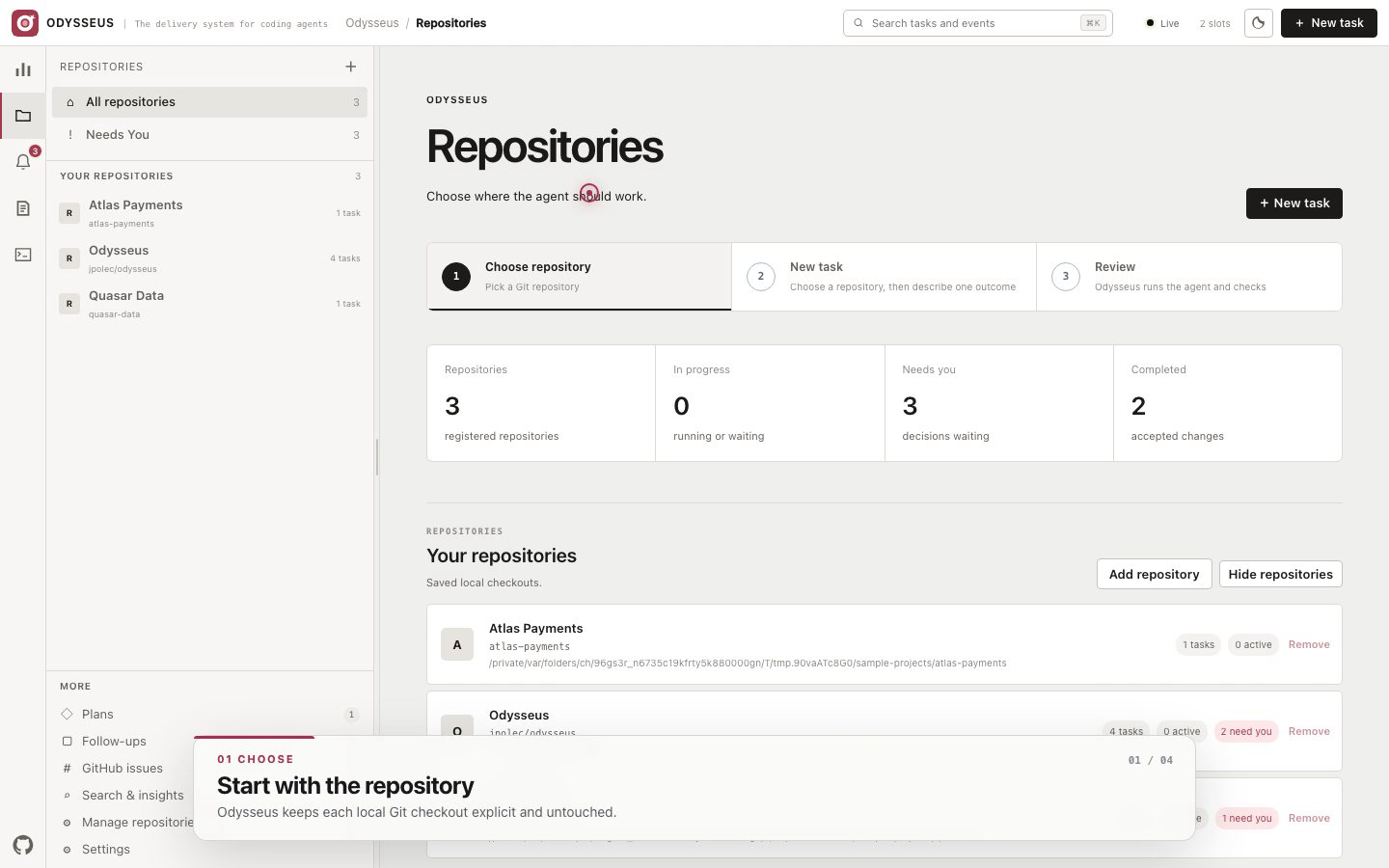
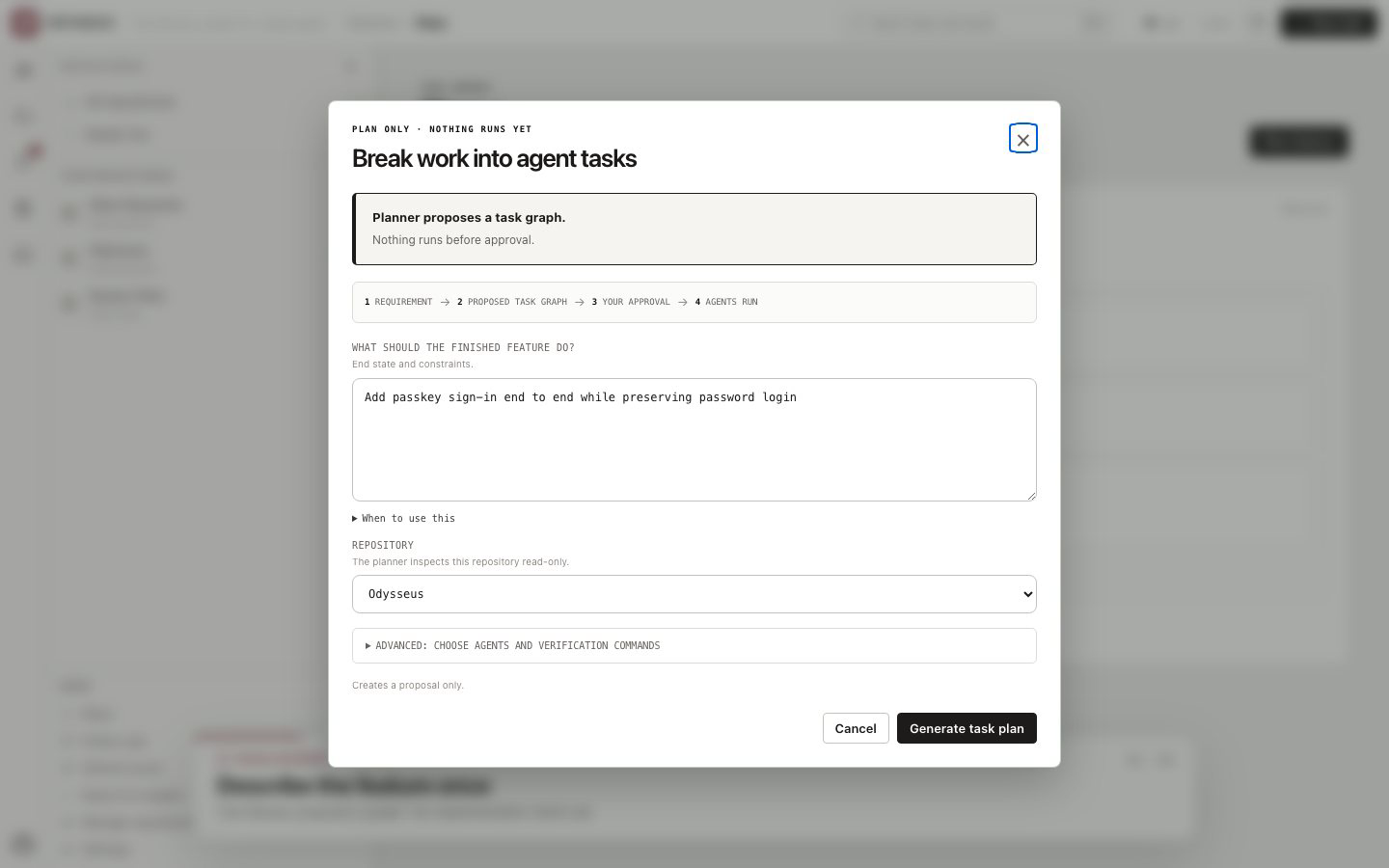
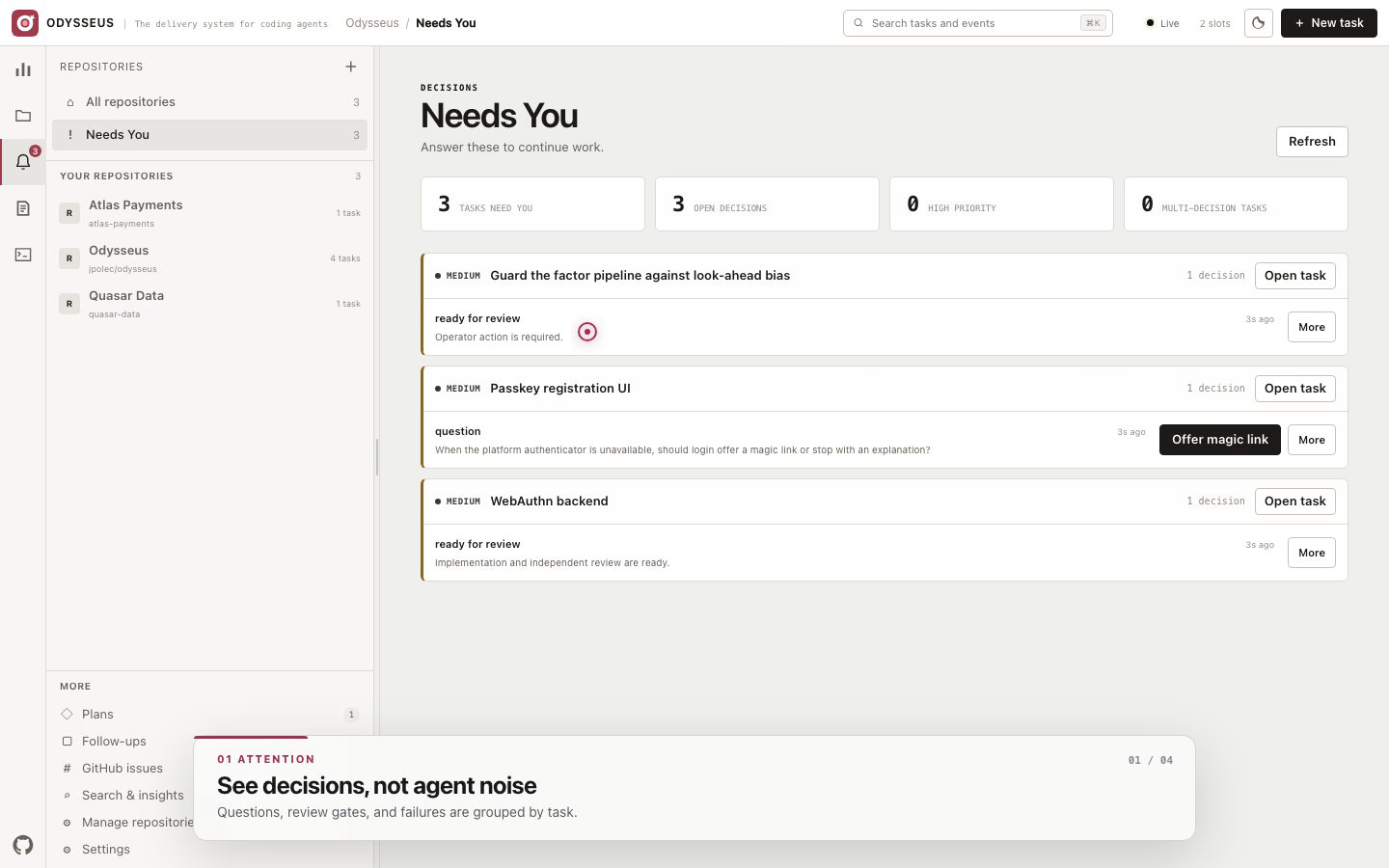
Click a preview to open the focused film.
| Task → verified artifact | Plan/DAG → safe parallel work |
|---|---|
 |
 |
| Needs You → recovery → terminal | Evidence → delivery → portfolio |
 |
 |
Full 90-second product tour ·
Video gallery and reproduction guide
Reproduce the web screenshots from that exact state with local Chrome/Chromium:
scripts/capture-web-screenshots.sh
The script writes twelve real browser captures—First run, Engineering Portfolio,
Repositories, Repository, Attention, Review, Delivery, Integration, CI repair,
Context Receipt, New task, and Settings—to docs/screenshots/ and
removes its temporary state when finished. Each URL selects the intended
repository, task surface, or dialog, so filenames match the visible UI.
Reproduce the hero and all focused walkthroughs with local Chrome/Chromium,
Node.js, and ffmpeg:
scripts/capture-web-video-suite.sh
It writes the H.264 films, clickable posters, and the lightweight animated
README preview to docs/demo/, then removes the isolated browser profile,
frames, and disposable Odysseus state.
Start with the outcome
New Task keeps the default path to three choices: the finished change, its
repository, and Agent: Auto. Runtime and budget overrides stay collapsed.
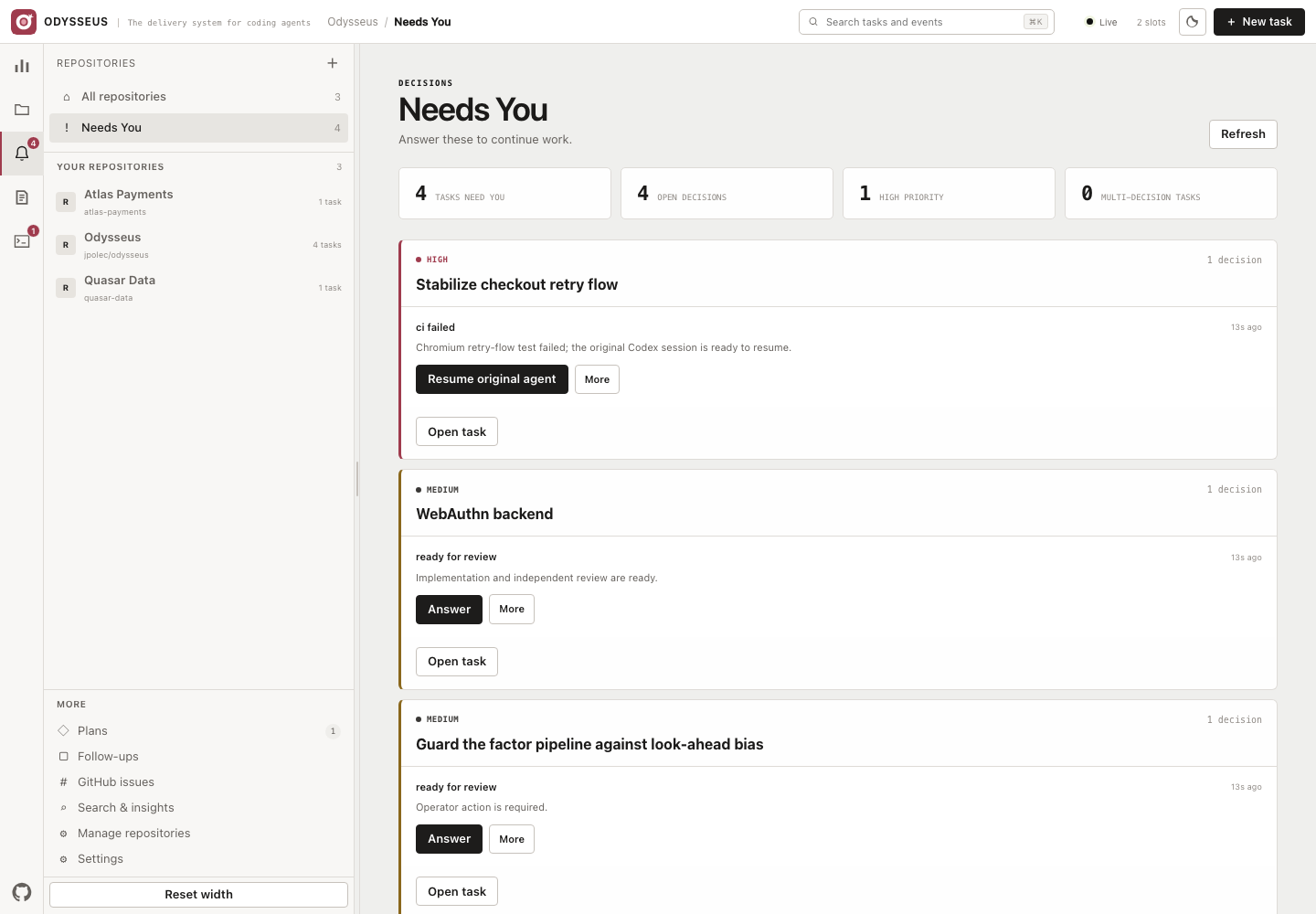
One queue for human decisions
Needs You counts tasks separately from their open decisions and groups every
question, review gate, or recovery action under the task it belongs to.
Engineering Portfolio
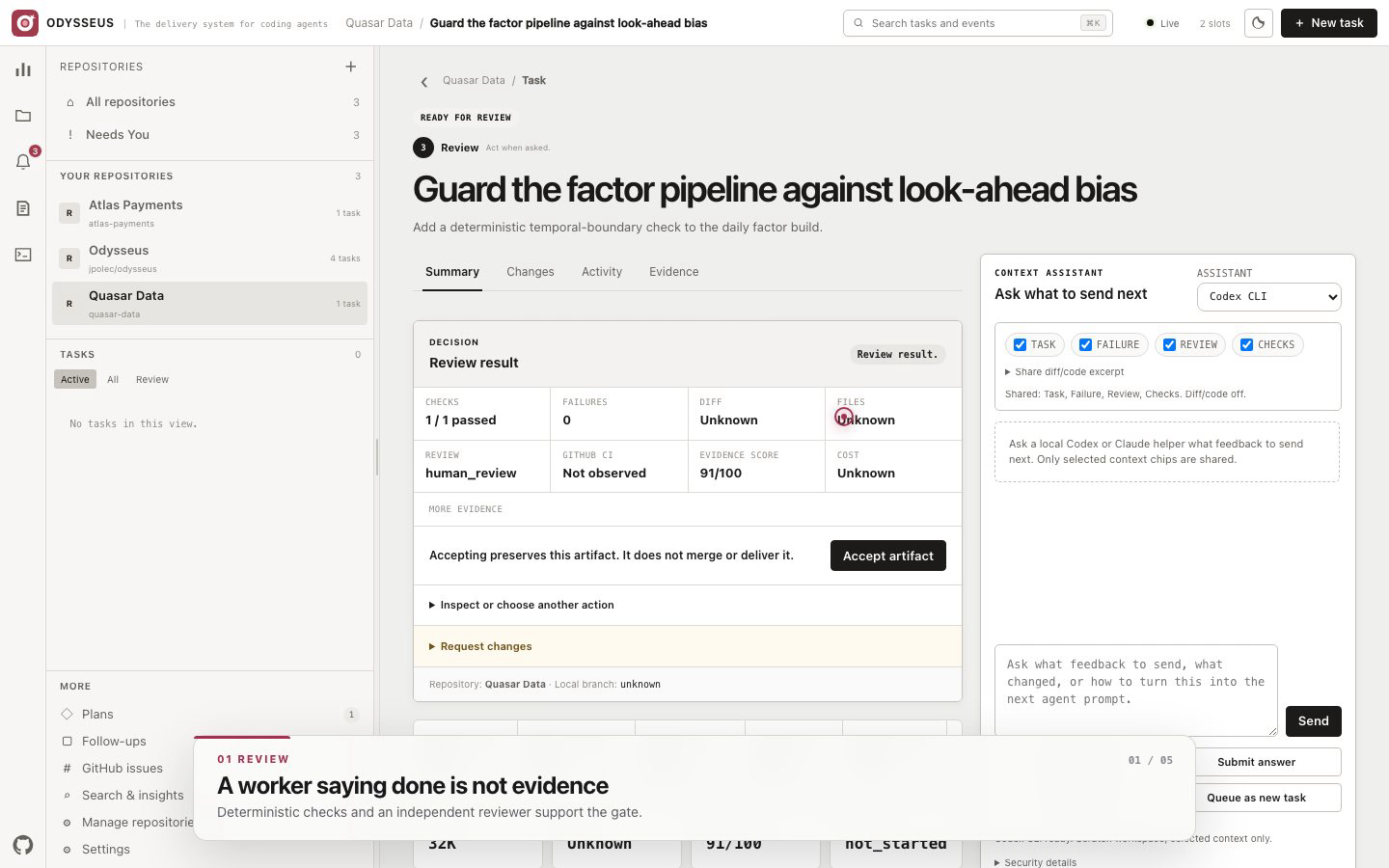
Review, then deliver
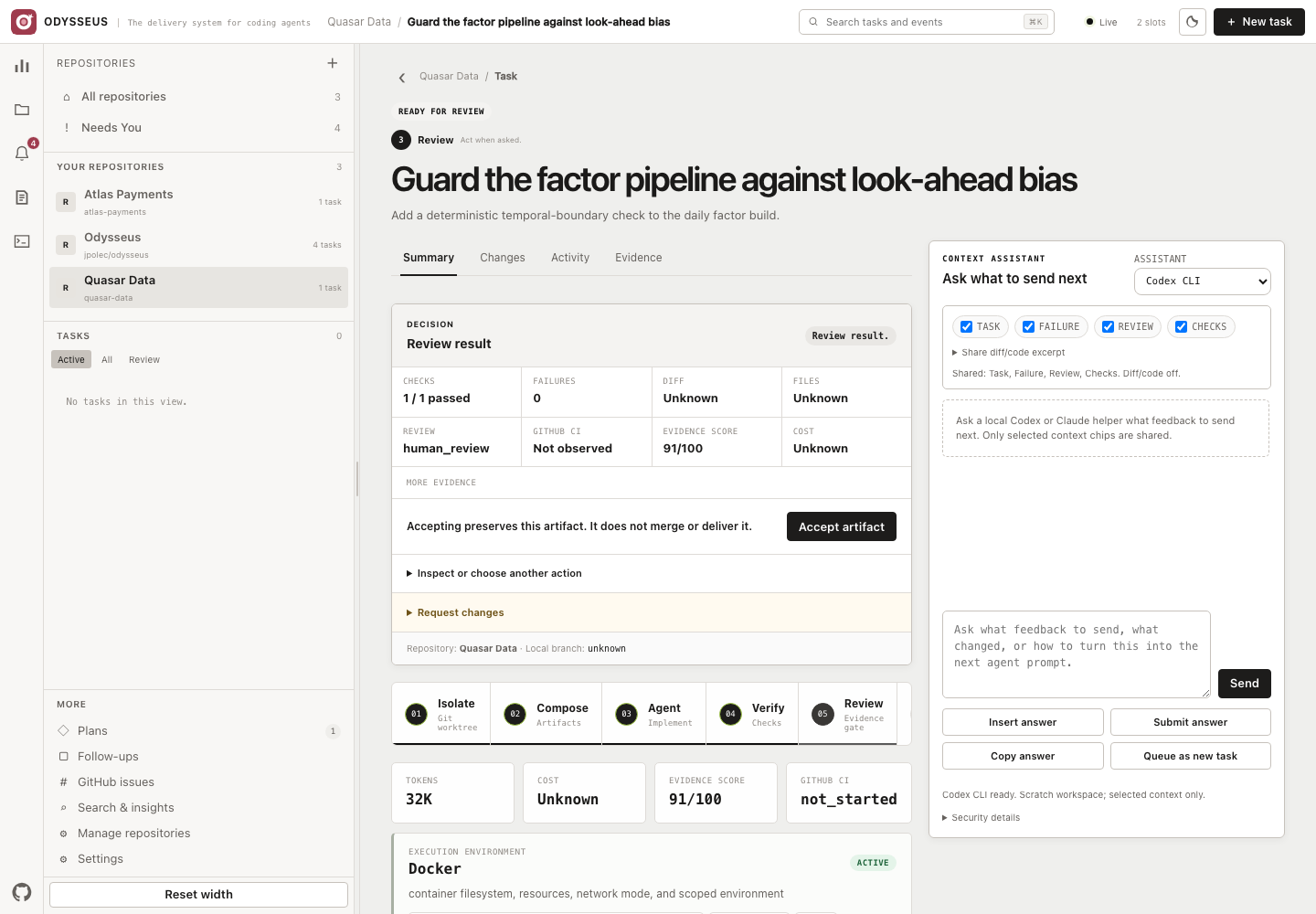
The result cannot silently become source code. After acceptance, the next
screen still says not delivered and offers explicit local or pull-request
delivery:
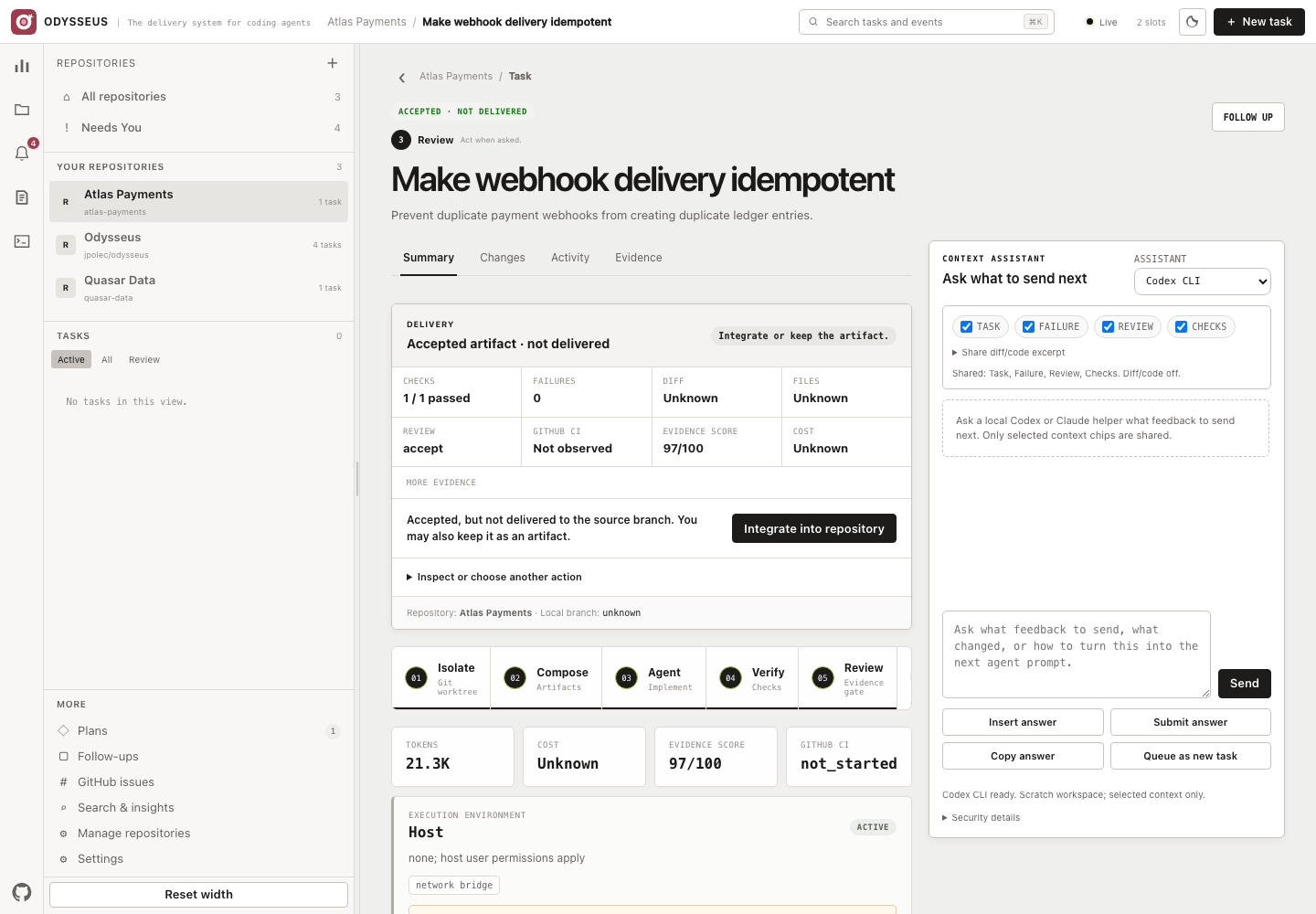
Odysseus develops Odysseus
The repository contains its own deterministic checks in .odysseus.json and a
small dogfooding entry point:
scripts/dogfood.sh start
scripts/dogfood.sh run "Make start explain and recover from a port conflict"
scripts/dogfood.sh status
scripts/dogfood.sh proof
Every newly queued autonomous run records a versioned provenance envelope. Theproof command counts only terminal attempts with ordered start, agent activity,
and outcome evidence; early failures stay in the denominator. Delivery claims
also require the final verifier to pass before artifact creation and acceptance,
so merely queueing tasks or editing a status cannot inflate the result.
Seeded demo, test, imported tmux, and pre-0.6.3 unclassified history are
excluded. Missing model cost remains unobserved, draft PRs are not acceptance,
and operator response latency is not mislabeled as active human time. JSON uses
opaque receipt IDs; Markdown is the public aggregate. See
PRODUCTION_PROOF.md.
Release governance is documented in PROOF.md: pull requests should
require Fast CI / unit, Fast CI / compatibility (3.10), Security / security, and Installer Smoke / installer-smoke; pushes to main must also
pass Main Proof / release-proof. Tag releases run Release Proof / release-proof, publish only after proof, and ship source/wheel artifacts withSHA256SUMS, SBOM.spdx.json, and PROVENANCE.json.
Where tasks come from
| Source | What happens |
|---|---|
| New task in the web UI | A branch and worktree are created, then the bounded agent/check/review workflow runs. |
bin/odysseus run ... |
The same workflow is queued from a terminal or script. |
Plan feature / bin/odysseus plan ... |
A read-only planner proposes a DAG; tasks exist only after explicit approval. |
| Existing Codex/Claude tmux pane | It appears in Agent terminals automatically; no import button is required. |
| Track in Odysseus on a tmux pane | A durable shortcut is created without restarting, controlling, or interrupting the pane. |
| Inbox Queue as agent task | A human or agent follow-up becomes a queued task in its repository. |
| GitHub Queue issue | An open issue becomes a queued task through authenticated gh. |
Automatic discovery does not silently turn arbitrary panes into autonomous
jobs. Existing panes are visible without pressing anything. Use Track in
Odysseus only when an interactive pane should also appear in Tasks and have a
durable Odysseus shortcut.
What to enter in the web forms
- New task is for one focused outcome. Write the request in natural
language and choose the repository. Odysseus uses the default agent and repository
checks and automatically relevant engineering skills; manual skill selection,
execution environment, agent selection, custom checks, priority, retries, and budgets stay
under More options…. - Plan feature is for a feature that should become several
dependent or parallel tasks. Describe the finished feature, not the task
breakdown. The Planner proposes the graph and nothing runs before approval. - Agent terminals requires no input. It discovers existing Codex/Claude tmux panes.
Tracking one does not provide historical tool/token data that Odysseus never
observed. - Inbox parks follow-up work. Adding an item does not launch an agent;
Queue as agent task does.
The autonomous workflow
queue -> isolated worktree -> host/container environment -> implementation agent -> project checks
      -> independent evaluation -> Needs You / policy
      -> approve / feedback / terminal / draft PR
For high-value or ambiguous work, explicitly opt into a Variants run instead of
starting a normal task. One parent task queues two or three isolated candidate
runs under the shared budget. Each candidate gets its own branch, worktree,
prompt, checks, review, evaluation, provenance, and retained artifact; candidates
do not share mutable worktrees or hidden intermediate answers. Odysseus compares
tests, code quality, regression and merge risk, observed cost, change size, and
human attention, then shows the Pareto frontier. It never applies, merges, or
declares a single winner for you: select a candidate, queue a separate
integration task for multiple candidates, or reject all.
bin/odysseus run \
  --project /absolute/path/to/repository \
  --variants 2 \
  --variant-lane codex \
  --variant-lane claude \
  --check "python3 -m unittest" \
  "Find the least risky way to replace the parser"

bin/odysseus variants RUN_ID select --selected-run-id CANDIDATE_RUN_ID
bin/odysseus variants RUN_ID combine --selected-run-id LEFT_ID --selected-run-id RIGHT_ID
bin/odysseus variants RUN_ID reject_all --reason "Both candidates are too broad"
For a larger requirement:
requirement -> read-only Planner -> proposed DAG -> operator approval
            -> ready tasks fan out -> accepted artifacts -> isolated fan-in
            -> integration checks -> review -> draft PR -> CI repair -> green
bin/odysseus plan \
  --project /absolute/path/to/repository \
  --planner-lane claude \
  --lane codex \
  --review-lane claude \
  "Implement passkey authentication end to end"

bin/odysseus approve-epic EPIC_ID
Queue a task from the CLI:
bin/odysseus run \
  --project /absolute/path/to/repository \
  --lane codex \
  --review-lane claude \
  --check "python3 -m unittest discover -s tests -v" \
  --check "git diff --check" \
  "Implement the feature and cover it with tests"
Use Docker when the task should not inherit the server user's filesystem and
credentials. The image must already contain the selected agent CLI and the
tools required by the project:
bin/odysseus run \
  --project /absolute/path/to/repository \
  --environment docker \
  --image ghcr.io/your-org/coding-agent:latest \
  --network none \
  --cpus 2 --memory 4g \
  --allow-env OPENAI_API_KEY \
  --untrusted-project \
  "Audit and fix the parser without changing its public API"
--allow-env records only the variable name; its value is resolved at runtime
and never written to a run snapshot or event. Host, Docker, and devcontainer
processes receive a scoped environment; server API keys such as the Context
Assistant keys are not inherited unless the task explicitly allowlists them.
For an untrusted repository,
Odysseus accepts only the Docker profile and pauses in Needs You before any
repository-supplied setup, check, evaluator, or environment configuration runs.
At the review gate:
| Action | Result |
|---|---|
| View changes | Opens the complete diff before any delivery decision. |
| Accept artifact | Records approval and a durable local artifact commit; it does not merge or deliver the change. |
| Integrate into repository | After acceptance, safely merges the complete artifact into the expected local branch, preserving unrelated untracked files and aborting tracked-edit or merge conflicts. |
| Request changes instead | Sends guidance to the saved implementation thread in the same worktree. |
| Continue in terminal | Resumes the exact implementation thread in a managed tmux session and copies its open command. |
| Create draft PR | Commits the task worktree, pushes its branch, and opens a draft pull request without changing the source checkout. |
Ready for review, Accepted, and Applied are deliberately different. The
review checklist shows 1 Review, 2 Test, and 3 Deliver; until Apply
or a PR is chosen, the UI says that the source checkout is unchanged. ForFailed or Needs You, the recovery path stays directly below the status
message. The Summary Context assistant can draft feedback with the already
authenticated local Codex CLI or Claude Code CLI; no separate API key is
required for local mode. The full conversation and context toggles remain in
the side panel. Task, failure, review, and check context are explicit toggles,
while diff/code sharing is off by default. Local CLI helpers start in a blank
scratch workspace, not the task repository; they receive only selected context
by prompt, but still run with the filesystem permissions of the Odysseus user.
Direct ChatGPT or Claude API modes are optional and require OPENAI_API_KEY orANTHROPIC_API_KEY in the Odysseus server environment. Their non-secret model
names can be selected in Settings; the keys themselves are only reported as
configured or missing and are never persisted.
You do not need tmux for the normal workflow. Use Continue in terminal only
when you want an interactive shell, manual debugging, or direct control of the
saved agent thread. Odysseus preserves the same branch and worktree either way.
Continue in terminal does not steal or recreate work. It prepares the exact
saved agent thread in tmux, inside the existing task worktree, then copies the
command you paste into a terminal. Request changes continues that same thread
autonomously.
tmux controls
Install with TPM by adding this before run '~/.tmux/plugins/tpm/tpm':
set -g @plugin 'jpolec/odysseus'
Reload tmux, press prefix + I, then use:
| Key | Action |
|---|---|
prefix + y |
Launch or reattach the current project's interactive agent. |
prefix + u |
Open the global agent-session picker. |
prefix + O |
Start or open the local Odysseus web control plane. |
That is all a normal installation needs. Optional keys, lane configuration,
status hooks, screenshots, and the exact terminal-handoff behavior live in the
tmux guide.
Repositories, inbox, and GitHub
Repositories register when a managed task is queued or when you add one
explicitly. Passive tmux discovery never changes this list. Add one directly:
bin/odysseus projects --add /srv/repos/api --tag backend --tag production
The cross-project Inbox holds work that should not expand the current task.
Add an operator note in the UI or CLI:
bin/odysseus inbox \
  --project /srv/repos/api \
  --title "Migration follow-up" \
  --add "Add a rollback integration test"
An implementation agent can create .odysseus-followups.json in its worktree:
[
  {
    "title": "Harden the migration rollback",
    "task": "Add a rollback integration test for the newly discovered edge case.",
    "priority": "high"
  }
]
Odysseus imports at most 50 entries and removes the handoff file before the
diff/review stage, so discovered work does not pollute the current patch.
Configuration and state
The web Settings view is the normal place to change queue capacity, default
lanes, retries, budgets, CI repair behavior, and direct-API assistant models.
The title-bar slot count links there. API keys are deliberately excluded: local
Codex/Claude uses existing CLI login, while direct API keys must be supplied in
the server environment.
Checks can be supplied per task or committed as .odysseus.json:
{
  "checks": [
    "python3 -m unittest discover -s tests -v",
    "git diff --check"
  ],
  "evaluators": [
    {
      "id": "security",
      "kind": "static",
      "command": "semgrep --config auto",
      "weight": 0.3
    }
  ],
  "environment": {
    "profile": "docker",
    "image": "ghcr.io/your-org/coding-agent:latest",
    "network": "bridge",
    "cpus": 2,
    "memory": "4g",
    "ports": {"APP_PORT": 3000},
    "setup": ["npm ci"]
  },
  "policy": {
    "min_confidence": 0.9,
    "require_human_review": true,
    "required_evaluators": ["security"]
  }
}
Task checks take precedence. Check and setup commands run through /bin/sh -c
inside the resolved execution profile and inherit a scoped server environment
including PATH; shell login files are deliberately not loaded. In ordinary mode, repository
configuration is trusted. --untrusted-project requires operator-controlled
Docker isolation and one explicit approval before repository commands run.
Global budgets, the CI repair loop, and notifications live in~/.odysseus/config.json:
{
  "budgets": {
    "timeout_seconds": 1800,
    "stall_seconds": 300,
    "max_tokens": 80000,
    "max_tool_calls": 120,
    "max_cost_usd": 8.0
  },
  "ci": {
    "watch": true,
    "auto_resume": true,
    "max_attempts": 2,
    "poll_seconds": 30
  },
  "notifications": [
    {"type": "ntfy", "name": "phone", "url": "https://ntfy.sh/your-private-topic"},
    {"type": "slack", "name": "engineering", "url": "https://hooks.slack.com/services/..."}
  ]
}
Per-task web/CLI budgets override global defaults. Notification destination
URLs can contain credentials; keep config.json private and never commit it.
State is stored under ~/.odysseus by default:
~/.odysseus/
├── config.json
├── projects.json
├── inbox.json
├── attention.json
├── notifications.ndjson
├── epics/<epic-id>.json
├── runs/<run-id>.json
├── events/<run-id>.ndjson
├── runtime/<run-id>/{environment.env,home,git}/
└── worktrees/<repository>-<sha>/<run-id>/
Override it with ODYSSEUS_HOME or --state-dir. Custom lanes can be added toconfig.json as an argv array or shell-style command using {worktree} and{prompt} placeholders. See docs/USAGE.md for examples and an
operator command reference.
Inspect retained worktrees and runtime directories without deleting anything:
bin/odysseus resources
bin/odysseus resources --json
Reclamation is separate and explicit:
bin/odysseus resources --reclaim
Delivered worktrees and stale runtime directories can be reclaimed after the
retention window; failed worktrees are kept for recovery.
Remote and VPS
The server binds to loopback by default. It is designed for one operator on a
workstation or private VPS, not as a public multi-tenant application server.
HTTP work is threaded and bounded; live SSE streams have a separate limit and
shut down with the server. JSON/NDJSON writes use an inter-process file lock and
atomic snapshot replacement. For a private VPS installation:
sudo scripts/install-vps.sh --service-user "$USER"
ssh -N -L 8741:127.0.0.1:8741 USER@VPS
Open http://127.0.0.1:8741/ on your workstation. The service stays private on
the VPS.
For mobile access without exposing Odysseus to the public internet, put the VPS
and your phone on the same Tailscale tailnet, then let the installer publish a
private tailnet URL while Odysseus itself remains on VPS loopback:
sudo scripts/install-vps.sh --service-user "$USER" --tailscale
Install the Tailscale app on the phone, sign in to the same tailnet, and open
the URL printed by the installer. Use --tailscale-name vps-name.tailnet.ts.net
when you already know the VPS tailnet DNS name and want the installer output to
be copy-pasteable.
To expose a public hostname with nginx Basic auth and Let's Encrypt TLS:
sudo scripts/install-vps.sh \
  --service-user odysseus \
  --domain agents.example.com
A direct remote bind without a password is refused unless the explicitly
unsafe override is supplied. Read SECURITY.md before exposing the
service. A reverse proxy or SSH tunnel remains required for TLS and
internet-facing connection handling; Odysseus does not claim high-availability
or horizontal multi-user operation.
CLI operator commands
bin/odysseus runs
bin/odysseus epics
bin/odysseus plan --project /repo "Implement the requirement"
bin/odysseus approve-epic EPIC_ID
bin/odysseus attention
bin/odysseus answer ATTENTION_ID "Use option A"
bin/odysseus show RUN_ID
bin/odysseus events RUN_ID
bin/odysseus resume RUN_ID "Address the review findings"
bin/odysseus takeover RUN_ID
bin/odysseus sessions
bin/odysseus adopt TMUX_SESSION
bin/odysseus inbox
bin/odysseus projects
bin/odysseus accept RUN_ID
bin/odysseus draft-pr RUN_ID
bin/odysseus ci RUN_ID
bin/odysseus search "failing browser test"
bin/odysseus stats
bin/odysseus resources
bin/odysseus version
bin/odysseus replay RUN_ID
bin/odysseus replay RUN_ID --until-event 42
bin/odysseus rebuild-projections --dry-run
bin/odysseus command
bin/odysseus state verify
bin/odysseus proof --release 0.9.2
bin/odysseus update --check
bin/odysseus rollback
bin/odysseus export --output odysseus-state.json
bin/odysseus config --max-parallel 3
Use bin/odysseus COMMAND --help for command-specific arguments.
Development
python3 -m unittest discover -s tests -v
# Optional real Docker proof when node:20-bookworm is available locally:
ODYSSEUS_DOCKER_TEST=1 python3 -m unittest tests.test_environments -v
python3 -m compileall -q odysseus
node --check web/app.js
bash -n scripts/*.sh codex_session_manager.tmux
git diff --check
See ROADMAP.md for planned work, CHANGELOG.md for
the chronological release history, and VERSION.md for the shipped
capability matrix and upgrade notes.
License
MIT. The original tmux manager was adapted from
craftzdog/tmux-claude-session-manager,
also MIT licensed.
Reviews (0)
Sign in to leave a review.
Leave a reviewNo results found