vs-token-safer
Health Warn
- License — License: MIT
- Description — Repository has a description
- Active repo — Last push 0 days ago
- Low visibility — Only 5 GitHub stars
Code Pass
- Code scan — Scanned 12 files during light audit, no dangerous patterns found
Permissions Pass
- Permissions — No dangerous permissions requested
No AI report is available for this listing yet.
Token-safe C++/C# code search via clangd/Roslyn index instead of grep. Local-only, no IDE required. Claude Code plugin + vts CLI.
vs-token-safer
English · 한국어
A token-saving code layer for Claude Code on any codebase — TypeScript, JavaScript, Python, C#, C++, Go, and
more. (Battle-tested down to a 26k-translation-unit Unreal Engine monorepo; bundles a game/build-log analyzer too.)





Your coding agent has a small context window. Your repo is large. vs-token-safer sits in between.
Ask where something is, what calls it, or even "how does the auth flow work?" when the name escapes you — and
instead of pasting a wall of source into the chat, it replies with a shortfile:linelist.When your project builds normally, the answers are exact: it reads the same code index your editor relies on.
When it doesn't, it still locates your functions and classes with nothing to set up. And when you've forgotten
the name and only remember what the code does, it finds it from the vocabulary your own code already uses — no
AI model, nothing uploaded. Markdown and config files work the same way: jump straight to one section by its
heading instead of opening the whole file.A companion plugin does the same for giant editor and build logs. None of it leaves your machine.
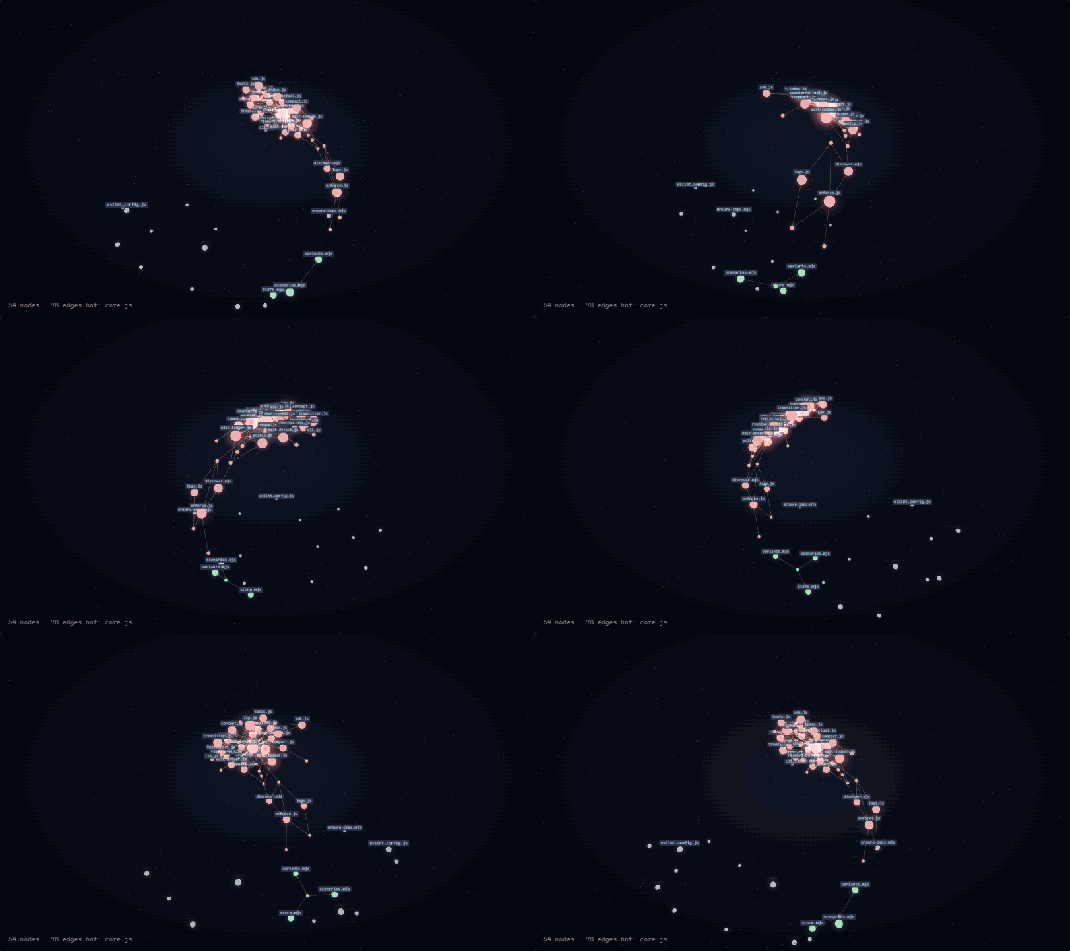
The built-in dashboard (vts serve) — your indexed repo as a live 3D graph, all on 127.0.0.1.
# Claude tries to grep code → the hook REWRITES it to the indexed query, in place:
$ grep -rn "createSession" src/
↻ [vs-token-safer] Rerouted → search_symbol "createSession"   # semantic, not a text match
  func createSession (in AuthService)  @ src/auth/session.ts:142   (+2 more)
  → ~120 tokens   (grep would have dumped thousands of lines)

# Editing that symbol? Name it — no Read-the-whole-file, no line counting:
$ replace_symbol_body symbol="createSession" body="…"        # preview; apply=true writes
  replace_symbol_body "createSession" — PREVIEW at src/auth/session.ts:142-160
Same flow on TypeScript, Python, C#, C++, Go and more (clangd · Roslyn · tsserver · pyright · tree-sitter). VTS_REWRITE=0 blocks instead of rewriting.
Why
grepon a large repo — a TypeScript/Python monorepo, a C#/.NET solution, even a 26k-TU Unreal C++ tree — floods the context. The language-server index stays token-capped — ~97–99% smaller (benchmarks).- Claude keeps reaching for
grep. The hook doesn't just block it — it rewrites the command to the indexed query in place, so the search still runs and the flow never breaks. - Edit by symbol, not by line. Replace/insert-around/delete a declaration by naming it — the index supplies the span, so you skip reading the whole file into context.
- You can't tell how much grep still slips through.
vts discoverreads your recent sessions and reports exactly which searches bypassed the index and what they cost. - The language server runs headlessly — no editor open, unlike an IDE-proxy approach.
Quickstart
# 1) Install (also auto-installs the gamedev-log-analyzer sibling)
/plugin marketplace add JSungMin/vs-token-safer
/plugin install vs-token-safer@vs-token-safer
/reload-plugins        # first run auto-installs the server deps (no manual npm)

# 2) Configure — detects the backend, asks for the project path, writes the config
/vs-token-safer:setup
Then restart the Claude Code session (the vs-search MCP server only starts on a fresh session).
Verify the tools appear and that grep src/**/*.cpp is rerouted to the index. Prerequisites: Node ≥ 18
and a language server — clangd (C/C++) / Roslyn (C#) you install; JS/TS + Python auto-install. Details in
Prerequisites below.
Want only the log analyzer?
/plugin install gamedev-log-analyzer@vs-token-safer.
How it works
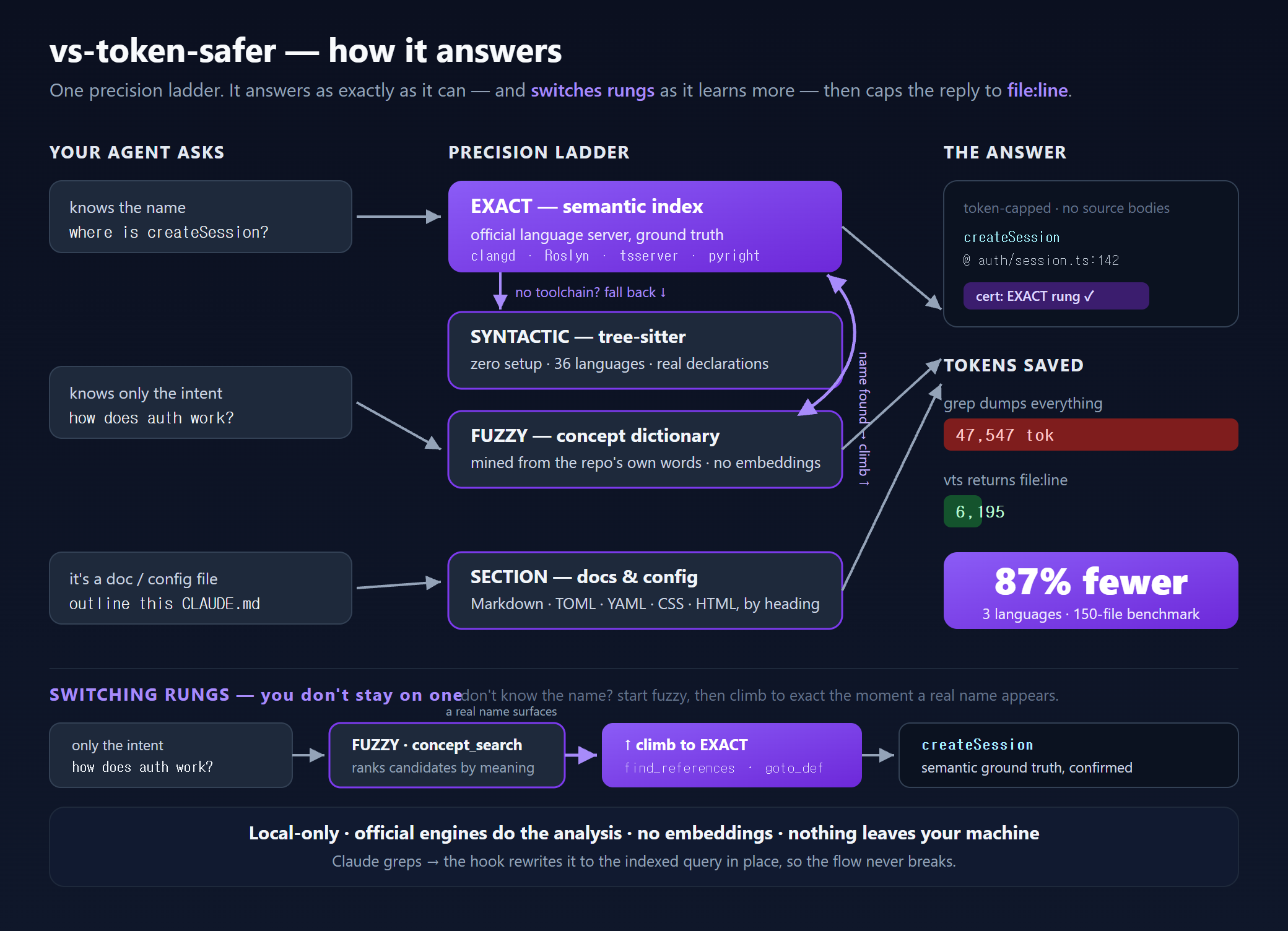
vs-token-safer isn't a search box — it's a precision ladder. You ask where something is, what calls it,
or "how does the auth flow work?" when the name escapes you, and it answers at the highest precision it can
reach, then tells you which rung the answer came from:
- EXACT — you know the name and the project builds → the official language server (clangd / Roslyn /
tsserver / pyright), the semantic ground truth. - SYNTACTIC — no toolchain set up → a tree-sitter parse (36 languages, bundled, no native build) still
returns real declarations, not a grep. - FUZZY — you only remember what the code does → a concept dictionary mined from the repo's own
identifiers + comments (no AI model, nothing uploaded). - SECTION — it's a doc or config, not code → Markdown / TOML / YAML / CSS / HTML addressed by heading.
The rungs aren't a one-time pick — they connect, and vts switches between them as it learns more. Start
on FUZZY when you only know the intent; the moment concept_search surfaces a real name, vts climbs to
EXACT to confirm it against the semantic index (and an exact search that misses drops back down to FUZZY).
The hooks steer that hand-off in both directions, so "I don't know the name" turns into a precise,
semantically-verified file:line instead of a dead end.
Every answer comes back capped to file:line (never source bodies) and carries a one-line completeness
certificate naming the rung — so the model always knows whether it got the semantic truth or a fallback.
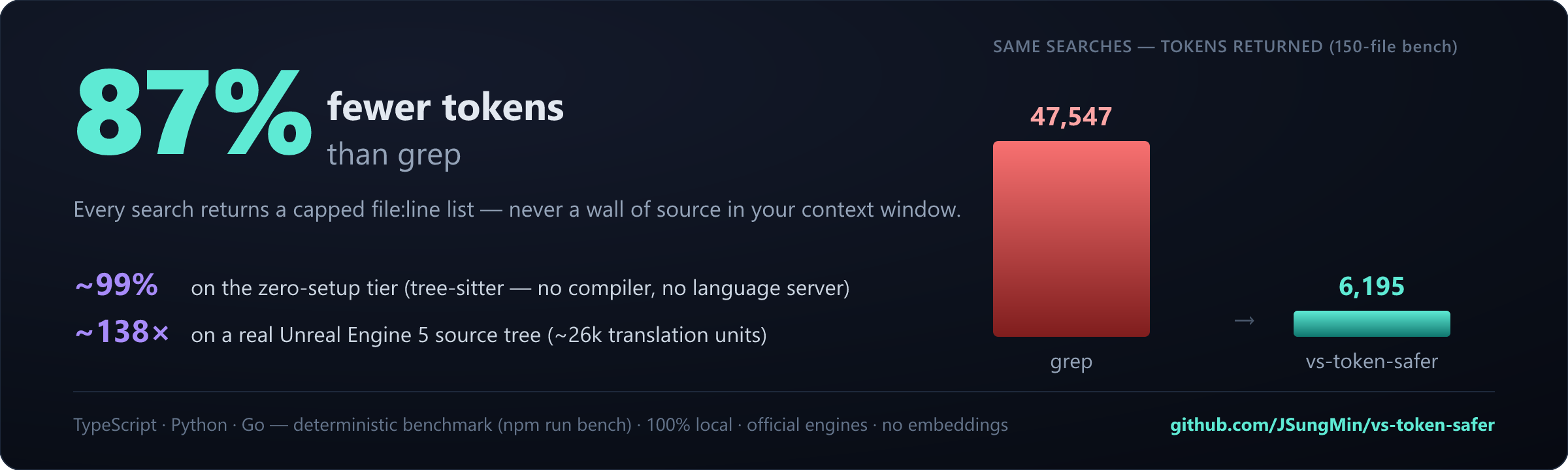
On a 3-language, 150-file benchmark that's 87% fewer tokens than grep (~138× on a real Unreal Engine 5
tree). Underneath, four mechanisms make Claude actually use the ladder instead of reaching for grep:
| Layer | Effect |
|---|---|
| Rewrite/enforcement hook | Covers four surfaces. Bash grep/rg/find -name over source → rewritten to the equivalent vts query in place (identifier → search_symbol, literal → search_text, find <dir> -name → find_files rooted at <dir>); ambiguous cases (pipeline, multi--name) block. Grep tool symbol hunt (bare identifier, ::/(/void·class regex, or a FooBar|BazQux CamelCase alternation) → blocked with a ready-to-use call; freeform/keyword alternations stay a warn. Glob tool concrete code file (*.cpp, Foo.h) → blocked toward find_files. Edit/MultiEdit that replaces or adds a whole declaration → a model-visible nudge toward the symbol-edit tools (replace_symbol_body/insert_symbol), escalating to a block on a safe insert after repeated ignores (VTS_EDIT_WARN, VTS_EDIT_BLOCK_AFTER); a sub-declaration tweak stays silent. Messages are agent-directed and i18n'd (EN/KO). Logs/.md/config pass through. Knobs: VTS_REWRITE=0, VTS_GREP_BLOCK=0, VTS_ENFORCE=0. |
| Token-capping core | Turns LSP results into kind name @ file:line, caps, appends … N more. A refs-heavy result collapses to one row per file (Foo.cpp:42,88,120) with a shared dir prefix factored out once (VTS_COMPACT_RESULTS=0 restores per-line). A truncated find_files/search_text tees the full set to a recovery file. |
| Symbol-level editing | replace_symbol_body/insert_*/safe_delete resolve a declaration by name via the outline and splice text at its exact span — preview by default, apply=true writes, safe_delete refuses while referenced. No whole-file Read into context. |
| Headless LSP client | A fully-owned LSP client spawns the official engine over stdio. The project root is resolved per call (explicit projectPath → the file's enclosing project → the MCP workspace root), so one global server answers for every repo a session touches. Live backends are pooled and bounded (VTS_MAX_BACKENDS + idle reaper). |
| Savings + discover | A local ledger records every search's tokens-saved (vts savings, with a 30-day graph). vts discover scans recent sessions for searches that bypassed the index — so you see the catch-rate, not just the wins. |
Engine = official, glue = ours. clangd (LLVM) and Roslyn (Microsoft) do the analysis; this repo
only writes the LSP↔MCP glue. No third-party MCP server runs over your source. Local-only, nothing uploaded.
Tools
All search/edit goes through an official language-server index — clangd (C/C++), Roslyn (C#/.NET),
tsserver (JS/TS), pyright (Python) — and comes back as a compact, capped file:line list (never
source bodies). MCP server vs-search; same tools as the vts CLI.
Search / navigate
| Tool | CLI | Does |
|---|---|---|
search_symbol |
vts symbol |
Find a symbol declaration by name/substring (semantic, not text). |
find_references |
vts references |
Every call site of a symbol. Takes the name directly (symbol="FooBar") — the one to reach for when you change a function/type and must touch every use. detail=file/dir → a blast-radius summary (dependents grouped + ranked) instead of the per-line list. direction=callers/callees switches to a multi-hop call hierarchy (who transitively calls this = blast radius / what it calls) to depth hops — built on LSP callHierarchy, the semantic call graph, not a text scan. vts trace-calls = shorthand for references --direction callers. |
read_symbol |
vts read-symbol |
Return the source of one named declaration (its span) — not the whole file. The read-side twin of replace_symbol_body: skip Read-ing a 700-line file to see one function. signatureOnly trims to the head. |
goto_definition |
vts definition |
Jump to the definition at a position. kind= also does type_definition / implementation (concrete impls of an interface/virtual) / declaration. |
hover |
vts hover |
Type/signature at a position. |
document_symbols |
vts symbols |
Outline a file (classes/functions/types as file:line). scope=directory → a signatures-only repo skeleton of every code file under a dir (the shape of a module without Reading each file). |
diagnostics |
vts diagnostics |
Compiler/linter errors + warnings as a token-capped file:line:col severity: message list — the compact stand-in for reading raw build output. One file by default; scope=directory scans the project. |
find_files |
vts files |
Find files by name/glob — token-capped stand-in for find -name. |
search_text |
vts text |
Raw text/regex search — capped stand-in for grep (path=/glob=/docs=true to target). |
concept_search |
vts concept |
Fuzzy search for a concept you can't name ("auth login flow") — mines a dictionary from the repo's own identifier+comment co-occurrence (no embeddings, nothing sent) and ranks declarations; --flow traces the top hit's call graph. |
Edit (symbol-level — name it, don't line-count) — preview by default, apply=true writes.
| Tool | CLI | Does |
|---|---|---|
rename |
vts rename |
Semantic project-wide rename (every reference, not a text sed). |
replace_symbol_body |
vts replace-symbol |
Replace a whole declaration (signature + body) by name — the index supplies the span. |
insert_symbol |
vts insert |
Insert text next to a declaration — position=after (default, e.g. a sibling method) or before (e.g. an import/attribute). |
safe_delete |
vts safe-delete |
Delete a declaration — refuses while it's still referenced unless force=true. |
Docs & config too (structure tier). Point any of
document_symbols/read_symbol/replace_symbol_body/insert_symbol/safe_deleteat a Markdown / AsciiDoc / reST / TOML / INI / YAML / JSON / text file and the "symbol" is a section (heading,[section], or key): outline a 2000-lineCLAUDE.mdin ~30 lines, read or replace one## Sectionby name without Reading the whole file. No language server, no new tools — same token-safer move, for documents.
Admin / meta — one MCP tool vts_admin {op, params} (folded to keep the per-session tool-definition
cost small; the CLI keeps the bare subcommands):
op |
CLI | Does |
|---|---|---|
git / p4 |
vts git / vts p4 |
Run a read-only git status/log/diff or Perforce opened/status/changes/reconcile, output grouped/deduped/capped. Mutating subcommands refused. |
setup / config |
vts setup / vts config |
Configure / show settings (projectPath, backend, maxResults, clangdCmd, genCompileDb). |
savings / savings_reset |
vts savings |
Token-savings ledger (graph/daily/history) / clear it. |
warmup |
vts warmup |
Pre-build the language-server index. |
discover |
vts discover |
Find code searches that bypassed vts (missed savings). |
gen_compile_db |
vts gen-compile-db |
Generate the Unreal clangd compile DB (UBT). |
e.g. vts_admin {op:"git", params:{argv:["status","-s"]}}. Or hand a whole "where is X / what calls Y /
find file W" lookup to the code-locator subagent — it searches in its own context and returns only
the file:line table.
Dashboard — vts serve. A local, interactive view of what vts knows + how much it saved: the
savings trend, language mix, per-tool savings, and an interactive 3D graph (WebGL / Three.js) with two
modes — the include graph (files sized by include fan-in) and an on-demand call graph (type a symbol
→ its transitive callers/callees, traced live through LSP callHierarchy — no persistent index; shows
call counts per node/edge). Nodes are laid out on a spherical shell (so they spread out, not clump);
drag/WASD to orbit, wheel/+-- to zoom, R to fit, hover for file:line. Symbol search has live
autocomplete (/symbols); color by connected-component groups · repo (which repository each
node is from, with a legend) · heat; click a node to drill into its group (Esc/Backspace to pop
out); a focus/maximize toggle, a highlight filter, and a node/edge metrics overlay.
Easiest via the slash commands: /vs-token-safer:viz (open) and /vs-token-safer:viz-stop (close).
Or the CLI:
vts serve --open     # → http://127.0.0.1:8731/  (launches the browser; --port N to change)
vts serve --stop     # stop it (or Ctrl-C the process)
It's 127.0.0.1-only and serves a fully self-contained page — CSS/JS inlined and Three.js vendored
locally (server/vendor/, served same-origin, never a CDN), so nothing leaves the machine; it renders
with the network unplugged. Same trust model as the rest of vts. Built on Node's stdlib http (no
web-framework dependency), and it runs only when you invoke it — the MCP server never starts it, so the
steady-state package stays a thin stdio client. The 3D graph caps at VTS_VIZ_MAX_NODES (200) for smoothness.
$ vts symbol --q createSession --projectPath ./app
3 symbol(s) matching "createSession" (backend: typescript, root: ./app):
func createSession (in AuthService)  @ app/src/auth/session.ts:142
method createSessionToken (in TokenStore)  @ app/src/auth/token.ts:88
func createSessionCookie  @ app/src/http/cookies.ts:31

✓ Saved ~4,200 tokens here (96.8% / 31× smaller than the raw index response).
The two plugins
| Plugin | Does | Needs |
|---|---|---|
| vs-token-safer (this page) | Force code search/edit through the clangd/Roslyn/tsserver/pyright index over Bash grep, token-capped to file:line |
Node + a language server (clangd / Roslyn you install; JS/TS + Python auto). No IDE. |
| gamedev-log-analyzer | Parse/dedup/classify huge Unreal/Unity/Godot/MSVC-UBT logs, search + diff + extract scalars | Node only |
vs-token-safer declares gamedev-log-analyzer as a dependency, so one install pulls in both. Used
together: the log analyzer emits file:line per entry → hand it to goto_definition/find_references
to open the code, without grepping or dumping the raw log. The handoff runs in reverse too — a code search
aimed at a log (Logs/, .log/.jsonl) points you back at gamedev-log instead of an empty result.
| Combined savings (measured) | Bash / raw | Plugin | Reduction |
|---|---|---|---|
Symbol search on a real UE5 repo (FGameplayTag) |
~282,194 tok | ~2,048 tok | ~99.3% (~138×) |
| Raw index response → capped list (eval, 1,000 symbols) | ~57,308 tok | ~1,549 tok | ~97.3% |
Read a ~1 MB editor log (summary) |
~267,000 tok | ~130 tok | ~99.95% |
Performance
A real A/B on a large Unreal Engine 5 project: finding one public engine symbol (FGameplayTag) via Bash
grep-and-paste vs this plugin. No project source is reproduced, only aggregate counts; see
BENCHMARK.md.
| Bash grep-and-paste (whole repo) | Plugin (clangd index, capped) | |
|---|---|---|
| What the model receives | 5,654 lines / 1,010 files | 47 semantic decls (file:line) |
| Tokens to the model | ~282,194 | ~2,048 |
~99.3% fewer (~138×). grep returns the full text of every matching line and matches by text (comments,
strings, unrelated identifiers); the plugin returns one file:line per semantic hit, capped. The mock-LSP
eval (node eval/run.mjs, no toolchain) gates this on every commit: ~57,308 → ~1,549 tok = 97.3%
(53/53 checks).
- Recall: the plugin returns the top
N(cap), not every textual occurrence — the withheld tail is mostly comments/includes/substring noise. Need exhaustive? RaisemaxResults, or use grep. - Precision: grep matches every substring (
Fooalso hitsFooBar); the index returns distinct semantic declarations.
So for navigation (a definition plus representative usages) the plugin is both more accurate and far
cheaper. For an exhaustive occurrence audit, raise the cap or fall back to grep on purpose.
clangd indexes asynchronously, so the first search pays a one-time warm-up. vts handles this like an IDE:
the MCP server pre-warms at boot (VTS_PREWARM, on when projectPath is set) and keeps the client
cached for the session, so you pay it once. vts warmup builds the on-disk index up front (CLI/CI), andVTS_CLANGD_REMOTE points clangd at a shared prebuilt index server.
Ordering matters: clangd boosts the priority of files you open, so vts warms query-history-first, then
what you're editing now (git status / p4 opened), then git-log recency, then include-centrality, then
mtime. On a huge tree you can only warm a small slice, so this is what makes the warm window contain what
you search for. Measured lift (node eval/bench-hitrate.mjs, 2,000 files):
| warm-up cap | arbitrary order | history-ordered | lift |
|---|---|---|---|
| 3% of files | 1.5% | 54.3% | 36× |
| 5% | 7.8% | 56.5% | 7.3× |
| 10% | 11.3% | 62.5% | 5.6× |
| 20% | 24.8% | 68.5% | 2.8× |
| 50% | 46.3% | 80.5% | 1.7× |
The smaller the slice you can afford to warm, the bigger the win.
Big trees: scope & pre-index (cold-start)On a huge monorepo (e.g. a full Unreal Engine source tree, ~26k translation units) the cold index is the
one real cost. Two opt-in levers cut it — both stay local, nothing is transmitted:
1. Scope — index a subtree, not the whole tree. See what you'd scope, then set it:
vts scope --projectPath /path/to/UE        # shows current scope, kept/total TUs, and top-level dirs to pick
vts setup --scope "TSGame,Plugins"         # persist it (or set VTS_SCOPE="TSGame,Plugins"); then reload/restart
clangd then indexes only the in-scope translation units (live UE5: TSGame → 3,377 of 26,488 TUs, 13%),
and every backend's warm-up is scoped with it. No scope set = whole-tree behavior, unchanged.
2. Pre-index — build the index ahead of the first query.
vts preindex --projectPath /path/to/UE # honors the scope above
With the full LLVM release installed (it bundles clangd-indexer next to clangd), this builds a
monolithic static index offline and clangd loads it via --index-file — a local file, no server — so the
first query is instant instead of waiting on the lazy background crawl. Without clangd-indexer it falls
back to a warm pass (and tells you to install full LLVM). Override the binary with VTS_CLANGD_INDEXER_CMD.
3. Zero-setup tier — works before any toolchain, on any repo. No compile DB, no language server, no
wait? vts still answers search_symbol from a tree-sitter parse (an official standard parser, 36
languages, bundled as wasm — no native build) — real declarations, not a usage grep, in the same
token-capped file:line shape. Make it instant and shareable by committing an index:
vts index --projectPath /path/to/repo      # writes .vts-index/symbols.jsonl (commit it!)
vts index --status                          # show the current committed index
.vts-index/symbols.jsonl is plain, git-committable, and portable — commit it so teammates (and your own
cold starts) get instant symbol search with zero setup. A language server, once it indexes, automatically
supersedes it (the syntactic tier locates decls; the LSP adds reference/overload/type resolution on top).
Benchmark (150-file symbol search): grep 4917 → tree-sitter 53 tokens = 98.9%, no toolchain.
Do existing users need to re-run setup? For default (whole-tree) behavior, no — just update the
plugin and /reload-plugins. You only run vts setup --scope … (once) if you want to opt into scoping;
the clangd-indexer path needs no vts setup at all (it's auto-detected — you just need full LLVM installed).
Each search records the tokens it saved vs forwarding the raw index response. Check it with/vs-token-safer:savings, vts savings (--graph/--daily/--history), or reset via vts savings-reset.
vs-token-safer savings (local, 1 search(es))
  total saved: ~4,200 tokens vs forwarding raw index responses
  raw → output: 4,340 → 140 tok (~31× smaller)
  est. value: ~$0.01 (@ $3/Mtok — set VTS_USD_PER_MTOK)
That's the caught side. vts discover scans recent sessions for searches that went around the index:
$ vts discover --since 1
  86 code search(es) bypassed vts (Grep×48, Glob×18, grep×12, find×8)
  catch-rate: ~770,333 tok caught (via vts) vs ~28,692 still bypassing → 96.4% routed through vts
(Searches the hook blocked don't count as bypasses.) discover is local and read-only — it reads
transcript metadata and tool I/O sizes, never ships any of it anywhere. --learn feeds the files past
searches hit into the warm-up set, so each session leaves the index warmer.
Prerequisites (details)
Language servers & the compile database- Node.js ≥ 18 on PATH.
- C/C++ → clangd ≥ 22 (releases). The clangd 19.1.x bundled with Visual Studio deadlocks indexing real Unreal TUs in server mode; vts warns on an older one. Needs a
compile_commands.json. Prefer the full LLVM release — it bundlesclangd-indexeralongsideclangd, whichvts preindexuses for an instant static index (see Big trees: scope & pre-index). - C#/.NET → a Roslyn LSP. Install the VS Code C# extension (
ms-dotnettools.csharp) — vts auto-detectsMicrosoft.CodeAnalysis.LanguageServerand its runtime from the bundle. Fallback:dotnet tool install --global csharp-ls. Needs a.sln/.csproj. - JS/TS → typescript-language-server, Python → pyright. Ship as plugin deps, install automatically on the first session (one-time ~50 MB; JS/TS wants Node 20+, skipped on 18).
- Mixed repo? A query that targets a file uses that file's own language backend — a
.py/.tsinside a C++/C# (clangd/roslyn-rooted) tree gets pyright/typescript automatically, so vts works in a UE tree with a Python tooling dir without a manualbackend=. This even overrides a pinnedbackend/VTS_BACKENDwhen they conflict: one global server serves every repo you touch, so abackend:"clangd"set for a C++ project never sends another repo's.js/.cs/.pyto clangd (which would answer-32001 invalid AST). A query with no file target (e.g.search_symbolby name) keeps the pinned backend.
clangd needs a compile database:
- Unreal:
<UE>/Engine/Build/BatchFiles/RunUBT … -mode=GenerateClangDatabase. If targets build with clang-cl, add-Compiler=VisualCppor it fails clang-toolchain validation. - CMake:
-DCMAKE_EXPORT_COMPILE_COMMANDS=ON.
No compile DB yet? You still get answers — search_symbol falls back to a bounded literal text
search, labeled as such, and the first result carries a one-time advisory. The one-command fix:vts_admin {op:"gen_compile_db"} (CLI vts gen-compile-db) assembles the exact UBT command (finds the .uproject,
derives the <Name>Editor target, locates the engine, adds -Compiler=VisualCpp). Dry-run by default;apply=true runs UBT and parks the DB outside the source tree (~/.vs-token-safer/db/<project>, with
clangd's .cache/ next to it, so git/p4 reconcile never see an artifact). inTree=true keeps the
classic project-root layout, protected by a VCS-ignore guard.
Not published to npm — install vts from a clone:
git clone https://github.com/JSungMin/vs-token-safer
cd vs-token-safer/server && npm install && npm link   # provides `vts`
# or run directly: node /path/to/vs-token-safer/server/cli.js symbol --q SpawnActor --projectPath /path/to/proj
Configuration
Setup command & updatingSettings live in ~/.vs-token-safer/config.json (read at startup — /reload-plugins after changes).
Configure via /vs-token-safer:setup (guided), vts_admin {op:"setup"} / {op:"config"}, or vts setup --projectPath <root> --backend clangd. Backend auto-detects from the root. Precedence: env (VTS_*) >
config file > default.
Updating: Claude Code caches the marketplace, so new commits aren't auto-fetched:
/plugin marketplace update vs-token-safer
/plugin update vs-token-safer
/reload-plugins
# then RESTART the session — REQUIRED.
All environment variables⚠️ A new version only takes full effect after a session restart.
/reload-pluginsupdates
hooks/commands/skills, but the runningvs-searchMCP server serves the old tool code until you quit
and reopen. Version history: Releases.
Precedence: VTS_* env > ~/.vs-token-safer/config.json > default.
| Config key | Env var | Default | Meaning |
|---|---|---|---|
projectPath |
VTS_PROJECT_PATH |
cwd | Project root (where the compile DB / .sln lives). |
backend |
VTS_BACKEND |
auto | clangd | roslyn | typescript | pyright. |
maxResults |
VTS_MAX_RESULTS |
60 |
Cap on returned file:line locations. |
| — | VTS_COMPACT_RESULTS |
1 |
0 restores one-location-per-line output. |
| — | VTS_MAX_BACKENDS |
2 |
Max concurrently-live language servers (LRU-evict past the cap). |
| — | VTS_BACKEND_IDLE_MS |
300000 |
Idle language server shut down after this (0 = off). |
clangdCmd |
VTS_CLANGD_CMD / VTS_CLANGD_ARGS |
clangd |
clangd executable (persist via vts setup --clangdCmd <path> — VS-bundled 19.1.x deadlocks UE, use ≥ 22) / args. |
| — | VTS_ROSLYN_DLL |
auto | Path to a specific Microsoft.CodeAnalysis.LanguageServer.dll. |
| — | VTS_ROSLYN_CMD / VTS_ROSLYN_ARGS |
auto → csharp-ls |
Override the C# LSP. |
| — | VTS_TS_CMD / VTS_PY_CMD (+ _ARGS) |
bundled | Override the JS/TS / Python LSP. |
| — | VTS_TS_OPEN_CAP / VTS_PY_OPEN_CAP |
60 |
Files the JS/TS / Python warm-up opens. |
| — | VTS_LSP_TIMEOUT_MS |
30000 |
Per-request LSP timeout. Raise for a cold, large index. |
| — | VTS_LSP_INDEX_WAIT_MS |
120000 |
How long the clangd warm-up waits for background-index completion. |
| — | VTS_CLANGD_OPEN_CAP |
100 |
Files the cold warm-up opens to prime clangd. |
| — | VTS_CLANGD_WARM_CAP_PERSISTED |
8 |
Open cap when a persisted .cache/clangd index exists. |
| — | VTS_CLANGD_PERSISTED_WAIT_MS |
60000 |
Cap on how long a query polls a still-loading persisted index. |
| — | VTS_CLANGD_PERSISTED_FLOOR_MS |
3000 |
Brief floor before the first query starts polling. |
| — | VTS_CLANGD_INDEX_PRIORITY |
normal |
clangd background-index priority (background = idle-CPU-only). |
| — | VTS_CLANGD_JOBS |
cores-1 |
clangd async/index workers (-j). |
| — | VTS_PREWARM |
on (if projectPath) |
MCP server pre-warms at boot; 0 disables. |
| — | VTS_PREWARM_BACKENDS |
auto | auto / all / comma list — which backends to pre-warm. |
| — | VTS_WARM_CAP_RATIO / VTS_WARM_CAP_MAX |
0.1 / 300 |
Adaptive warm-up open-cap (fraction of a language's files, clamped). |
| — | VTS_CLANGD_REMOTE |
— | Address of a shared/prebuilt clangd index server. |
| — | VTS_QUERY_HISTORY / VTS_INCLUDE_GRAPH |
~/.vs-token-safer/… |
Warm-up ordering caches. |
| — | VTS_CENTRALITY_MAX / VTS_CENTRALITY_BUDGET_MS |
20000 / 400 |
Include-centrality scan bounds (0 disables / cache-only). |
| — | VTS_ENFORCE |
1 |
0 lets Bash code-grep through (escape hatch). |
| — | VTS_REWRITE |
1 |
0 makes the hook block a Bash code-grep instead of rewriting it. |
| — | VTS_GREP_BLOCK |
1 |
0 reverts the Grep/Glob tool escalation from block to warn-only. |
| — | VTS_EDIT_STEER |
1 |
0 hides the one-line hint (on a focused search_symbol/goto_definition result) pointing at the symbol-edit tools. VTS_EDIT_STEER_MAX (10) caps the result size that gets it. |
| — | VTS_EDIT_WARN |
1 |
0 silences the model-visible nudge when a built-in Edit/MultiEdit replaces or adds a whole declaration (it points at replace_symbol_body / insert_symbol). Sub-declaration tweaks are never nudged. |
| — | VTS_TEXT_STEER |
1 |
0 hides the one-line hint appended to a search_text result whose query is really a symbol/class usage hunt (a Foo<Bar> template arg, :: scope, or CamelCase/snake identifier) — it points at find_references / search_symbol, which are semantic and complete (no 4s time-box). Fires only when the scan was truncated or the query carries a <>/:: cue. |
| — | VTS_EDIT_BLOCK_AFTER |
0 (off) |
Opt-in. Set ≥1 to escalate the warn to a one-time block on a safe insert after that many consecutive ignored nudges (then it resets — fire-once, not a wall). Default off: a persistent block trapped the agent (it fought the wall with Edit retries instead of switching). A replace always stays a warn; VTS_GREP_BLOCK=0 also holds it to warn. |
| — | VTS_EXCLUDE_COMMANDS |
— | Comma list of executables to exempt (also excludeCommands in config). |
| — | VTS_COMPACT_VCS |
1 |
0 stops rerouting read-only git/p4 to the compacted wrapper. |
lang |
VTS_LANG |
auto | Hook message language: ko / en (auto-detects from OS locale). |
| — | VTS_TEE / VTS_TEE_DIR |
truncate |
Recovery file for a capped find_files/search_text result. |
| — | VTS_USD_PER_MTOK |
3 |
$/Mtok rate for the estimated-value line (informational). |
starMin |
VTS_STAR_MIN |
50000 |
Cumulative-saving threshold (tokens) past which vts savings appends a one-line ⭐ pointer. |
| — | VTS_STAR_NUDGE |
1 |
0 hides the ⭐ line. Shown ONLY in the manual vts savings report (never in the search/edit flow); pure, no network / no star-status check. |
| — | VTS_SAVINGS_GRAPH |
1 |
vts savings shows the 30-day graph by default; 0 (or graph:false) omits it for a terse report. |
| — | VTS_P4_EDIT |
1 |
A symbol-edit / rename apply auto-runs p4 edit on a read-only (Perforce) file before writing — symbol edits write via the server, bypassing any built-in Edit/Write p4 hook. Only fires on read-only files (a writable/git repo never invokes p4); 0 disables. |
| — | VTS_P4_CMD |
p4 |
Perforce CLI used for the auto-checkout above (VTS_P4_TIMEOUT_MS, default 15000, caps it). |
| — | VTS_INDEX_ADVISORY |
1 |
On an EMPTY clangd result, append a why-advisory: the file isn't in compile_commands.json, or the background index is only N% built. 0 silences it. |
| — | VTS_CLAUDE_PROJECTS |
~/.claude/projects |
Where vts discover looks for transcripts. |
| — | VTS_DB_DIR |
~/.vs-token-safer/db |
Out-of-tree home for generated compile DBs. |
| Symptom | Cause | Fix |
|---|---|---|
/vs-token-safer:setup not in autocomplete |
Plugin not installed (only marketplace added), or stale | /plugin install vs-token-safer@vs-token-safer → /reload-plugins. |
| First clangd query very slow | Per-spawn clangd cost on a UE-scale tree (cold index, or re-validating a persisted one) | Keep the MCP server running so clangd spawns once. Tune VTS_CLANGD_PERSISTED_WAIT_MS / VTS_LSP_INDEX_WAIT_MS. |
| clangd query never returns (hangs) on UE | clangd 19.1.x bundled with VS deadlocks on UE TUs | Install clangd ≥ 22, point VTS_CLANGD_CMD at it. |
GenerateClangDatabase fails: "Unable to find valid C++ toolchain for Clang x64" |
Targets build with clang-cl | Add -Compiler=VisualCpp to the UBT command. |
| clangd resolves only header-free symbols | Compile DB has no include dirs | Use a UBT-generated DB (it includes the paths). |
| No C# results / "No backend resolved" | Roslyn engine not found | Install the VS Code C# extension, or csharp-ls; or set VTS_ROSLYN_DLL / VTS_ROSLYN_CMD. |
| No JS/TS or Python results | Bundled LSP didn't install (offline first run) | Re-run the session, or set VTS_TS_CMD / VTS_PY_CMD. |
| Code search blocked when you wanted plain grep | The hook is steering you to the index | VTS_ENFORCE=0 lets grep through. |
| Wrong backend picked | Multiple project files under the root | Pin VTS_BACKEND=clangd (or pass backend per call). |
-32001 invalid AST / nothing on a non-C++ file |
A backend pinned for a C++ repo was reaching another repo's .js/.cs/.py |
Fixed in 0.28.4 — the file's own backend now wins on conflict; update the plugin (/plugin marketplace update). |
| clangd finds nothing on a symbol you KNOW exists | The compile DB doesn't cover that module, OR the background index isn't built yet (vts prints which — see VTS_INDEX_ADVISORY) |
If "not in compile_commands.json": build the editor target + regenerate the DB. If "index N% complete": keep the server warm so indexing finishes, or scope the DB to your game modules (a 26k-TU full-engine DB indexes slowly — exclude Engine/ for ~8× faster, complete coverage). |
Status & safety
- clangd & Roslyn live-verified —
search_symbol/find_references/goto_definitionconfirmed against real clangd (incl. a real Unreal 5.x game project end-to-end) and Microsoft.CodeAnalysis.LanguageServer. Needs clangd ≥ 22 and a correct compile DB. - Local-only, nothing uploaded. The hook only inspects the command string (honors
VTS_ENFORCE=0); the language server runs over stdio; the only outbound call is the first-runnpm installof the MCP SDK. It writes only its config + a local savings ledger under~/.vs-token-safer/. See SECURITY.md and PRIVACY.md. - Savings/benchmark numbers are response-shaping (raw index → capped); savings vs grep are larger (BENCHMARK.md).
Contributing
Issues and PRs welcome — bug reports, new backends/engines, language mappings, docs. Keep PRs small,
evidence-backed, and free of proprietary data (real paths/symbols/project IDs); add an eval/run.mjs guard
for any new code path. See CONTRIBUTING.md. If this saved you tokens, a star helps
others find it. ⭐
Acknowledgments
vs-token-safer stands on ideas from the open-source code-intelligence community. With gratitude to:
- codebase-memory-mcp (DeusData) — the tree-sitter
tags.scmcall-site approach, the multi-hop call-hierarchy (trace_path) shape, and content-hash-keyed
caching. Our difference: we keep the official language server as the semantic source of truth and use
tree-sitter only as a zero-setup syntactic tier below it — no reimplemented type-resolution layer, no
persistent semantic DB; everything stays local and nothing is transmitted. - Codeix (montanetech) — the idea of a plain, git-committable JSONL symbol index. Our difference: ours
is a cold-start accelerator that a language server automatically supersedes once it has indexed. - Code Context Engine (elara-labs) — the token-savings framing for AI code search. Our difference: no
embeddings/vectors (so no nearest-but-wrong retrieval) — exactfile:line, token-capped. - Serena — symbol-level editing (
replace_symbol_body/insert_symbol/safe_delete), here layered on the LSP with preview-by-default. - The tree-sitter project and tree-sitter-wasms for the prebuilt grammars that power the syntactic tier.
Each of these made vs-token-safer better. Thank you. (Reuse here always keeps our charter: official engines do
the analysis, output is token-capped file:line, and nothing leaves your machine.)
References & related work
The design choices here have academic backing, and the field is moving fast. The companion papers carry the
full treatment — paper/vs-token-safer.tex and the fuzzy-retrieval follow-up paper/fuzzy-concept-dictionary.tex.
Key references:
Foundations we build on
- HyperAgent — Phan et al., arXiv:2409.16299. Generalist software-engineering agents; motivates giving the model structured tools instead of raw grep.
- Codebase-Memory: Tree-Sitter Knowledge Graphs for LLM Code Exploration via MCP — arXiv:2603.27277. The closest sibling. Our difference: official-LSP ground truth + capped
file:line, no persistent semantic DB, nothing transmitted. - Dead-code lineage — Rapid Type Analysis (Bacon & Sweeney, OOPSLA'96) and demand-driven reachability (the Go
deadcodemodel) underpinvts dce's preview-only call-graph reachability.
Related & subsequent work (2024–2026) — two of these are now migrated into vs-token-safer (marked Migrated).
- LARGER: Lexically Anchored Repository Graph Exploration and Retrieval — Hu et al., arXiv:2605.16352. Formalizes "lexical anchor → structural expansion" — the academic shape of our fuzzy→climb-to-exact ladder, also without embeddings. Migrated →
concept_searchnow expands the import-graph neighbourhood only from high-confidence lexical anchors (a neighbour lifts a symbol only if its own match clears a fraction of the strongest one;VTS_CONCEPT_ANCHOR_MIN), so a weak/cross-cutting neighbour can't drag its imports up the ranking. - Pseudo-relevance feedback (RM3) — Lavrenko & Croft, SIGIR 2001 (the classical embedding-free retrieval-feedback technique). Migrated →
concept_searchruns a second pass that mines expansion terms from the top results' own identifiers + comments and re-scores — bridging a synonym the query couldn't reach lexically ("warm" → the warmset'swarming/dominant; "reachable" → the dead-code module'sfixpoint/cascades). Drift-guarded (terms need a ≥2-result consensus, idf-ranked, capped) and the climb seed stays the pre-feedback exact match, so it widens recall without chasing the feedback.VTS_CONCEPT_PRF=0reverts to single-shot. - Rethinking Agentic Search with Pi-Serini: Is Lexical Retrieval Sufficient? — Hsu, Yang & Lin, arXiv:2605.10848. Empirical case that lexical retrieval suffices inside the agent loop — backing for our no-embeddings charter.
- One Tool Is Enough: RL for Repository-Level LLM Agents (RepoNavigator) — Zhang et al., arXiv:2512.20957. A single jump-to-definition tool, RL-trained, beats large multi-tool agents — a strong recent endorsement of LSP navigation over grep.
- DCE-LLM: Dead Code Elimination with Large Language Models — arXiv:2506.11076. LLM-judged dead code. Our difference:
vts dcestays preview-only static reachability — deterministic, no model judgment, withsafe_deleteas the disposal backstop. - cAST: Structural Chunking via Abstract Syntax Tree — Zhang et al., arXiv:2506.15655. Tree-sitter chunking for code RAG — the neighbor of our SYNTACTIC tier. Migrated →
read_symbolnow cuts an over-budget body at a whole-child AST boundary (the end of a complete member/statement), never mid-statement, so the returned source stays syntactically whole (falls back to the plain line cap when tree-sitter is absent). - RepoGraph (arXiv:2410.14684) and LocAgent (arXiv:2503.09089) — repository code-graph localization; we reach the same call/dependency structure via live LSP call-hierarchy, with no prebuilt graph and no embeddings.
License
MIT © 2026 JSungMin
Reviews (0)
Sign in to leave a review.
Leave a reviewNo results found