event-tracking-skill

agent
Security Audit
Fail
Health Pass
  • License — License: Apache-2.0
  • Description — Repository has a description
  • Active repo — Last push 0 days ago
  • Community trust — 11 GitHub stars
Code Fail
  • network request — Outbound network request in package-lock.json
  • exec() — Shell command execution in runtime/skill-runtime/common.mjs
  • spawnSync — Synchronous process spawning in runtime/skill-runtime/common.mjs
  • os.homedir — User home directory access in runtime/skill-runtime/common.mjs
  • process.env — Environment variable access in runtime/skill-runtime/common.mjs
  • fs.rmSync — Destructive file system operation in runtime/skill-runtime/self-update.mjs
  • process.env — Environment variable access in runtime/skill-runtime/self-update.mjs
  • spawnSync — Synchronous process spawning in scripts/check.mjs
  • fs.rmSync — Destructive file system operation in scripts/check.mjs
  • process.env — Environment variable access in scripts/check.mjs
  • fs.rmSync — Destructive file system operation in scripts/export-skills.mjs
  • process.env — Environment variable access in scripts/export-skills.mjs
  • spawnSync — Synchronous process spawning in scripts/install-skills.mjs
  • fs.rmSync — Destructive file system operation in scripts/install-skills.mjs
  • os.homedir — User home directory access in scripts/install-skills.mjs
  • process.env — Environment variable access in scripts/install-skills.mjs
Permissions Pass
  • Permissions — No dangerous permissions requested
Purpose
This tool is a local-first CLI and AI agent skill that fully automates Google Analytics 4 (GA4) and Google Tag Manager (GTM) event tracking. It handles the complete pipeline from website analysis to generating, syncing, and publishing tracking configurations.

Security Assessment
Overall Risk: High. The code makes extensive use of dynamic, synchronous shell command execution (`spawnSync` and `exec`) which could potentially lead to command injection if paired with untrusted inputs. It also performs destructive file operations (`fs.rmSync`) and accesses the user's home directory (`os.homedir`) to install packages. While the tool is designed to manage local files and sync with GTM APIs, the combination of outbound network requests, environment variable access, and aggressive file deletion scripts poses a significant attack surface. No hardcoded secrets or excessive manifest permissions were detected.

Quality Assessment
The project is actively maintained, with its most recent push happening today. It uses a standard, permissive open-source license (Apache-2.0) and clearly documents its intended workflow. However, community trust and adoption are currently minimal, represented by only 11 GitHub stars. As a relatively new and niche tool, it lacks the widespread community vetting that typically guarantees reliability and security.

Verdict
Use with caution — while the project is active and legitimately useful, the high volume of shell execution and destructive file operations warrants a thorough manual code review before integrating it into your development environment.
SUMMARY

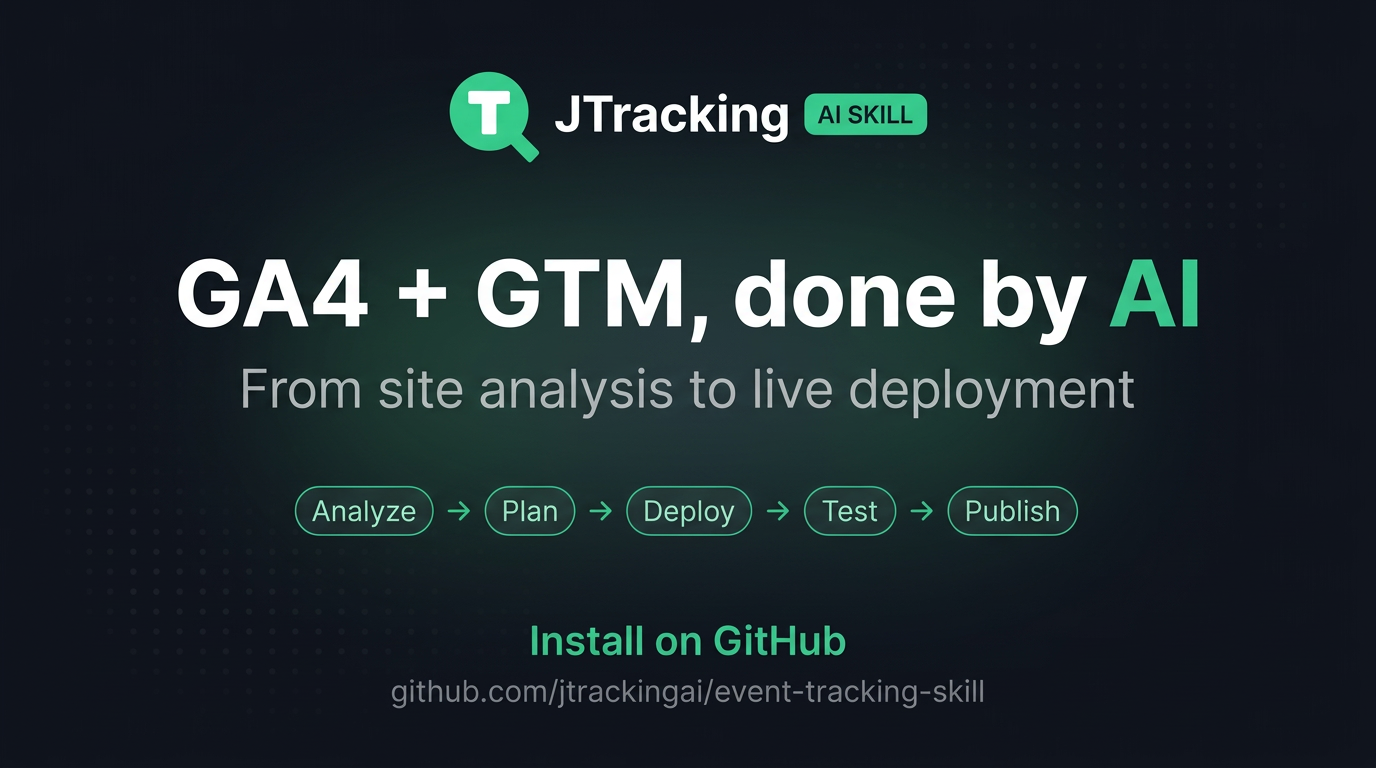
AI-powered GA4 + GTM event tracking — from site analysis to publish, fully automated. Works with Cursor, Codex, and any AI agent.
README.md

GA4 + GTM, done by AI. From site analysis to go live.
Works with Cursor · Codex · Any AI Agent

What You Get · Quick Start · Website

Event Tracking Skill

event-tracking-skill is a local-first skill and CLI for planning, generating, validating, and syncing GA4 event tracking in Google Tag Manager.

It keeps the implementation reviewable from crawl to publish:

  1. analyze a site
  2. group pages by business intent
  3. prepare schema context
  4. review the event schema
  5. generate GTM config
  6. sync to a GTM workspace
  7. verify in Preview Mode or the Shopify manual flow
  8. publish with more confidence

What You Get

For a given website, this skill can help you:

  • analyze page structure, shared UI, platform signals, and existing dataLayer usage
  • organize pages into business-purpose groups before defining events
  • generate a reviewable GA4 event schema and stakeholder-friendly event spec
  • turn the approved schema into GTM-ready tags, triggers, and variables
  • sync to GTM, verify before publish, and keep the whole flow artifact-driven
  • resume recent runs, audit schema decisions, and compare preview health against a baseline
  • support both generic websites and Shopify storefronts with different verification paths

Installation

Install Into A Local Agent Skills Directory (Recommended)

There are two install paths:

  • if you already have this repository checked out locally, use the built-in installer below
  • if you do not want to clone the repository, skip to npx skills add ...

Most users only need the umbrella skill.

If you want the built-in installer, first clone the repo and run the installer from the repo root:

git clone https://github.com/jtrackingai/event-tracking-skill.git
cd event-tracking-skill
npm run install:skills

That installs event-tracking-skill into the default skills directory with installer-managed auto-update metadata.
You do not need npm ci just to install the exported skill bundles.

If you already know you want the full phase-oriented family installed together, make that explicit:

npm run install:skills -- --with-phases

This is the recommended install path for Codex and also the most portable path for other agent environments that can load skills from a local directory.

Codex defaults:

  • $CODEX_HOME/skills when CODEX_HOME is set
  • otherwise ~/.codex/skills

For other agent runtimes, point the installer at that runtime's skills directory:

npm run install:skills -- --target-dir /path/to/agent/skills

If you also want the phase skills in a custom directory:

npm run install:skills -- --target-dir /path/to/agent/skills --with-phases

For local development only, if you want the installed skills to stay pointed at local exported bundles:

npm run install:skills -- --mode link

To link the full skill family during local iteration:

npm run install:skills -- --mode link --with-phases

Auto-update behavior:

  • copy installs are the recommended user path and can self-check for newer GitHub versions
  • link installs are for local development only and intentionally do not auto-update from GitHub
  • older installer-managed copies need one reinstall through npm run install:skills before they gain the installed auto-update bootstrap

Use docs/README.codex.md for Codex-specific defaults, update notes, and troubleshooting.
Use docs/README.install.md for the full shared agent-install guide.

Install with skills.sh (Alternative)

Use this if you want to install the skill into your local agent skills directory without cloning the repository first.

npx skills add jtrackingai/event-tracking-skill

This portable install can self-check for updates too. On the first successful self-update it rewrites the installed copy into the repo's normal copy-mode layout.

If you want the full umbrella + phase-skill family installed together from the start, use npm run install:skills -- --with-phases.

If you want the repo-local CLI, contributor setup, or local development workflow, use DEVELOPING.md instead of treating README as a maintainer guide.

Documentation Map

  • README.md for installation, quick start, and the public command surface
  • docs/README.install.md for the shared agent-install flow, copy vs link behavior, and auto-update notes
  • ARCHITECTURE.md for artifact lifecycle, branch behavior, and system boundaries
  • DEVELOPING.md for maintainer commands, edit rules, and release checks
  • docs/README.codex.md for Codex-specific defaults and troubleshooting on top of the generic installer flow
  • docs/skills.md for the umbrella skill and phase-skill map
  • SKILL.md for the agent-facing workflow contract

Skill Family

The repository now has:

  • one umbrella skill: event-tracking-skill
  • seven phase-oriented subskills under skills/: tracking-discover, tracking-group, tracking-live-gtm, tracking-schema, tracking-sync, tracking-verify, tracking-shopify

Use the umbrella skill for end-to-end or ambiguous requests. Use the phase skills when the user clearly wants only one part of the workflow, such as discovery, grouping, live GTM baseline review, schema review, GTM sync, preview QA, or Shopify-specific handling.

See docs/skills.md for the full map.

Root skill UI metadata now lives in agents/openai.yaml.

Exported Skill Bundles

If you need to package these skills outside this repository, generate self-contained bundles with:

npm run export:skills

That writes per-skill bundles to dist/skill-bundles/<skill-name>/.

Each exported bundle includes:

  • SKILL.md
  • agents/openai.yaml
  • the references/ files that the skill may need, including exported architecture.md and skill-map.md where relevant

The exported bundles rewrite command examples to the public event-tracking command name. Inside this repository, keep using ./event-tracking.

Quick Start

Scenario-First (Recommended)

Use scenario templates when you already know the delivery intent and want versioned run history grouped by scenario from the start.
For a brand-new URL with no artifacts yet, run-new-setup is a labeled entry point, not a replacement for analyze; it will usually point you to analyze as the first execution command.

# New implementation from scratch
./event-tracking run-new-setup ./output/example_com

# Incremental update for existing tracking
./event-tracking run-tracking-update ./output/example_com --baseline-schema ./output/example_com/schema-restore/confirmed-<hash>.json

# Routine upkeep check
./event-tracking run-upkeep ./output/example_com --baseline-schema ./output/example_com/schema-restore/confirmed-<hash>.json

# Audit-only health assessment before deciding rebuild
./event-tracking run-health-audit ./output/example_com --live-gtm-analysis ./output/example_com/live-gtm-analysis.json

Use these helpers when needed:

  • ./event-tracking scenario <artifact-dir> --set <scenario> --new-run [--sub-scenario ...] [--input-scope ...] to relabel or branch a run without executing a workflow step
  • ./event-tracking scenario-check <artifact-dir> to validate scenario-required artifacts and return the next scenario step
  • ./event-tracking scenario-transition <artifact-dir> --to <scenario> --reason "<why>" to record scenario handoff decisions
  • ./event-tracking runs <output-root> --json to inspect recent runs with scenario summary

Scenario guardrails:

  • tracking_health_audit is audit-only. generate-gtm, sync, and publish are blocked by default unless explicitly forced.
  • Scenario report commands are intent-gated (for example, upkeep report commands require upkeep).
  • scenario-check is a readiness check for the current scenario contract; use status when you need checkpoint, warning, and gate details.

Use It As A Skill

If you are using this in an agent environment, call it in natural language and provide the current workflow inputs:

Use event-tracking-skill to set up GA4 / GTM tracking for https://www.example.com.
Use ./output as the output root directory.
GA4 Measurement ID is G-XXXXXXXXXX.
Google tag ID is GT-XXXXXXX if needed.

The skill creates the run artifact directory as <output-root>/<url-slug> and then walks through grouping, conditional live GTM baseline review, schema review, GTM generation, sync, preview, and publish.

Use It As A CLI

Start with site analysis:

./event-tracking analyze https://www.example.com --output-root ./output

The CLI creates the artifact directory automatically as <output-root>/<url-slug>, for example ./output/example_com.

After filling and reviewing pageGroups in ./output/example_com/site-analysis.json, continue with the same artifact directory:

./event-tracking confirm-page-groups ./output/example_com/site-analysis.json
# If site-analysis.json detected real GTM public IDs, run this before prepare-schema:
./event-tracking analyze-live-gtm ./output/example_com/site-analysis.json
./event-tracking prepare-schema ./output/example_com/site-analysis.json
./event-tracking validate-schema ./output/example_com/event-schema.json --check-selectors
./event-tracking generate-spec ./output/example_com/event-schema.json
./event-tracking confirm-schema ./output/example_com/event-schema.json
./event-tracking generate-gtm ./output/example_com/event-schema.json --measurement-id G-XXXXXXXXXX
./event-tracking sync ./output/example_com/gtm-config.json
./event-tracking preview ./output/example_com/event-schema.json --context-file ./output/example_com/gtm-context.json
./event-tracking publish --context-file ./output/example_com/gtm-context.json --version-name "GA4 Events v1"

Execution environment note:

  • Run analyze, validate-schema --check-selectors, preview, and sync outside sandboxed environments by default.
  • analyze, selector checking, and preview launch Playwright. sync may need a local OAuth callback on 127.0.0.1.

Important workflow note:

  • prepare-schema requires pageGroups to already be filled in site-analysis.json and explicitly confirmed
  • Key decision checkpoints require explicit user confirmation before proceeding:
    • pageGroups review/approval
    • final event-schema.json approval
    • GTM account/container/workspace target during sync
    • publish decision
  • If any of the above confirmations are not explicit, stop and confirm first; do not auto-advance.
  • after grouping pages, run ./event-tracking confirm-page-groups <artifact-dir>/site-analysis.json
  • if site-analysis.json detected real GTM public IDs, run ./event-tracking analyze-live-gtm <artifact-dir>/site-analysis.json before prepare-schema
  • for generic sites, event-schema.json is authored after prepare-schema from schema-context.json
  • for Shopify sites, prepare-schema bootstraps event-schema.json automatically if it does not already exist
  • publish now checks tracking-health.json before going live; use --force only when you intentionally want to override missing or blocking verification health

The full workflow used by the skill is documented in SKILL.md.

Common Entry Points

You do not need to run the full flow every time.

Intent Start From Minimum Inputs Typical Command(s)
Find recent runs Output root output root ./event-tracking runs ./output
Inspect current progress Any artifact directory or file inside it artifact directory or file path ./event-tracking status <artifact-dir>
Analyze a new site Step 1 URL, output root ./event-tracking analyze <url> --output-root <dir>
Review or approve page groups Step 2 site-analysis.json update pageGroups, then ./event-tracking confirm-page-groups <artifact-dir>/site-analysis.json
Review the live GTM baseline before schema prep Step 3 approved site-analysis.json with detected live GTM IDs, or explicit primary GTM ID ./event-tracking analyze-live-gtm <artifact-dir>/site-analysis.json [--primary-container-id GTM-XXXXXXX]
Author or review schema Step 4 approved site-analysis.json or existing event-schema.json prepare-schema, edit event-schema.json, validate-schema, generate-spec, confirm-schema
Generate GTM config from an approved schema Step 5 event-schema.json, measurement ID ./event-tracking generate-gtm <artifact-dir>/event-schema.json --measurement-id <id>
Sync an approved GTM config Step 6 gtm-config.json ./event-tracking sync <artifact-dir>/gtm-config.json
QA an existing GTM workspace Step 7 event-schema.json, gtm-context.json ./event-tracking preview <artifact-dir>/event-schema.json --context-file <artifact-dir>/gtm-context.json
Publish an already-verified workspace Step 8 gtm-context.json, current tracking-health.json ./event-tracking publish --context-file <artifact-dir>/gtm-context.json --version-name "GA4 Events v1"

Scenario-oriented reporting commands:

  • ./event-tracking generate-update-report <artifact-dir>/event-schema.json [--baseline-schema <file>]
  • ./event-tracking generate-upkeep-report <artifact-dir>/event-schema.json [--baseline-schema <file>] [--health-file <file>]
  • ./event-tracking generate-health-audit-report <artifact-dir>/event-schema.json [--live-gtm-analysis <file>]
  • ./event-tracking start-scenario <new_setup|tracking_update|upkeep|tracking_health_audit> <artifact-dir> [--sub-scenario ...] [--input-scope ...]
  • ./event-tracking scenario-transition <artifact-dir> --to <scenario> [--to-sub-scenario ...] [--reason ...] [--no-new-run]
  • ./event-tracking scenario-check <artifact-dir> [--json]
  • ./event-tracking run-new-setup <artifact-dir> [--input-scope ...]
  • ./event-tracking run-tracking-update <artifact-dir> [--schema-file ...] [--baseline-schema ...]
  • ./event-tracking run-upkeep <artifact-dir> [--schema-file ...] [--baseline-schema ...] [--health-file ...]
  • ./event-tracking run-health-audit <artifact-dir> [--schema-file ...] [--live-gtm-analysis ...]

Scenario gate note:

  • tracking_health_audit is treated as audit-only and blocks generate-gtm, sync, and publish unless explicitly forced.
  • Scenario reporting commands are gated by scenario intent: upkeep reports require upkeep, health-audit reports require tracking_health_audit.
  • runs --json now includes a scenarioSummary section with per-scenario counts and latest run pointers.

If a user already has an artifact directory, resume from the earliest unmet prerequisite instead of restarting from analyze. If they only know the output root, use ./event-tracking runs <output-root> to find recent artifact directories.

Advanced Commands

  • ./event-tracking scenario <artifact-dir> --set <scenario> --new-run [--sub-scenario ...] [--input-scope ...] updates run metadata only. Use it when you want to relabel or branch work without executing a workflow step.
  • ./event-tracking sync <artifact-dir>/gtm-config.json --dry-run prints planned GTM creates, updates, and deletes without modifying the workspace.
  • ./event-tracking sync <artifact-dir>/gtm-config.json --new-workspace explicitly creates a new workspace instead of selecting an existing one.
  • ./event-tracking analyze-live-gtm <artifact-dir>/site-analysis.json --gtm-id GTM-XXXXXXX[,GTM-YYYYYYY] overrides or supplements the live GTM IDs detected during crawl.
  • ./event-tracking preview <artifact-dir>/event-schema.json --context-file <artifact-dir>/gtm-context.json --baseline <previous-tracking-health.json> compares the new preview health report against an older baseline.
  • ./event-tracking auth-clear --context-file <artifact-dir>/gtm-context.json clears the URL-scoped OAuth cache for one run. Use --output-root <output-root> to clear all cached auth under an output root.

Required Inputs

Before running the full workflow, prepare:

  • target website URL
  • output root directory for generated artifacts
  • GA4 Measurement ID
  • optional Google tag ID

The artifact directory is required for every downstream step and is derived as <output-root>/<url-slug>.

Workflow

The current workflow mixes agent-led review steps with CLI execution steps.

Step Owner What It Does Command / Output
Analyze CLI Crawls the site and captures pages, shared UI, warnings, detected events, and platform signals ./event-tracking analyze <url> --output-root <output-root> -> site-analysis.json
Page Grouping Agent or user Fills pageGroups in site-analysis.json by business purpose before schema preparation updated site-analysis.json
Page Group Confirmation User + CLI Reviews the current page groups and records explicit approval for the current pageGroups snapshot ./event-tracking confirm-page-groups <artifact-dir>/site-analysis.json -> updated site-analysis.json
Live GTM Baseline Audit CLI Reviews the site's real public GTM runtime before schema generation when live GTM container IDs were detected during analysis ./event-tracking analyze-live-gtm <artifact-dir>/site-analysis.json -> live-gtm-analysis.json, live-gtm-review.md
Prepare Schema Context CLI Compresses grouped analysis plus any reviewed live GTM baseline for schema authoring and bootstraps Shopify artifacts when needed ./event-tracking prepare-schema <artifact-dir>/site-analysis.json -> schema-context.json, Shopify bootstrap files
Schema Authoring And Review Agent or user + CLI validation Creates or refines event-schema.json, validates selectors, generates a readable spec, emits a live-baseline comparison report when available, records schema approval, and keeps restore/audit history validate-schema, generate-spec, confirm-schema -> event-schema.json, event-spec.md, tracking-plan-comparison.md (when live baseline exists), schema-decisions.jsonl, schema-restore/, workflow-state.json
GTM Generation CLI Converts the approved schema into GTM-ready tags, triggers, and variables ./event-tracking generate-gtm <artifact-dir>/event-schema.json --measurement-id <G-XXXXXXXXXX> -> gtm-config.json
GTM Sync CLI Authenticates with Google, requires explicit account/container/workspace selection, and syncs the generated configuration ./event-tracking sync <artifact-dir>/gtm-config.json -> gtm-context.json, credentials.json
Verification CLI Runs GTM preview for generic sites, records unexpected fired events, writes tracking health JSON plus a human-readable health report and timestamped health history, or writes a Shopify manual verification guide instead ./event-tracking preview <artifact-dir>/event-schema.json --context-file <artifact-dir>/gtm-context.json -> preview-report.md, preview-result.json, tracking-health.json, tracking-health-report.md, tracking-health-history/
Publish CLI Publishes the validated GTM workspace as a new container version, but only after current tracking health is present and non-blocking unless the user explicitly passes --force ./event-tracking publish --context-file <artifact-dir>/gtm-context.json --version-name "GA4 Events v1"

Generic vs Shopify Branch

After analyze, the run still shares grouping, page-group approval, and live GTM baseline review when applicable before the generic and Shopify-specific schema behavior diverges:

  • generic: follow the standard schema authoring, GTM sync, and automated preview flow
  • shopify: use Shopify bootstrap artifacts after the shared early stages, generate a Shopify custom pixel after sync, and use manual post-install verification instead of the normal automated browser preview

Shopify-specific behavior today:

  • prepare-schema writes shopify-schema-template.json and shopify-bootstrap-review.md
  • prepare-schema initializes event-schema.json automatically when it does not exist yet
  • sync generates shopify-custom-pixel.js and shopify-install.md
  • preview skips automated browser validation and writes manual Shopify verification guidance instead

For the detailed Shopify branch, see references/shopify-workflow.md.

Main Artifacts

Artifacts now follow a site-level directory with versioned runs:

  • current files under <output-root>/<url-slug>/
  • run snapshots under <output-root>/<url-slug>/versions/<run-id>/
  • scenario handoff audit in scenario-transitions.jsonl

For the complete and always-current artifact list (including scenario deliverables), see references/output-contract.md.

GTM Selection Rule

During sync, GTM target selection is a required user-confirmation step.

  • never auto-select the GTM account, container, or workspace for the user
  • always show the candidate list and require explicit user confirmation at each selection step
  • a matching domain name or a likely production-looking option is not enough to justify auto-selection
  • only skip a selection step when the user has already provided the exact GTM ID for that step
  • if no existing workspaces are available, sync asks before creating a new default workspace; --new-workspace makes that choice explicit up front

Important Notes

  • prefer --output-root for analyze; --output-dir is only a deprecated exact artifact-directory override
  • analyze supports partial mode with --urls for specific same-domain pages
  • analyze also supports --storefront-password for password-protected Shopify dev stores
  • when site-analysis.json contains real GTM public IDs, prepare-schema requires analyze-live-gtm first so schema design can compare against the current live baseline
  • generate-gtm will surface any custom dimensions that must be registered in GA4 before you continue
  • generate-gtm now requires a current schema confirmation; use ./event-tracking confirm-schema <artifact-dir>/event-schema.json after schema review
  • selector-based events may still need review when the site uses unstable or highly dynamic markup
  • preview now scores only the schema events that are actually verified in automation, persists unexpected fired events, and keeps timestamped health history snapshots
  • publish now blocks when preview health is missing, still manual-only, or contains blockers; use --force only for an intentional override
  • Shopify validation differs from the standard automated GTM preview flow

Maintenance

  • npm test rebuilds the CLI and runs the standalone automated workflow-state and gate tests.
  • npm run doctor checks Node, the built CLI artifact, the repo-local wrapper, and the Playwright Chromium install.
  • npm run export:skills writes self-contained skill bundles to dist/skill-bundles/ for packaging outside the repo.
  • npm run install:skills installs the umbrella bundle into $CODEX_HOME/skills or ~/.codex/skills, with optional --target-dir, --skill, and --with-phases controls.
  • copy-mode installed bundles can now check GitHub for a newer VERSION and self-update the selected installed bundle set.
  • npm run install:skills -- --mode link links the selected exported bundles into the skills directory instead of copying them, which is useful during local iteration.
  • npm run check rebuilds the CLI, runs automated tests, smoke-tests ./event-tracking --help, exports and installs skill bundles into a temp directory, and enforces the public command surface in docs.

Product Boundary

  • the core workflow runs locally
  • it does not require JTracking product authorization
  • GTM sync is handled through Google OAuth
  • generic sites are validated through GTM Preview Mode
  • Shopify stores use custom pixel artifacts plus manual validation after installation

Need A More Advanced Setup?

This skill reflects the implementation workflow behind JTracking.

If you need a more advanced setup, JTracking also supports:

  • richer event design based on business scenarios
  • server-side tracking and custom loader support
  • more channel connections such as GA4, Meta, Google Ads, TikTok, and Klaviyo
  • longer-term, unified tracking management

License

This project is licensed under the Apache License, Version 2.0. See LICENSE for the full text.

Use of the JTracking name, logo, and other brand assets is not granted under this license.

Reviews (0)

No results found