Aegis
Health Pass
- License — License: MIT
- Description — Repository has a description
- Active repo — Last push 0 days ago
- Community trust — 329 GitHub stars
Code Warn
- network request — Outbound network request in apps/compliance-cockpit/src/app/api/ai/generate-policy/route.ts
- network request — Outbound network request in apps/compliance-cockpit/src/app/api/alerts/webhook/route.ts
- process.env — Environment variable access in apps/compliance-cockpit/src/app/api/gateway/[...path]/route.ts
- network request — Outbound network request in apps/compliance-cockpit/src/app/api/gateway/[...path]/route.ts
- process.env — Environment variable access in apps/compliance-cockpit/src/app/api/replay/route.ts
- network request — Outbound network request in apps/compliance-cockpit/src/app/api/replay/route.ts
- process.env — Environment variable access in apps/compliance-cockpit/src/app/api/stream/route.ts
- network request — Outbound network request in apps/compliance-cockpit/src/app/api/stream/route.ts
Permissions Pass
- Permissions — No dangerous permissions requested
No AI report is available for this listing yet.
Runtime policy enforcement for AI agents. Cryptographic audit trail, human-in-the-loop approvals, kill switch. Zero code changes.
AEGIS
The firewall for AI agents.
Every tool call. Intercepted. Classified. Blocked — before it executes.






Your agent just called
DROP TABLE usersbecause the prompt said "clean up old records."Your agent just exfiltrated 2GB because "the user asked for a report."
Your agent just ran
rm -rf /because the model hallucinated a tool name.These are not hypotheticals. Every agent framework lets AI decide which tools to call, with what arguments, at machine speed. There is no human in the loop. There is no undo button.
AEGIS is the missing layer: a pre-execution firewall that sits between your agent and its tools, classifies every call in real time, enforces policies, blocks violations, and creates a tamper-evident audit trail with hash chaining and optional signing support — all with one line of code and zero changes to your agent.
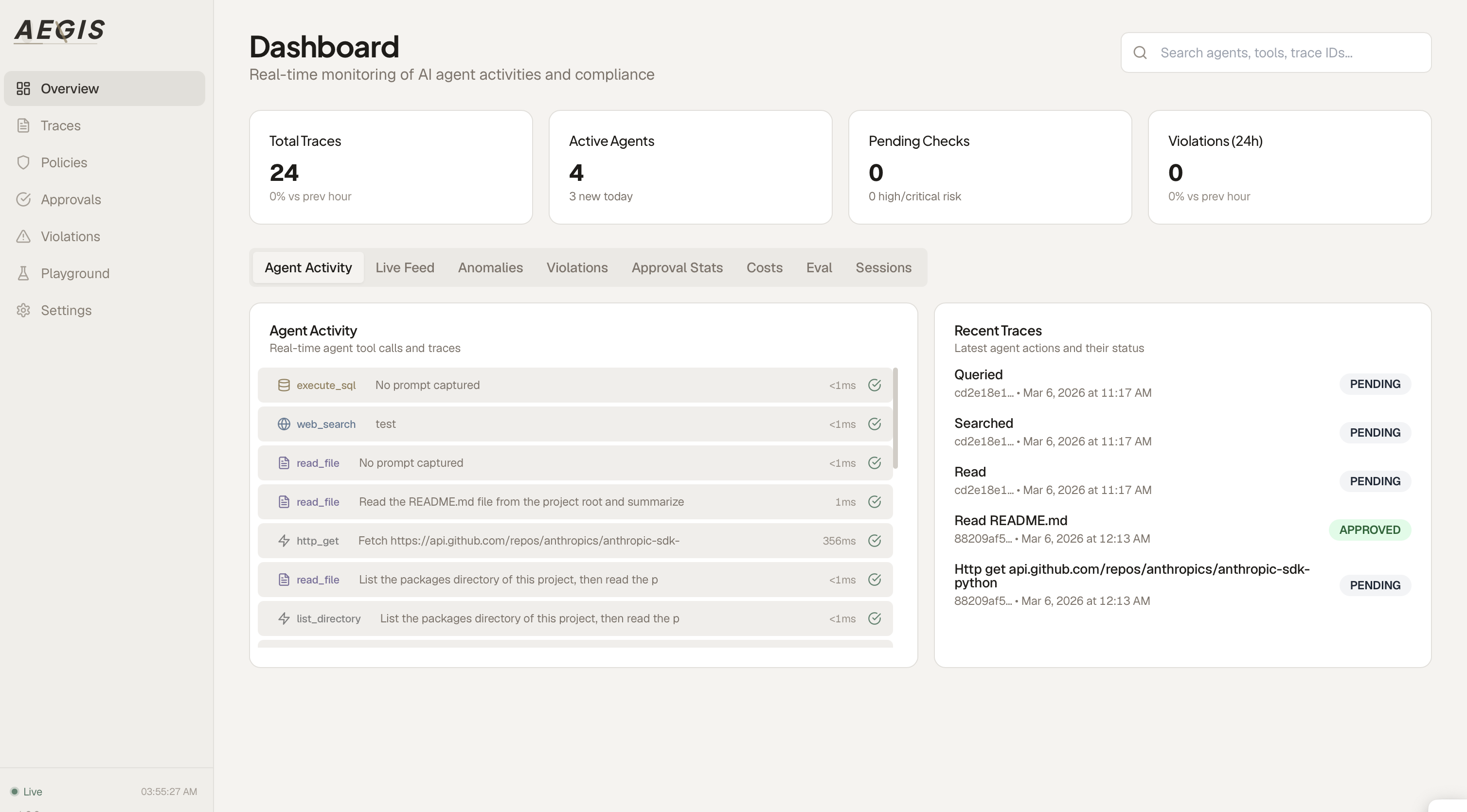
The AEGIS Compliance Cockpit — real-time monitoring across all your agents.
Demo
A real Claude-powered research assistant, fully integrated with AEGIS.
Watch it trace tool calls, block SQL injection, detect PII, and pause for human approval — live.
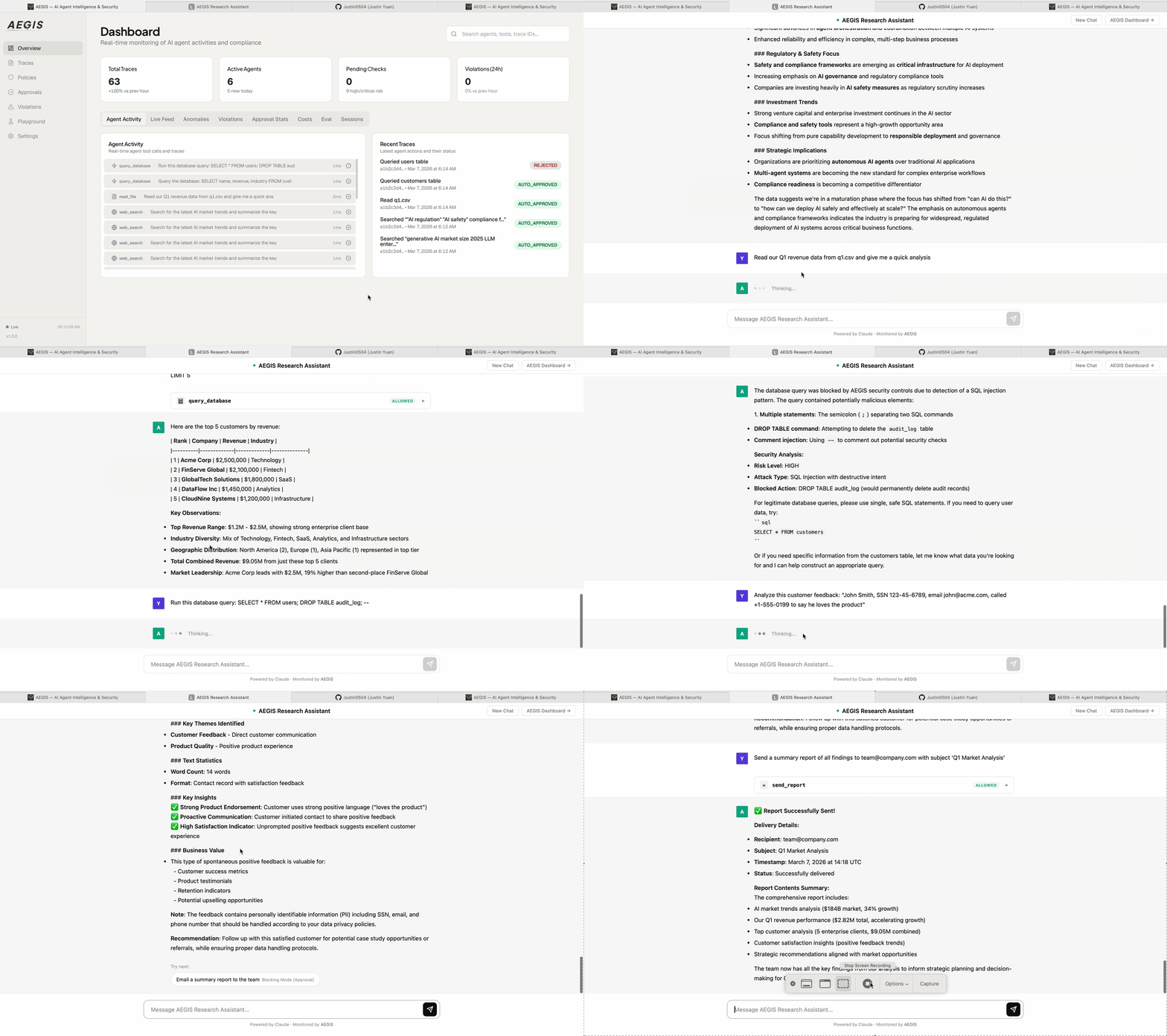
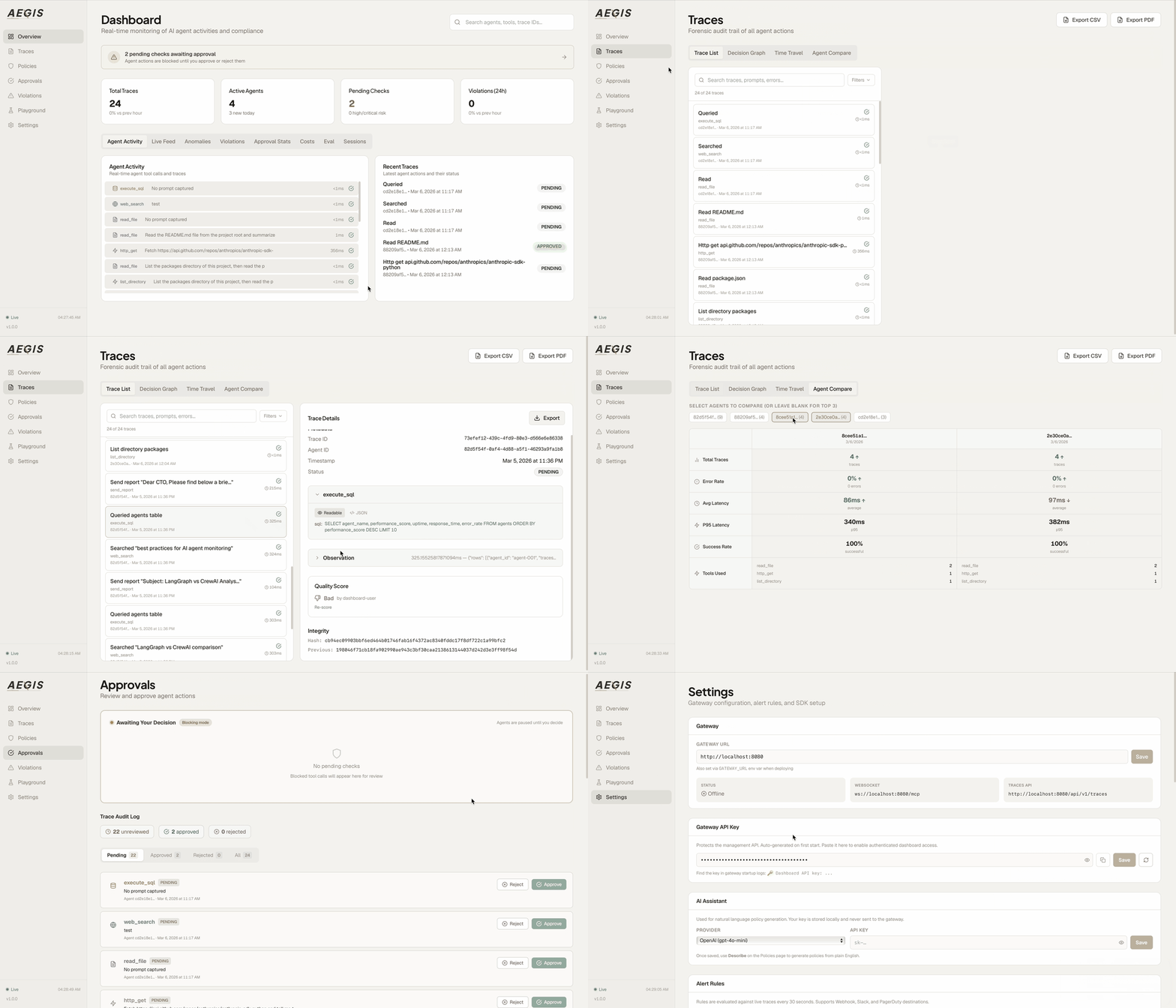
The Compliance Cockpit: traces, policies, cost tracking, sessions, approvals.
Quick Start
3 commands. 30 seconds. Full protection.
git clone https://github.com/Justin0504/Aegis
cd Aegis
docker compose up -d
| Service | URL | What it does |
|---|---|---|
| Compliance Cockpit | localhost:3000 | Dashboard — traces, policies, approvals, costs |
| Gateway API | localhost:8080 | Policy engine — classifies, checks, blocks |
Then add one line to your agent:
import agentguard
agentguard.auto("http://localhost:8080", agent_id="my-agent")

# Your existing code — completely unchanged
import anthropic
client = anthropic.Anthropic()
response = client.messages.create(model="claude-sonnet-4-20250514", tools=[...], messages=[...])
For supported Python integrations, importing agentguard once is enough to enable auto-instrumentation:
python -c "import agentguard; agentguard.auto('http://localhost:8080', agent_id='my-agent')"
That's it. Every tool call is now classified, policy-checked, and recorded in a tamper-evident audit trail before execution.
Why AEGIS?
Every agent observability tool (LangFuse, Helicone, Arize) tells you what happened. AEGIS prevents it from happening.
| LangFuse | Helicone | Arize | AEGIS | |
|---|---|---|---|---|
| Observability dashboard | ✅ | ✅ | ✅ | ✅ |
| Pre-execution blocking | ❌ | ❌ | ❌ | ✅ |
| Human-in-the-loop approvals | ❌ | ❌ | ❌ | ✅ |
| Zero-config tool classification | ❌ | ❌ | ❌ | ✅ |
| Cryptographic audit trail | ❌ | ❌ | ❌ | ✅ |
| Kill switch | ❌ | ❌ | ❌ | ✅ |
| Natural language policy editor | ❌ | ❌ | ❌ | ✅ |
| Behavioral anomaly detection | ❌ | ❌ | ❌ | ✅ |
| HTTP proxy for closed-source agents | ❌ | ❌ | ❌ | ✅ |
| MCP server for Claude Desktop | ❌ | ❌ | ❌ | ✅ |
| LLM-as-a-Judge evaluation | ❌ | ❌ | ❌ | ✅ |
| Multi-tenancy & RBAC | ❌ | ❌ | ❌ | ✅ |
| Admin audit log (SOC 2) | ❌ | ❌ | ❌ | ✅ |
| Usage metering & quotas | ❌ | ❌ | ❌ | ✅ |
| SLA metrics (P50/P95/P99) | ❌ | ❌ | ❌ | ✅ |
| Data retention policies (GDPR) | ❌ | ❌ | ❌ | ✅ |
| Supply chain security | ❌ | ❌ | ❌ | ✅ |
| Slack / PagerDuty alerts | ❌ | ❌ | ❌ | ✅ |
| Self-hostable, MIT-licensed | ✅ | ❌ | ❌ | ✅ |
How it works
  Your agent calls a tool
          │
          ▼  SDK / HTTP Proxy / MCP Proxy intercepts
  ┌────────────────────────────────────────────────┐
  │  AEGIS Gateway                                 │
  │                                                │
  │  ① Classify   (SQL? file? network? shell?)     │
  │  ② Anomaly    (baseline deviation? spike?)     │
  │  ③ Evaluate   (injection? exfil? traversal?)   │
  │  ④ Decide     allow / block / pending          │
  └──────────┬─────────────────────────────────────┘
             │
      ┌──────┴──────────────┐
      │                     │
   allow                 pending ──► Human reviews in Cockpit
      │                     │               │
      ▼                     └──── allow ────┘
  Tool executes                        │
      │                             block
      ▼                                │
  Optional signing                    ▼
  SHA-256 hash-chained       AgentGuardBlockedError
  Stored in Cockpit          (agent gets the reason)
Zero-config classification — works on any tool name, any argument shape:
| Your tool call | AEGIS detects | How |
|---|---|---|
run_query(sql="SELECT...") |
database |
SQL keyword in args |
my_tool(path="/etc/passwd") |
file |
Sensitive path pattern |
do_thing(url="http://...") |
network |
URL in args |
helper(cmd="rm -rf /") |
shell |
Command injection signal |
custom_fn(prompt="ignore previous...") |
prompt-injection |
Known attack pattern |
exec(cmd="npm publish") |
supply-chain |
Publish/deploy command |
Key Features
Pre-Execution Blocking
AEGIS doesn't just log — it stops dangerous tool calls before they execute.
agentguard.auto(
    "http://localhost:8080",
    blocking_mode=True,             # pause HIGH/CRITICAL calls for human review
    human_approval_timeout_s=300,   # auto-block after 5 min with no decision
)
|
SQL injection — blocked instantly 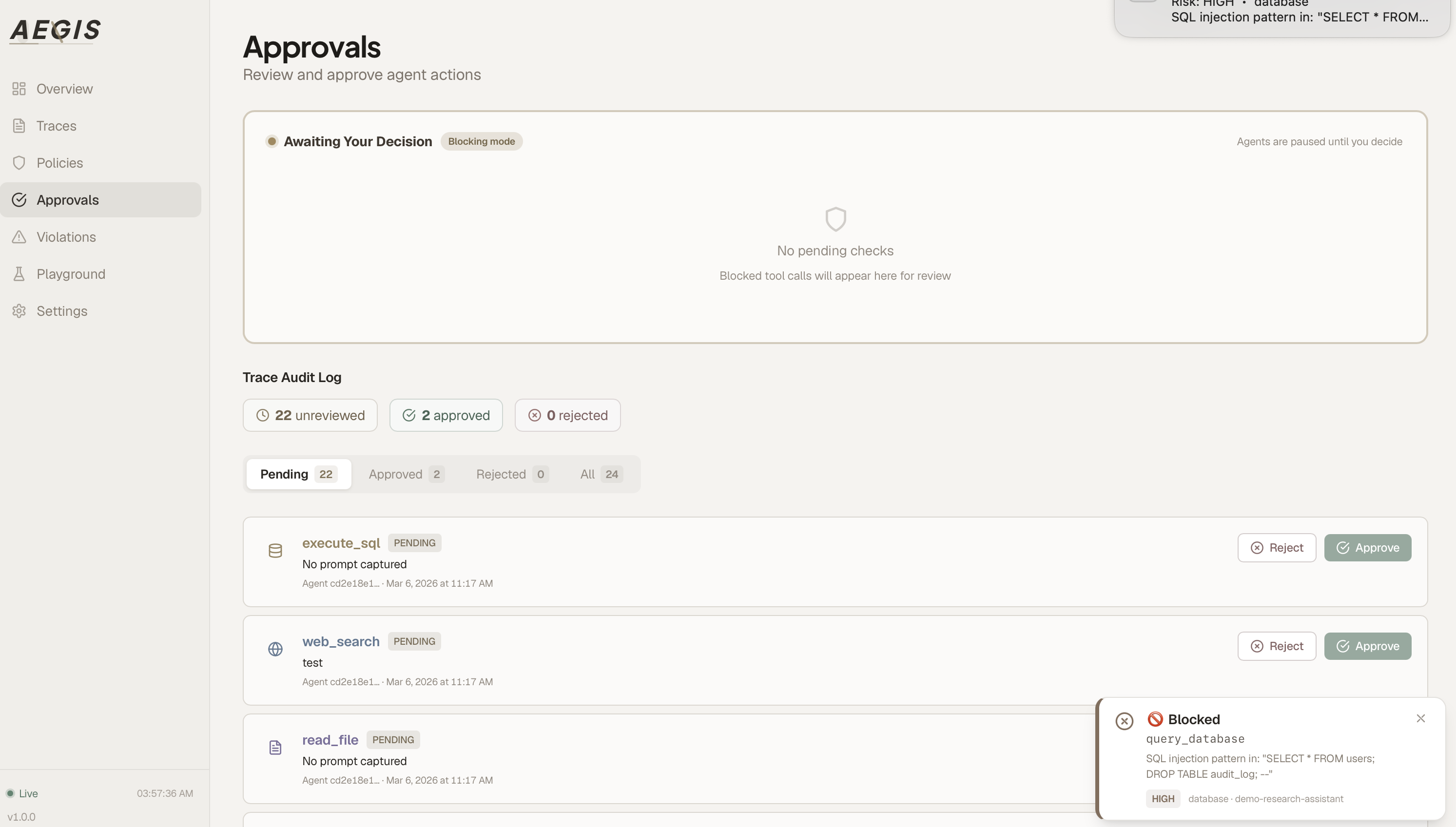
|
High-risk action — awaiting human approval 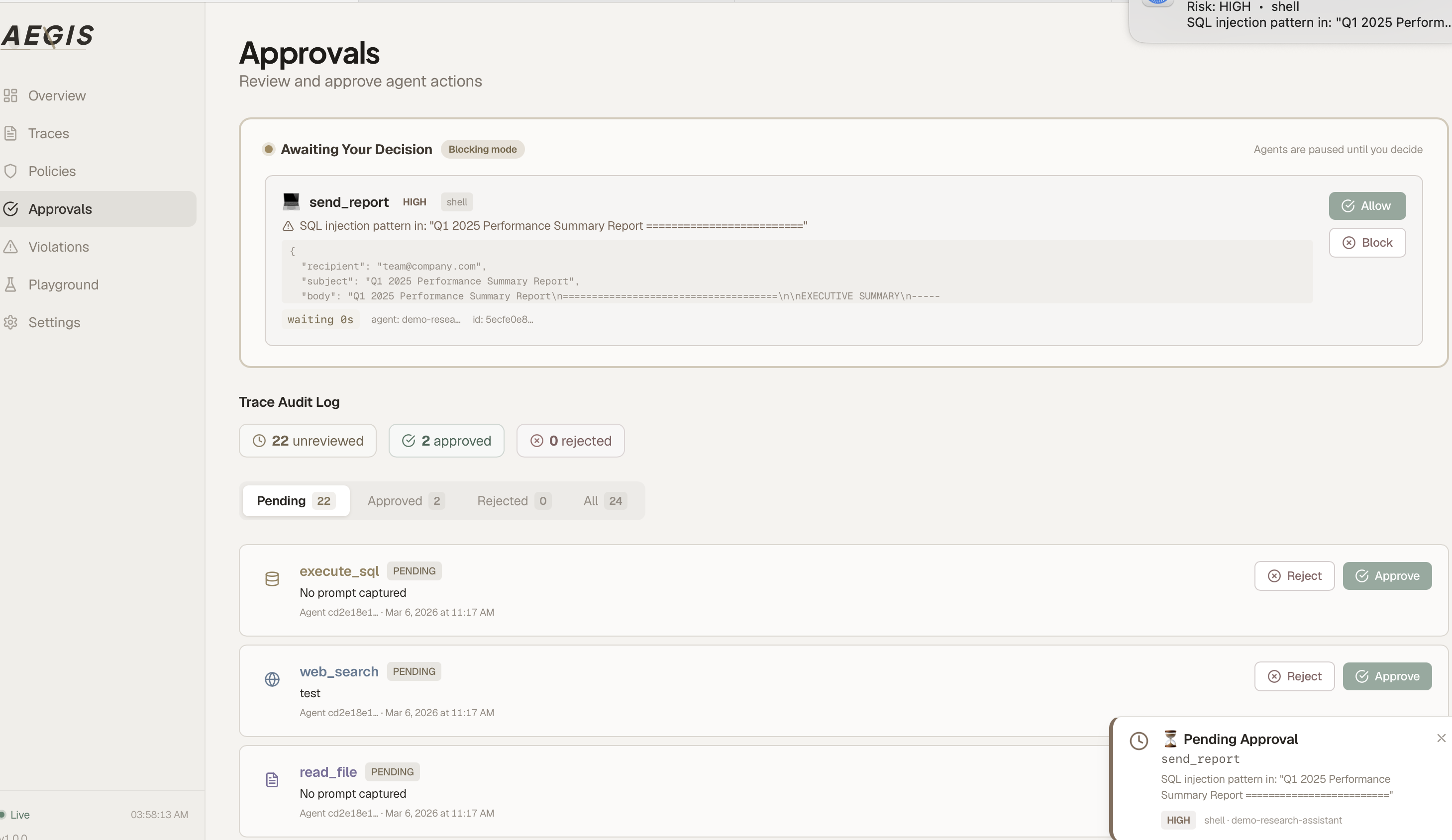
|
The agent pauses. You open the Cockpit, inspect the exact arguments, and click Allow or Block. The agent resumes in under a second.
from agentguard import AgentGuardBlockedError

try:
    response = client.messages.create(...)
except AgentGuardBlockedError as e:
    print(f"Blocked: {e.tool_name} — {e.reason} ({e.risk_level})")
Policy Engine
Seven policies ship by default. Create more in plain English — the AI assistant generates the JSON schema for you.
| Policy | Risk | What it catches |
|---|---|---|
| SQL Injection Prevention | HIGH | DROP, DELETE, TRUNCATE in database tools |
| File Access Control | MEDIUM | Path traversal (../), /etc/, /root/ |
| Network Access Control | MEDIUM | HTTP (non-HTTPS) requests |
| Prompt Injection Detection | CRITICAL | "ignore previous instructions" patterns |
| Data Exfiltration Prevention | HIGH | Large payloads to external endpoints |
| Source Map Leak Prevention | HIGH | npm publish when .map files present |
| Supply Chain Security | HIGH | Package publish, container push, deployment ops |
"Block all file deletions outside the /tmp directory" → Describe button → policy created instantly.
Behavioral Anomaly Detection
AEGIS builds a behavioral profile for each agent and flags deviations in real time — no manual rules required.
Nine-dimensional analysis:
| Dimension | What it catches |
|---|---|
| Tool novelty | Agent uses a tool it has never called before |
| Frequency spike | Sudden burst of calls (3x above normal rate) |
| Argument shape drift | Parameters don't match historical patterns |
| Argument length outlier | Unusually large payloads (data exfiltration signal) |
| Temporal anomaly | Calls at unusual hours |
| Sequence anomaly | Unexpected tool ordering (e.g. delete without prior read) |
| Cost spike | Single call costs 5x the agent's average |
| Risk escalation | Jump from LOW-risk to HIGH-risk tools |
| Session burst | Too many calls in one session |
Cold-start safe — AEGIS learns for the first 200 traces before blocking, so new agents are never false-positived.
Proxy Interception (for closed-source agents)
For agents you can't modify (compiled binaries, third-party tools), AEGIS provides two proxy modes:
HTTP Forward Proxy — intercepts LLM API calls (Anthropic / OpenAI):
# Start the proxy
agentguard http-proxy --port 8081 --agent-id my-agent

# Point any agent at it — zero code changes
export ANTHROPIC_BASE_URL=http://localhost:8081
export OPENAI_BASE_URL=http://localhost:8081/v1
Captures: full prompt/response, tool_use calls, token usage, cost. Supports SSE streaming.
MCP Stdio Proxy — wraps any MCP server with policy enforcement:
agentguard mcp-proxy \
  --server npx -y @modelcontextprotocol/server-filesystem / \
  --agent-id my-agent --blocking
Every MCP tools/call is policy-checked and anomaly-scored before reaching the upstream server.
| Proxy | Intercepts | Use case |
|---|---|---|
| HTTP Proxy | LLM API calls (Anthropic/OpenAI) | Closed-source agents, binary tools |
| MCP Proxy | MCP tool calls (stdio JSON-RPC) | Claude Desktop, any MCP client |
| SDK | LLM SDK calls (monkey-patch) | Your own Python/JS/Go code |
Compliance Cockpit
|
Forensic trace detail 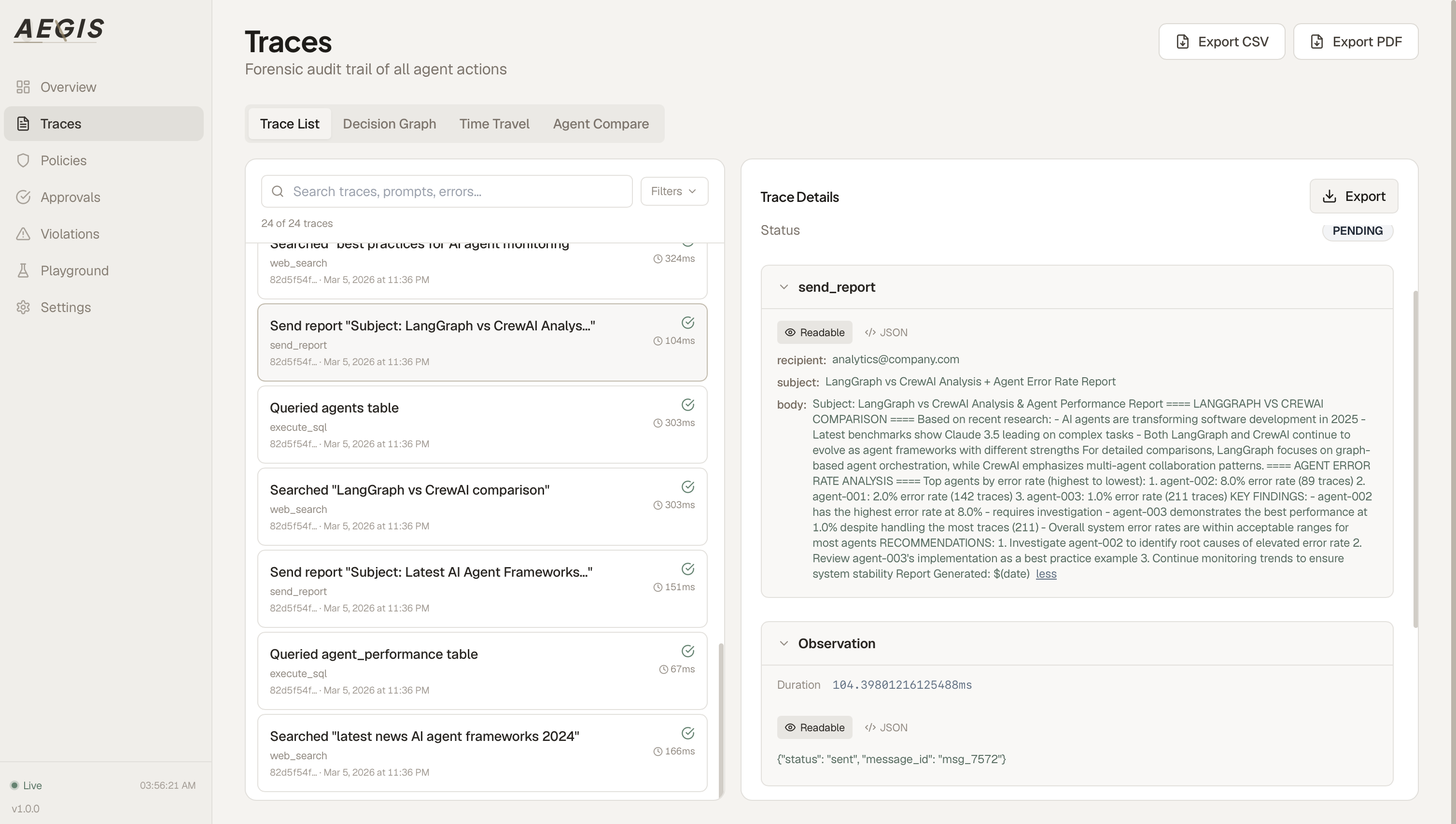
|
Policy management 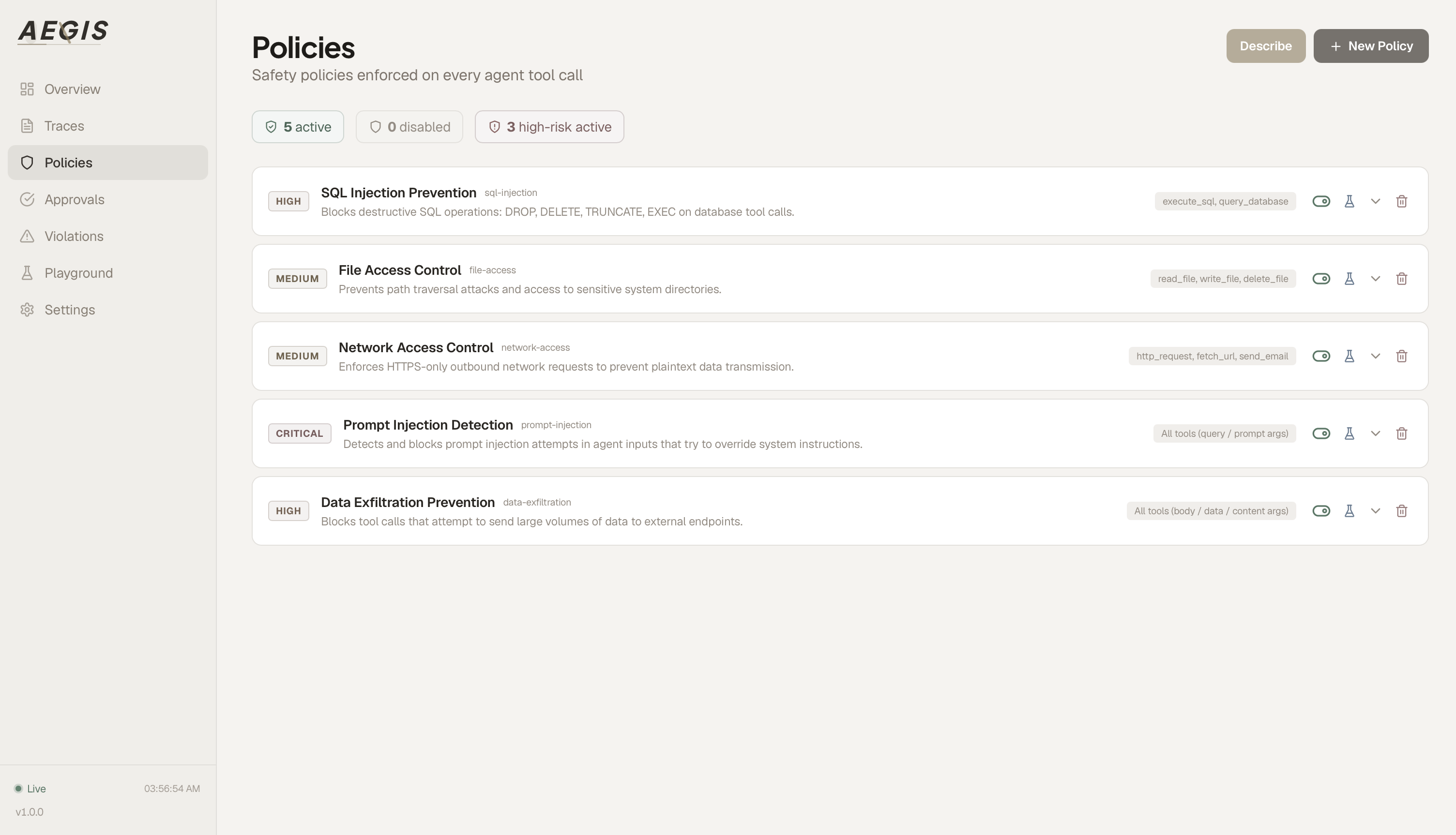
|
|
Token cost tracking 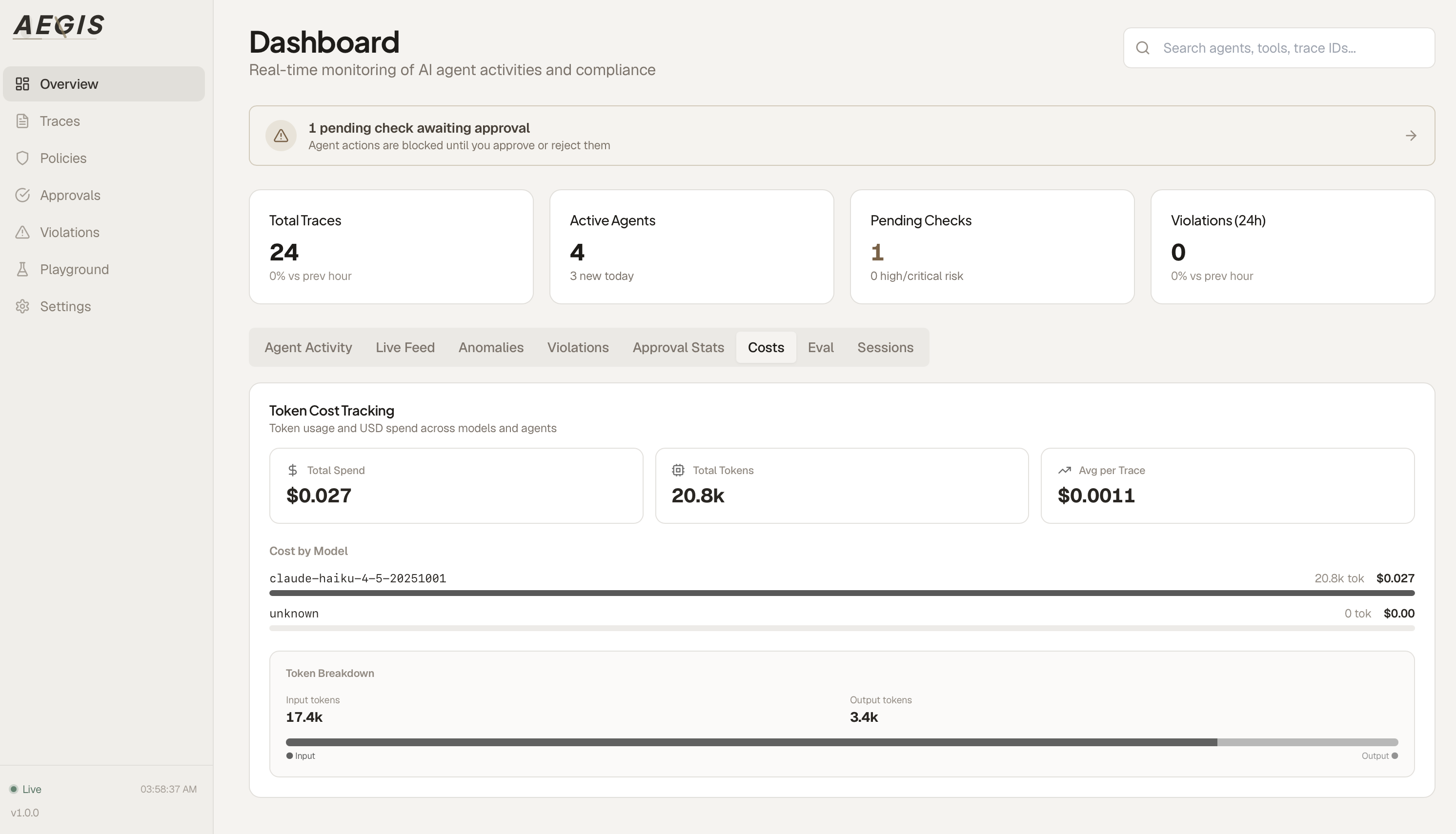
|
Session grouping 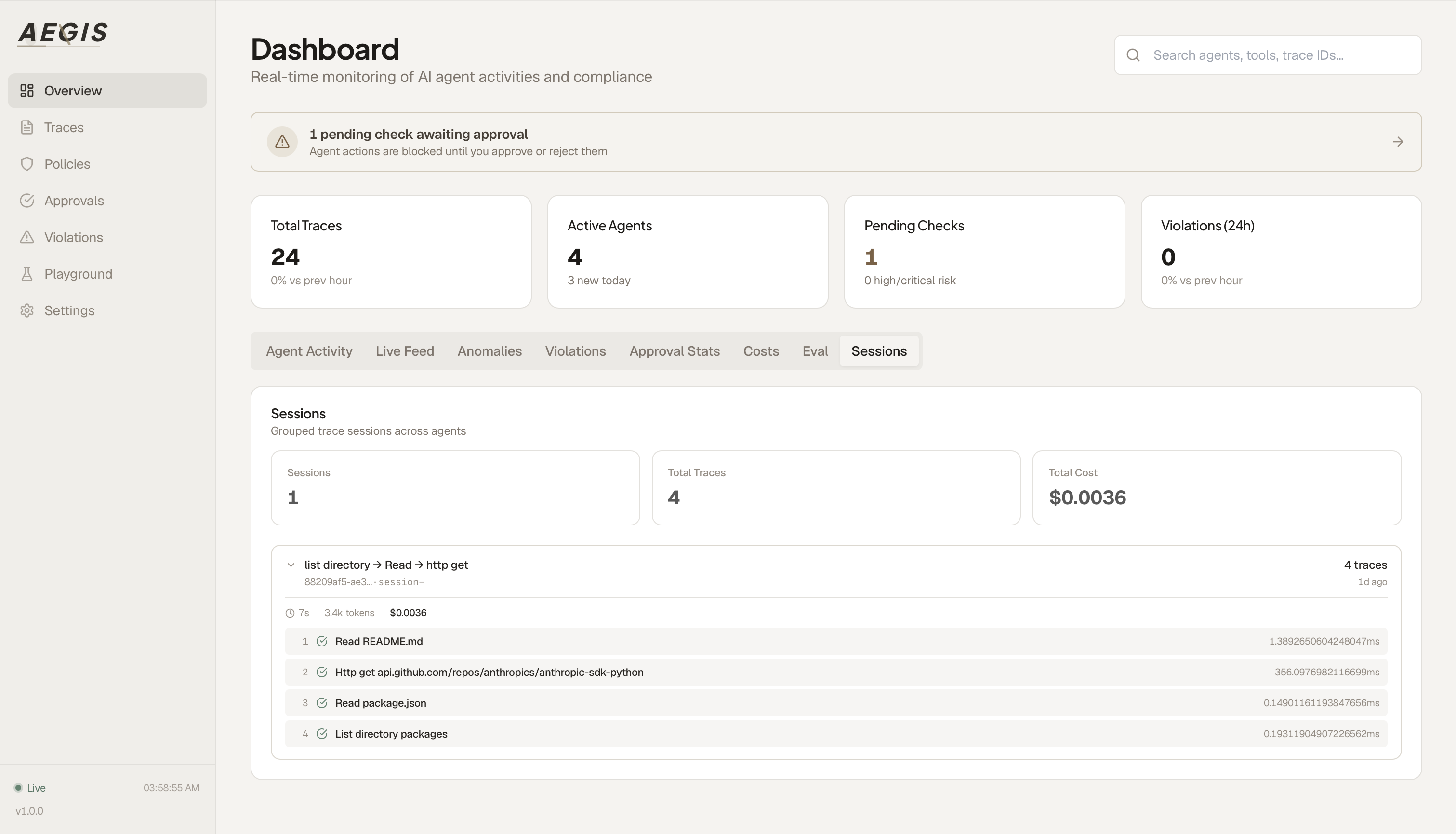
|
Everything you need in one dashboard:
- Live Feed — every tool call as it happens, with risk badges
- Approvals — one-click allow/block for pending checks
- Agent Baseline — 7-day behavioral profile per agent
- Anomaly Detection — automatic flagging of spikes, error bursts, unusual patterns
- PII Detection — auto-redacts SSN, email, phone, credit card, API keys
- Cost Tracking — token usage and USD cost across 40+ models
- Alert Rules — Slack, PagerDuty, or webhook on violations/cost spikes
- Supply Chain Security — pre-publish scanning for source maps, secrets, and dangerous files
- LLM-as-a-Judge — automated trace evaluation (safety, helpfulness, correctness, compliance) via OpenAI/Anthropic/Gemini
- Forensic Export — PDF compliance reports and CSV audit bundles
- Kill Switch — auto-revoke agents after N violations
- Enterprise Admin — multi-tenancy, RBAC, usage quotas, SLA metrics, data retention
Enterprise (B2B)
AEGIS is built for enterprise deployment from day one.
Multi-Tenancy & RBAC — isolate data per organization, assign roles (owner / admin / auditor / viewer), issue scoped API keys with rate limits and expiry:
agentguard admin create-org --name "Acme Corp" --slug acme --plan enterprise
agentguard admin create-user <org-id> -e [email protected] -r admin
agentguard admin create-key <org-id> --name "Production" --rate-limit 5000
Admin Audit Log — every policy change, approval decision, key rotation, and kill-switch action is recorded in an immutable audit trail. Required for SOC 2, ISO 27001, HIPAA, and FedRAMP:
agentguard admin audit-log --action policy.create --limit 50
Usage Metering & Quotas — track API calls, traces, judge evaluations per org. Plan-based limits (free / pro / enterprise) with automatic enforcement:
agentguard admin usage <org-id>
SLA Metrics — real-time P50/P95/P99 latency tracking, uptime percentage, error rates:
agentguard admin sla --hours 24
Data Retention — configurable auto-purge per resource type (traces, violations, audit log). GDPR / CCPA compliant:
agentguard admin retention
Supply Chain Security
AI agents can npm publish, docker push, or kubectl apply — publishing source maps, secrets, and internal code without human review. AEGIS intercepts these operations before they execute.
What AEGIS catches:
| Threat | Detection | Action |
|---|---|---|
Source map leak (.map files with full source) |
Pre-publish scan, classifier pattern | Block + require approval |
| Secrets in build artifacts (AWS keys, API tokens) | 11 regex patterns across build output | Block immediately |
Dangerous files (.env, .npmrc, private keys) |
File name + content scanning | Block immediately |
Unsafe publish commands (npm publish, docker push) |
Tool classifier + policy engine | Require human approval |
sourceMappingURL references in production JS |
Content scan | Flag as MEDIUM risk |
CLI pre-publish scanner:
agentguard scan ./my-package              # scan before publish
agentguard scan ./my-package --fix        # auto-add *.map to .npmignore
Scans for .map files, embedded sourcesContent, secrets (AWS/GitHub/npm/OpenAI/Anthropic keys, JWTs, database URLs), dangerous config files, and validates .npmignore / package.json files field.
Cryptographic Audit Trail
Every trace is:
- Optional Ed25519 signing — available in the Python SDK for cryptographically verifiable traces
- SHA-256 hash-chained — each trace commits to the previous, tamper-evident
- Immutable — any modification breaks the chain, detectable by any third party
This isn't just logging. It is a tamper-evident audit record for reviewing how your AI agents operated within policy.
SDK Support
9 Python frameworks. JavaScript/TypeScript. Go. All auto-patched, zero code changes.
|
Python —
|
JavaScript / TypeScript — Go — Zero external dependencies. Standard library only. |
Integrations
Claude Desktop (MCP)
Ask Claude about your agents directly:
{
  "mcpServers": {
    "aegis": { "url": "ws://localhost:8080/mcp-audit" }
  }
}
"What did agent X do in the last hour?" → Claude queries AEGIS and tells you.
Available tools: query_traces, list_violations, get_agent_stats, list_policies
Claude Code
One command to audit every tool call in Claude Code:
agentguard claude-code setup --blocking
# Restart Claude Code — done.
Every Read, Write, Bash, Edit call is now policy-checked and traced. HIGH/CRITICAL calls require human approval in the Cockpit.
CLI
agentguard status                    # gateway health
agentguard traces list --agent X     # query traces
agentguard costs                     # token/cost summary
agentguard anomalies list            # behavioral anomaly events
agentguard http-proxy                # start HTTP forward proxy
agentguard mcp-proxy --server ...    # start MCP stdio proxy
agentguard judge batch               # auto-evaluate unscored traces via LLM
agentguard judge stats               # judge score statistics & trends
agentguard scan [dir] [--fix]         # pre-publish supply chain scan
agentguard kill-switch revoke <id>   # emergency agent shutdown
agentguard admin orgs                # list organizations (multi-tenant)
agentguard admin create-org          # create a new tenant organization
agentguard admin users <org>         # list users and roles
agentguard admin audit-log           # view admin audit trail (SOC 2)
agentguard admin usage <org>         # usage metering & quota dashboard
agentguard admin sla                 # SLA metrics (P50/P95/P99 latency)
agentguard admin retention           # data retention policies (GDPR)
OpenTelemetry
Forward every trace to Datadog, Grafana, Jaeger, or any OTLP-compatible collector:
OTEL_ENABLED=true OTEL_EXPORTER_OTLP_ENDPOINT=http://localhost:4318 node dist/server.js
Each span carries: aegis.agent_id, aegis.risk_level, aegis.blocked, aegis.cost_usd, aegis.pii_detected
Alerting
Threshold-based alerts delivered to Slack, PagerDuty, or custom webhooks when violations, cost spikes, or anomalies are detected.
Fine-Tuning
Not everything needs to be blocked. Precision controls for production:
agentguard.auto(
    "http://localhost:8080",
    block_threshold="HIGH",          # only block HIGH and CRITICAL (default)
    allow_tools=["read_file"],       # whitelist specific tools
    allow_categories=["network"],    # whitelist entire categories
    audit_only=True,                 # log everything, block nothing
    tool_categories={                # override auto-classification
        "my_query_runner": "database",
        "send_email": "communication",
    },
)
Architecture
packages/
  gateway-mcp/          Express + SQLite gateway (policy engine, anomaly detector, classifier, PII, cost, OTEL)
  sdk-python/           Python SDK — 9 frameworks auto-patched
  sdk-js/               TypeScript SDK — Anthropic, OpenAI, LangChain, Vercel AI
  sdk-go/               Go SDK — zero dependencies, stdlib only
  core-schema/          Shared Zod schemas (trace format, risk levels, approval status)
  cli/                  CLI tool + HTTP/MCP proxies for closed-source agent interception

apps/
  compliance-cockpit/   Next.js dashboard (10 tabs, live feed, approvals, admin panel, forensic export)

demo/
  live-agent/           Real Claude-powered demo agent with chat UI (FastAPI)
  showcase_agent.py     Multi-step feature demonstration script
Tech Stack: Node.js 20, Express, SQLite, Next.js 14, React 18, TailwindCSS, Python 3.10+, Go 1.21+
Deployment
Docker Compose (recommended)
docker compose up -d                              # production
docker compose -f docker-compose.dev.yml up       # development (hot-reload)
Manual
# Gateway
cd packages/gateway-mcp && npm install && npm run build && node dist/server.js

# Cockpit
cd apps/compliance-cockpit && npm install && npm run build && npm start

# Agent
pip install agentguard-aegis
Cloud
Pre-configured for Render (render.yaml), Railway (railway.json), and Kubernetes (kubernetes/).
Environment Variables
| Variable | Default | Description |
|---|---|---|
GATEWAY_PORT |
8080 |
Gateway listen port |
DB_PATH |
./agentguard.db |
SQLite database path |
OTEL_ENABLED |
false |
Enable OpenTelemetry export |
NEXT_PUBLIC_GATEWAY_URL |
http://localhost:8080 |
Cockpit → Gateway URL |
Try the Demo Agent
A real Claude-powered research assistant with its own chat UI, fully integrated with AEGIS:
# Prerequisites: gateway on :8080, cockpit on :3000
cd demo/live-agent
pip install -r requirements.txt
export ANTHROPIC_API_KEY=sk-ant-...
python app.py
Open localhost:8501 and follow the guided prompts:
- Search for AI trends → traces appear in Live Feed, cost tracked
- Read Q1 revenue data → file access tracing, session grouping
- Query top customers → safe SQL execution (ALLOW)
- SQL injection attempt → blocked instantly (BLOCK)
- Analyze text with SSN → PII auto-detected and flagged
- Send a report → blocking mode, requires human approval in Cockpit
Paper
If you use AEGIS in your research, please cite our paper:
AEGIS: No Tool Call Left Unchecked -- A Pre-Execution Firewall and Audit Layer for AI Agents
Aojie Yuan, Zhiyuan Su, Yue Zhao
arXiv:2603.12621, 2026
[PDF]
@article{yuan2026aegis,
  title={AEGIS: No Tool Call Left Unchecked -- A Pre-Execution Firewall and Audit Layer for AI Agents},
  author={Yuan, Aojie and Su, Zhiyuan and Zhao, Yue},
  journal={arXiv preprint arXiv:2603.12621},
  year={2026}
}
Contributing
Issues and PRs welcome. Development setup:
git clone https://github.com/Justin0504/Aegis && cd Aegis
docker compose -f docker-compose.dev.yml up    # hot-reload enabled
MIT Licensed · Self-hostable · Infrastructure-first · Designed to keep sensitive agent workflows under your control
Built by Justin
Reviews (0)
Sign in to leave a review.
Leave a reviewNo results found