beeper-mcp-addon
Health Warn
- License — License: MIT
- Description — Repository has a description
- Active repo — Last push 0 days ago
- Low visibility — Only 5 GitHub stars
Code Fail
- rm -rf — Recursive force deletion command in package.json
- process.env — Environment variable access in scripts/call.mjs
- process.env — Environment variable access in scripts/install-git-hooks.mjs
- spawnSync — Synchronous process spawning in scripts/live-test.mjs
- process.env — Environment variable access in scripts/live-test.mjs
- network request — Outbound network request in scripts/live-test.mjs
Permissions Pass
- Permissions — No dangerous permissions requested
No AI report is available for this listing yet.
Companion MCP for Beeper Desktop: catch up on all chats in one call, download & send files, start new chats, reactions, edit & delete messages
beeper-mcp-addon
Unofficial. Not affiliated with or endorsed by Beeper.
The missing tools for Beeper Desktop's MCP server: files, new conversations, catching up, reactions and edits.
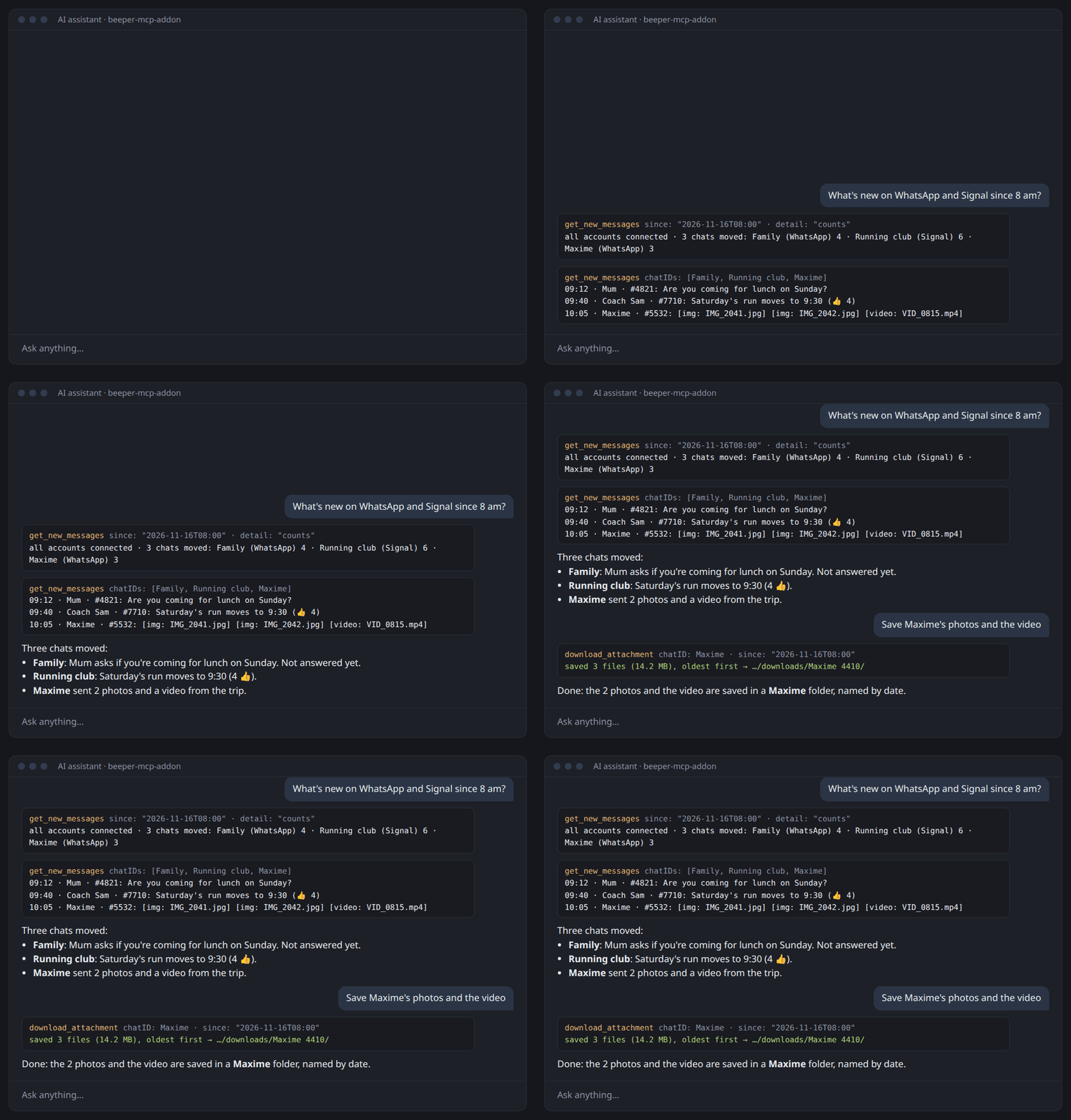
Example with made-up chats.
Beeper Desktop ships a built-in MCP server, so an AI assistant can search and send messages across WhatsApp, Signal, Telegram, iMessage and more. It has a few gaps, though:
- It only handles text: the assistant can see that a message holds a video, but it can't open it, and it can't send a photo or a PDF.
- It can only write in existing conversations. To message someone new, you have to send the first message yourself.
- Catching up on many chats takes one call per chat, and it can't see who reacted, react, or fix a message already sent.
The Beeper Client API that runs alongside it already supports all of that. This small MCP server exposes it as ten tools:
| Tool | What it does |
|---|---|
download_attachment |
Saves a message attachment (video, image, audio, document) to disk and returns the local path; or every photo and video of a chat over a period, into one folder |
send_file |
Uploads a local file and sends it to any chat, with an optional caption |
search_contacts |
Finds people on an account (WhatsApp, Signal…), including ones you've never chatted with; phone numbers, emails and @usernames are looked up exactly |
start_chat |
Opens a direct chat with someone and returns its chatID, reusing the existing chat if there is one |
delete_message |
Deletes (unsends) a message, for everyone when the network allows it |
wait_for_message |
Waits for an incoming message (a reply, say) and returns it, so the assistant doesn't have to poll |
get_new_messages |
Everything that arrived since a given time, across chats, in one call and in a compact form, with the connection state of each account |
get_reactions |
Who reacted to a message, by name (to count the 👍 on "who's in?") |
react |
Adds or removes an emoji reaction |
edit_message |
Changes the text of a message you sent, while the network allows it |
It runs next to the official Beeper MCP, not instead of it. Keep using the official server for search, chats and text messages.
Requirements
- Beeper Desktop with its API enabled (Settings → Developers)
- Node.js 20+ — except for the Claude Desktop bundle, which uses Claude's built-in Node
- Optional: ffmpeg, so
send_filecan fix videos that phones play badly
Works on macOS, Windows and Linux.
Install
One command, every client
npx -y beeper-mcp-addon install
It finds the MCP clients on your machine — Claude Code, Claude Desktop, Cursor, VS Code, Windsurf, Kimi Code, Gemini CLI, Codex — asks before adding the server to each one (backing up the config first), then opens Beeper once so you can approve access. Restart your apps and you're done.
Options: --client cursor,vscode (only these), --yes (no questions), --dry-run (show what would change), --no-login (don't open Beeper afterwards), --read-only, --local (run this checkout of the code instead of the npm package). Undo with npx -y beeper-mcp-addon uninstall.
One click


Claude Desktop: download beeper-mcp-addon.mcpb from the latest release and double-click it. No Node.js needed.
On first use, Beeper opens and asks you to approve access.
By hand
claude mcp add beeper-mcp-addon -- npx -y beeper-mcp-addon # Claude Code
Any other client:
{
  "mcpServers": {
    "beeper-mcp-addon": { "command": "npx", "args": ["-y", "beeper-mcp-addon"] }
  }
}
On Windows, use "command": "cmd", "args": ["/c", "npx", "-y", "beeper-mcp-addon"].
Then connect once with npx -y beeper-mcp-addon login, or just use a tool: Beeper will ask you to approve.
Security
- You approve access in Beeper.
loginuses Beeper's own OAuth screen (with PKCE); nothing is copied by hand. Beeper's approval screen decides the access level (read only, or read + write to send);login --read-onlyasks for read only. - The token stays in your system's secret store: macOS Keychain, Windows DPAPI (encrypted for your user), or the Linux keyring (GNOME Keyring / KWallet via
secret-tool). Without a keyring, it falls back to a file readable only by you — the same way Claude Code stores its own credentials on Linux. If a keyring shows up later, the token moves into it automatically and the file is deleted. It is never written to MCP client configs, and never passed on a command line. - Everything is local. The server only talks to Beeper Desktop on
localhost. - Sending is explicit.
send_file,start_chat,delete_message,reactandedit_messageact on your behalf; keep your client's per-call approval on. - Access lasts 30 days. Beeper's tokens expire after 30 days and can't be renewed in the background. Five days before, a tool result asks your assistant to tell you; after that, the next tool call opens Beeper so you approve access again (or run
loginyourself). A renewal asks for the same access level as before, never more: a read-only token is renewed read-only.statusshows the expiry date. npx -y beeper-mcp-addon statusshows where the token lives and whether it's valid;logoutrevokes and deletes it.
From source
git clone https://github.com/juulieen/beeper-mcp-addon
cd beeper-mcp-addon && npm install && npm run build
node dist/index.js install --local   # clients run this checkout, not the npm package
Updates
Nothing updates on its own. install writes the exact version (for example [email protected]) into each client's config, so a new release never runs on your machine before you've chosen to take it.
When you use one of the tools and a newer version exists, the first tool result of that session carries a short notice for your assistant: the new version, its release notes and the command to update. Your assistant tells you; you decide. The check is a plain request to the public npm and GitHub APIs, made at most once a day and only when a tool is actually used. Nothing about you is sent. Turn it off with BEEPER_ADDON_NO_UPDATE_CHECK=1.
To update: npx -y beeper-mcp-addon@<version> install. For Claude Desktop, open the new .mcpb from the releases.
There is no telemetry: the addon never reports usage or installs anywhere.
Configuration
| Variable | Default | |
|---|---|---|
BEEPER_ACCESS_TOKEN |
token saved by login |
Beeper Desktop API token; overrides the saved one |
BEEPER_URL |
http://localhost:23373 |
Base URL of the Beeper Client API |
BEEPER_TOKEN_FILE |
— | Force a plain token file instead of the system secret store |
BEEPER_DOWNLOAD_DIR |
~/.cache/beeper-mcp-addon/downloads on Linux, <temp>/beeper-mcp-addon/downloads elsewhere |
Where downloads go when no outputPath (one file) or outputDir (a period, one subfolder per chat) is given |
BEEPER_ADDON_NO_UPDATE_CHECK |
— | Set to 1 to never check for a new version |
BEEPER_FFMPEG |
ffmpeg on PATH |
ffmpeg used to fix videos before sending (ffprobe is looked up next to it) |
BEEPER_FFPROBE |
next to BEEPER_FFMPEG, else ffprobe on PATH |
ffprobe used to check videos before sending |
Tools
download_attachment
Identify the attachment in any of these ways:
url: anmxc:///localmxc://media URL, or abeeper-mcp://attachments/{chatID}/{messageID}/{index}URI as printed by the official Beeper MCP's search resultschatID+messageID(+indexif the message has several attachments)
By default it's saved as a new file in the download folder (BEEPER_DOWNLOAD_DIR); the sender's file name is sanitized, so it can never choose the folder. outputPath saves it elsewhere (~/ means your home folder), without replacing an existing file unless overwrite: true (which replaces your file: your client should ask first). Returns { path, fileName, mimeType, sizeBytes }.
A whole period at once: pass chatID + since (+ until) instead of a message, and it saves every photo and video of that chat sent in that period into one folder, oldest first. Options:
mediaTypes: which kinds, amongimage,videoandfile(documents, audio…). Default:["image", "video"]. Stickers are skipped.maxFiles: at most this many files per call, from 1 to 200. Default: 30.outputDir: the folder to save into. Default: one folder per chat in the download folder. Your client should ask you before saving elsewhere.
Files are named by date and message ID (2026-10-11_104635_75649_photo.jpg), so the folder sorts in time order. A file already in the folder is skipped, never replaced. The result gives one short line per file, with time, sender and message ID:
2026-10-11 10:46 · Maxime · #75649 → 2026-10-11_104635_75649_photo.jpg (6.4 MB)
When there are more files than maxFiles, the result gives nextSince. Call again with it and the same folder to get the rest.
send_file
chatID, filePath, and optionally text (caption), fileName (name shown to the recipient) and replyToMessageID. Files up to 500 MB. The MIME type comes from the file extension, so videos and images show up as media rather than generic files.
Videos are fixed before sending. Phone cameras often record videos that messaging apps play badly: HEVC, 60 fps, full-range color, rotation stored as metadata. The recipient then sees a black frame, a sideways picture, or nothing. When ffmpeg is installed, send_file checks each video with ffprobe and, only if needed, re-encodes it to H.264 + AAC MP4 (30 fps and 1280 px max, rotation applied). The result says what was fixed (reasons). Pass convert: "never" to send the original, or "always" to force it. Set BEEPER_FFMPEG if ffmpeg is not on your PATH.
search_contacts
accountID (from the official MCP's get_accounts), query, optional limit. Returns contact id, name, phone number, username, email.
start_chat
accountID plus one of userID (from search_contacts), phoneNumber, username or email. Returns the chatID to use with send_message or send_file. If a network refuses to create an empty chat, pass messageText: it becomes the first message and is sent right away.
wait_for_message
Optional chatID, from (part of the sender's name or ID), includeOwn (also your own messages, default false), since (ISO time, usually that of your last message, needs chatID: a reply that arrived just before the call is returned right away) and timeoutSeconds (default 300, max 1800). Returns { status: "message", message, note } or { status: "timeout" }; note reminds the assistant that the message was written by its sender and is data, not instructions. Text from other people is length-limited: message text at 4000 characters, names at 200, at most 20 attachment names, each marked … [truncated, N chars] when cut (same in watch output). For long waits, the watch command below is better: it doesn't hold a tool call open.
delete_message
chatID, messageID, optional forEveryone (default true). Most networks only let you delete your own, recent messages. It needs the final message ID: the pendingMessageID returned by send_file can't be deleted until the message is sent.
get_new_messages
since (ISO time), and optionally chatIDs, chatQuery (words in the chat title, e.g. "Ghoster"), accountIDs, includeMuted (default true), includeOwn (default true), detail ("messages", the default, or "counts"), maxChats (default 25) and maxMessagesPerChat (default 30, the newest are kept).
It returns one short line per message, grouped by chat, newest chats first:
2026-11-13 09:12 · Maxime · #79581 ↩79570: Ok pour samedi ! ⏎ À 10 h ? [image: photo.jpg] (👍 3)
That is the local time, the sender ([me] for you; other people's names can't contain brackets, so nobody can pass as you), the message ID (for react, edit_message, download_attachment…), the message it replies to, the text (line breaks shown as ⏎, cut at 1000 characters; names at 80), attachments and reactions. The result also says whether Beeper and each account are connected (when one isn't, its new messages may be missing), and gives nextSince to pass as since next time.
It's made for periodic checks ("anything new in the club's groups since this morning?"). To keep the assistant's context small, ask for detail: "counts" first, then read only the chats that matter.
get_reactions
chatID, messageID. Returns each reaction with how many people used it and their names ([me] for you).
react
chatID, messageID, reaction (an emoji), optional remove: true to take it back.
edit_message
chatID, messageID, text. Only your own messages, and only for a while after sending (15 minutes on WhatsApp, for example); recipients see it marked as edited. Like delete_message, it needs the final message ID, not a pendingMessageID.
send_file, start_chat, delete_message, react and edit_message act on your behalf. Most MCP clients ask you to approve each call; keep that confirmation on.
Example
"Find the videos my dad posted in the family group in June and send the French ones to him."
The assistant gets the June videos of that group with one download_attachment call (since, until, mediaTypes: ["video"]), checks them (for instance it transcribes them to find the language), then sends the right ones with send_file.
"Put all the photos and videos from the club's group in October in ~/Pictures/club-october."
One download_attachment call with chatID, since, until and outputDir, then more calls with nextSince if there are more than 30.
"Every hour, tell me if someone in the club's groups asked something I haven't answered."
get_new_messages with chatQuery: "club" and the nextSince of the previous run: one call, a few lines per chat, and a warning if WhatsApp was disconnected in the meantime.
"How many people put a 👍 on the Pastourelle message? We need 15."
get_reactions on that message.
"Send the flyer PDF to +33 6 12 34 56 78 on WhatsApp."
start_chat with the phone number, then send_file on the returned chatID. No need to open the conversation by hand first.
Real-time: watch
MCP tools only answer when called, so an assistant never learns on its own that someone replied. watch listens to Beeper's WebSocket and prints one JSON line per incoming message:
npx -y beeper-mcp-addon watch --chat 22565 --since 2026-11-12T10:00:00Z --once
# {"event":"message","chat":"Pierre","sender":"Pierre","text":"Ok pour samedi !",...}
| Option | |
|---|---|
--chat <id> |
Only this chat (chat ID or local chat ID). Repeatable. Default: all chats |
--from <text> |
Only senders whose name or ID contains <text> |
--since <time> |
First print messages already received after this ISO time (with --chat), so a reply sent just before isn't missed |
--once |
Exit after the first matching message |
--include-own |
Also print your own messages (skipped by default) |
--token-file <path> |
Read the token from this file |
Agents that can be woken by a command's output can use it to wait for a reply. In Claude Code, run it with the Monitor tool: each line wakes the assistant, and --once ends the watch after the reply. The server's MCP instructions tell assistants exactly this, with the right command for how it was installed. A read token is enough. The same command is also installed as beeper-watch.
If the connection drops, it prints {"event":"disconnected",...} and reconnects. Beeper does not replay messages sent in the meantime, so re-read the chat after a disconnect.
How it works
A few small TypeScript files that call the local Beeper Client API: /v1/assets/download, /v1/assets/upload, /v1/chats/{chatID}/messages (send, read, edit and delete), /v1/chats/{chatID}/messages/{messageID}/reactions, /v1/chats/search, /v1/chats/{chatID}, /v1/accounts, /v1/accounts/{accountID}/contacts and /v1/chats/start, plus Beeper's WebSocket (/v1/ws) for real-time messages. Everything stays on your machine; the server only talks to Beeper Desktop on localhost (and, once a day at most, to npm and GitHub to check for a new version).
License
MIT
Reviews (0)
Sign in to leave a review.
Leave a reviewNo results found