wardline
Health Uyari
- License — License: Apache-2.0
- Description — Repository has a description
- Active repo — Last push 0 days ago
- Low visibility — Only 5 GitHub stars
Code Gecti
- Code scan — Scanned 12 files during light audit, no dangerous patterns found
Permissions Gecti
- Permissions — No dangerous permissions requested
Bu listing icin henuz AI raporu yok.
Open source control-plane proxy for AI agents: identity, policy, budget, audit for MCP and beyond

The control-plane proxy that auto-blocks compromised AI agents — in one static Go binary.








Wardline is an open-source proxy that sits between your AI agents and everything they call (MCP servers, tools, gRPC upstreams) and enforces identity, policy, budget, and audit — with statistical anomaly detection that blocks a compromised agent in real time, no rule written for the attack and no human in the loop. One static Go binary; no database, IdP, or sidecar to start.
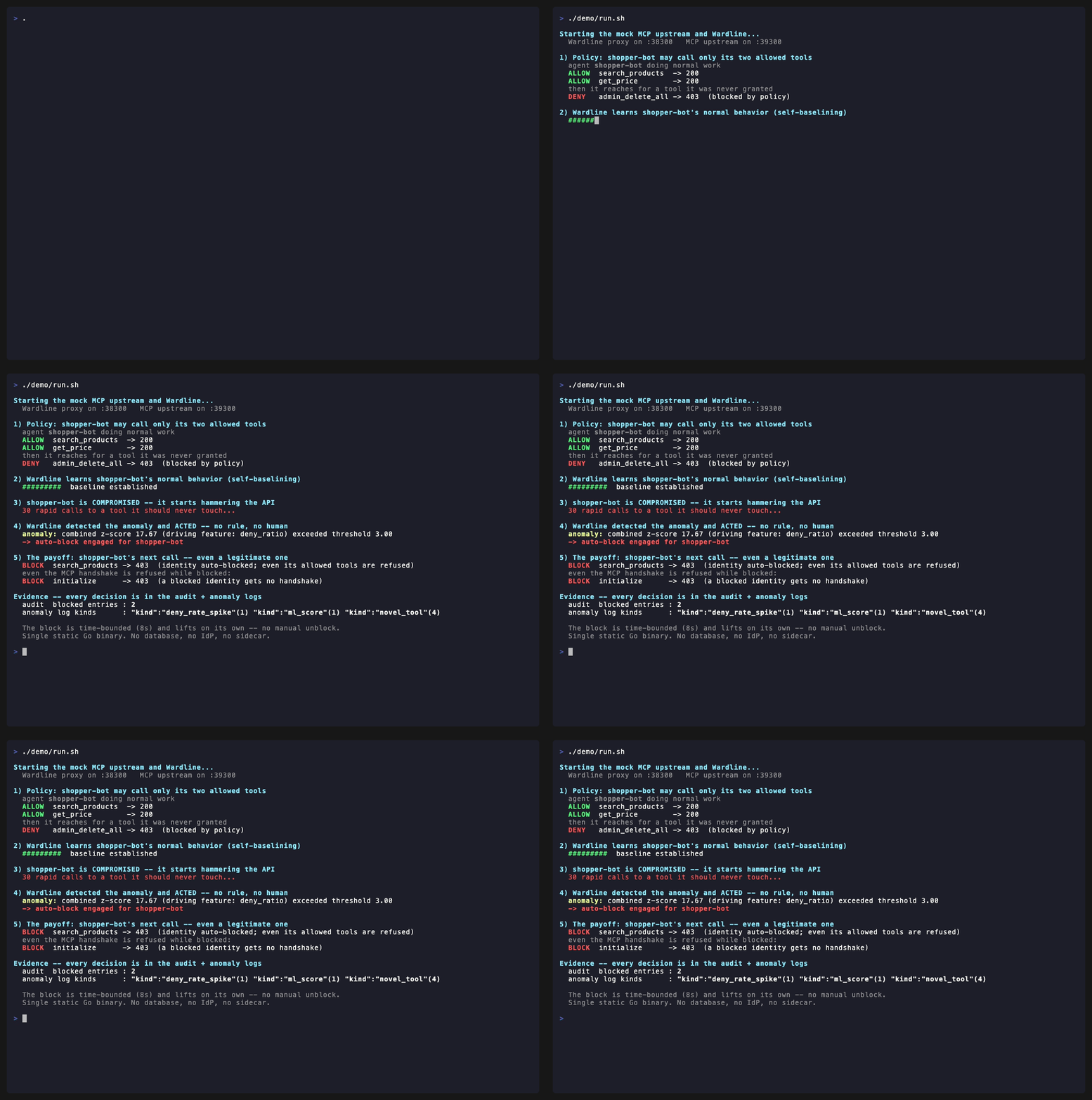
make demo # spins up a mock MCP server + Wardline and runs the scenario above

The same run in the built-in read-only dashboard — the block, the anomaly that triggered it, and the policy behind it:
How it works
Any caller — an AI agent, a CLI/IDE, or an app — reaches its MCP/gRPC upstreams only through Wardline, which applies identity, policy, budget, and anomaly detection in-process and writes every decision to the audit trail.
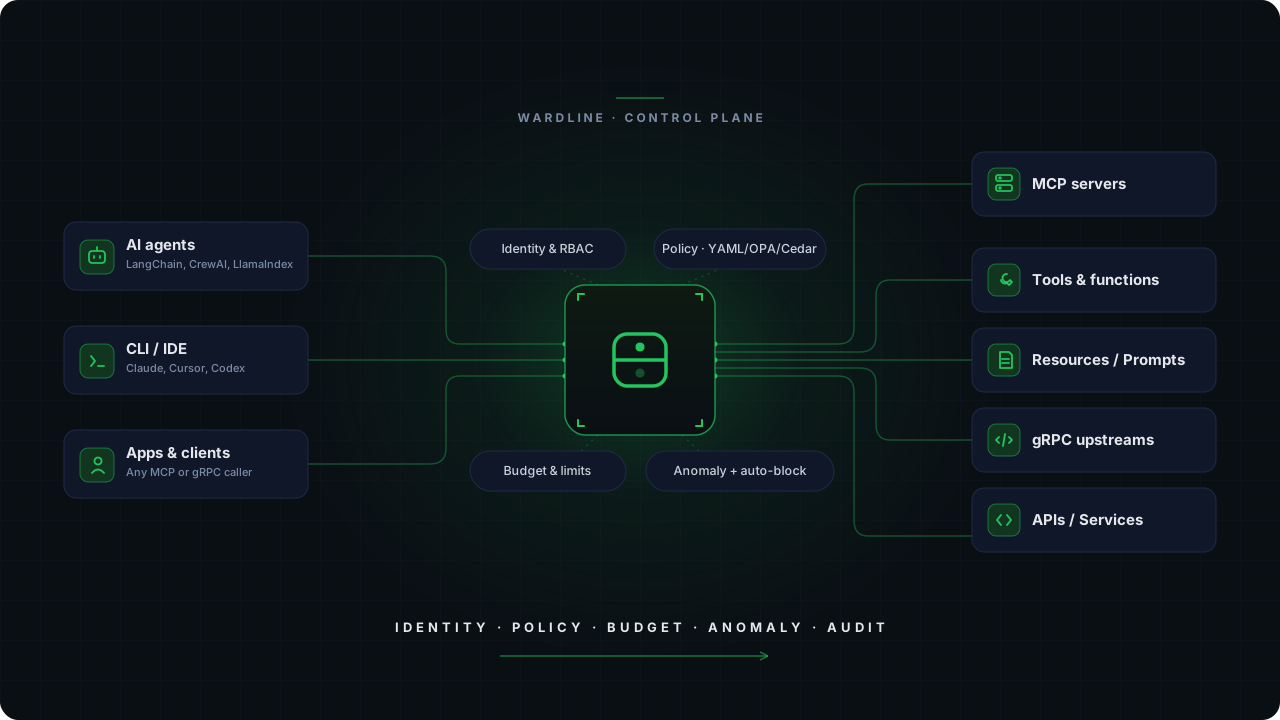
Full design: Architecture.
Key Features
Real-time anomaly auto-block
Four self-baselining heuristics (rate spike, novel tool, deny-rate spike, and a combinedml_scorez-score via Welford's algorithm — no training data, no external model) that don't just alert:auto_blockrejects a flagged identity's calls for a bounded TTL. Enforcement, not a log line.Three policy backends, one binary
Static YAML, embedded OPA/Rego, and embedded AWS Cedar — switched by a singlepolicy_backendconfig key, with no external process and no network hop.Identity & access
Short-lived RS256 JWT issuance with refresh tokens and JWKS rotation, OIDC / mTLS-SPIFFE bootstrap, Kubernetes-style RBAC, SCIM 2.0 provisioning, and end-to-end tenant isolation.Budget & rate control
Two-tier per-identity and per-tenant rate limits — both must clear for a call to proceed.Compliance & audit
Structured JSON audit trail,wardline export-evidence(checksummed, RSA-signable bundle for an auditor), configurable retention, andwardline infer-policyto generate a starter allow-list from observed traffic.Federation & observability
Cross-instance correlation over signed, pseudonymized anomaly summaries; OpenTelemetry tracing; a live web dashboard; and HA multi-replica deployment with shared state over Postgres.
Getting Started
# From source (always works)
go build -o wardline ./cmd/wardline

# Or pull the published multi-arch image (built for each tagged release)
docker pull ghcr.io/kabirnarang39/wardline:latest
./wardline validate-policy --file policy.yaml.example
./wardline validate-config --config wardline.yaml.example
./wardline serve --config wardline.yaml.example
Point upstream at a real MCP server (a proxied call 502s until you do — for a quick test, python3 -m http.server 9000). Every request carries an X-Wardline-Identity header; policy matches on that value plus the MCP tool name:
curl -X POST http://localhost:8080 \
  -H "X-Wardline-Identity: agent-abc123" \
  -H "Content-Type: application/json" \
  -d '{"jsonrpc":"2.0","method":"tools/call","params":{"name":"read_file"}}'
Prebuilt binaries (linux/darwin/windows · amd64/arm64) and multi-arch images ship on every v* tag via Releases and GHCR.
Documentation
Full docs, per-feature design notes, and honest known-limitations live on the docs site:
- Getting Started — install, quickstart, configuration
- Concepts — architecture, policy backends, identity, audit
- Features — every capability in depth
- Deployment — Docker, Helm, HA, observability
- Framework integrations — LangChain, LlamaIndex, OpenAI Agents SDK, CrewAI, raw MCP
Full capability list
Everything below is shipped and testable under internal/features/. The v0.1 baseline (proxy + policy + audit) is always on; everything else is gated by a config flag.
| Capability | Docs |
|---|---|
| Policy backends — YAML · OPA/Rego · AWS Cedar | Policy backends |
| Anomaly detection + auto-block | Anomaly detection |
| Budget enforcement (per-identity + per-tenant) | Budget |
| Credential issuance (JWT + refresh + JWKS) | Credentials |
| SSO (OIDC) / mTLS-SPIFFE bootstrap | SSO · mTLS |
| RBAC + SCIM + tenancy | RBAC · SCIM |
| Federation (cross-instance correlation) | Federation |
| Compliance evidence export + retention | Compliance |
| Auto-generated sandbox policy | infer-policy |
Policy packs (12 embedded + -packs-dir) |
Policy packs |
| gRPC transport passthrough | gRPC |
| Postgres storage + HA deployment | HA |
| Web dashboard | Dashboard |
| OpenTelemetry tracing | Observability |
| Taint tracking (untrusted-read gating) | Taint tracking |
| Approval workflow (needs_approval + approve-and-retry) | Approval workflow |
| Per-job budget ceiling (hard cap per tenant/identity/session job) | Per-job budget ceiling |
Performance
Reproducible with go test -bench, not marketing numbers. BenchmarkDecider_Decide (default YAML backend, Apple Silicon): ~33 ns / 0 allocations at 10 rules, ~2.4 µs at 1000 rules. The ml_score false-positive claim is regression-guarded by TestDetector_MLScore_FalsePositiveRateOnSteadyTraffic (asserts 0% false positives on steady traffic, budget < 2%).
Security
The dashboard and the X-Wardline-Identity header are unauthenticated by default — pair with credential_issuance and/or rbac for real security value. Every optional capability ships off by default and fails closed. On startup Wardline logs a WARN for each insecure default still in effect, so the posture is never silent. Report vulnerabilities per SECURITY.md.
Hardening
Out of the box the proxy fails closed on policy, but identity and the dashboard are open. For any real deployment, turn on:
features:
  credential_issuance: true   # verify a signed bearer token instead of trusting X-Wardline-Identity
  rbac: true                  # gate the dashboard and admin actions on real permissions
With credential_issuance on, the spoofable header is replaced by RS256 bearer-token verification; with rbac on, dashboard read views and mutations require an authorized identity. Anomaly detection catches abrupt abuse but not low-and-slow ramps (see its known limitations), so keep explicit policy + budget limits as the hard floor.
Project status
Wardline is young and moving fast. Every feature's docs page is deliberately blunt about what it does and doesn't do. Feedback, issues, and contributions are welcome — especially on the anomaly-detection approach and threat model.
Contributing
See CONTRIBUTING.md and CODE_OF_CONDUCT.md. Architecture and engineering conventions are documented in CLAUDE.md; the roadmap lives in the docs.
License
Yorumlar (0)
Yorum birakmak icin giris yap.
Yorum birakSonuc bulunamadi