Open-Health-Atlas
Health Pass
- License — License: AGPL-3.0
- Description — Repository has a description
- Active repo — Last push 0 days ago
- Community trust — 48 GitHub stars
Code Fail
- rm -rf — Recursive force deletion command in .github/workflows/checks.yml
- network request — Outbound network request in app/__init__.py
Permissions Pass
- Permissions — No dangerous permissions requested
No AI report is available for this listing yet.
Explore sleep, training, mood and nutrition together using local records, traceable calculations and optional MCP tools for your preferred AI client.
Open Health Atlas
Explore your health records together—and check the evidence behind the patterns.
Created by Kajeesan Jeevendra · AGPL-3.0 licensed

Open Health Atlas brings sleep, training, mood, nutrition and other health
records into one local application. Compare periods and inspect the sources,
units and calculations behind the results.
Use the dashboard on its own, or connect a compatible MCP client to query your
records and verify evidence with the model you choose. Open Health Atlas runs
the calculations; the external model provides the interpretation.
Try the fictional demo ·
Connect an MCP client ·
Develop the project
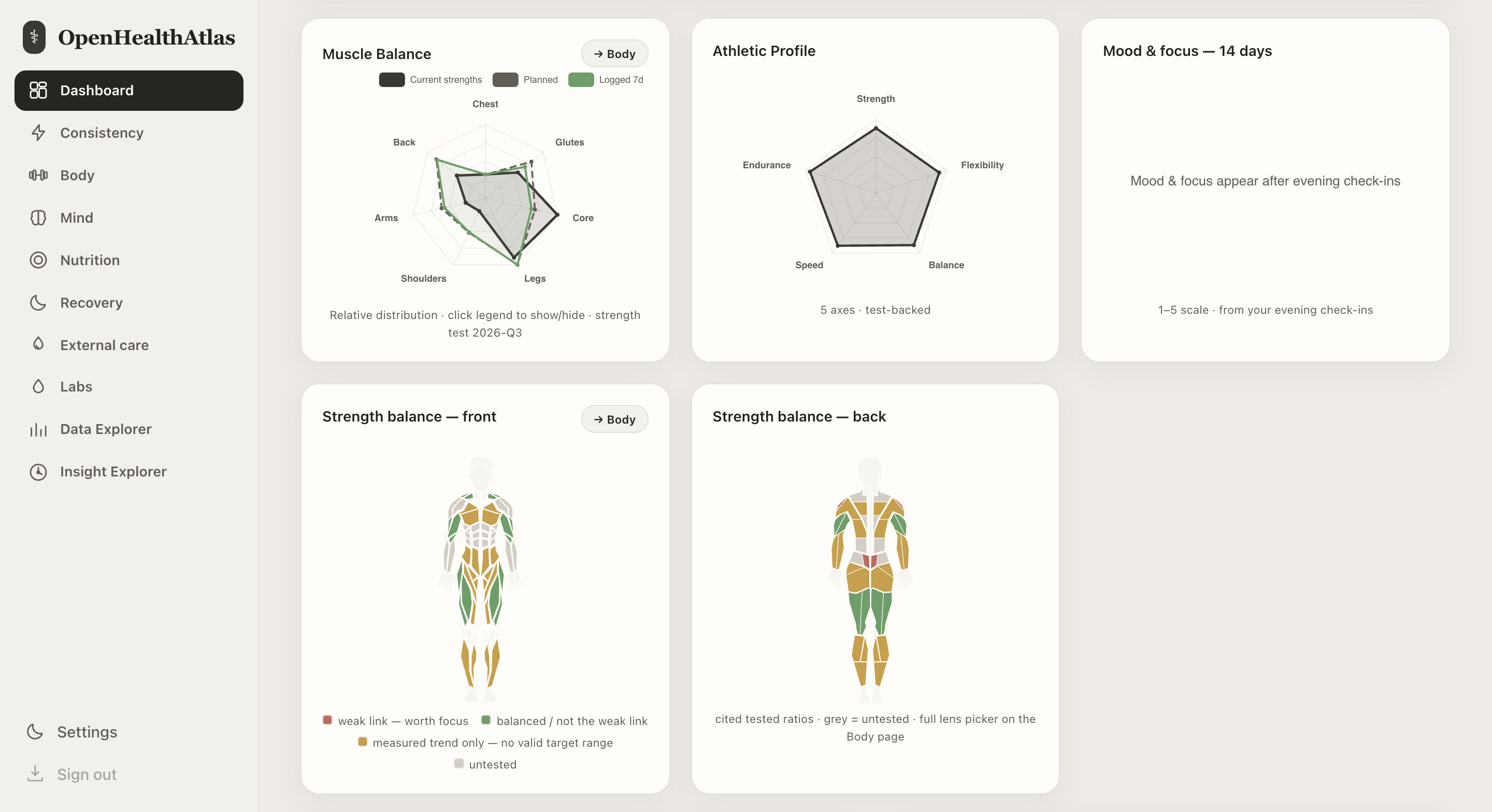
Fictional UI demo snapshot. Explore the demo
· Image details.
Choose your starting point
| I want to… | Start here |
|---|---|
| See the interface without installing anything | Open the browser demo — a clickable, read-only fictional snapshot, with no backend or AI connected. |
| Run the real panel and try fictional data locally | Try the local demo — includes the local API and write broker. |
| Use my preferred AI client with local data | Connect an MCP client — copyable setup and a fictional query → analysis → evidence example. |
| Change code or contribute | Develop the project — environment, relevant tests and contribution guidance. |
The browser snapshot is useful for exploring screens and navigation; its
values are not a fresh evaluation of the current engine. Run the local demo
to execute calculations, save fictional entries and test imports.
What you can do
- Bring records into a shared timeline. Supported imports and validated
entry tools cover training, wearables, sleep, nutrition, subjective logs,
symptoms, laboratory records and other health domains. - Explore recorded patterns. Query summaries or periods, inspect training
exposure and recovery, and calculate bounded associations across selected
features. Missing data and source differences remain visible. - Check how a result was produced. Findings retain source, time, units,
sample coverage, transformations and replayable evidence references. - Choose your AI client. The optional local MCP server exposes discovery,
query, background analysis and evidence tools. It contains no model and
makes no provider calls itself.
For example, compare recorded sleep with day ratings over a selected period,
then inspect the number of observations, source coverage and evidence behind
the result. An association can suggest a useful question; it does not establish
why the days differed.
How the pieces fit
| Component | Responsibility |
|---|---|
| Open Health Atlas | Local records, deterministic calculations, validated writes, evidence and dashboard. |
| Your MCP client and chosen model | Conversation, tool selection and interpretation of returned evidence. |
| Optional external Hermes | The existing integrated conversations, Telegram and configured automation workflows. |
The standalone MCP connection is read-only and does not require Hermes. Model
credentials belong in the client. A local database does not guarantee that a
client using a hosted model processes returned data locally.
Current scope
This is a developer-oriented, single-user source release. Current local setup
supports macOS and Linux with Python 3.11 or newer; native Windows is not
supported by the Unix-socket broker and POSIX file locks. The standalone MCP
entry point uses stdio. Clients requiring remote MCP need a separate transport
setup.
A desktop installer, built-in API-key chat, hosted multi-user service and
bundled always-on agent are not included. Existing Hermes and external-service
integrations require their own configuration. Results describe recorded data
and bounded associations; clinical validation and causal conclusions are not
claimed. See known limitations and the
feature-retention matrix.
Contribute
Start with Contributing, the development guide
and the code of conduct. Look for
good first issues
or propose a focused improvement through the issue forms.
Use fictional or redacted reproductions. Report security vulnerabilities through
the private reporting channel,
not a public issue.
Evidence and technical detail
- Architecture and product boundaries
- Testing and verified results
- Current implementation checkpoint
- Service deployment
- Repository checks
Creator and license
Open Health Atlas was created by Kajeesan Jeevendra. Its product
architecture, data/evidence boundaries and user experience were developed and
assembled through an AI-assisted development process.
Original project code uses the GNU Affero General Public License, version 3
only (AGPL-3.0-only). Commercial use is allowed subject to its
terms, including applicable source-sharing requirements. See
licensing and earlier MIT releases for details. Preserve
applicable copyright and license notices.
Third-party components retain their own licenses and credits; see
NOTICE, third-party notices and
research references. Use CITATION.cff for citation.
Reviews (0)
Sign in to leave a review.
Leave a reviewNo results found