kauak
Health Uyari
- License — License: Apache-2.0
- Description — Repository has a description
- Active repo — Last push 0 days ago
- Low visibility — Only 6 GitHub stars
Code Basarisiz
- spawnSync — Synchronous process spawning in packages/appearance/src/registry.test.mjs
- fs.rmSync — Destructive file system operation in packages/appearance/src/registry.test.mjs
Permissions Gecti
- Permissions — No dangerous permissions requested
Bu listing icin henuz AI raporu yok.
A Sims-style isometric office that shows what your Herdr coding agents are doing, live
Kauak

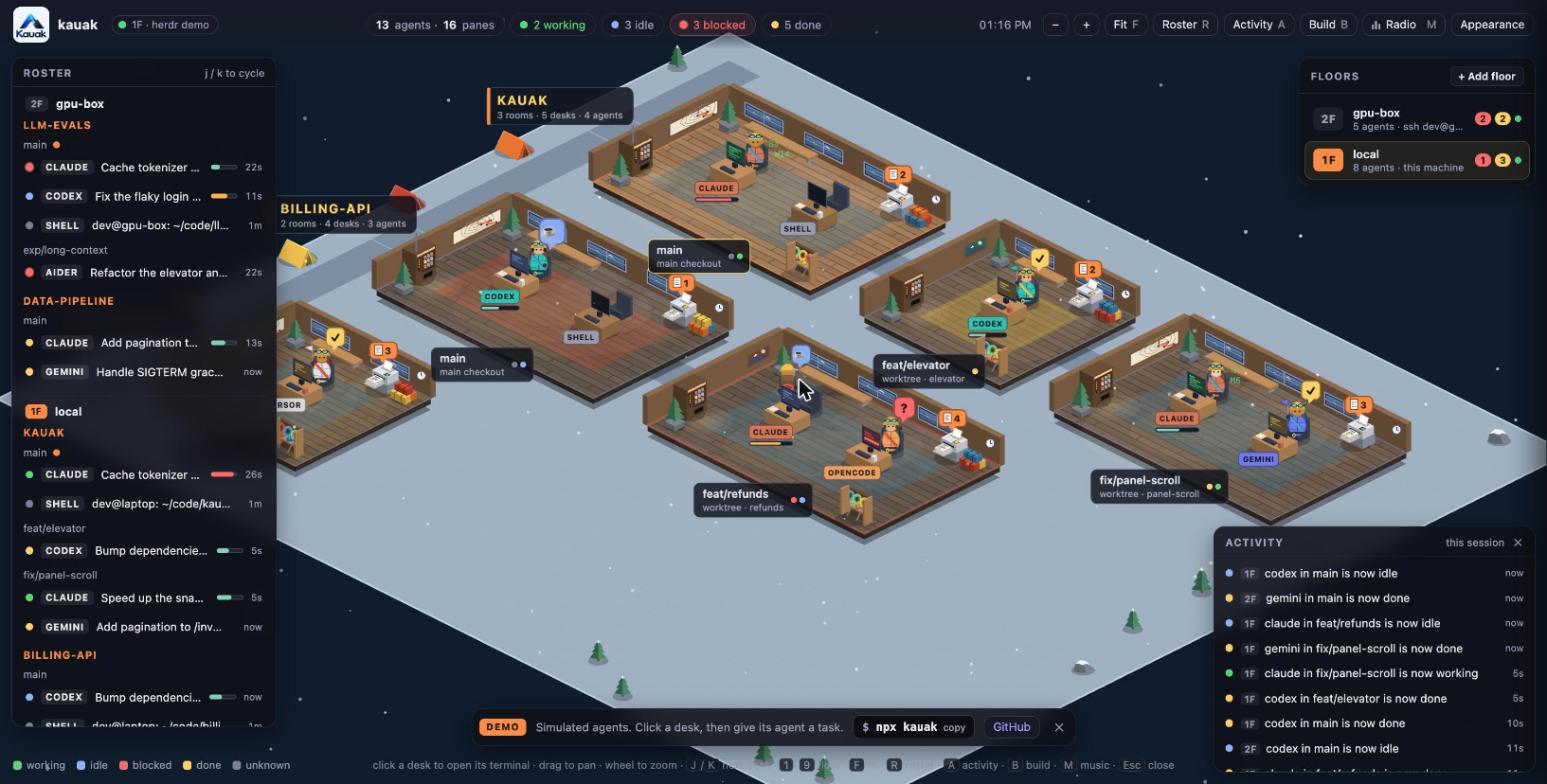
Kauak is a Sims-style isometric office that shows what your coding agents are
doing, live. It connects to Herdr, a terminal multiplexer
for coding agents, and turns each machine into a floor, each repository into a
wing, each workspace into a room and each pane into a desk, with someone at it
when an agent runs there. You see at a glance who is working, who is on a break
and who is waiting for you, and you click a desk to read that agent's terminal
and answer it.
Why
With several agents running at once, across repositories and machines, most of
the work is noticing which one needs you. A list of panes does not make that
easy. In Kauak a blocked agent raises its hand and its room pulses red, a
finished one shows a hopping ✓, and an idle one goes for a drink. When one
needs an answer, you give it from the office instead of hunting for the right
tab.
Quick start
You need Node.js 22 or newer, and Herdr (0.9.x) running on this machine.
npx @kauakdev/kauak serve
The office opens at http://127.0.0.1:7788. The package carries the built page,
so there is nothing to clone or build. npx @kauakdev/kauak serve --demo shows
simulated agents without Herdr, and npx @kauakdev/kauak serve --help lists the
options.
To keep the kauak command around, install it globally instead:
npm install -g @kauakdev/kauak
kauak serve
Run from source
You need Node.js 22.18 or newer and pnpm.
git clone https://github.com/kauakdev/kauak.git
cd kauak
pnpm install
pnpm dev
pnpm dev runs the bridge on port 7788 and the page on http://localhost:5178,
which reloads as you edit. Add ?demo to the URL for simulated agents.pnpm build && pnpm start runs the built page the way the npm package does.
CONTRIBUTING.md has the checks and conventions.
What you can do
- Watch: each agent's state (working, idle, blocked, done) drives its
animation, the roster and the activity feed. The tab title counts blocked
agents. - Answer: click a desk to open a mirror of its terminal, and type in the
message box under it to reply, accept a prompt or run a command. In a Claude
Code or Codex pane,/lists the agent's slash commands. - Track context: Claude Code and Codex agents get a meter showing
how full their context window is. - Read edits as they happen: each room's printer prints the diff of every
file edit in its checkout, and shows everything not yet committed. - Build: add desks (new Herdr tabs, with or without an agent) and rooms
(new git worktrees or folders) from the office. - Go remote: add other machines that run Herdr as floors, over SSH.
Nothing is installed on them. - Make it yours: pick the Classic office, the Orbital workshop or the
Alpine basecamp, a background, and a company banner for the wall.
The guide covers all of it, keyboard shortcuts included.
Kauak and Herdr
Herdr (source) owns
your agents' terminals: the panes and workspaces they run in, on this machine
and others, and it knows what state each agent is in. Kauak runs none of that.
It is a separate project that talks to Herdr through Herdr's
local socket API: it follows Herdr's
events, reads session snapshots and pane screens, and asks Herdr to send text
and keys, create tabs and worktrees, and start agents when you do those things
in the office. So Kauak needs a running Herdr; without one, only the demo
works. Other machines are reached through an SSH tunnel to their Herdr socket.
Kauak is an independent project. It is not affiliated with or endorsed by
Herdr, and it would not exist without it.
Architecture
Herdr (a unix socket on each machine; through an SSH tunnel for a remote one)
   │  Herdr's API
   ▼
Herdr adapter    packages/bridge/src/runtimes/herdr/ (machine.ts, herdr.ts)
   │  Kauak terms, the Runtime port
   ▼
Bridge           packages/bridge/src/ (core/, enrichers/, transport/ws.ts)
   │  the Kauak protocol, over a WebSocket
   ▼
Page             packages/web/
- Herdr adapter (
packages/bridge/src/runtimes/herdr/machine.ts,packages/bridge/src/runtimes/herdr/herdr.ts): one per floor. It talks to
Herdr's socket, here or through an SSH tunnel, and translates Herdr's
snapshots and errors into Kauak's own. Herdr-specific code lives only here. - Kauak protocol (
packages/protocol/src/index.ts, TypeScript): the JSON
messages between the page and the bridge, described in
docs/protocol.md. The bridge checks every message from a
page against it. - Bridge (
packages/bridge/, Node, TypeScript): its core
(packages/bridge/src/core/) holds the floors and answers each message from
a page,packages/bridge/src/transport/ws.tsserves the page and the
WebSocket on 127.0.0.1:7788, and its enrichers
(packages/bridge/src/enrichers/) add what Herdr does not report: context
usage, read from the agents' transcripts, and file diffs, from git. - Page (
packages/web/, TypeScript, PixiJS, xterm.js, built with Vite):
lays each snapshot out as floors and rooms, draws the office, and holds the
roster, activity feed, terminal panel and build mode. For the demo,packages/web/src/bridge/demo.tsspeaks the protocol with no bridge at all. - CLI (
packages/kauak/bin/kauak.js,packages/kauak/cli/): thekauak
command, one module per command inpackages/kauak/cli/commands/. - Appearance packages (
packages/appearance/): offices and
characters as declarative JSON, validated before use. See the
appearance and banner guide.
How Kauak works goes into the details.
Configuration, security and privacy
The bridge can type into your terminals, create worktrees and open SSH
connections, so it listens on 127.0.0.1 only and accepts WebSocket connections
only from pages served by this computer. The environment variables
(HERDR_SOCKET_PATH, KAUAK_PORT, KAUAK_HOST, KAUAK_ORIGINS,KAUAK_CONFIG, KAUAK_SSH), remote floors and opening the office from another
device are in docs/configuration.md; the threat model
and how to report a vulnerability are in SECURITY.md.
The page talks only to the bridge, with one exception: the radio. It is off
until you turn it on; then it plays CLIAMP Lofi straight from
cliamp.stream, and your browser connects to it
directly.
Where it's going
Kauak 0.1 is its first version. Next up:
- Sprites in place of the procedurally drawn furniture and people, one piece at
a time.
Herdr is the only runtime today. The Kauak protocol keeps it behind an adapter,
so that another runtime could be added later. Protocol versioning, incremental
updates and a way for a runtime to say what it supports were left out on
purpose for now; they are possible next steps, not commitments (see
docs/protocol.md).
Contributing
Issues and pull requests are welcome: see CONTRIBUTING.md.
Report vulnerabilities privately, as SECURITY.md describes.
License
Apache 2.0. The build writes the licenses of the packages bundled
into the page to dist/THIRD_PARTY_LICENSES.txt, which ships with the npm
package and the demo.
Artwork: the logo (packages/web/public/kauak.png) and banner
(packages/web/public/kauak-banner.png) were generated for Kauak with OpenAI's
ChatGPT image generation, and both files carry C2PA metadata saying so. The
contour-map background (packages/web/src/appearance/backgrounds/contours.svg)
appears to be programmatically generated: evenly spaced concentric rings with no
geographic reference. No map or elevation data is known to have been used.
Name and logo. The Apache License 2.0 does not grant permission to use the
Kauak name, logo or banner as trademarks (section 6). Forks and redistributions
are welcome, and so is saying that your project is based on Kauak, but do not
present a modified version as the official Kauak or as endorsed by its
maintainers.
Yorumlar (0)
Yorum birakmak icin giris yap.
Yorum birakSonuc bulunamadi