phpstan-type-trace
Health Gecti
- License — License: MIT
- Description — Repository has a description
- Active repo — Last push 0 days ago
- Community trust — 11 GitHub stars
Code Gecti
- Code scan — Scanned 3 files during light audit, no dangerous patterns found
Permissions Gecti
- Permissions — No dangerous permissions requested
Bu listing icin henuz AI raporu yok.
See the full type-inference chain of any value in PHPStan, not just a single snapshot.
phpstan-type-trace
Trace any variable's type history through your code — no more guessing why PHPStan thinks it's
mixed.
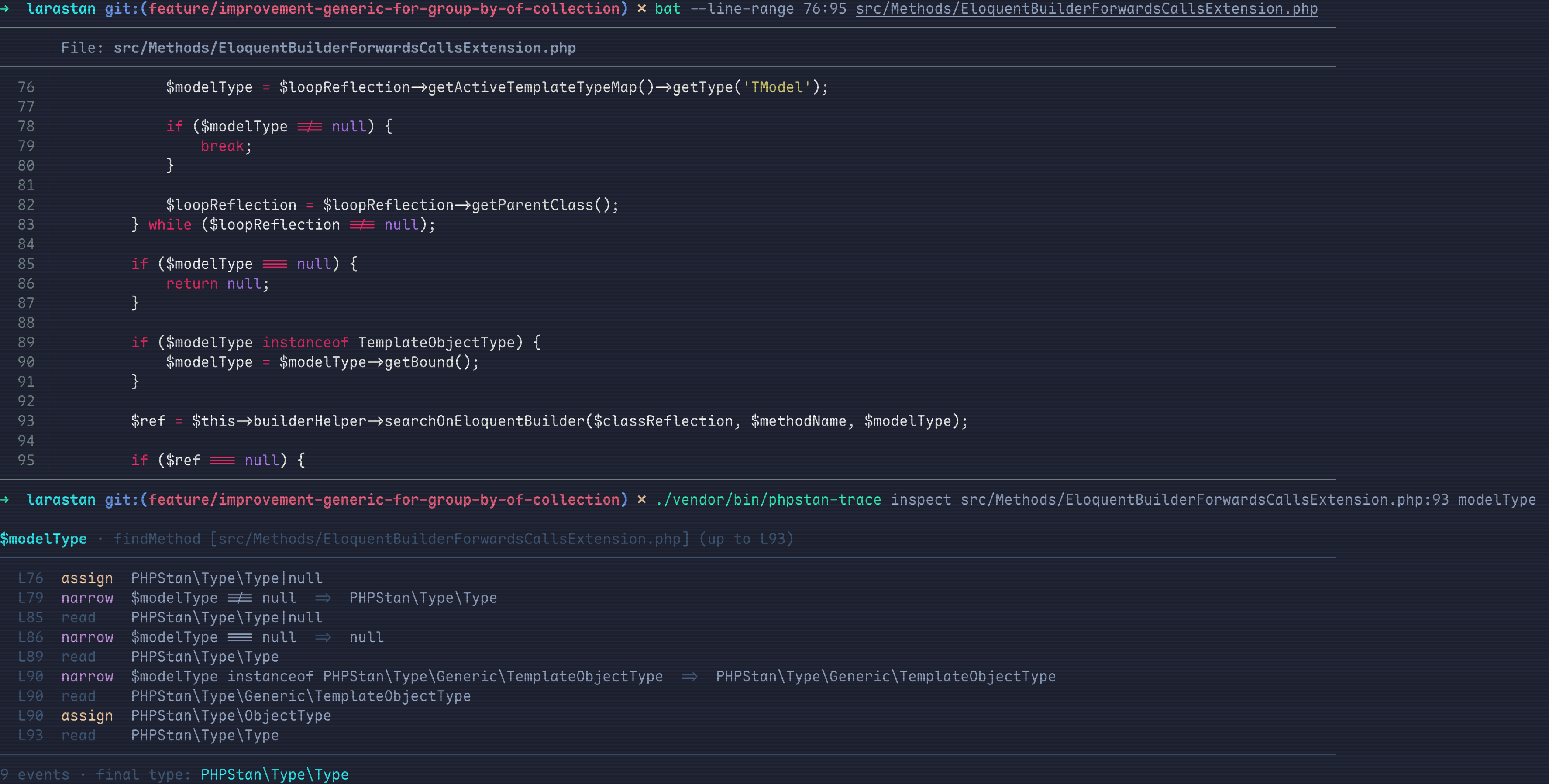
Above: the type evolution of $modelType in real larastan code. Nine events — including three narrow rows that show why the type tightened — one command, zero source edits.
Install
composer require --dev kayw-geek/phpstan-type-trace
Auto-registered via phpstan-extension-installer. Otherwise add to phpstan.neon:
includes:
    - vendor/kayw-geek/phpstan-type-trace/extension.neon
Two ways to use it
1. CLI — inspect any line, no source edits
./vendor/bin/phpstan-trace inspect src/Foo.php:42 myVar
Output:
$myVar · doStuff [src/Foo.php] (up to L42)

  L18  param    int|null
  L25  assign   int|null
  L31  narrow   $myVar !== null  =>  int
  L42  read     int

4 events · final type: int
Variable name is optional — if only one variable has events at the target line, it's auto-picked. Otherwise the candidates are listed.
Pass --json for machine-readable output (handy for tooling).
2. traceType() — drop in a marker, get the chain on your next phpstan run
No extra command. Just call traceType($var) anywhere, then run vendor/bin/phpstan analyse like you always do — the chain shows up as a phpstan error at that line.
function compute(?float $discount = null): float
{
    $discount ??= 0.1;
    traceType($discount, 'after ??=');
    return 1 - $discount;
}
 ------ -----------------------------------------------------------
  Line   PriceCalculator.php
 ------ -----------------------------------------------------------
  5      Type chain for $discount in compute — after ??=
           L3   param      float|null
           L4   assign-op  float
 ------ -----------------------------------------------------------
traceType() is a runtime no-op (autoloaded from src/runtime.php), so leaving a stray call in production code does nothing — it only emits during static analysis.
Use it with Claude Code
When Claude Code (or any LLM agent) is chasing PHPStan errors, it usually guesses at types. With this extension installed as a Claude Code plugin, Claude invokes the trace automatically — fixes are grounded in real upstream type evidence, not pattern-matching.
/plugin marketplace add kayw-geek/phpstan-type-trace
/plugin install phpstan-type-trace@kayw-geek
Installed into ~/.claude/plugins/cache/, auto-discovered across every project. Updates: /plugin marketplace update kayw-geek then reinstall.
Signature
function traceType(mixed $value, ?string $reason = null): void
$value— a variable, property fetch ($this->x), or static property (Foo::$bar). For arbitrary expressions, only the snapshot type is printed.$reason— optional label shown in the chain header. String literal only.
What gets captured
| Source | Origin label | Example |
|---|---|---|
| Function/method params | param |
function f(int $x) |
| Closure / arrow-fn params | param |
fn(int $x) => ... |
| Variable assignment | assign |
$x = 5; |
| Compound assignment | assign-op |
$x += 1; $x ??= 'def'; |
| Reference assignment | assign-ref |
$x = &$other; |
| Array write | array-write |
$x[] = 'y'; $x['k'] = $v; |
| Property fetch | read |
$this->foo |
| Static property fetch | read |
Foo::$bar |
| Variable read | read |
bare $x usage |
| If / ternary narrowing | narrow |
if (is_string($x)), $x ?? 'd', etc. |
narrow events carry a reason showing the predicate that justified the narrowing (is_string($x), $x instanceof Foo, $x !== null, ...), anchored to the branch where the narrow takes effect. Same-line events are ordered by source position, so an inline ternary reads cause → effect: the cond-read first, then the narrow, then the then-branch read.
Extension attribution (via)
When a third-party PHPStan extension shaped the type at an event, the responsible extension is appended as via …. Three extension categories are attributed today:
| Extension category | Event | Example chain row |
|---|---|---|
| Dynamic return type (method / static / function) | assign / assign-op |
L9 assign Builder<User> via NewModelQueryDynamicMethodReturnTypeExtension |
Type-specifying (method / static / function), inside an if / ternary condition |
narrow |
L12 narrow Webmozart\Assert\Assert::notNull($x) => string via AssertTypeSpecifyingExtension |
| Properties class reflection (magic / virtual attrs) | read |
L23 read string via MagicPropsExt |
Third-party detection is by source-file location, not namespace — official add-ons (e.g. phpstan/phpstan-webmozart-assert) that ship under the PHPStan\ namespace are still attributed; only classes shipped by phpstan/phpstan core (or its phar) are filtered out.
When the inferred type surprises you, via tells you which extension to blame (or thank) without grepping the vendor tree.
Real CLI output against a project with phpstan/phpstan-webmozart-assert installed:
$ ./vendor/bin/phpstan-trace inspect src/demo.php:12 '$x'

$x · Demo\viaIfStatic [src/demo.php] (up to L12)
────────────────────────────────────────────────────────────────────────────────
  L9   param   string|null
  L12  narrow  Webmozart\Assert\Assert::notNull($x)  =>  string  via AssertTypeSpecifyingExtension
  L12  read    string
────────────────────────────────────────────────────────────────────────────────
3 events · final type: string
Not attributed yet: type-specifying calls used as bare statements (e.g. Assert::notNull($x); outside any if / ternary). PHPStan still narrows the scope but no narrow event is emitted, so the chain shows read without an explanation. Wrap the call in an if if you need the attribution.
Limitations
- Loops report the post-fixpoint type, not per-iteration deltas.
- Multiple closures inside the same enclosing function share one bucket. Same-named vars across sibling closures may collide.
- Cannot follow values across function boundaries.
- Ref-aliases (
$alias = &$x; $alias[] = 'y';) show only the snapshot at the call.
Two-phase PHPStan pipeline:
- Collectors (one per event kind) record every relevant AST event with
(file, functionKey, path, line, pos, type, origin):- Param entry:
ParamInFunctionCollector,ParamInMethodCollector,ParamInClosureCollector,ParamInArrowFunctionCollector— hooked on PHPStan'sIn*Nodevirtual nodes so scope is already inside the function when params are read. - Reads:
VarReadCollector,PropertyFetchCollector,StaticPropertyFetchCollector. - Writes:
AssignCollector,AssignOpCollector(covers all 13 compound-op subclasses),AssignRefCollector,ArrayWriteCollector. - Narrowing:
NarrowingCollector(if-statements),TernaryNarrowingCollector(ternaries) — anchored to the branch where the narrow holds, with a reason predicate extracted from the guard. - Call sites:
TraceCallCollector.
- Param entry:
TraceReportRuleruns once at the end on the virtualCollectedDataNode. For eachtraceType()call it joins the recorded events on(functionKey, path)filtered to lines<=the call line, sorts byline → source position → rank(so inline ternaries read cond-read → narrow → then-read, not narrow first), collapses repeated reads of the same type except right after a narrow (since the narrow is evidence and the read is the usage — they convey different things), and emits the delta chain as a PHPStan error.
The CLI runs the same pipeline with a dump env var set, captures every chain as a JSON sentinel error, then filters to the (file, line, variable) you asked about.
License
MIT
Yorumlar (0)
Yorum birakmak icin giris yap.
Yorum birakSonuc bulunamadi