claudia
Health Gecti
- License — License: NOASSERTION
- Description — Repository has a description
- Active repo — Last push 0 days ago
- Community trust — 194 GitHub stars
Code Basarisiz
- network request — Outbound network request in _archived/cli-v1/commands/google-auth.js
- network request — Outbound network request in _archived/cli-v1/core/google-oauth.js
- exec() — Shell command execution in _archived/cli-v1/services/extraction.js
Permissions Gecti
- Permissions — No dangerous permissions requested
Bu listing icin henuz AI raporu yok.
Terminal-based AI chief of staff. Remembers relationships, tracks commitments, helps you think strategically. Runs on Claude Code.
A thinking partner who tracks relationships, not just tasks.
Remembers your people. Catches your commitments. Learns how you work.



Install · Why Claudia · Her Mind · Integrations · How It Works
The Problem With AI Assistants
You tell ChatGPT about Sarah on Monday. By Wednesday, it's forgotten.
You make a promise in a meeting. Nobody tracks it. You promise a deliverable on Friday and lose track of it by Wednesday. You meet someone important, and three weeks later you can't remember what you talked about.
AI tools don't have memory. Claudia does.
What Makes Claudia Different
🎯 Catches CommitmentsSay "I'll send that by Friday" and she tracks it. On Friday morning, she reminds you. |
🔗 Knows Your PeopleEvery person she meets gets a living profile: relationship health, contact trends, connected entities. Ask about anyone and she has the full picture. |
⚖️ Learns Your JudgmentTell her "revenue work beats internal cleanup" once. She writes it down and applies it across sessions: briefs, triage, delegation, risk surfacing. |
⚠️ Spots Patterns You MissOvercommitting again? A key relationship going cold? The same mistake twice? She sees it forming and speaks up. |
🧠 Second Brain in ObsidianMemory syncs to an Obsidian vault organized with PARA: Active projects, Relationships, Reference, Archive. Graph view maps your world. Plain markdown you own forever. |
👥 Agent TeamA two-tier team works behind the scenes. Fast Haiku workers handle document processing, while a Sonnet research scout tackles deep research with full autonomy. |
🌙 Learns in the BackgroundOvernight, old memories fade, near-duplicates merge, and patterns surface. Each morning she knows a little more than yesterday. |
📄 Shows Her SourcesEvery fact traces to its source. Ask "how do you know that?" and she shows the receipt. |
🪞 Session ReflectionsEnd a session with |
How Her Mind Works
💾 RememberEvery fact is stored with who said it, when, and how confident she is. Embeddings capture meaning, not just keywords, so "we pushed the launch" and "timeline shifted" connect naturally. |
🔍 RecallSearch blends meaning similarity, importance, recency, and full-text matching. Accessing a memory strengthens it, just like the rehearsal effect in human cognition. |
🌙 ConsolidateOvernight background jobs fade old memories, merge near-duplicates, and surface patterns: cooling relationships, overdue commitments, repeated behaviors. She wakes up sharper. |
📓 VaultMemory syncs to an Obsidian vault organized with PARA: Active projects, Relationships, Reference material, Archive. Graph view shows how your world connects. Plain markdown you own forever. |
Quick Start
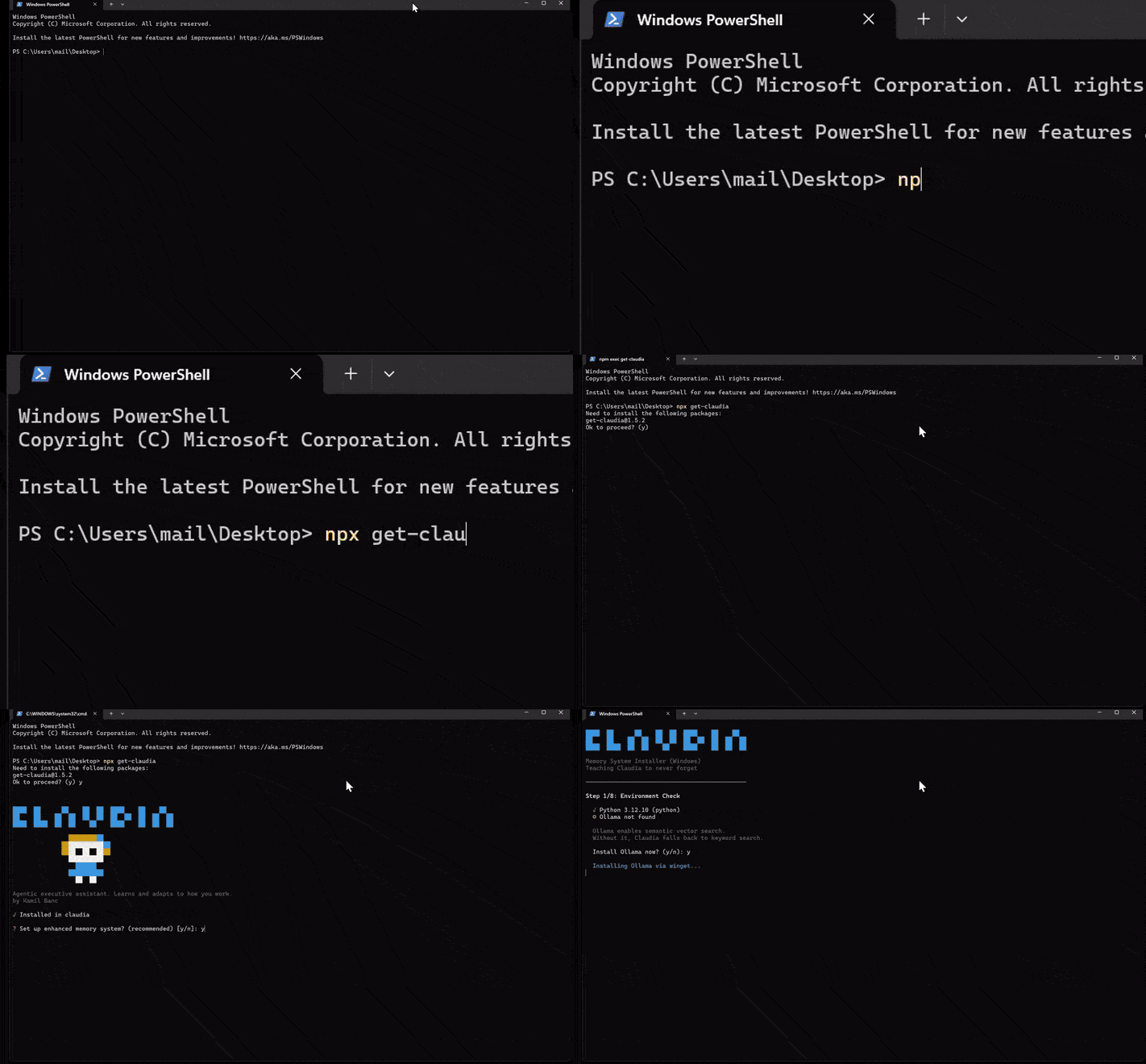
1. Install
npx get-claudia
2. Start
cd claudia
claude
3. Say hi. She'll introduce herself, learn about you through a natural conversation, and generate a personalized workspace.
What's next:
/morning-briefto see what needs attention- Tell her about a person and she'll create a relationship file
- Share meeting notes and she'll extract action items
npx get-claudia googleto connect Gmail, Calendar, Drive, and more
Requirements: Claude Code, Node.js 18+, Python 3.10+ (for memory), Ollama (for embeddings)
Template-only install (no memory system)Embeddings model: After installing Ollama, pull the required model:
ollama pull all-minilm:l6-v2
npx get-claudia my-project --no-memory
Installs only the template layer (skills, commands, rules). Claudia works using markdown files without semantic search or pattern detection. You can add the memory system later by running the installer again without --no-memory.
cd your-claudia-directory
npx get-claudia .
This upgrades framework files (CLAUDE.md, skills, rules, daemon code) while preserving your data (context/, people/, projects/, databases). Safe to run multiple times. The installer detects existing installations and only updates system files.
See It in Action
You:     What do I know about Sarah Chen?

Claudia: Sarah Chen is CEO at Meridian Ventures. You met at SaaStr 2025.

         📊 Relationship Health: Strong (last contact 3 days ago)

         🎯 Open Commitments:
         • Send updated pitch deck to Sarah [OVERDUE - was due Friday]

         💡 Recent Context:
         • She's interested in AI infrastructure angle
         • Wants to see technical architecture doc
         • Bringing in technical partner for next meeting

         🔗 Connected to: Series A (project), Priya Sharma (introduced by)

         Source: Call notes from Jan 28, Email thread Jan 30
Morning brief pulls everything together:
You:     /morning-brief

Claudia: ☀️ Morning Brief — Wednesday, Feb 19

         ⚠️ Needs Attention:
         • Send updated pitch deck to Sarah Chen [OVERDUE]
         • Quarterly review with Acme Corp is tomorrow

         👀 Watch:
         • Haven't spoken to Marcus in 18 days (usually weekly)
         • Two new commitments this week, zero closed

         📊 Today: 3 meetings, 2 open commitments
Judgment rules shape everything she does:
You:     I've got the Acme proposal and Marcus wants a catch-up.
         Which first?

Claudia: Acme proposal. Your judgment rules say revenue-generating
         work beats relationship maintenance when there's a
         deadline, and the Acme proposal is due Thursday.

         I'll remind you about Marcus tomorrow morning.
Pattern detection works across weeks, not just moments:
Claudia: I've noticed something across the last few weeks.
         You've taken on 4 new commitments without closing any.
         Last time this happened (early January), two slipped
         past deadline.

         Want me to flag the lowest-priority ones so you can
         decide what to defer?
Every conversation builds on the last. She remembers.
Who It's For
Claudia detects your work style and generates structure that fits:
| Role | What You Get |
|---|---|
| Consultant | Client folders, deliverable tracking, pipeline commands |
| Executive | Direct reports, initiatives, board prep, leadership tools |
| Founder | Investor CRM, fundraising cycles, team and product tracking |
| Solo Professional | Flexible structure for wearing many hats |
| Creator | Audience growth, content calendar, collaboration tracking |
Key Commands
| Command | What It Does |
|---|---|
/morning-brief |
What needs attention today: commitments, meetings, warnings |
/new-workspace [name] |
Spin up a new project workspace from templates |
/meeting-prep [person] |
One-page briefing before a call |
/capture-meeting |
Process notes into decisions, commitments, action items |
/what-am-i-missing |
Surface risks, overdue items, cooling relationships |
/research [topic] |
Deep research with web sources and memory integration |
/inbox-check |
Lightweight inbox triage across connected email accounts |
/brain |
Launch 3D brain visualizer |
/meditate |
End-of-session reflection: extracts learnings, judgment, patterns |
/deep-context [topic] |
Full-context deep analysis |
/memory-audit |
See everything Claudia knows, with source chains |
| Command | What It Does |
|---|---|
/weekly-review |
Guided reflection across relationships and projects |
/growth-check |
Periodic reflection on development, skills, and progress |
/financial-snapshot |
Revenue, expenses, invoicing, and cash flow metrics |
/draft-reply |
Email response drafts in your voice |
/follow-up-draft [person] |
Post-meeting thank-you and summary |
/new-person [name] |
Create a relationship file |
/pipeline-review |
Active deals, capacity, pipeline health |
/client-health |
Status across all client relationships |
/databases |
View, switch, and manage memory databases |
/brain-monitor |
Launch the Brain Monitor TUI dashboard |
/fix-duplicates |
Find and merge duplicate entities |
/memory-health |
Check memory system health |
/diagnose |
Check memory daemon health and troubleshoot |
Plus ~30 proactive skills (commitment detection, pattern recognition, judgment awareness, cognitive extraction, risk surfacing, and more) that activate automatically based on context.
Brain Visualizer
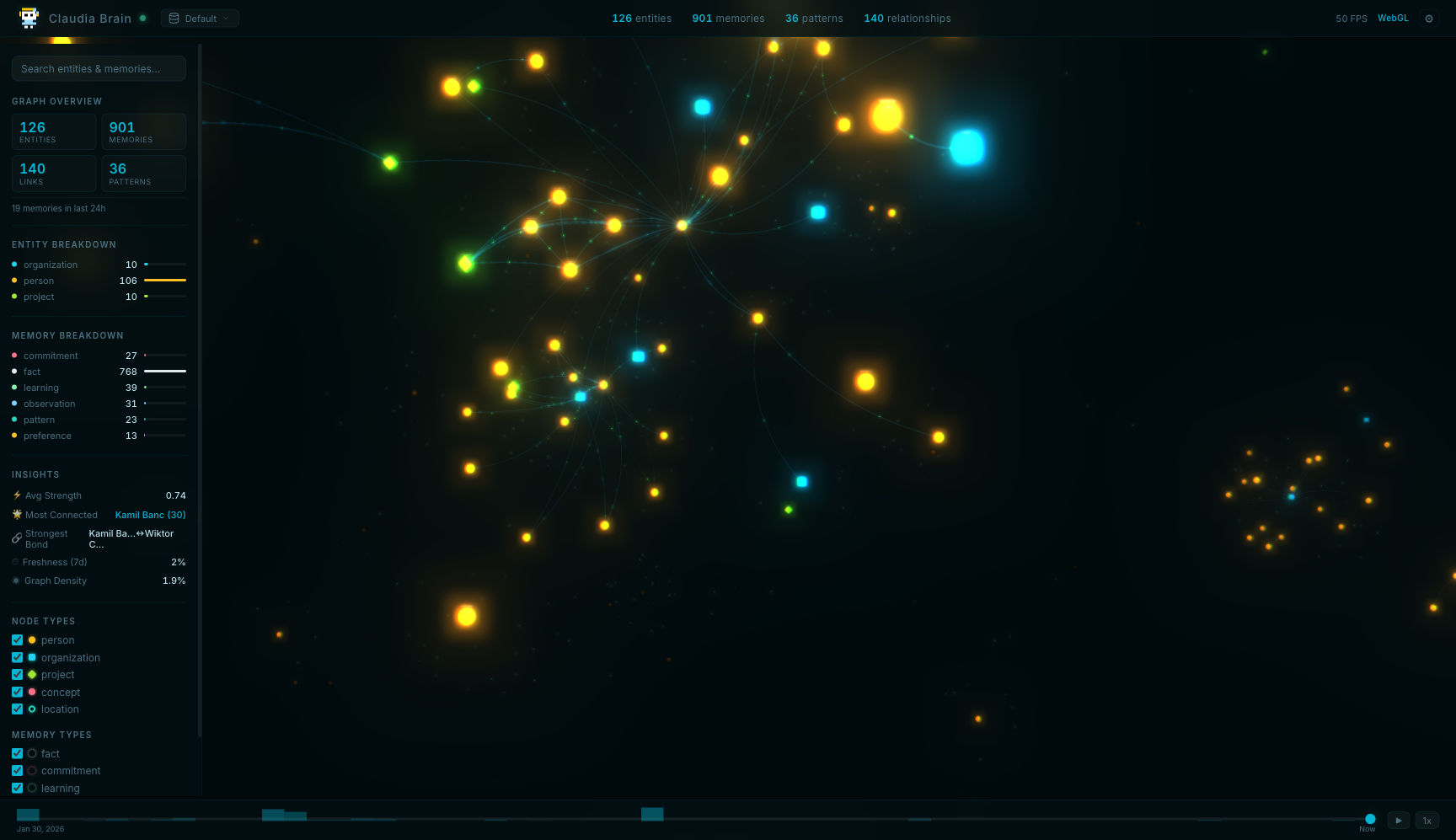
Launch with /brain to see your memory as a 3D network graph. Entities are nodes, relationships are edges, and everything is interactive: click to inspect, filter by type, search by name.
Integrations
Claudia works fully on her own, but integrations let her see further.
Google Workspace
Connect Gmail, Calendar, Drive, Docs, Sheets, Tasks, and more with a single setup command:
npx get-claudia google
This generates a one-click URL to enable all required Google APIs and walks you through OAuth setup. Three tiers available:
| Tier | Tools | What You Get |
|---|---|---|
| Core | 43 | Gmail, Calendar, Drive, Contacts |
| Extended | 83 | Core + Docs, Sheets, Tasks, Chat |
| Complete | 111 | Extended + Slides, Forms, Apps Script |
500+ Apps via Rube
Rube (by Composio) connects Claudia to Slack, Notion, Jira, GitHub, Linear, HubSpot, Stripe, Figma, and hundreds more through one-click OAuth. No per-app MCP setup needed.
| Category | Examples |
|---|---|
| Communication | Slack, Discord, Teams, Telegram |
| Project Management | Jira, Linear, Asana, Trello, Monday.com |
| Knowledge & Docs | Notion, Confluence, Google Docs, Coda |
| Code & Dev | GitHub, GitLab, Bitbucket |
| CRM & Sales | HubSpot, Salesforce, Pipedrive |
| And 500+ more | Browse the full list |
Obsidian Vault
Memory auto-syncs to an Obsidian vault at ~/.claudia/vault/ using PARA structure. Every entity becomes a markdown note with [[wikilinks]], so Obsidian's graph view maps your network. SQLite is the source of truth; the vault is a read-only projection you can browse and search.
How It Works
41 skills · 33 MCP tools · 500+ tests
Claudia has two layers:
Template layer (markdown) defines who she is. 41 skills, rules, and identity files that Claude reads on startup. Skills range from proactive behaviors (commitment detection, pattern recognition, judgment awareness) to user-invocable workflows (/morning-brief, /research, /meditate). Workspace templates let you spin up new projects with /new-workspace [name].
Memory system (Python) defines what she remembers. Two daemon modes share the same SQLite database:
| Daemon | When | Purpose |
|---|---|---|
| MCP daemon | Per-session (stdio) | Serves ~33 memory tools to Claude Code |
| Standalone daemon | 24/7 (LaunchAgent) | Runs scheduled jobs even when Claude Code is closed |
| Scheduled Job | When | What It Does |
|---|---|---|
| Adaptive decay | 2 AM | Fades old memories, high-importance at half rate |
| Consolidation | 3 AM | Merges duplicates, detects patterns, tracks relationships |
| Vault sync | 3:15 AM | Syncs memory to Obsidian vault (PARA structure) |
| Pattern detection | Every 6h | Surfaces trends across conversations |
You ──► Claude Code ──► Reads Claudia's templates ──► Becomes Claudia
                                                           │
                                                    MCP daemon (stdio)
                                                           │
                                                           ▼
                                                     SQLite + vectors
                                                           ▲
                                                           │
                                              Standalone daemon (24/7)
                                               ┌──────┼──────┐
                                               ▼      ▼      ▼
                                          Scheduler Ollama  Obsidian vault
                                                           (PARA structure)
Agent team for speed. Claudia delegates structured work to a two-tier team. Tier 1 (Haiku): fast workers for document archiving, processing, and schedule analysis. Tier 2 (Sonnet): a research scout with independent context for multi-turn web research. Claudia keeps relationship judgment and strategy decisions for herself.
Technical deep diveSemantic search uses hybrid ranking: 50% vector similarity, 25% importance, 10% recency, 15% full-text. Accessing a memory boosts it (rehearsal effect).
Judgment layer stores user-defined decision rules in context/judgment.yaml. Rules are extracted during /meditate reflections and applied by morning briefs, commitment detection, and risk surfacing. Claudia learns your priorities once and applies them consistently.
Document storage keeps files, transcripts, emails on disk, linked to people and memories. Content-hash deduplication. Automatic lifecycle management.
Provenance chains trace any fact to its source email, transcript, or conversation.
Graph traversal connects dots across your network. Ask about one person, see related entities with top memories. The 3D brain visualizer (/brain) renders the graph in real-time.
Per-project isolation keeps work memories separate from personal. Each workspace gets its own database.
Session reflections (/meditate) extract learnings about your preferences, communication patterns, and judgment calls. These persist across sessions and make Claudia progressively sharper.
For full architecture diagrams, see ARCHITECTURE.md.
Privacy and Safety
- Fully local. Memory, embeddings, cognitive tools run on your machine. No external APIs for storage.
- No external actions without approval. Every email, calendar event, external action requires your explicit "yes."
- Your data in two formats. SQLite database (
~/.claudia/memory/) for fast semantic search, plus a PARA-organized Obsidian vault for reading and graph navigation. Two independent copies you own forever. - Delete anything, anytime. Full control over your data. No lock-in, no cloud dependency.
System Requirements
| Component | Required | Purpose |
|---|---|---|
| Claude Code | Yes | Runtime |
| Node.js 18+ | Yes | Installer |
| Python 3.10-3.13 | Recommended | Memory system |
| Ollama | Recommended | Embeddings + cognitive tools |
Without the memory system, Claudia still works using markdown files. With it, she gains semantic search, pattern detection, and relationship tracking.
Ollama model: Run
ollama pull all-minilm:l6-v2after installing Ollama. This is the embedding model used for semantic search.
Platforms: macOS, Linux, Windows
Troubleshooting
Memory tools not appearing in Claude Code?
- Check
.mcp.jsonhas aclaudia-memoryentry with the correct venv Python path - Restart Claude Code in a NEW terminal
- Re-run the installer to fix paths:
npx get-claudia .
Check standalone daemon health:
curl http://localhost:3848/status
launchctl list | grep claudia
tail -20 ~/.claudia/daemon-stderr.log
Standalone daemon not running?
launchctl load ~/Library/LaunchAgents/com.claudia.memory.plist
Ollama not running after reboot?
open -a Ollama          # macOS
ollama serve            # Linux
Pull models manually:
ollama pull all-minilm:l6-v2 # Embeddings (required)
Google Workspace not working after enabling new APIs?
Delete the cached token and restart to re-authenticate with updated scopes:
rm ~/.workspace-mcp/token.json
# Restart Claude Code
Broken install? Re-run setup:
cd your-claudia-directory
npx get-claudia .
This updates daemon code, skills, and rules while preserving your databases and context files.
Contributing
Claudia is source-available under the PolyForm Noncommercial License 1.0.0.
- Template (skills, rules, identity):
template-v2/ - Memory daemon (Python):
memory-daemon/(tests:cd memory-daemon && pytest tests/) - Installer:
bin/index.js - Architecture: ARCHITECTURE.md
- Dev guide: CLAUDE.md
License
Free for personal, research, educational, and nonprofit use. Commercial licensing: [email protected]
Created by Kamil Banc · @kamilbanc · AI Adopters Club
"I learn how you work. Let's get started."
If Claudia helps you, a ⭐ on GitHub means a lot.
Yorumlar (0)
Yorum birakmak icin giris yap.
Yorum birakSonuc bulunamadi