martin-loop
Health Pass
- License — License: MIT
- Description — Repository has a description
- Active repo — Last push 0 days ago
- Community trust — 13 GitHub stars
Code Pass
- Code scan — Scanned 12 files during light audit, no dangerous patterns found
Permissions Pass
- Permissions — No dangerous permissions requested
No AI report is available for this listing yet.
Martin Loop — The control plane for autonomous AI coding agents.

The cross agent governance layer for autonomous AI coding agents.⭐




MartinLoop has been accepted into the NVIDIA Inception program.
Your overnight AI pipeline estimated $2.40.
You woke up to a $65 bill.
47 retries. No hard stop. No rollback. No audit trail. Nothing merged.
MartinLoop exists so that never happens again.✅
If you think autonomous AI coding agents need budgets, brakes, and receipts, Plase star ⭐ the repo so more builders can find it.
AI coding agents are useful. Unbounded retry loops are not.
MartinLoop wraps agent runs with budgets, policy checks, verifier gates, rollback evidence, and inspectable run records. Built for Enterprise Coding Agents, Agentic Teams, and Autonomous Companies.
The Problem
A typical autonomous coding loop keeps attempting work until tests pass. Without a governance layer, that loop can keep spending, mutate files outside the intended scope, lose track of why it failed, and leave teams without a clean audit trail.
Ralph-style loops are powerful but they attempt ➡️ check ➡️ retry ➡️ repeat, with no strong answer to:
- What changed?
- What did it cost?
- Why was it allowed?
- Why did it stop?
- Can we inspect or resume it later?
MartinLoop governs the failure mode.
The Solution
✅ Martin Loop wraps AI coding loops with a governance layer.
It does not try to replace the agent pattern. It makes that pattern safe to run.
What MartinLoop Does Today
| Capability | Current behavior |
|---|---|
| Budget governance | Enforces maxUsd, softLimitUsd, maxIterations, and maxTokens; rejects attempts projected to exceed remaining budget and exits on budget or iteration exhaustion. Hard USD budget caps that stop work before the next attempt breaches policy. |
| Verifier gate | A run only reaches completed when the adapter result and verifier state pass. Unsafe verifier commands are blocked before agent execution. |
| Failure taxonomy | Classifies failures across 11 current classes, including hallucination, test regression, scope creep, repo grounding failure, environment mismatch, and budget pressure, that distinguishes real success from unsafe, invalid, or terminal behavior. |
| Safety leash | Evaluates verifier commands, file scope, dependency or migration changes that require approval, and secret-like values in task text. Policy-as-code. |
| Context integrity | Scans user prompts and tool output for injection patterns (authority inversion, instruction override, identity redefinition) before any attempt is admitted. Aborts with human escalation on detection. |
| Rollback evidence | Captures rollback boundaries and restore outcomes for repo-backed attempts when a persistence store is configured. |
| Context distillation | Carries a distilled summary of recent attempts and remaining constraints into subsequent attempts. |
| Run records | The CLI appends JSONL loop records under ~/.martin/runs/<workspaceId>.jsonl; lower-level stores can also persist contracts, ledgers, and attempt artifacts. |
⭐The result is a runtime that can complete good work, refuse unsafe work, stop uneconomical work, and leave evidence behind.✅
Ralph-Style Loops Need a Control Layer
"Everybody has gotten infatuated with what we call these Ralph Wiggum loops, just like send the thing off and it'll just go figure something out..A, It never figures anything out. And B, you just get this ginormous bill..." - Chamath Palihapitiya, All-In Podcast #263, March 2026
⛔ The Ralph Loop is the failure mode where an AI coding agent keeps trying without knowing when it should stop.
The pattern is simple: attempt the task, run checks, retry on failure, repeat. The problem is not that the loop exists. The problem is that most implementations have no hard budget cap, no signed evidence layer, and no pre-execution control system. They know how to keep trying. They do not know when continuing is unsafe, uneconomical, or impossible.
✅ Martin Loop solves the Ralph Loop problem by enforcing rules before damage happens:
- it stops the next attempt before budget overspend
- it classifies unsafe or invalid actions before execution
- it appends a structured JSONL audit record for every attempt
- it rolls back failed runs instead of leaving broken state behind
- it reduces runaway token growth with context distillation
If a Ralph-style loop has ever burned budget without producing a verified result, MartinLoop is designed to stop that failure mode before the next unsafe attempt runs. $165.70 on your dime, you're in the right place. Martin stopped him at $40.97 with a full audit trail.

How It Works — Five Layers
| Layer | What it does |
|---|---|
| 1. Task Contract | Objective, verifier plan, repo root, allowed/denied paths, acceptance criteria, workspace, project, and budget. |
| 2. Policy & Budget | Defaults from martin.config.yaml; CLI flags override. Budget preflight rejects attempts before execution. |
| 3. Agent Adapters | Claude CLI, Codex CLI, direct-provider, and stub adapters normalize execution results into the core runtime contract. |
| 4. Safety & Verification | Verifier commands, file scope, approval-boundary changes, secret-like values, and grounding determine whether work is kept. |
| 5. Persistence | CLI writes JSONL records under ~/.martin/runs/. Repo-backed runs can also persist contracts, ledgers, diffs, and rollback artifacts. |
See It In Action
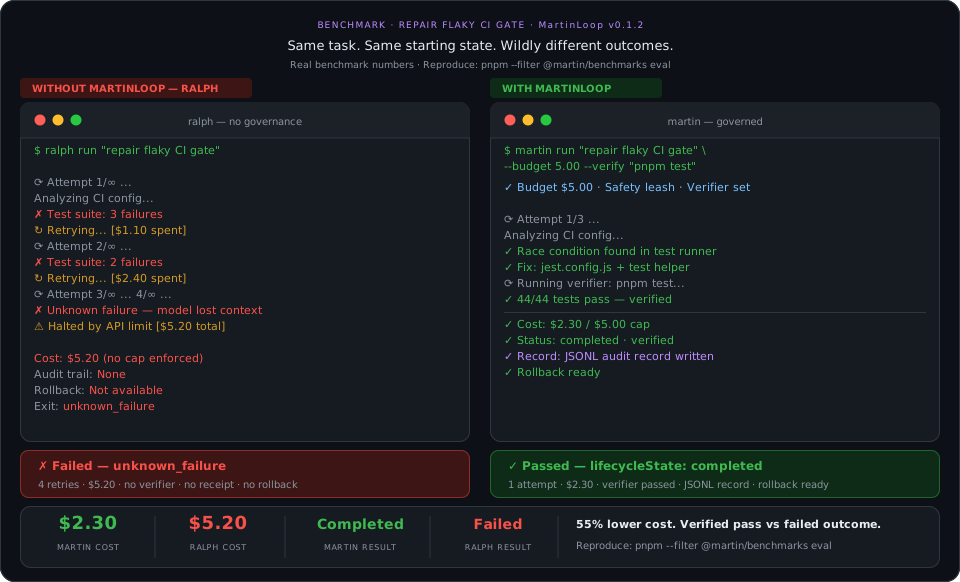
Same task, same starting state. MartinLoop completes in one verified attempt at $2.30. The uncontrolled loop retries four times, spends $5.20, and fails with no audit trail.
Martin Loop matters because it turns AI coding from an opaque experiment into something that can be governed, replayed, verified, and trusted.
Reproducible locally:
pnpm --filter @martin/benchmarks test
pnpm --filter @martin/benchmarks eval
pnpm --filter @martin/benchmarks eval:phase12
Quick Start
npm install -g martin-loop
This installs both the martin-loop package and the martin command alias. The package is currently published on npm as version 0.1.4.
Public Package Surface
The frozen public package surface for this release candidate is:
- Install target:
npm install martin-loop - CLI target:
npx martin-loop - SDK target:
import { MartinLoop } from "martin-loop" - MCP target (registry-ready package):
npx -y @martinloop/mcp
The martin command alias is installed for local operator convenience, but the public CLI surface is npx martin-loop.
The standalone MCP server package is smoke-validated locally with pnpm --filter @martinloop/mcp smoke:pack and is ready for registry publication as a separate release step.
Claude Code MCP install
Use the published MCP package directly:
- macOS/Linux:
claude mcp add --scope user martin-loop -- npx -y @martinloop/mcp - Windows PowerShell/cmd:
claude mcp add --scope user martin-loop -- cmd /c "npx -y @martinloop/mcp"
If you just want to launch the server manually, the one-line command is:
npx @martinloop/mcp
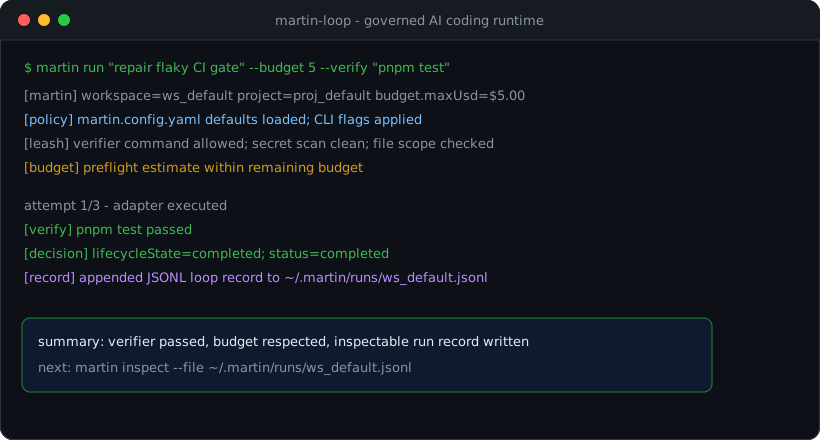
Run a governed task
martin run "fix the auth regression" \
  --budget 3.00 \
  --verify "pnpm test"
You can also pass the objective explicitly:
martin run --objective "fix the auth regression" --budget 3.00 --verify "pnpm test"
For a no-spend repo-local dry run, use the stub adapter:
$env:MARTIN_LIVE='false'
pnpm run:cli -- run --objective "Summarize the current runtime state" --verify "pnpm --filter @martin/core test"
Remove-Item Env:MARTIN_LIVE
Inspect or resume runs
martin inspect --file ~/.martin/runs/<workspaceId>.jsonl
martin resume <loopId>
inspect prints a portfolio summary for records in the file. resume looks up a persisted loop record by ID under ~/.martin/runs/.
CLI
martin run <objective> [options]

  --objective <text>      The task to accomplish, or pass it as the first positional arg
  --budget <n>            Hard cost cap in USD
  --budget-usd <n>        Alias for --budget
  --soft-limit-usd <n>    Soft budget threshold in USD
  --verify <cmd>          Verifier command after each attempt
  --max-iterations <n>    Maximum number of attempts
  --max-tokens <n>        Maximum total token budget
  --engine <name>         Adapter to use: claude (default) or codex
  --model <name>          Override the adapter model
  --cwd <path>            Repo root for the run
  --allow-path <glob>     Restrict agent writes to this path pattern; repeatable
  --deny-path <glob>      Block this path pattern; repeatable
  --accept <criterion>    Add an acceptance criterion; repeatable
  --config <path>         Path to a martin.config.yaml file
  --workspace <id>        Workspace ID for the run record
  --project <id>          Project ID for the run record
  --metadata <key=value>  Attach metadata to the run record; repeatable
The public CLI also includes inspect, resume, and a bench redirect that points reviewers to the workspace benchmark harness.
Policy File
Drop a martin.config.yaml in your repo root to set governance defaults:
budget:
  maxUsd: 5.00
  softLimitUsd: 3.75
  maxIterations: 5
  maxTokens: 40000

governance:
  destructiveActionPolicy: approval
  telemetryDestination: local-only
  verifierRules:
    - pnpm test
CLI flags override config values when provided.
TypeScript SDK
npm install martin-loop
import {
  MartinLoop,
  createClaudeCliAdapter,
  createCodexCliAdapter,
  runMartin
} from "martin-loop";

const loop = new MartinLoop({
  adapter: createClaudeCliAdapter({ workingDirectory: process.cwd() }),
  defaults: {
    workspaceId: "my-workspace",
    projectId: "my-project",
    budget: {
      maxUsd: 3.00,
      softLimitUsd: 2.25,
      maxIterations: 3,
      maxTokens: 20_000
    }
  }
});

const result = await loop.run({
  task: {
    title: "Fix auth regression",
    objective: "Fix the failing auth regression tests",
    verificationPlan: ["pnpm test"],
    repoRoot: process.cwd()
  }
});

console.log(result.decision.status);
Use Codex instead of Claude by swapping adapters:
const loop = new MartinLoop({
  adapter: createCodexCliAdapter({ workingDirectory: process.cwd() })
});
The lower-level runMartin function is also exported for callers that want to assemble the runtime input directly.
Workspace Map
| Package or app | Role |
|---|---|
martin-loop |
Root public npm facade that vendors the runtime, CLI, adapters, and contracts into dist/. |
@martin/contracts |
Shared types for loops, policy, governance, budget, telemetry, and rollback. |
@martin/core |
Runtime controller, policy engine, safety leash, grounding, persistence, and rollback logic. |
@martin/adapters |
Claude CLI, Codex CLI, direct-provider, and stub adapter surfaces. |
@martin/cli |
Local CLI implementation for run, inspect, resume, and the benchmark redirect. |
@martinloop/mcp |
MCP server tools: martin_run, martin_inspect, and martin_status. |
benchmarks/ |
Workspace-only deterministic benchmark and RC validation harness. |
apps/control-plane/ |
Hosted control-plane workstream, outside the initial npm package surface. |
apps/local-dashboard/ |
Local dashboard/read-model viewer, not currently packaged as public npm API. |
The @martin/core, @martin/adapters, and @martin/contracts package manifests are still private workspace packages. The public runtime install target is the root martin-loop facade, while @martinloop/mcp is packaged as a standalone MCP server with vendored internal runtime dependencies for registry publication.
Development
Requirements:
- Node 20+
- pnpm 10.x
git clone https://github.com/Keesan12/martin-loop.git
cd martin-loop
pnpm install

pnpm test
pnpm lint
pnpm build
Current RC gate commands:
pnpm oss:validate
pnpm public:smoke
pnpm repo:smoke
pnpm rc:validate
pnpm pilot:prep:validate
pnpm release:matrix:local
Caution: This package is live on npm. Treat registry publication as a guarded release step — verify the RC gate commands, confirm semantic versioning, and document breaking changes before publishing.
The repository is organized as a dual-track workspace: the OSS runtime and package facade are present and published, while the hosted control-plane, local dashboard, and benchmark harness remain gated in private workspace for future release rather than the primary npm package API.
Helpful docs:
- OSS quickstart
- OSS examples
- Claude Code walkthrough
- Ralph-style loop safety guide
- OSS boundary report
- Release surface report
Contributing
git checkout -b feat/your-feature
pnpm lint
pnpm test
git commit -m "feat: describe what you built"
git push -u origin feat/your-feature
Conventional commit prefixes: feat:, fix:, chore:, docs:, refactor:, and test:.
⭐Give the repo a star⭐ if you think AI coding needs budgets, brakes, and receipts.
MIT Licensed · martinloop.com · [email protected]
"AI coding accountability: completes good work, refuses unsafe work, stops uneconomical work."

Reviews (0)
Sign in to leave a review.
Leave a reviewNo results found