dev-skills
Health Uyari
- No license — Repository has no license file
- Description — Repository has a description
- Active repo — Last push 0 days ago
- Low visibility — Only 5 GitHub stars
Code Gecti
- Code scan — Scanned 4 files during light audit, no dangerous patterns found
Permissions Gecti
- Permissions — No dangerous permissions requested
Bu listing icin henuz AI raporu yok.
Dev skills I use day to day in agentic engineering, focused on multi-agent-driven work modes and long-horizon autonomous tasks.

Dev Agent Skills
A set of dev skills I use day to day in agentic engineering, focused on multi-agent-driven work modes and long-horizon autonomous tasks.
Install
Choose the pack you want the agent to read. The two packs use the same skill names, but their instructions and natural-language triggers are written separately; install one, not both.
English:
npx skills@latest add keli-wen/dev-skills
Chinese:
npx skills@latest add https://github.com/keli-wen/dev-skills/tree/master/skills-zh
The commands above install ordinary, unnamespaced skills. Both packs are also available as namespaced plugins.
English plugin for Codex:
codex plugin marketplace add keli-wen/dev-skills
codex plugin add devai@dev-skills
English plugin for Claude Code:
claude plugin marketplace add keli-wen/dev-skills
claude plugin install devai@dev-skills
Chinese plugin for Codex:
codex plugin marketplace add keli-wen/dev-skills --ref zh
codex plugin add devai@dev-skills-zh
Chinese plugin for Claude Code:
claude plugin marketplace add keli-wen/dev-skills@zh
claude plugin install devai@dev-skills-zh
See the installation guide for global and project installs, namespace behavior, and language switching.
Skills
| When you… | Use |
|---|---|
| have a goal worth hours of autonomous work: agree on the spec and acceptance checks together, let the agent run, then review the report | /long-horizon |
| are mentally drained but the work must keep moving: the agent reports only what matters and turns the decisions only you can make into two-option questions with a recommendation | /lowband |
| find the agent's replies tiring to read: it writes one claim per sentence, keeps the action in the verb, and ties each uncertainty to the claim it belongs to | /readout |
| are only asking a question and want an analyzed answer, without the agent starting to "fix" anything — one turn, then back to normal | /just-ask |
| want to hand the current task to another agent or session without duplicating existing documents, so it can start working immediately | /handoff |
| want the task split across several subagents in parallel, but only after checking that the split is actually worth it | /fan-out |
| need deep research that starts from your project's existing documents and writes verified findings back into them | /ctx-research |
| have conclusions in the chat that deserve to become a properly placed project document | /to-ctx |
| are about to commit to a plan and want the agent to interrogate it first, then write down the decisions you reach | /ctx-grill |
🧭 Design philosophy
long-horizon: don't run long for the sake of running long
The obvious way to set up a long agent run is to break a goal into a few sub-goals, hand over a sufficiently detailed instruction document, and let it loose. It looks thorough. But this easily becomes long-horizon for its own sake: plenty of tokens burned, nothing reliably delivered.
The entire skill is designed around one question: how do you make a long run valuable, not merely long?
- Before the run: you and the agent iterate on the spec until every acceptance criterion names a runnable check. A goal that cannot explain how completion will be verified does not enter the run. At the same time, you agree on what the agent may and may not do unattended.
- During the run: the agent remains an orchestrator and uses
/fan-outto dispatch execution to subagents. Nothing counts as done without real evidence such as test output or command results; "I finished it" is not evidence. Newly discovered problems join the queue, while a blocked item records exactly who needs to answer what without stalling independent branches. - Watch at any time:
.long-horizon/<goal-slug>/report.htmlrefreshes as the run progresses. It shows the goal and acceptance criteria, every item's status, a dependency graph with the critical path and blocking cut-points, key decisions, open questions, the last update time, and the session count. You should never have to reconstruct the agent's current state from its logs. - After the run: the same HTML report becomes the final review surface. You define the goal at the beginning and review the result at the end; in between, you can observe without repeatedly taking the task back.
I deliberately specify a Contract, not Template. The contract defines what the report must contain and keeps its data separate from presentation; the agent decides what the page should look like. Hardcoding a visual template would bet against the next model. I would rather constrain what the report must communicate than how it must look.
This is the skill I most want to get right, and I am still iterating on it through real work. Its evolution, including the field test that forced a full redesign, is recorded in RELEASE_LOG.md.
lowband: let the agent carry the information-processing load
The usual advice is to stop working when you are drained. But in reality the work often has to continue; you simply no longer have the energy to sift through everything the agent gives you and decide what matters.
lowband applies to the whole collaboration rather than joining a pipeline as another step. Once it is on, the agent digests the information and handles routine choices for you. It brings back only decisions that genuinely need your judgment, formatted as two options with a recommendation; most of the time, you can answer with one letter. Other skills stay unchanged. lowband filters their questions and confirmation requests in one place: the agent decides anything that will not change the task's direction, and asks you about anything that might. See skills/lowband/SKILL.md for the full rules.
But one thing never changes: the information-processing load can move toward the agent; authority cannot. Deleting, publishing, deploying, spending, and sending anything external still require your explicit approval in every mode.
readout: the problem is density, not length
The obvious diagnosis of hard-to-read agent output is that there is too much of it. That is usually wrong. Human writing often runs longer; what makes an agent's report tiring is how much it packs into each sentence. Three claims arrive inside one clause, and you resolve them one at a time before any of them can be banked.
readout is a small set of sentence-level rules aimed at exactly that: one claim per sentence, the action in the verb, known information before new, and uncertainty tied to the claim it belongs to rather than sprayed over everything. Metaphor is held to a threshold. An analogy is allowed only when you can name what corresponds to what, and only when the reader does not already hold the model you would be mapping onto.
Every rule states its reason, and none of them is a banned-word list. That is deliberate. A blacklist has to be enforced, and the place this skill most needs to work is a plain markdown file that no enforcement mechanism protects. A rule that explains the cost it saves the reader survives being pasted somewhere with nobody watching; a rule that only forbids does not.
That is also how it ships. Invoke /readout and it stays on for the rest of the session. Copy the body into AGENTS.md or CLAUDE.md and it applies from the first turn, in any tool that reads those files. The body is written to stand on its own, so both paths give the same result.
One line does not move: readout governs how things are said, never what may be concluded. No rule in it licenses softening a finding or reporting a result you did not get.
The rest: composable atoms
The remaining skills are more conventional. I wrote my own versions so they can form a coherent system and evolve together.
just-ask is the smallest atom. It compresses one prompt you would otherwise retype — "I'm only asking; investigate read-only and answer, don't touch anything" — into a single command, because an agent deep in a working context tends to treat every message as the next task. It is the mirror image of the modes: where lowband and readout stay on until turned off, /just-ask covers exactly one turn.
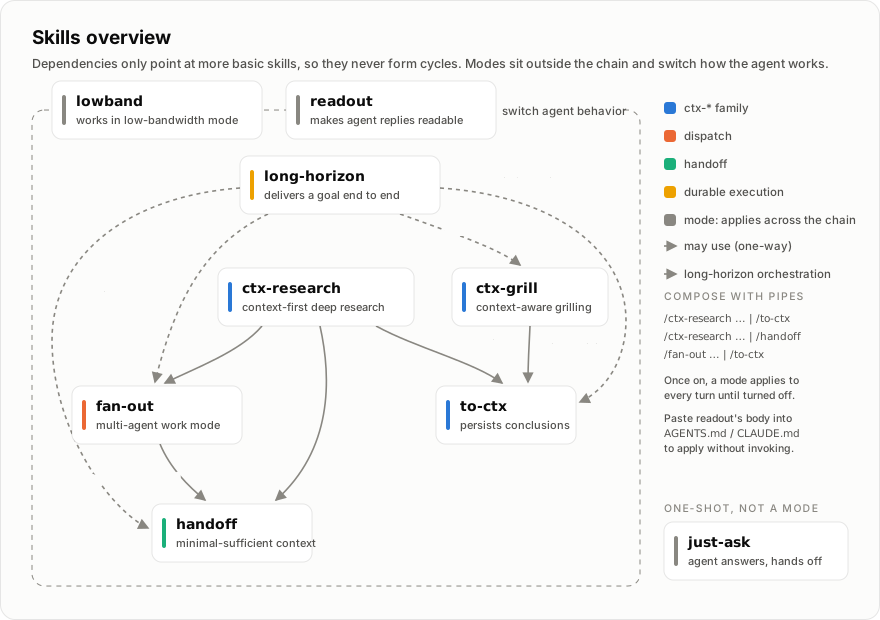
The ctx-* family includes ctx-research for research, ctx-grill for interrogation, and to-ctx for filing. They share one contract: read the project's durable context documents before acting, then write back conclusions worth keeping. A question those documents already answer is never asked again (ctx-grill's interview engine is adapted from grilling in mattpocock/skills, MIT). handoff compresses the current task into something the next agent can start from directly. It points to existing documents and carries only the new information instead of duplicating the source of truth.
fan-out deserves a closer look. Agents do not reliably initiate multi-agent collaboration on their own, so the skill is not merely about spawning more subagents; it teaches them when a split is worth it and where to cut. It checks the economics first, because many problems that appear to "need multi-agent" are really failures of single-context management. If a split is worthwhile, the cut follows context coupling between subtasks rather than mechanically dividing work by stage. The full reasoning is in my blog post: When Multi-Agent?
These atoms stay small enough to compose into concrete scenarios with pipes. The agent interprets the convention from left to right:
/ctx-research <topic> | /to-ctx    # research, then file the findings
/fan-out <task> | /to-ctx          # dispatch, then file the integrated result
Dependencies only flow downward, so they cannot form loops; the graph at the top shows the complete structure. English skills/ is the source of truth, while skills-zh/ holds its Chinese counterpart under the same names. The packs remain separate so each language gets its own instructions, triggers, and examples without loading the other language's writing rules. Most of the time the Chinese version is a translation. readout is the exception: writing defects such as verb-into-noun conversion and stacked four-character set phrases only exist in Chinese, so skills-zh/readout carries the shared principles plus rules written specifically for Chinese.
[!Note]
TODO: a set of best-practice examples is coming, using real scenarios to show how these skills compose.
References
- mattpocock/skills: this repository's organization follows Matt's;
ctx-grillvendors itsgrillinginterview engine (MIT).
Yorumlar (0)
Yorum birakmak icin giris yap.
Yorum birakSonuc bulunamadi