agent-connector
Health Warn
- License — License: Apache-2.0
- Description — Repository has a description
- Active repo — Last push 0 days ago
- Low visibility — Only 5 GitHub stars
Code Warn
- network request — Outbound network request in docs/research/audits/fleet-surface-gap-audit-2026-06-16.json
Permissions Pass
- Permissions — No dangerous permissions requested
No AI report is available for this listing yet.
Deploy one MCP to every agent CLI. Write your server + hooks once with defineConnector() → native config, plugin & marketplace across 42 agent CLIs (Claude Code, Codex, Cursor, Copilot, Gemini, OpenCode, Warp, Zed…). Built-in per-tool token telemetry. Apache-2.0.

agent-connector
Deploy one MCP to every agent CLI.
Write your server + hooks once with defineConnector(), then install it into
the native config — or package it as a real plugin — across every detected agent CLI
(Claude Code, Codex, Cursor, Copilot, Gemini, OpenCode, Warp, Zed…).









Two audiences: connector developers start at Quick start;
if you already run an agent CLI and just want token totals, jump straight tousage.
- Quick start — depend on the SDK, declare a connector, install it
- Ship it — direct install or a marketplace plugin
- What you define once — server, hooks, and the other surfaces
- How it works — single home binary, per-project data, hook paradigms
- CLI — every command at a glance
- Token telemetry & usage — per-tool telemetry vs. connector-free
usage - Publish to the MCP ecosystem — emit the official MCP standard artifacts
- Verification — how the platform coverage contract is proven
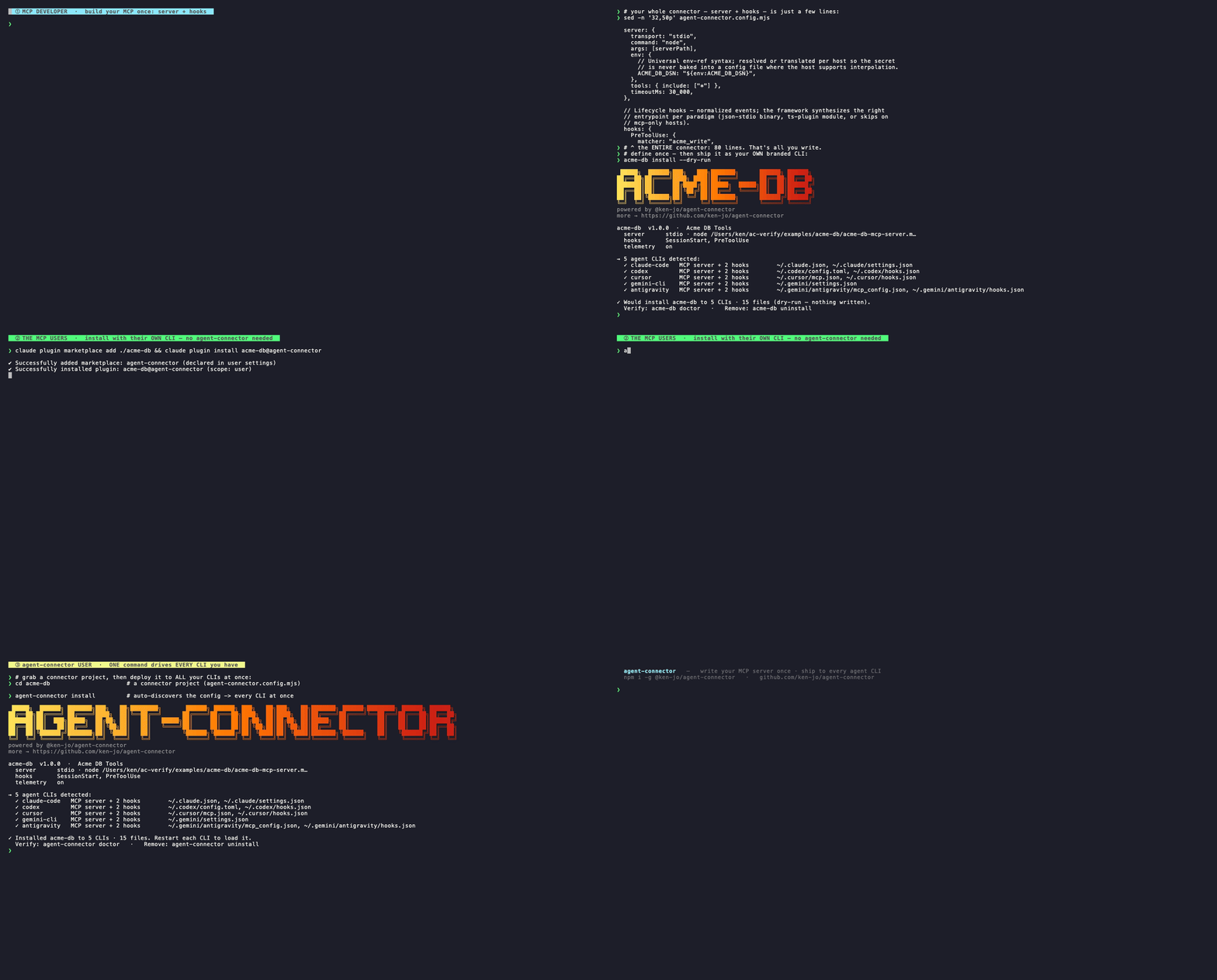
Define once → ship it as your own branded CLI → users install via their host's native marketplace → one command drives every CLI. Regenerate this demo.
Quick start
agent-connector is an SDK connector developers depend on. Add it to the
package that holds your connector, declare the connector once, then ship a
branded MCP package/bin such as npx @acme/acme-db-mcp install — it deploys to
every detected agent CLI in that host's own native config. Installing@ken-jo/agent-connector globally is not the branded MCP lifecycle path; reserve
the global CLI guidance for connector-free token usage reports. Framework
artifact tooling stays developer-facing and normally runs throughnpx @ken-jo/agent-connector ... --connector. The linear path is:
get a server → declare it → install through your branded package.
0. You need an MCP server file first. The config below points at./my-mcp-server.mjs, so that file must exist before you install. Don't have an
MCP server yet? Copyexamples/acme-db/acme-db-mcp-server.mjs
(a self-contained ~35-line stub) as ./my-mcp-server.mjs, or follow the
official MCP SDK quickstart.
# 1. add agent-connector as a DEPENDENCY of your connector package
npm install @ken-jo/agent-connector
// 2. package.json — this is the user-facing package identity
{
  "name": "@acme/acme-db-mcp",
  "mcpName": "io.github.acme/acme-db",
  "bin": { "acme-db": "./bin.mjs" },
  "dependencies": { "@ken-jo/agent-connector": "^0.4.98" }
}
// 3. agent-connector.config.mjs — declare your server + hooks once
import { fileURLToPath } from "node:url";
import { defineConnector } from "@ken-jo/agent-connector/sdk";

const serverPath = fileURLToPath(new URL("./my-mcp-server.mjs", import.meta.url));

export default defineConnector({
  // package.json / npm metadata is the source of truth. The host alias/runtime
  // id and connector version are derived from name/mcpName/bin/version unless
  // you need a legacy or multi-instance alias. Host-native ids are generated
  // during install, so do not copy them back into defineConnector({ id }).
  server: {
    transport: "stdio",
    command: "node",
    args: [serverPath],
  },
  // hooks, telemetry, and more surfaces — see "What you define once" below
});
The wiring contract is:
package.jsondefines the public product identity (name,mcpName,bin,version).bin.mjscallscreateConnectorCli({ packageJson, connector })so every
install/doctor/upgrade/uninstall command runs under the developer's brand.agent-connector.config.*usesdefineConnector({ server, ...surfaces })to
describe the real MCP launch shape or remote endpoint.installrenders that single declaration into each detected host's native
MCP config. For stdio processes, the host points at the stable
agent-connector home binary, which launches the real command and can measure
per-tool traffic. For remote HTTP servers, the host receives the URL where
supported; there is no stdio process to wrap.
Command boundary
Keep the two command layers separate:
| Layer | Who runs it | Examples | Purpose |
|---|---|---|---|
| Branded MCP lifecycle | Users of your MCP package | npx @acme/acme-db-mcp install, acme-db doctor --probe, acme-db upgrade, acme-db uninstall, acme-db telemetry report --by tool |
Install, verify, update, remove, and inspect telemetry for your MCP. |
| Framework tooling | MCP package developers | npx @ken-jo/agent-connector package --connector ./agent-connector.config.mjs |
Emit host plugin bundles and MCP distribution artifacts from a connector config. |
| Connector-free user telemetry | Agent-CLI users with no MCP package | npx @ken-jo/agent-connector usage report --by platform |
Read host CLI logs read-only for whole-conversation token totals. |
If a command operates the MCP after it is authored, prefer the branded package/bin.
If a command builds framework distribution artifacts, use the framework CLI.
MCP server launch examples
Pick the server shape that matches the MCP you are building. The wrapper
package identity still comes from package.json; these examples only describe
how to start or connect to the actual MCP server.
| Shape | Use when | Minimal launch |
|---|---|---|
| Package-runner MCP | The MCP is published as a package. | npx -y @acme/acme-db-mcp |
| Local server-process MCP | The MCP server ships inside your package. | node ./my-mcp-server.mjs |
| Python MCP | The MCP server is Python and should resolve runtime deps at launch. | uv run --with mcp ./my_mcp_server.py |
| CLI-based MCP | An existing executable exposes an MCP serving mode. | local-tools mcp serve |
| Remote server MCP | The MCP is hosted behind an HTTP endpoint. | https://mcp.example.com/mcp |
Each snippet below is the server field for defineConnector({ ... }); only
the local server-process example needs the serverPath helper shown inline.
Package-runner MCP — a published package that should be launched with npx:
server: {
  transport: "stdio",
  command: "npx",
  args: ["-y", "@acme/acme-db-mcp"],
}
Local server-process MCP — a bundled server file or binary:
import { fileURLToPath } from "node:url";

const serverPath = fileURLToPath(new URL("./my-mcp-server.mjs", import.meta.url));

server: {
  transport: "stdio",
  command: "node",
  args: [serverPath],
}
Python MCP — usually run through uv so dependencies are resolved with the
server:
server: {
  transport: "stdio",
  command: "uv",
  args: ["run", "--with", "mcp", "./my_mcp_server.py"],
}
Use direct python ./my_mcp_server.py only when the runtime environment is
already managed by your package or deployment wrapper.
CLI-based MCP — an existing executable exposes an MCP mode:
server: {
  transport: "stdio",
  command: "local-tools",
  args: ["mcp", "serve"],
}
Remote server MCP — a hosted MCP endpoint:
server: {
  transport: "http",
  url: "https://mcp.example.com/mcp",
}
# 4. deploy under your branded MCP package/bin
npx @acme/acme-db-mcp detect            # which platforms are installed here?
npx @acme/acme-db-mcp audit             # catch package/bin/connector identity drift
npx @acme/acme-db-mcp install --dry-run # preview every change first
npx @acme/acme-db-mcp install           # write native config in each host
installtargets only the hosts actually detected on this machine (or an
explicit--targets/connector.targetslist), intersected with the
current adapter registry shown on/coverage
— there is no "install to every host unconditionally" path.@ken-jo/agent-connectoris the framework dependency underneath; use it
directly for framework packaging/debugging or connector-free token telemetry,
not as the foreground install brand for your users.
Ship it: direct install or a marketplace plugin
Same one definition, your choice of distribution.
Direct install — your branded command (acme-db install,npx @acme/acme-db-mcp install) writes each host's native MCP + hook +
content-surface config in place, with no per-platform marketplace submission or
review. This is the Quick start path above.
Framework fallback can also install a connector source directly when you are
testing distribution intake: github:owner/repo, npm:@scope/package@version,
or an archive: / direct .tgz source. Every fetched source is cached under~/.agent-connector/sources/ and must contain agent-connector.config.*.
Marketplace plugin — the framework package command turns the connector
into a real plugin/extension bundle (manifest + bundled commands, agents,
skills, hooks, MCP) from one definition. This is framework tooling, so run it
with npx @ken-jo/agent-connector package --connector .... If you already keep
the framework CLI installed globally, agent-connector package --connector ...
is only the shorter equivalent. Hooks + MCP keep the
telemetry serve-wrapper, so a marketplace-installed connector still reports
per-tool tokens for its stdio server. --format all emits 10 host formats:
| Format | Hosts |
|---|---|
claude-plugin |
Claude Code · Codex · VS Code Copilot · OpenClaw · OMP |
codex-plugin |
Codex (.codex-plugin/ manifest variant) |
copilot-plugin |
GitHub Copilot CLI |
factory-plugin |
Droid |
gemini-extension |
Gemini CLI |
qwen-extension |
Qwen Code |
agy-plugin |
Antigravity (CLI + IDE) |
cursor-plugin |
Cursor |
kimi-plugin |
Kimi CLI |
npm-plugin |
OpenCode · Kilo CLI · Pi |
Two official MCP standard artifacts are opt-in (they need a publish block,
so they're excluded from --format all) — mcp-server-json (an MCP Registryserver.json) and mcpb (a one-click MCPB bundle); see
Publish to the MCP ecosystem.
# emit every host format (mcp-server-json + mcpb are opt-in by name)
npx @ken-jo/agent-connector package --connector ./agent-connector.config.mjs --format all --out ./dist-plugin
npx @ken-jo/agent-connector package --connector ./agent-connector.config.mjs --format gemini-extension --out ./ext   # or just one

# if you already keep the framework CLI globally installed, the same command is:
agent-connector package --connector ./agent-connector.config.mjs --format all --out ./dist-plugin

# e.g. Claude Code:  /plugin marketplace add ./dist-plugin/claude-plugin
#                    /plugin install <connector-id>@agent-connector
# e.g. Gemini CLI:   gemini extensions install ./dist-plugin/gemini-extension/<id>
Embedded-path caveat. Most host bundles bake in the absolute home-bin
launcher path of the machine that ranpackage, so they're valid for a
local install on that same machine/home. For shared distribution usenpm-pluginor the MCP standard artifacts, or re-runpackageper machine.
Let your branded MCP package drive the host's own install flow withinstall --method marketplace:
acme-db install --method marketplace

# framework fallback for local framework development/debugging only
npx @ken-jo/agent-connector install --method marketplace --connector ./agent-connector.config.mjs
- What it does — stages the bundle, registers a local marketplace where the
host has one, then runs the host's plugin-install verb (or, for npm-plugin
hosts, writes a localfile://entry); headless and idempotent. Other
marketplace-format hosts print the exact manual commands. - Host coverage — live-verified for Claude Code, Codex, OpenCode, Kilo
(CLI + ext), and Antigravity (CLI + IDE) on Linux, Windows, and macOS; Droid
and Qwen Code have the driver shipped but pending a live host; Gemini CLI is
legacy (sunsetting toward Antigravity — driver kept for existing installs). - Safety + reversal — a guard refuses installing the same connector by BOTH
methods,uninstall --method autoreverses whichever method is installed, anddoctorchecks registration drift.
Ship a branded CLI
A connector developer can ship their own bin instead of having users typeagent-connector. createConnectorCli({ packageJson, connector }) (from the@ken-jo/agent-connector/cli export) derives the bin name/version frompackage.json and exposes every subcommand under your brand, fully
delegated and auto-scoped to your connector — so your users do not need a
framework global install or --connector for branded MCP install/doctor/uninstall. Seeexamples/branded-cli for the full, runnable package.
#!/usr/bin/env node
// bin.mjs — every agent-connector subcommand, branded as `acme-db`
import { createConnectorCli } from "@ken-jo/agent-connector/cli";

// run() resolves to the exit code and never calls process.exit
process.exitCode = await createConnectorCli({
  // packageJson supplies public identity: name, mcpName, bin, version.
  packageJson: new URL("./package.json", import.meta.url),
  // connector supplies behavior: server, hooks, skills, telemetry.
  // These are two layers, not duplicate id/display-name inputs.
  connector: new URL("./agent-connector.config.mjs", import.meta.url),
}).run();
After a consumer installs your package, the acme-db bin is on their PATH
and every command is scoped to your connector (acme-db install ≈agent-connector install --connector ./agent-connector.config.mjs). Auto-scoping
is pure argument injection over the SAME single home binary; serve and hook
still route through the one ~/.agent-connector home binary every host config
points back to. An explicit --connector / --connector-id always overrides
the injected default.
What you define once
A single defineConnector({...}) declares your MCP server + lifecycle
hooks, and optionally the additional surfaces — commands, skills,
subagents, memory, statusline, actions, plus host-native escape
hatches. agent-connector renders each surface into every detected host's native
format, or skip-warns (never silently drops) where a host can't support it.
import { fileURLToPath } from "node:url";
import { defineConnector } from "@ken-jo/agent-connector/sdk";

// Resolve your server to an absolute path — host CLIs spawn it from their own CWD.
const serverPath = fileURLToPath(new URL("./my-mcp-server.mjs", import.meta.url));

export default defineConnector({
  server: {
    transport: "stdio",
    command: "node",           // or "npx", "python", etc. — whatever starts your server
    args: [serverPath],        // replace with your real server entrypoint
    env: { ACME_DB_DSN: "${env:ACME_DB_DSN}" },
  },
  hooks: {
    PreToolUse: {
      matcher: "acme_write",
      async handler(evt) {
        return evt.toolName === "acme_write"
          ? { decision: "ask", reason: "Confirm write" }
          : { decision: "allow" };
      },
    },
  },
  // telemetry is on by default
});
npx @acme/acme-db-mcp install turns that into, e.g.:
| Host | What gets written |
|---|---|
| Claude Code | ~/.claude.json → mcpServers.acme-db (+ hooks in ~/.claude/settings.json) |
| Codex CLI | ~/.codex/config.toml → [mcp_servers.acme-db] (+ ~/.codex/hooks.json) |
| Cursor | ~/.cursor/mcp.json → mcpServers.acme-db (+ ~/.cursor/hooks.json) |
…each pointing hooks at a single stable home binary, so one update propagates
everywhere.
Secret env-refs (${env:VAR}). Write "${env:VAR}" (or "${env:VAR:-default}") anywhere in command / args / env / url / headers to reference an environment variable.
On hosts with native interpolation (Claude Code, Cursor, VS Code Copilot,
amp, codebuff) the token is written through to the host config and resolved at
runtime. Every other host has no native interpolation, so the value is
resolved to a literal at install time; an unset variable with no default
resolves to an empty string, andinstallemits awarnfor it on a
literal-resolving host.
Native hooks escape hatch. The normalized hooks API covers the 13 cross-platform events; for host-only events (Claude Code alone ships 30) declare platforms: { "claude-code": { nativeHooks: { TaskCompleted: { handler } } } }.
The handler receives the host's raw payload and whatever it returns is the
verbatim JSON reply (exit 0 only — exit-2 blocking isn't modeled). Hosts
supporting host-native passthrough:amp,claude-code,continue,copilot-cli,cursor,gemini-cli,hermes,jetbrains-copilot,kimi,nemoclaw,omp,openclaw,opencode,qwen-code. Others skip-warn.
Host-config key patches. For host-exclusive settings keys no other surface reaches, declare platforms: { "claude-code": { configPatch: [{ key, value, reason }] } } (Claude Code only for now; other hosts skip-warn with the exact manual edit).
Semantics are fixed: set-if-absent + skip-warn on any conflict — never
overwrite, never deep-merge. Ownership is refcounted in a persisted ledger;
security-relevant keys and keys agent-connector models as first-class surfaces
are hard-refused.
Memory, statusline, actions, and the SDK
memory(aligned with the AGENTS.md standard) — ship
standing guidance into the memory/rules file each host actually reads.
AGENTS.md adopters get the standard file; host-specific exceptions such as
Claude Code →CLAUDE.mdand Gemini CLI →GEMINI.mdare wired per their own
official docs. Writes are surgical marker-fenced, hash-stamped managed blocks
— multiple connectors coexist, bytes outside your markers are never touched,
and uninstall excises exactly your blocks.statusline(defineStatusline) — a live HUD render function the host
calls on every status refresh. v1 registers Claude Code'ssettings.json.statusLine
or Qwen Code'ssettings.json.ui.statusLine(set-if-absent, refcounted,
reversible); other hosts skip-warn. The runtime is fail-safe: any error
exits 0 with empty stdout so a HUD never wedges the host.actions(defineAction) — named, user-invocable operations dispatched by
the universal verbagent-connector action <platform> <id> --connector <id>.installemits host-side affordances ondroid,hermes,nemoclaw,omp,openclaw, andwarp; other hosts skip-warn. Error semantics are
user-triggered (unknown id or throw exits 1).- The Connector SDK (
@ken-jo/agent-connector/sdk,/sdk/test) — the
consolidated authoring surface re-exportsdefineConnector, the fulldefine*
family (defineHook,defineCommand,defineSkill,defineSubagent,defineMemory,defineStatusline,defineAction,defineConfigPatch,defineNativeHook), introspection helpers (hostsSupporting,capabilitiesOf,surfaceSupport), and an offline harness
(simulate,explain,explainHooks) that runs the real adapter
parse→handler→format chain to answer "does my handler actually work on host
X?" before you touch a real host. Agent-facing guidance is intentionally
split into a small router skill plus focused references underskills/agent-connector/references. Seedocs/ARCHITECTURE.md.
How it works
- Home-dir, single binary. The runtime installs once under
~/.agent-connector(overrideAGENT_CONNECTOR_DATA_DIR). Every host config we
write is a thin pointer back to that one binary. Updates are
explicit/managed (agent-connector upgrade), never silent auto-update. - Per-project data, kept. Telemetry/state is keyed by a stable project
identity (git remote or normalized path), partitioned per project, stored under
the home data-root — survivinggit clean, shared across hosts opening the same
project. - Native config stays native. We never relocate a host's own settings files;
only framework-owned state lives under the data-root. - Windows-first correctness. No symlinks, no POSIX-only assumptions.
Three hook paradigms, all install-verified across the registered platform
set (see /coverage anddocs/ARCHITECTURE.md):
| Paradigm | Platforms |
|---|---|
json-stdio (full hook dispatch) |
CodeBuddy · Claude Code · Codex CLI · Cursor · VS Code Copilot · JetBrains Copilot · GitHub Copilot CLI · Gemini CLI · Qwen CLI · Kiro · Kimi CLI · Crush · Goose · Hermes · Droid (Factory) · OpenHands · Antigravity · Antigravity CLI · Continue · Amazon Q · Grok CLI · Devin CLI |
mcp-only (MCP registration only) |
Warp · Roo Code · Cline · Trae · Zed · Codebuff · Mux · Pi · Windsurf · Open Interpreter · Junie · Mistral Vibe |
ts-plugin (generated bridge module) |
OpenCode · MiMoCode · Kilo CLI · Kilo · OMP · NemoClaw · OpenClaw · Amp |
Adding a platform = one registry entry + one adapter.
CLI
| Command | Purpose |
|---|---|
detect |
List installed platforms, scopes, capabilities, hook paradigm. |
install [<source>] [--scope …] [--targets …] [--method …] [--dry-run] [--force] |
Render + write MCP + hooks + content surfaces. <source> may be local, GitHub/git, npm:<package>[@version], or .tgz/archive:. |
uninstall [--targets …] [--purge] [--method …] |
Full inverse — removes everything we wrote; --purge also clears framework state. |
upgrade [--channel …] |
Re-render host config + heal stale pointers + refresh the home binary (alias: update, sync); never a silent self-update. |
doctor [--probe] [--explain] |
Per-platform health checks with fixes; --probe runs a live MCP handshake, --explain prints the per-(host, event) hook honor matrix. |
status |
Light install-state: which connectors are present on which hosts (always exits 0). |
package [--format <fmt>|all] |
Emit a host plugin bundle, or an OFFICIAL standard artifact: mcp-server-json (registry) · mcpb (one-click bundle). |
audit [--strict] |
Pre-install package identity lint: package name/version/bin, runtime dependency, connector id/version drift, and publish files coverage. |
action <platform> <id> [--connector <id>] |
Run a declared action from the shell. |
telemetry report [--by …] [--since …] [--connector <id>] |
Per-tool token footprint of your connector's own wrapped server. Stdio servers only. |
telemetry export [--format …] [--connector <id>] |
Raw aggregate records for your wrapped server. |
usage report|export|leaderboard [--by …] |
No connector needed. Host-native whole-conversation token totals parsed read-only from each agent CLI's own logs. Does NOT break down by individual MCP or tool. |
leaderboard [--since …] [--connector <id>] [--scope …] |
Three origin-labeled boards with different prerequisites (🔌 MCP/plugin · 🛰️ host-native turns · 🖥️ host/user); counts are never summed across them. |
hookandservealso exist — internal entrypoints the written host configs
point at; you never run them by hand. Full flag-level reference: the
docs site/docs/dev/cli·llms-full.txt§3 (canonical, drift-guarded by tests).
Token telemetry & usage
Two independent, never-summed views of token cost:
Per-tool telemetry for your own server (the MCP-developer path). No host
reports per-tool usage back to an MCP server, so agent-connector measures your
server's own bytes (args in, results out, tool schemas) and tokenizes them
locally — aggregate counts only, stored locally, zero egress by default.
Per-tool telemetry is automatic for stdio servers; remote (http/sse/ws)
servers are registered but not wrapped (the proxy can't intercept remote
transports). Read it withagent-connector telemetry report --by tool.Connector-free usage (
agent-connector usage). Already run Claude Code /
Codex / Cursor and just want totals?usagereads your local agent-CLI session
logs read-only and never writes any host config — no connector, no install:npx @ken-jo/agent-connector usage report --by platform # CLI/model/project/session/day npx @ken-jo/agent-connector usage leaderboard --by platform # or --by model npx @ken-jo/agent-connector usage export --format csv --out usage.csvIt reports whole-conversation totals per agent CLI / model / project /
session / day. It does not itemize cost by individual MCP server or tool —
agent CLIs don't log per-tool attribution.
Privacy & tokenizer. Default tokenizer is gpt-tokenizer (pure-JS, no native
build) — o200k_base for OpenAI/Codex-family, a documented approximation for
Anthropic; falls back to a chars/4 heuristic if it can't load. Every record
carries a confidence tag. Raw tool arguments and results are never stored or
transmitted. Off switch: AGENT_CONNECTOR_TELEMETRY=0, ortelemetry: { enabled: false }.
Publish to the MCP ecosystem
Where the MCP standard already covers your server's functionality,
agent-connector emits the standard exactly so your already-standard work is
portable:
package --format mcp-server-json→ an official MCP Registryserver.json(schema2025-12-11). It describes your real upstream server
(what a registry installer runs), not our telemetry wrapper. Publish it with
the officialmcp-publisherCLI.package --format mcpb→ an official MCPB (.mcpb, formerly DXT)
bundlemanifest.json(manifest_version 0.3) for one-click local install in
Claude Desktop and any MCPB host, with secrets routed through the host keychain
(user_config).
Both read a publish block on your connector (the namespace you own + your
published package + author):
defineConnector({
  server: { transport: "stdio", command: "npx", args: ["-y", "@acme/acme-db-mcp"] },
  publish: {
    registryNamespace: "io.github.acme", // a namespace YOU proved ownership of
    packageName: "@acme/acme-db-mcp",     // your REAL published package
    author: { name: "Acme Inc" },
  },
});
Config we write is the standard.
installwrites each host's native MCP
config in the de-facto canonicalmcpServersshape —{ command, args, env }
for stdio,{ url, headers }for remote. The spec transport slug for
streamable HTTP isstreamable-http(registryserver.json); host configs
canonically usehttp. WebSocket (ws) is not an MCP spec transport and
the standard artifacts reject it.
Forward-compatible by transport. The
serveproxy is byte-transparent:
it forwards every JSON-RPC message verbatim and only tees a copy to counttools/callround-trips. So newer MCP features ride through untouched —
MCP Apps (the officialio.modelcontextprotocol/uiextension) and any
reverse-DNS extension negotiated atinitialize. A connector whose server
already speaks these deploys across every host and keeps its telemetry today,
no agent-connector change required.
Verification
The full single-API contract is install-verified across the current platform
registry by a committed registry-driven install-roundtrip harness that, for
every adapter, drives the real install → uninstall into an isolated HOME and
asserts on-disk placement + zero residue. A separate committedscripts/verify-host.mjs driver installs real host CLIs from the verification
matrix and checks install → placement → clean-uninstall; live hook dispatch +
telemetry are proven end-to-end where the host can run headlessly. IDE
extensions / GUI editors with no headless CLI stay covered by the
install-roundtrip harness.
Dogfood result: porting the real multi-host context-mode plugin todefineConnector collapsed ~20,322 lines of hand-maintained per-host code down
to ~76 lines (a 99.63% reduction). See the reports underdocs/research/ and CHANGELOG.md.
Development
npm install
npm run typecheck
npm run build
npm run dev -- detect     # run the CLI from source via tsx

# Tests: scope + single-fork (useful on low-RAM machines).
npm run test:single -- tests/adapters/<host>.test.ts
Contributing
PRs welcome — especially new host adapters and fixes verified against a host's
primary source. See CONTRIBUTING.md for the dev workflow,
the single-fork test discipline, the verify-first rule for adapters, and the
new-host checklist. Want a new agent CLI supported? Open a
host adapter request.
Security reports: see SECURITY.md.
License
Apache-2.0 © 2026 KenJo
Reviews (0)
Sign in to leave a review.
Leave a reviewNo results found