agent-knowledge
Health Warn
- License — License: MIT
- Description — Repository has a description
- Active repo — Last push 0 days ago
- Low visibility — Only 5 GitHub stars
Code Fail
- spawnSync — Synchronous process spawning in bench/longmemeval-matrix.ts
- process.env — Environment variable access in bench/longmemeval-matrix.ts
- process.env — Environment variable access in bench/longmemeval.ts
- fs.rmSync — Destructive file system operation in bench/promote-bench.ts
- process.env — Environment variable access in bench/promote-bench.ts
- process.env — Environment variable access in bench/run.ts
- rm -rf — Recursive force deletion command in package.json
Permissions Pass
- Permissions — No dangerous permissions requested
This MCP server provides cross-session memory and knowledge recall for AI coding assistants. It uses a git-synced markdown vault to store architecture decisions and context, coupled with a search system for past session transcripts.
Security Assessment
Overall Risk: Medium. The tool inherently accesses sensitive data by design—it automatically reads and indexes your past AI session transcripts, which likely contain proprietary code and conversation history. The scan caught several concerning code patterns, including destructive file system operations (`fs.rmSync`) and recursive force deletion commands (`rm -rf`). However, these findings are isolated within the benchmarking scripts (`bench/`), meaning they are likely used to clean up test environments rather than posing a threat during standard operation. The tool accesses environment variables in multiple files, which is standard for configuring storage paths. No hardcoded secrets or dangerous system permissions were found. It also runs entirely offline and does not make external network requests.
Quality Assessment
The codebase is in excellent shape. It is licensed under the permissive MIT license, requires no dangerous permissions, and features an impressive suite of 534 passing automated tests. The repository is highly active, with its most recent push occurring today. The main drawback is its extremely low community visibility—currently sitting at only 5 GitHub stars. Because of this, the project has not been widely vetted by the broader open-source community, and you will need to rely on your own testing rather than public consensus.
Verdict
Use with caution—it appears professionally built, well-tested, and offline-first, but its low community adoption means you should review exactly how it handles your proprietary session data before deploying it to sensitive projects.
Cross-session memory and recall for AI agents — git-synced knowledge base, hybrid semantic+TF-IDF search, auto-distillation with secrets scrubbing
agent-knowledge





Cross-session memory and recall for AI coding assistants -- works with Claude Code, Cursor, OpenCode, Cline, Continue.dev, and Aider out of the box. Git-synced knowledge base, hybrid semantic+TF-IDF search, auto-distillation with secrets scrubbing.
Benchmark: R@5 = 97.2% (sparse) / 98.8% (hybrid) on longmemeval_s and 86.0% (sparse) / 88.4% (hybrid) on the harder longmemeval_m split — the public LongMemEval academic benchmark (Wu et al. 2024, ICLR 2025), full 500 questions per split, no LLM, no API key, runs entirely offline. +8.6pp to +13.2pp R@5 over the paper's official flat-bm25 baseline in apples-to-apples reproduction. Full per-category table, reproduction instructions, and paper-comparison details in bench/README.md.
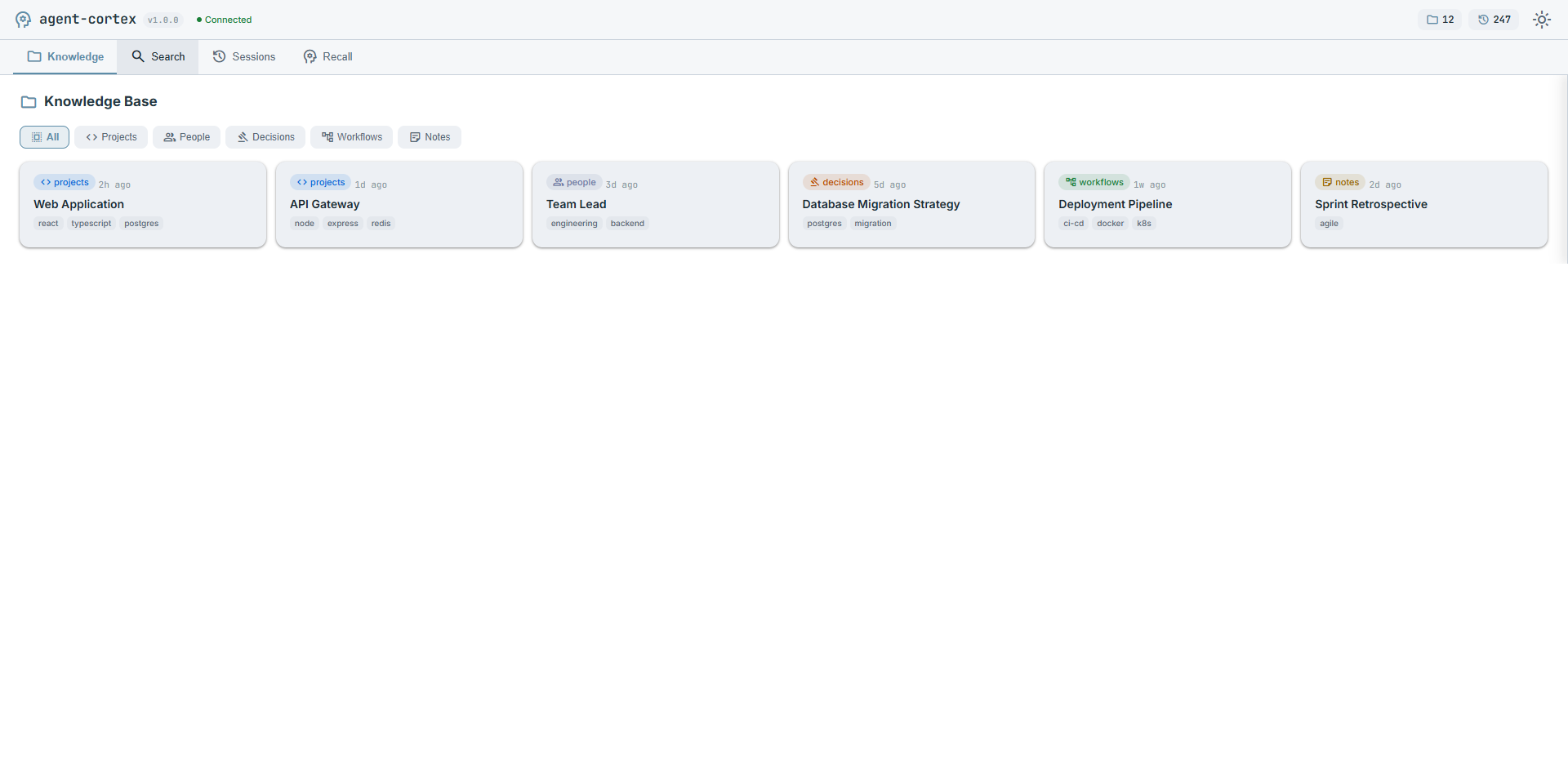 |
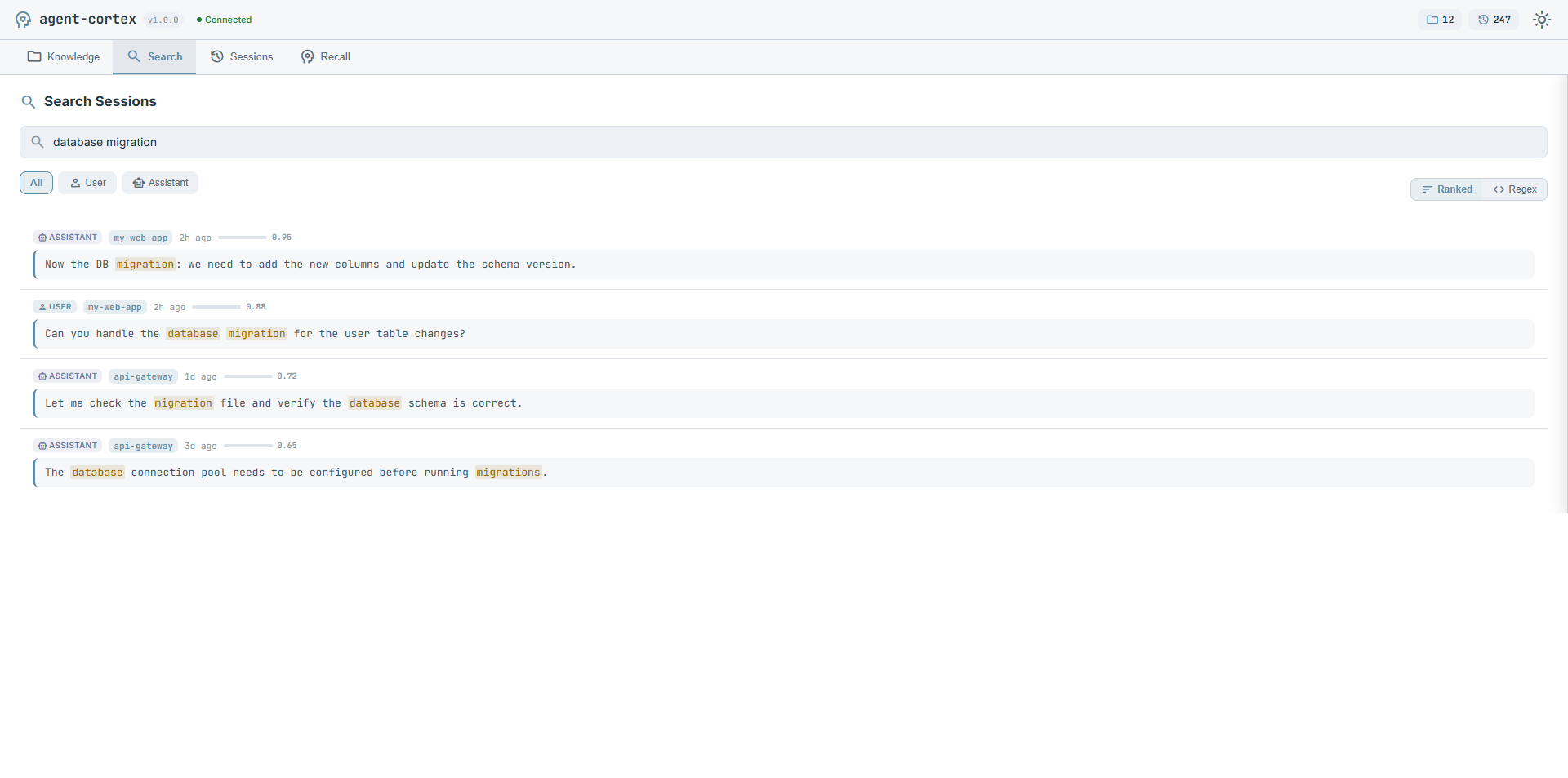 |
| Knowledge base with category filtering | TF-IDF ranked session search |
Why
AI coding sessions are ephemeral. When a session ends, everything it learned -- architecture decisions, debugging insights, project context -- is gone. The next session starts from scratch.
agent-knowledge solves this with two complementary systems:
- Knowledge Base -- a git-synced markdown vault of structured entries (decisions, workflows, project context) that persists across sessions and machines.
- Session Search -- TF-IDF ranked full-text search across session transcripts from all your coding tools, so agents can recall what happened before -- regardless of which tool was used.
Supported Tools
Sessions from all major AI coding assistants are auto-discovered -- if a tool is installed, its sessions appear automatically.
| Tool | Format | Auto-detected path |
|---|---|---|
| Claude Code | JSONL | $KNOWLEDGE_DATA_DIR/projects/ (default ~/.claude/projects/) |
| Cursor | JSONL | ~/.cursor/projects/*/agent-transcripts/ |
| OpenCode | SQLite | ~/.local/share/opencode/opencode.db (or $OPENCODE_DATA_DIR) |
| Cline | JSON | VS Code globalStorage saoudrizwan.claude-dev/tasks/ |
| Continue.dev | JSON | ~/.continue/sessions/ |
| Aider | Markdown/JSONL | .aider.chat.history.md / .aider.llm.history in project dirs |
No configuration needed. Additional session roots can be added via the EXTRA_SESSION_ROOTS env var (comma-separated paths).
Features
- Multi-tool session search -- unified search across Claude Code, Cursor, OpenCode, Cline, Continue.dev, and Aider sessions
- Hybrid search -- semantic vector similarity blended with TF-IDF keyword ranking
- Git-synced knowledge base -- markdown vault with YAML frontmatter, auto commit and push on writes
- Scored + gated promoter (v1.8) -- session insights promoted via a 6-signal weighted scorer with three independent gates (
minScore,minRecallCount,minUniqueQueries). Runs automatically in background, on demand viaknowledge_admin(action: "promote"), or benchable offline vianpm run bench:promote. Emits an auditable.dreams/YYYY-MM-DD.mddiary every run. Replaces the regex-only distiller. - Pluggable adapter system -- add support for new tools by implementing the
SessionAdapterinterface - Embeddings -- local (Hugging Face), OpenAI, Claude/Voyage, or Gemini providers
- Fuzzy matching -- typo-tolerant search using Levenshtein distance
- 6 search scopes -- errors, plans, configs, tools, files, decisions
- 6 MCP tools -- consolidated action-based interface (
knowledge,knowledge_search,knowledge_session,knowledge_graph,knowledge_analyze,knowledge_admin) - Wakeup context (L0+L1) --
knowledgeactionwakeupreturns a token-budgeted identity + top-weight entries blob for session-start hydration - Code graph resolution --
calls,imports,inheritsedge types for code structure; directed BFS traversal (outbound/inbound/both);bulk_linkfor efficient ingestion;unlink_by_originfor clearing stale code edges before re-ingest;code:prefixed node IDs distinguish code from knowledge - Temporal knowledge graph -- edges support
valid_from/valid_tovalidity windows;as_ofqueries return point-in-time snapshots;invalidateaction marks facts as ended without deleting them - Hybrid scoring boosts -- proper-noun and temporal-proximity boosts on top of TF-IDF + semantic blend, capped at +66.7%, short-circuit when no signals are present
- Category as boost (not filter) -- opt into
category_mode: "boost"so a wrong category guess down-ranks instead of discarding the right answer - Verbatim session indexing -- per-message chunks (≥30 chars) embedded into the vector store so raw conversation is retrievable; toggle with
KNOWLEDGE_INDEX_VERBATIM=false - Configurable git URL --
knowledge_admin(action: "config")for runtime setup, persisted at XDG/AppData location - Cross-machine persistence -- knowledge syncs via git, sessions read from local storage of each tool
- Real-time dashboard -- browse, search, and manage at
localhost:3423 - Secrets scrubbing -- API keys, tokens, passwords, private keys automatically redacted before git push
- Knowledge graph -- relationship edges between entries (related_to, supersedes, depends_on, contradicts, specializes, part_of, alternative_to, builds_on) with BFS traversal
- Confidence/decay scoring -- entries scored by access frequency and recency; auto-promotion from candidate to established to proven
- Memory consolidation -- TF-IDF duplicate detection on write (warns of similar entries) plus
knowledge_analyze(action: "consolidate")for batch dedup scanning - Reflection cycle --
knowledge_analyze(action: "reflect")surfaces unconnected entries and generates structured prompts for the agent to identify new graph connections - Auto-linking on write -- new entries automatically linked to top-3 similar existing entries when cosine similarity > 0.7
- Confidence metadata — entries tagged
extracted(user-written) orinferred(auto-distilled, 0.85× search rank multiplier);confidence_scorefield carries the model's certainty 0-1 - Knowledge analysis —
knowledge_analyzeactionsgod_nodes(most-connected entries),bridges(cross-category connectors),gaps(isolated entries) - Knowledge brief —
knowledge_analyze(action: "brief")returns a cached ~200 token summary (core concepts, active projects, recent decisions, stale and gap counts) for session-start orientation - Edge provenance — graph edges track
origin(manual, auto-link, distill, reflect) so analysis can distinguish user judgment from automated heuristics - Deterministic pre-extraction in distillation — session summaries now include git commits, error patterns, URLs accessed, and packages changed extracted via regex from bash/tool output (no LLM cost)
Codebase Ingestion
The knowledge-ingest skill populates or updates the knowledge base from a codebase directory. It uses tree-sitter for zero-token structural extraction (classes, functions, imports, call graphs, rationale comments), then clusters files into subsystems and creates knowledge entries + graph edges via existing MCP tools. Subsequent runs are incremental — only changed files are reprocessed.
/knowledge-ingest ./my-project
Uses the Agent Skills standard — works with Claude Code, OpenCode, Cursor, Codex CLI, and Gemini CLI. See Ingestion Guide for details.
Supported languages: TypeScript, JavaScript, Python, Go, Rust, Java, C, C++.
Quick Start
Install from npm
npm install -g agent-knowledge
Or clone from source
git clone https://github.com/keshrath/agent-knowledge.git
cd agent-knowledge
npm install && npm run build
Option 1: MCP server (for AI agents)
Add to your MCP client config (Claude Code, Cline, etc.):
{
  "mcpServers": {
    "agent-knowledge": {
      "command": "npx",
      "args": ["agent-knowledge"]
    }
  }
}
The dashboard auto-starts at http://localhost:3423 on the first MCP connection.
See Setup Guide for client-specific instructions (Claude Code, Cursor, Windsurf, OpenCode).
Option 2: Standalone server (for REST/WebSocket clients)
node dist/server.js --port 3423
MCP Tools (6)
Knowledge Base
| Tool | Action | Description | Parameters |
|---|---|---|---|
knowledge |
list |
List entries by category and/or tag | category?, tag? |
read |
Read a specific entry | path (required) |
|
write |
Create/update entry (auto git sync) | category, filename, content (all required) |
|
delete |
Delete an entry (auto git sync) | path (required) |
|
sync |
Manual git pull + push | -- | |
wakeup |
Return L0 identity + L1 top-weighted entries (token-budgeted) | token_budget?, category? |
Search
| Tool | Description | Parameters |
|---|---|---|
knowledge_search |
General hybrid TF-IDF + semantic (no scope) |
query, project?, role?, max_results?, ranked?, semantic?, category?, category_mode?, mmr?, mmr_lambda?, explain? |
Scoped session-only recall (when scope set) |
query, scope, project?, max_results? |
Response shape: {mode: "general" | "scoped", sessions, knowledge}. Scoped mode returns knowledge: [] by design.
Scopes: errors, plans, configs, tools, files, decisions, all.
v1.8 search knobs:
mmr: trueapplies Maximal Marginal Relevance re-ranking (kills near-duplicate clusters in top-K).mmr_lambda0-1, default 0.7.category_mode: "boost"(default) gives matching-category entries a 1.25× score multiplier instead of dropping non-matches. Pass"filter"for legacy hard-filter behavior.explain: trueattachesscore_components: {bm25, decay, maturity, confidence, category_boost, mmr_penalty}to every knowledge hit.
Sessions
| Tool | Action | Description | Parameters |
|---|---|---|---|
knowledge_session |
list |
List sessions with metadata | project? |
get |
Retrieve full session conversation | session_id, project?, include_tools?, tail? |
|
summary |
Session summary (topics, tools, files) | session_id, project? |
Knowledge Graph
| Tool | Action | Description | Parameters |
|---|---|---|---|
knowledge_graph |
link |
Create/update edge between entries | source, target, rel_type, strength? |
unlink |
Remove edges between entries | source, target, rel_type? |
|
invalidate |
Mark edges as expired (set valid_to) | source, target, rel_type?, valid_to? |
|
list |
List edges | entry?, rel_type?, as_of? |
|
traverse |
Directed BFS traversal from an entry | entry, depth?, direction?, rel_type?, as_of? |
|
bulk_link |
Batch-create edges (code graph ingestion) | edges (array of {source, target, rel_type, strength?, origin?}) |
|
unlink_by_origin |
Delete all edges by origin | origin |
Knowledge types: related_to, supersedes, depends_on, contradicts, specializes, part_of, alternative_to, builds_on
Code structure types: calls, imports, inherits
Traverse directions: outbound (source→target), inbound (target→source), both (default, undirected)
Analysis
| Tool | Action | Description | Parameters |
|---|---|---|---|
knowledge_analyze |
consolidate |
Find near-duplicate entries | category?, threshold? |
reflect |
Find unconnected entries for linking | category?, max_entries? |
|
god_nodes |
Most-connected entries (degree centrality) | top_n? |
|
bridges |
Cross-category connectors (betweenness) | top_n? |
|
gaps |
Isolated entries (0-1 edges) by maturity | max_entries? |
|
brief |
Cached ~200 token knowledge base summary | -- |
Admin
| Tool | Action | Description | Parameters |
|---|---|---|---|
knowledge_admin |
status |
Vector store statistics | -- |
config |
View or update configuration | git_url?, memory_dir?, auto_distill? |
|
rebuild_embeddings |
Re-embed all knowledge entries (useful on provider switch) | -- | |
prune_orphans |
Delete embeddings for sessions no longer on disk | vacuum?, force_vacuum? |
|
vacuum |
Reclaim free pages in the vector store | -- | |
promote |
Scored + gated promoter (v1.8) | promote_mode? (apply|explain), min_score?, min_recall_count?, min_unique_queries? |
Scored promoter (v1.8)
Session insights no longer drop into the knowledge base via regex distillation. Instead, every project-level candidate is scored on six signals (relevance 0.30, frequency 0.24, query-diversity 0.15, recency 0.15, consolidation 0.10, conceptual-richness 0.06) and gated on minScore ≥ 0.5, minRecallCount ≥ 2, minUniqueQueries ≥ 2. All three gates must pass. Background auto-promotion is controlled by the same auto_distill config flag; invoke on demand with knowledge_admin(action: "promote").
promote_mode: "explain"(default) — score + gate candidates, write diary, DO NOT touch the KB.promote_mode: "apply"— promote candidates that pass, write diary, git-commit.- Every run drops
~/agent-knowledge/.dreams/YYYY-MM-DD.mdwith per-candidate signal breakdowns and gate outcomes. The.-prefixed dir is git-tracked but excluded from list/search. - Grounded rehydration: a candidate is skipped if its source session file no longer exists on disk (prevents promoting deleted content).
- Entries with
evergreen: truefrontmatter are never overwritten by promotion — activity is appended.
Write-bench harness: npm run bench:promote — offline replay with auto-labeling by "referenced in later sessions". Compares gated promoter to a naive "ship all" baseline, reports precision / recall / F1. Use it to gate signal-weight or threshold changes before rolling them out.
REST API
| Method | Endpoint | Description |
|---|---|---|
| GET | /api/knowledge |
List knowledge entries |
| GET | /api/knowledge/search?q= |
Search knowledge base |
| GET | /api/knowledge/:path |
Read a specific entry |
| GET | /api/knowledge/god-nodes?top_n= |
Most-connected entries |
| GET | /api/knowledge/bridges?top_n= |
Cross-category connectors |
| GET | /api/knowledge/gaps?max_entries= |
Isolated entries |
| GET | /api/knowledge/brief |
Knowledge base brief |
| GET | /api/sessions |
List sessions |
| GET | /api/sessions/search?q=&role=&ranked= |
Search sessions (TF-IDF) |
| GET | /api/sessions/recall?scope=&q= |
Scoped recall |
| GET | /api/sessions/:id |
Read a session |
| GET | /api/sessions/:id/summary |
Session summary |
| POST | /api/knowledge |
Write entry (HTTP clients) |
| GET | /health |
Health check |
Architecture
graph LR
    subgraph Storage
        KB[(Knowledge Base<br/>~/agent-knowledge<br/>Git Repository)]
    end

    subgraph Session Sources
        CC[(Claude Code<br/>JSONL)]
        CU[(Cursor<br/>JSONL)]
        OC[(OpenCode<br/>SQLite)]
        CL[(Cline<br/>JSON)]
        CD[(Continue.dev<br/>JSON)]
        AI[(Aider<br/>MD / JSONL)]
    end

    subgraph agent-knowledge
        KM[Knowledge Module<br/>store / search / git]
        AD[Session Adapters<br/>auto-discovery]
        SE[Search Engine<br/>TF-IDF + Fuzzy]
        DS[Dashboard<br/>:3423]
        MCP[MCP Server<br/>stdio]
    end

    subgraph Clients
        AG[Agent Sessions]
        WB[Web Browser]
    end

    KB <-->|git pull/push| KM
    CC --> AD
    CU --> AD
    OC --> AD
    CL --> AD
    CD --> AD
    AI --> AD
    AD --> SE
    KM --> MCP
    SE --> MCP
    KM --> DS
    SE --> DS
    MCP --> AG
    DS --> WB
Knowledge Graph
Entries and code symbols can be connected via typed, weighted edges stored in a dedicated edges SQLite table. Eleven relationship types are supported — 8 for knowledge edges and 3 for code structure:
Knowledge: related_to, supersedes, depends_on, contradicts, specializes, part_of, alternative_to, builds_on
Code structure: calls, imports, inherits
knowledge_graph(action: "link")creates or updates an edge (with optional strength 0-1)knowledge_graph(action: "unlink")removes edges (optionally filtered by type)knowledge_graph(action: "list")lists edges for an entry or relationship typeknowledge_graph(action: "traverse")performs directed BFS traversal from a starting entry. Supportsdirection(outbound,inbound,both) andrel_typefilterknowledge_graph(action: "bulk_link")batch-creates edges in a single transaction (for code graph ingestion)knowledge_graph(action: "unlink_by_origin")deletes all edges with a specific origin (for clearing stale code edges before re-ingest)
Code Graph
Code structure edges are created by the knowledge-ingest skill during codebase ingestion. They use code: prefixed node IDs:
code:src/auth/middleware.ts                    # file node
code:src/auth/middleware.ts::validateToken      # symbol node
Query examples:
# Who calls validateToken?
knowledge_graph({ action: "traverse", entry: "code:src/auth.ts::validateToken", direction: "inbound", rel_type: "calls", depth: 3 })

# What breaks if I change this function?
knowledge_graph({ action: "traverse", entry: "code:src/auth.ts::validateToken", direction: "inbound", rel_type: "calls", depth: 5 })

# Combined: callers + knowledge context (decisions, design rationale)
knowledge_graph({ action: "traverse", entry: "code:src/auth.ts::validateToken", depth: 2 })
Auto-linking
When knowledge with action: "write" creates or updates an entry, it automatically finds the top-3 most similar existing entries via cosine similarity and creates related_to edges for any pair scoring above 0.7.
Confidence & Decay Scoring
Each knowledge entry has a confidence score tracked in the entry_scores SQLite table. Search results are ranked using:
finalScore = baseRelevance * 0.5^(daysSinceLastAccess / 90) * maturityMultiplier
Entries mature automatically based on access count:
| Stage | Accesses | Multiplier |
|---|---|---|
candidate |
< 5 | 0.5x |
established |
5-19 | 1.0x |
proven |
20+ | 1.5x |
Frequently accessed entries rise in search rankings; stale entries decay over time.
Search Capabilities
TF-IDF Ranking -- results scored by term frequency-inverse document frequency. Rare terms boost relevance. Global index cached for 60 seconds.
Fuzzy Matching -- Levenshtein edit distance with sliding window. Configurable threshold (default 0.7).
Scoped Recall via knowledge_search with the scope parameter:
| Scope | Matches |
|---|---|
errors |
Stack traces, exceptions, failed commands |
plans |
Architecture, TODOs, implementation steps |
configs |
Settings, env vars, configuration files |
tools |
MCP tool calls, CLI commands |
files |
File paths, modifications |
decisions |
Trade-offs, rationale, choices |
Integrations
REST Write Endpoint
POST /api/knowledge accepts { category, filename, content } and runs the full write pipeline: git pull → file write → embedding index → auto-link → git push → duplicate check. Returns { path, autoLinks?, duplicateWarnings?, git } with status 201.
This enables HTTP-based writes from other services without an MCP connection.
agent-tasks KnowledgeBridge
agent-tasks has a built-in KnowledgeBridge that auto-pushes learning and decision artifacts to agent-knowledge on task completion. Entries land in decisions/ with frontmatter tags (agent-tasks, project name, artifact type), are auto-indexed with embeddings, and auto-linked to similar entries. No configuration needed — if agent-knowledge is running at localhost:3423, it works.
Testing
npm test              # 352 tests across 20 files
npm run test:watch    # Watch mode
npm run lint          # Type-check (tsc --noEmit)
Environment Variables
| Variable | Default | Description |
|---|---|---|
KNOWLEDGE_MEMORY_DIR |
~/agent-knowledge |
Path to git-synced knowledge base |
KNOWLEDGE_GIT_URL |
-- | Git remote URL (auto-clones if dir missing) |
KNOWLEDGE_AUTO_DISTILL |
true |
Auto-distill session insights to knowledge base |
KNOWLEDGE_EMBEDDING_PROVIDER |
local |
Embedding provider: local, openai, claude, gemini |
KNOWLEDGE_EMBEDDING_ALPHA |
0.3 |
TF-IDF vs semantic blend weight (0=pure semantic, 1=pure TF-IDF) |
KNOWLEDGE_EMBEDDING_IDLE_TIMEOUT |
60 |
Seconds before unloading local model from memory (0 = keep alive) |
KNOWLEDGE_DATA_DIR |
~/.claude |
Primary session data directory (Claude Code JSONL files) |
EXTRA_SESSION_ROOTS |
-- | Additional session directories, comma-separated paths |
OPENCODE_DATA_DIR |
(see below) | Override OpenCode data directory (default: ~/.local/share/opencode) |
KNOWLEDGE_ANTHROPIC_API_KEY / ANTHROPIC_API_KEY |
-- | API key for Claude/Voyage embeddings |
KNOWLEDGE_PORT |
3423 |
Dashboard HTTP port |
Documentation
- Setup Guide — installation, client setup (Claude Code, OpenCode, Cursor, Windsurf), hooks, skills
- Ingestion Guide — codebase ingestion skill, tree-sitter extraction, incremental updates
- Architecture — source structure, design principles, database schema
- Dashboard — web UI views and features
- Changelog
License
Reviews (0)
Sign in to leave a review.
Leave a reviewNo results found