factory
Health Pass
- License — License: MIT
- Description — Repository has a description
- Active repo — Last push 0 days ago
- Community trust — 119 GitHub stars
Code Pass
- Code scan — Scanned 12 files during light audit, no dangerous patterns found
Permissions Pass
- Permissions — No dangerous permissions requested
No AI report is available for this listing yet.
A live isometric world in the browser: a seaside town, a new city, a farming village and a Starship launch site, all simulated in real time. Built with Claude Opus 5.5, three.js, TypeScript and Next.js.
Factory Yard
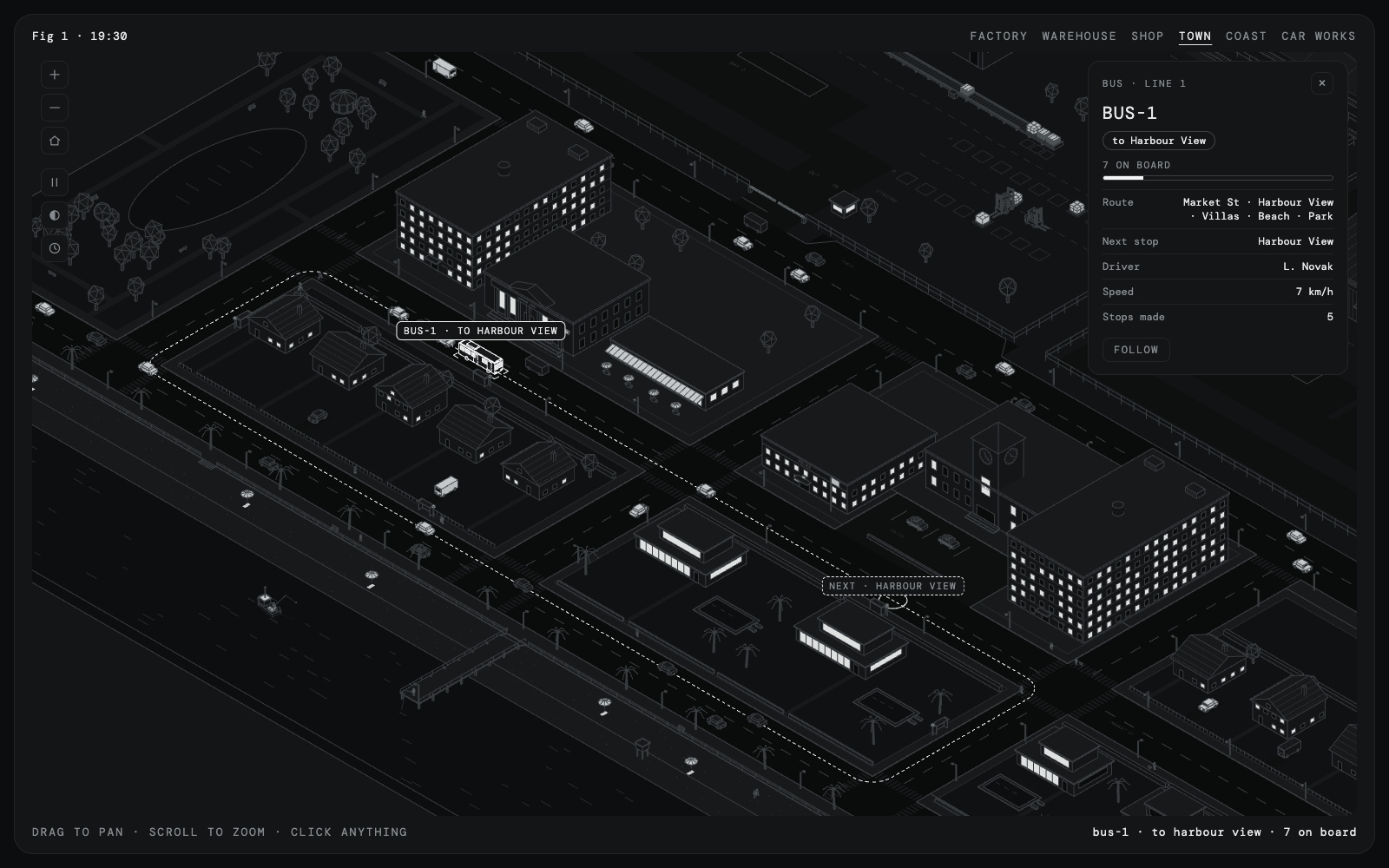
A live isometric town drawn with WebGL in the hairline style of ai-iso-skill.
Goods go from a factory to a warehouse along the main road of a small seaside town, and on to a shop by the sea. East of
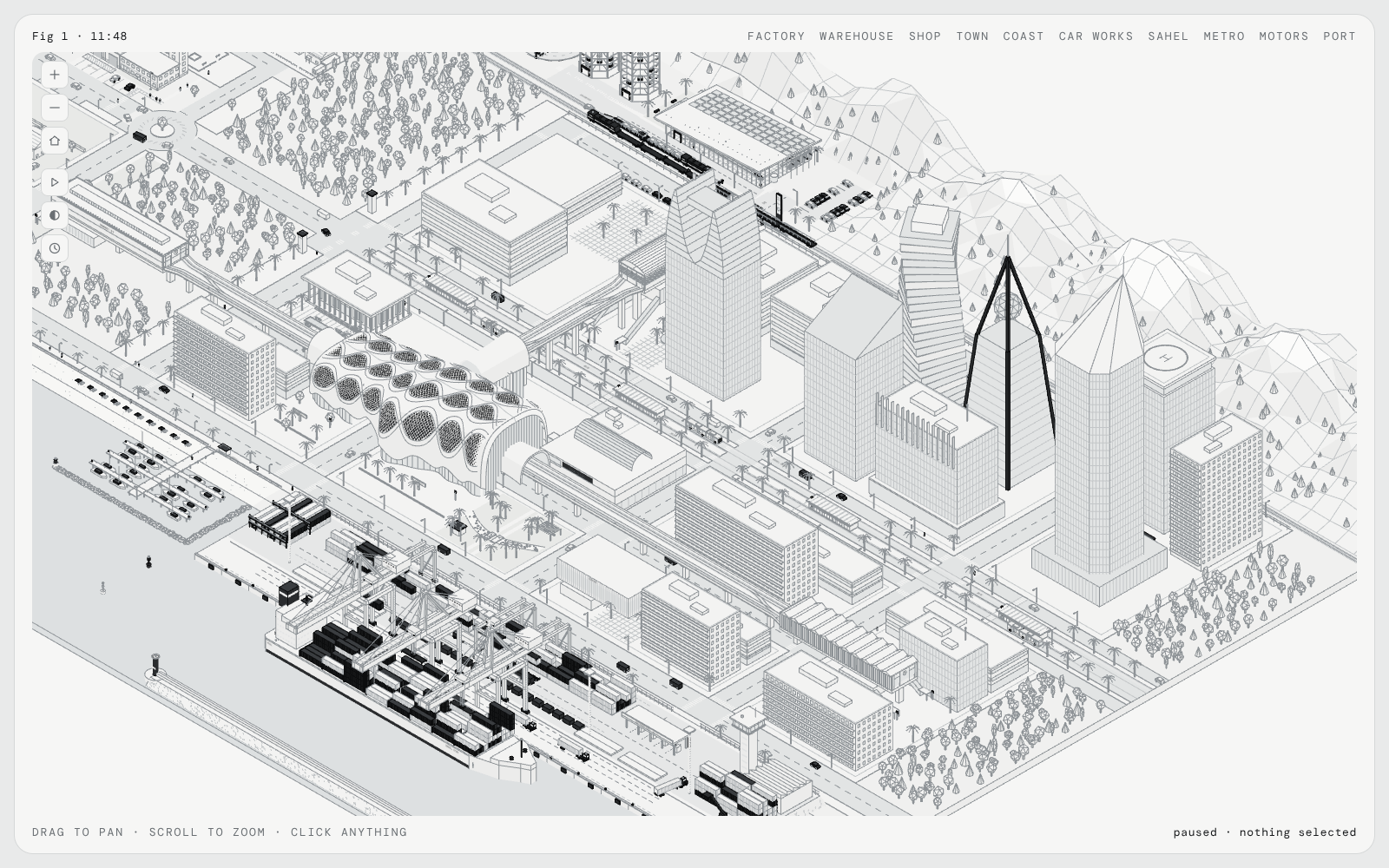
the town, past a green belt of woods, lies Sahel, a new city of towers, with a metro, a Metrobus, a car showroom and a
container port. Beyond Sahel the land rises into mountains, and the metro runs out through them to Millbrook, a valley
of farms. An observatory stands on Beacon Hill, and on a spit out over the sea below the valley, Starships are built and
launched:
- Behind both towns are hills; in front of them, the sea. Woods ring them round.
- A day passes in six minutes. Windows, street lamps, headlights and the lighthouse come on at dusk.
- There is no dashboard. Click anything and a card shows its live details; click a vehicle and its route appears.
Open it
It's a Next.js app that builds to a static site. You need Node 20 or later.
npm install
npm run dev
Then go to http://localhost:3000.
To build the site, run npm run build. It writes plain HTML and JS to out/, so you can host it anywhere. To try the built copy locally, run npm run preview.
How the code is laid out
| Folder | What's in it |
|---|---|
app/ |
The page, the layout (which self-hosts DM Mono) and globals.css with the colour tokens |
components/YardFigure.tsx |
The plate around the map: caption, buttons, tags and the card. It loads the engine in the browser. |
yard/kernel/ |
The iso projection, Part (boxes, faces, hairlines, text), Path, the corridor graph and the seeded random numbers |
yard/theme.ts |
Tokens → materials, and the day/night blend |
yard/models/, yard/world/ |
Vehicles, people, boats, and the static town |
yard/land.ts |
The east country's land: the hills, the gorge and the moor, and the corridors cut through them for the line and the roads |
yard/sim/ |
The simulation: clock, traffic, trucks, forklifts, people, homes, the shop and its courier, the police and the robbers, the fire station, the pier, fishing, weather, Car Works and the train; Sahel's traffic and people, the metro, the Metrobus, Sahel Motors, the port and the container truck; the east country, Millbrook, the observatory and Starbase |
yard/view.ts |
Camera, selection, card, routes, peeking into buildings, the frame loop, keys |
yard/index.ts |
Builds everything in a fixed order and starts the view |
The engine runs once per page load. React draws the plate, and the engine drives it from then on.
The places
| Place | What's there |
|---|---|
| Factory | Plant 01, its conveyor, staging, two loading bays, a truck park for flatbeds waiting for a free bay, and the rail loading platform |
| Warehouse | Warehouse 01: two rows of racks three levels high, shelving with a packing bench and pickers, a loading lane, two docks, and a sliding gate with its guard |
| Shop | Corner Market on the seafront, where Hill Av meets Coast Rd: its delivery lay-by, a zebra crossing, and parking bays across the road on the promenade |
| Town | Flats, Harbour Bank, Café Mira, the police station, Town Hall (whose clock tells the simulated time), houses with gardens and villas with pools. Orchard Lane, a new street of six houses, runs off the roundabout. Riverside Fire Station stands on Riverside Rd with ENG-1 in its bay. Mill Park lies on the west side. |
| Car Works | A car factory on a terrace cut into the hills behind the warehouse, its lot of finished cars in front. Inside, one line runs through a press shop, a body shop of welding robots, a paint shop, assembly and the end-of-line tests. |
| Railway | One track along the foot of the hills, out of a tunnel under Harrow Ridge, with a loop through the Plant 01 yard and its loading platform |
| Coast | Coast Rd, the promenade, the beach, the town pier, Sunset Pier with its rides, and a breakwater with a lighthouse. A sailboat, a motorboat and the fishing boat Kestrel are out at sea. |
| Woods | A strip of woods west of the old town, a green belt between the two towns with footpaths through it, and another strip east of Sahel; pines up the hills |
| Sahel | The new city: four avenues (Gate, Najd, Tower and Port Av), North St, Sahel Blvd with a busway down its middle, Souq St and the Corniche. Skyscrapers in the Financial District (Sahel Tower, Sahel Arch, the Globe and more), City Hall behind its colonnade, Souq Sahel mall, the library, flats and hotels, Wadi Park, and Sahel Marina with its yachts. |
| Sahel Metro | Two lines on viaducts, after Riyadh's: Line 1 from Market St in the old town through Sahel Central and Port and on out to Millbrook, Line 2 from Motor District down to Sahel Central. Sahel Central, after the King Abdullah Financial District station, is a long row of white lobes woven with ribbons and eyes of lattice that glow at night. |
| Sahel Motors | Car Works' showroom on a terrace at the foot of the hills: twin glass car towers, a glass hall with cars on show, a test track, and a level crossing over the main line down to Najd Av |
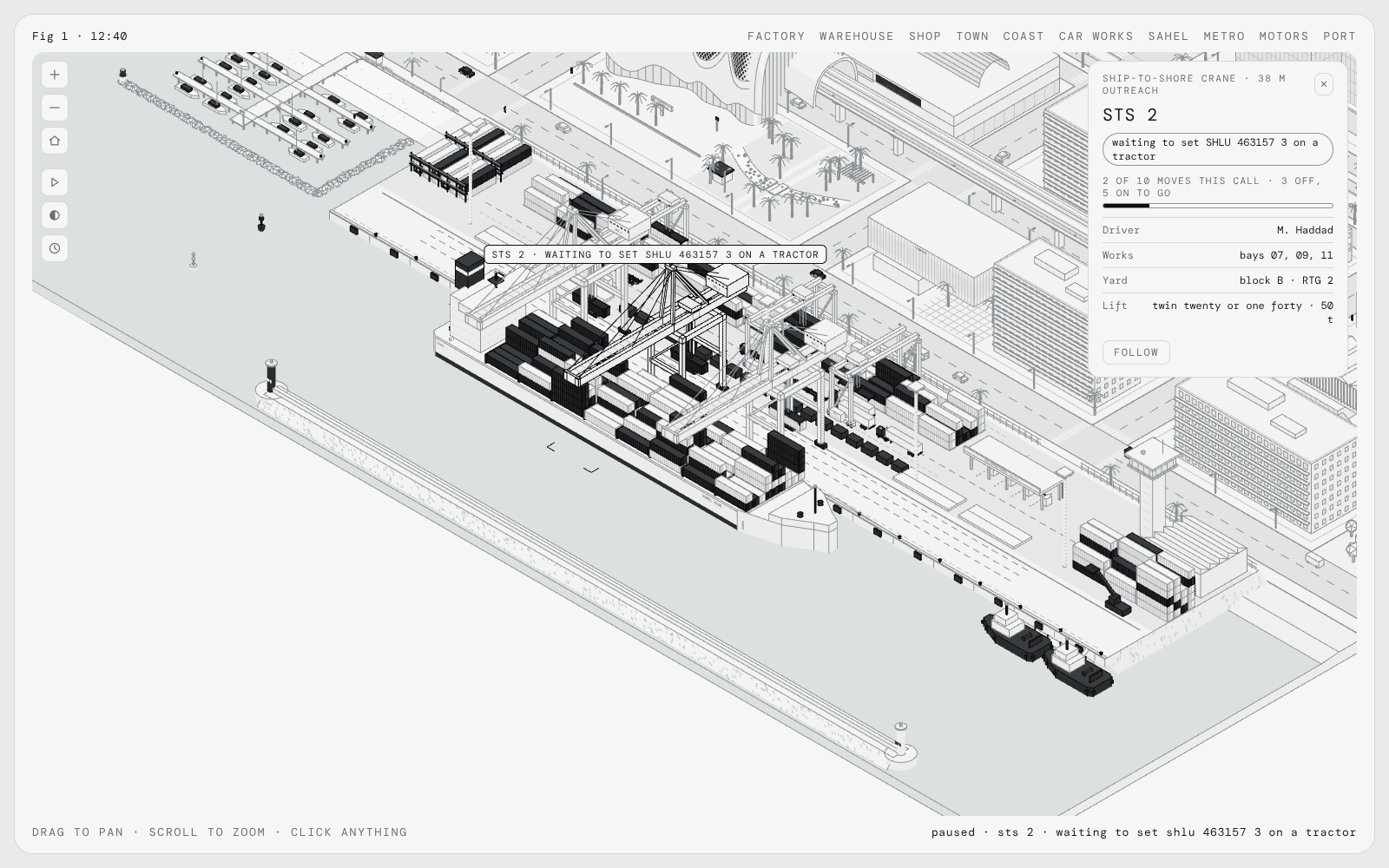
| Port | Sahel Container Terminal, east of the marina: a quay with three ship-to-shore cranes, a yard of stacked boxes with three gantry cranes, a gate, a control tower, reefer racks, and a breakwater with a light at each end |
| East | The country beyond Sahel. Harrow Ridge, which the Vale Road climbs in hairpins; Raven Gorge, with the Raven Beck and alders and willows on its floor, crossed by Line 1 on a concrete arch and by the road on a suspension bridge; the plateau of High Moor with Beacon Hill standing on it; Long Edge; and Millbrook Vale, the valley at the end of the line. Snow on the high peaks behind. |
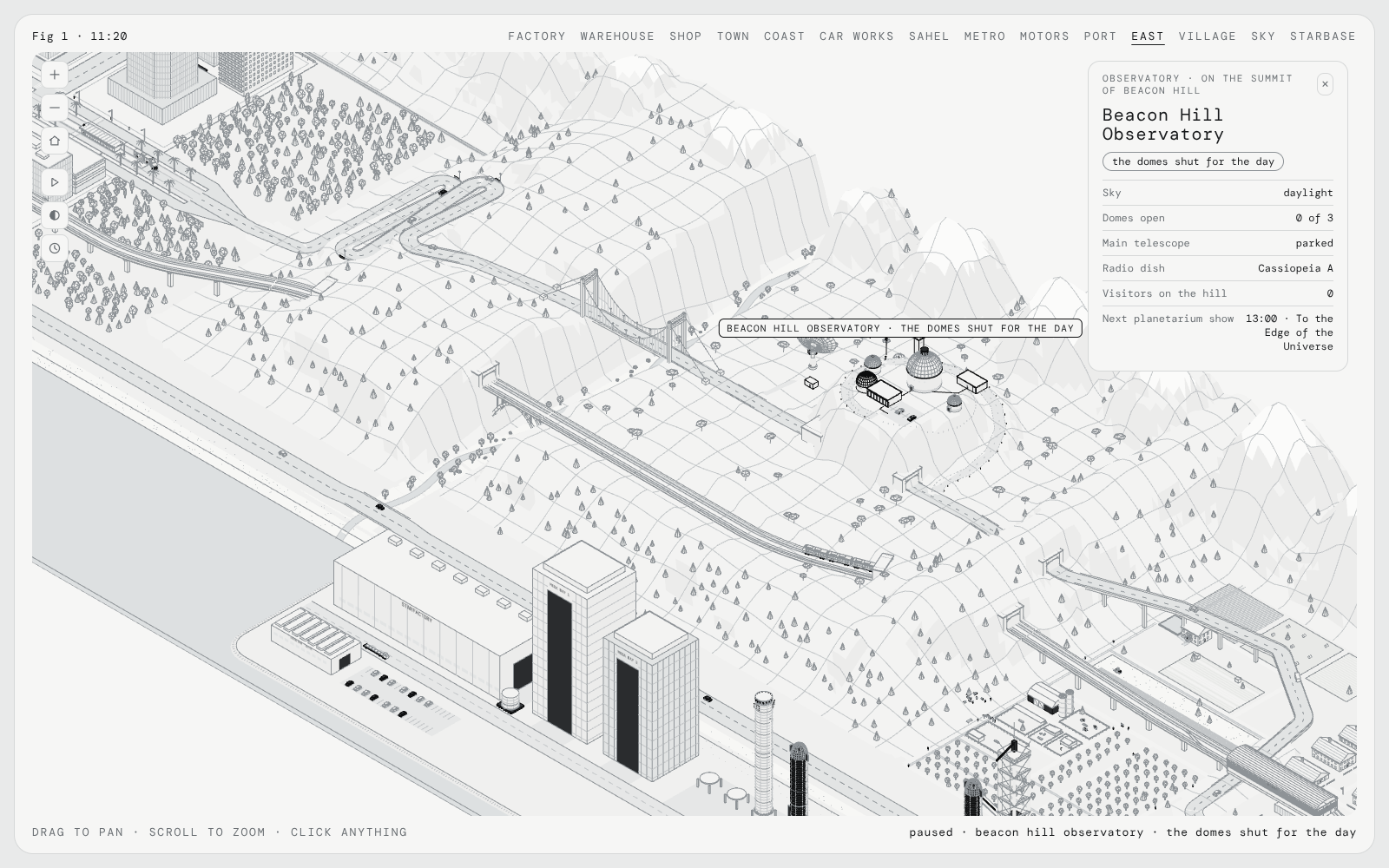
| Sky | Beacon Hill Observatory, on the levelled top of Beacon Hill above High Moor. Observatory Road winds up round the hill from the Vale Road. On top: the Beacon Telescope in its big dome, a public dome and a survey camera's dome, a solar tower, the visitor centre with its planetarium, the astronomers' residence, a weather mast and an all-sky camera. The Moor Dish, a radio telescope, stands on the moor below. |
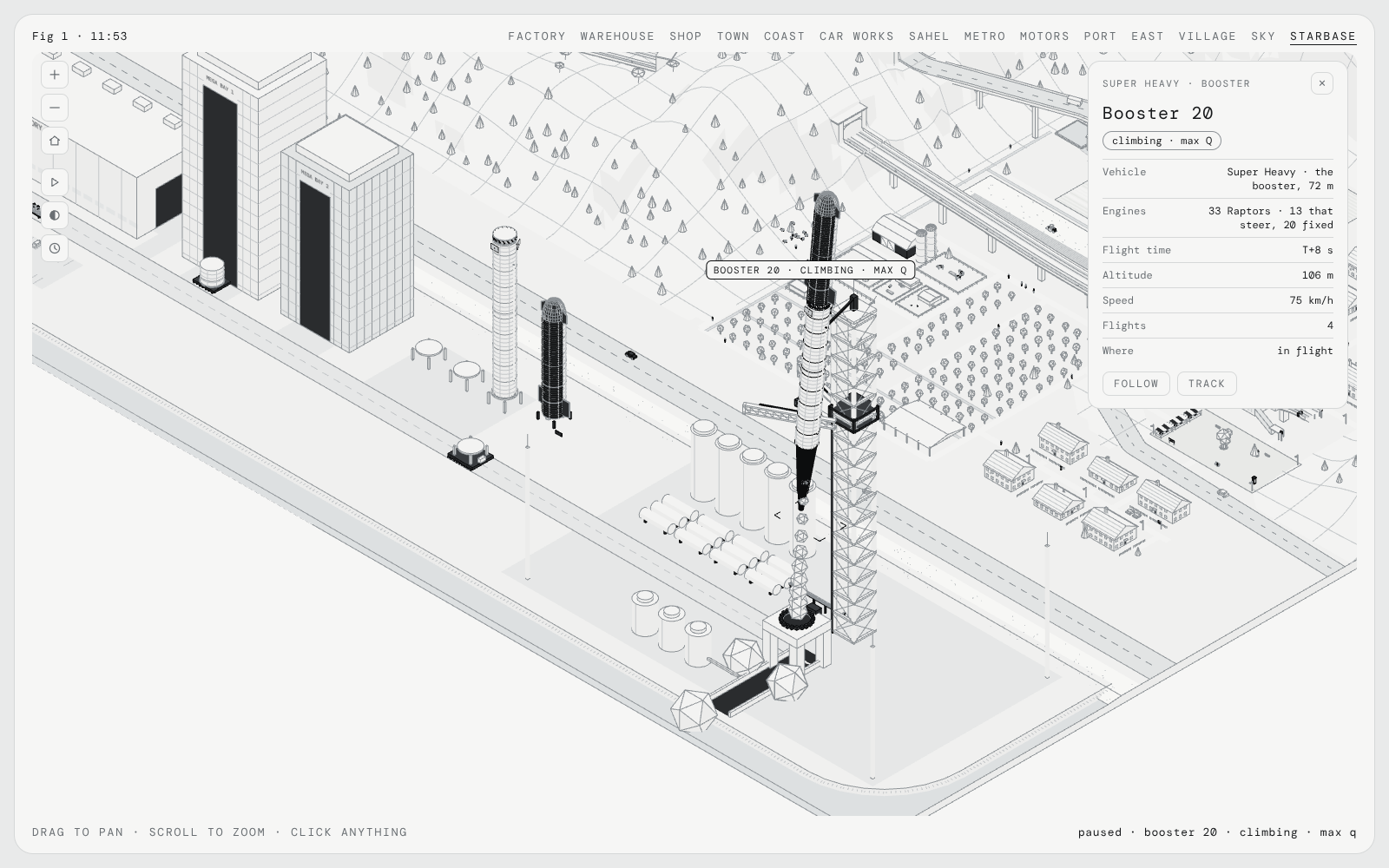
| Starbase | Gull Spit Starbase, a Starship factory and launch site on land made out over the sea below Millbrook. At its west end the Starfactory, the Engine Shop, and the two Mega Bays (the second glass-walled) where boosters and ships are stacked; along the road the Rocket Garden, then the tank farm, and at the tip the launch tower with its chopsticks, the launch mount over its flame trench, and the deluge tanks. |
| Village | Millbrook, an English farming village round Line 1's terminus. Cottages with front gardens behind picket fences, a green with an old oak, a pump and a farmers' market, the Plough Inn and Millbrook Stores. Across the road, the farm: wheat, a hay meadow with its bales and a windpump, allotments, the long field, the millpond and its watermill, a red barn with two silos, pens for the sheep, cows, pigs, hens and horses, and an apple orchard with its store. |
What moves
Plant 01: a pallet leaves the factory on Line A every 26 s. Forklifts FL-01 to FL-03 load the train while it stands at the platform, then the flatbed waiting at a bay, and otherwise clear the belt into staging.
Flatbeds (TRK-2051 to TRK-2053): the three trucks share two bays and two docks.
- A loaded truck waits at its bay until a dock is free, then crosses the road.
- It goes round the roundabout, and the guard opens the warehouse gate.
- On the way back it waits in the truck park until a bay is free.
Warehouse 01: forklifts FL-04 to FL-06 unload the flatbeds into the racks, lifting to the top level with a telescoping mast. They load the box trucks from the rear in the loading lane. Two pickers carry parts from the shelving to the packing bench.
Box trucks (DLV-01 to DLV-03): they carry four pallets down Hill Av to the shop, open their rear doors in the lay-by, and staff carry the boxes in. They go back along Coast Rd and up Harbour Av, and cross Riverside Rd straight into the warehouse gate.
Shoppers: they walk in down Hill Av or along the promenade, or drive in, park in the bays on the seafront and cross at the zebra. They take boxes off the shelves, pay and leave.
Online orders (PKG-1): now and then a home orders from Corner Market.
- A shop assistant picks the boxes, packs the parcel and carries it over the zebra to the parcel van.
- PKG-1 drives to the house by the shortest way and pulls in at the kerb, and the courier walks it to the door.
- The home's card shows the order with an arrival time and a Track parcel button. The camera then follows the van, and its card shows the order's timeline.
Traffic:
- Cars pass through on Riverside Rd and Coast Rd.
- Town cars loop round the blocks and give way where they join a busier street.
- The bus (BUS-1) runs Line 1 round the southern blocks. It stops at five shelters, where people get off and queue to board.
People:
- They walk the pavements from home to home, to the beach, the park, the café, the bank, the piers or the fair. They wait at the kerb for a gap, and traffic stops for anyone on the road.
- Each has an outfit that suits who they are, from shoppers and staff to police, firefighters and line workers. Arms swing as they walk, and they sit at café tables and on benches. Some jog, and some walk a dog.
- There are fewer people out at night, and fewer shoppers.
Homes: every house and villa can be looked inside. Its rooms are furnished, and whoever is home is on the sofa, at the table or in bed, depending on the hour. Delivered parcels wait inside the door.
Robberies:
- Now and then a crew of two to four drives into town in a dark car. They rob Harbour Bank (walking in by day, forcing the door by night), hold up Corner Market while it is open, or break into a refrigerated container at the terminal in Sahel by night. The driver waits at the kerb with the engine running.
- When the alarm goes off, staff and customers get out of the bank. At the shop, the staff at the till put their hands up and shoppers run out. All three police cars come with their lights flashing, two officers in each, and POL-AIR, the police helicopter, lifts off the station roof and circles overhead. By night its searchlight follows the action.
- Each robbery ends one of four ways:
- The police surround the place, and after a stand-off the crew come out one by one with their hands up.
- It turns into a shootout: the crew fire from inside and the officers fire back from behind their cars. Nobody dies, but anyone hit goes down and is arrested where he fell, and the rest give up.
- The crew run for the car as the sirens come, and it races off through the traffic with the police behind it and the helicopter above. It may run into a roadblock, be abandoned while the crew scatter on foot and are chased down, or get clean away.
- The driver loses his nerve and leaves without them, and the crew try to escape on foot.
- While it lasts, the bank or the shop stands open so you can see inside. Click the place, a suspect, the getaway car, an officer or POL-AIR for their cards. The police station's card keeps the last few calls.
Freight by box: CTR-01, a container truck, runs a triangle. At a Plant 01 bay the forklifts load five pallets into its forty-foot box. It drives out along Riverside Rd, through Sahel and down Port Av, up the ramp and through the terminal's gate. Inside it joins the tractors' circuit, and the gantry over block C lifts its box into the stack, to go out on a ship, and sets an import box on. Back along the coast, it unloads five pallets of imported goods into Warehouse 01's racks, then takes the empty box back to the plant. Its card shows the box, what is in it and the pallets exported and imported so far; the box has a card of its own.
Sunset Pier: a pleasure pier with a Ferris wheel, a carousel and a small coaster. Visitors queue, ride and wander. The rides open 10:00–23:00 and close in the rain.
Fishing: Kestrel leaves the town pier in the morning, fishes on the bay and lands her catch, which shows on her card. An angler fishes from the end of the town pier.
Weather: showers come through the day, and some mornings there is sea fog. People put up umbrellas and leave the beach, the park and the piers, the boats come in, and the caption says so.
Car Works:
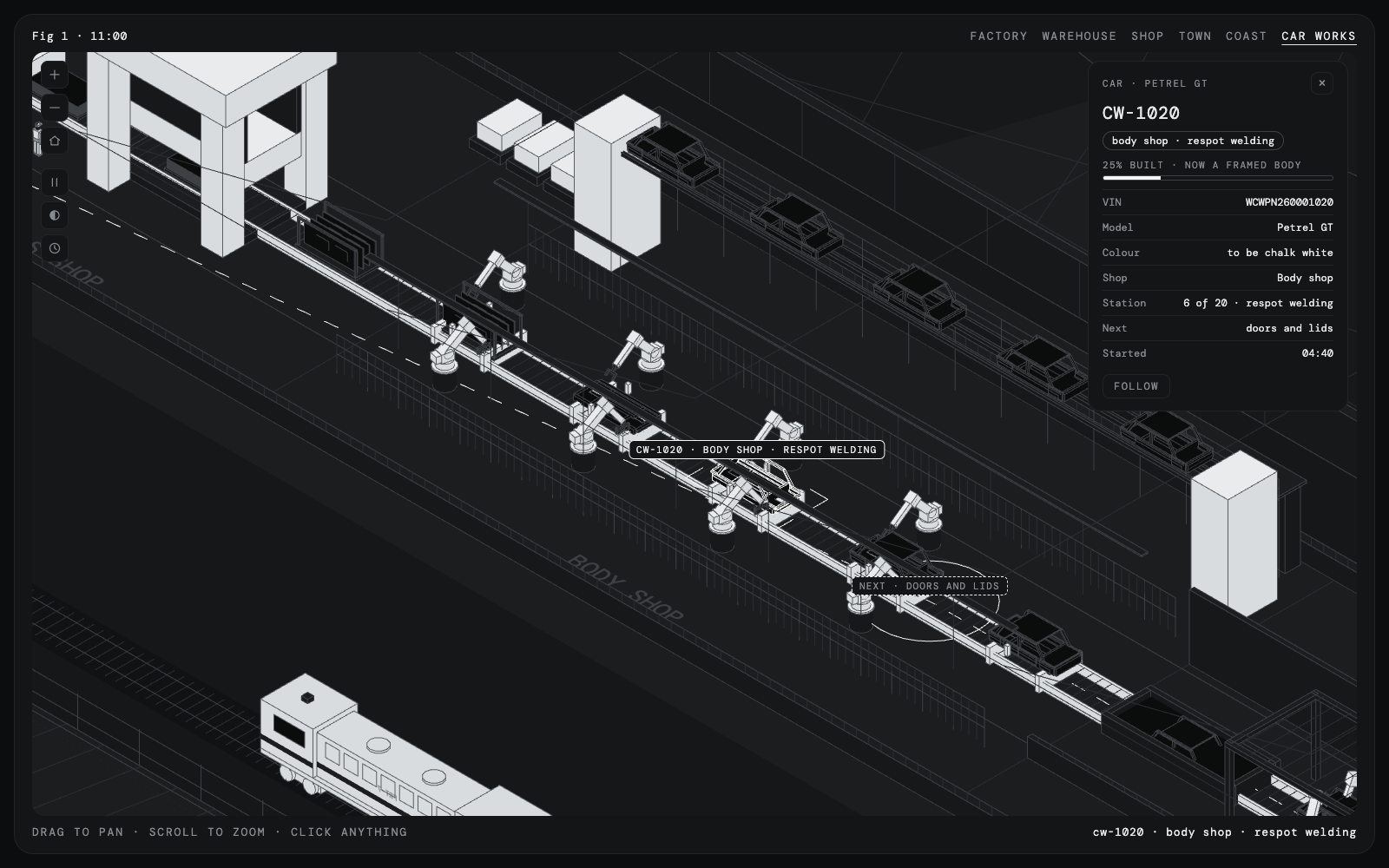
- Every 18 s the line moves on one station. Steel blanks come off the coils and are pressed into panels. Robots weld the underbody, frame the sides, respot the shell and hang the doors.
- The body is dipped and painted chalk white or slate. In assembly it rides a hanger, the powertrain rises into it, and robots fit the wheels and glass.
- At the end of the line come the fluids, a lights test, a rolling road and the light tunnel. Then the car drives out to the lot.
- Round the line the hall works like a real plant. Three tandem presses stroke one after another, and an overhead crane carries a die across the press shop, past dies in store, coils on their saddles and racks of stamped panels. The body shop has a framing gate, sub-assembly cells whose turntables turn as the line moves, a robot controller behind every welding cell, fume hoods, two sealing robots and a lamp arch before paint. Paint has its air plenum, a drum store and the paint kitchen. Assembly has tool balancers over both sides, an engine dress area with a jib crane, a seat-lift arm, a parts supermarket with a tugger train running round, and an andon board that lights as the stations work. At the end are a water test booth and a quality audit bay. High-bay lamps light it all after dark, and fifteen people work the shift.
- Click any car on the line to see its VIN, model, colour, station and how far built it is, with the rest of its way dashed. The factory's card has a Follow a new car button, which follows one from the press shop all the way to the lot.
- A full lot stops the line until the train takes cars away.
The freight train (FRT-7):
- Every few minutes it comes in from the east: a locomotive, four flat wagons and three car carriers.
- At Car Works it stops alongside the lot, and a ramp is lowered behind it. Up to twelve finished cars back out of their spaces, drive round and up onto the carriers.
- It runs on into the loop in the Plant 01 yard, where the forklifts load pallets onto the flat wagons. Then it leaves to the west.
Chimney fires:
- Every so often a chimney catches. Smoke and flames rise from the stack, and whoever is home comes out onto the pavement.
- A neighbour calls it in. The bell goes at Riverside Fire Station, the bay door rolls up, the watch runs to ENG-1, and it drives out with its lights flashing.
- At the kerb the officer takes the gate and the driver the pump, while two firefighters run a hose up the garden path and put a jet on the chimney until it is out.
- They make up the hose, the household goes back in, and ENG-1 drives home and backs into its bay while the traffic waits.
- The house's card shows the fire and has a Track ENG-1 button. The station's card shows the watch and the last call.
Sahel's streets: cars come through from the old town along Riverside Rd and down Sahel Blvd, and loop round the city's blocks. People walk between the towers, the flats, the mall, the park, the beach and the marina, and to City Hall in office hours.
Sahel Metro:
- Driverless four-car trains run both lines, stop behind platform screen doors, and turn back at the ends over crossovers.
- People ride up the escalators, through the gates, wait on the island and board, and change lines at Sahel Central. Follow one and the camera goes with them onto the train.
- Zoom in close over a station, or click it, and it opens: the concourse, the gates, the islands, the escalators and the trains.
The Metrobus (Line M1): four articulated buses run the busway down Sahel Blvd between glass stations on the median, waiting for anyone on a crossing.
Sahel Motors:
- CS-1, a car shuttle, takes finished cars from Car Works' lot (it and FRT-7 take turns there), runs them along its siding, and stands while a ramp rises behind it. The cars back off and drive to the twin towers, where a lift carries each up to a bay. Click a car in a tower for its bay and its price.
- People come up from the metro, look at the cars on show, take one round the test track, and sit down with a consultant. Some buy: their car comes down its tower and round to the handover bay, and they drive it away over the level crossing, whose barriers come down for FRT-7, and off to the old town.
The port:
- A ship comes in from the west past the old town's pier, and two tugs push her alongside. The cranes lower their booms and take boxes off onto terminal tractors, which run them round to the yard, where the gantries stack them. Then the other way: boxes out of the yard and onto the ship.
- When she is done the booms go up, the tugs pull her off and she sails on east. Every crane, gantry, tractor, tug and box has a card.
Out east:
- Line 1's trains run on from Port over the woods, into Harrow Ridge, out of its cliff onto the arch over Raven Gorge, across High Moor in a cutting, through Long Edge and down a viaduct to Millbrook, where they turn back. They go faster on the open line.
- Through traffic from the old town takes the Vale Road: up the hairpins, over the suspension bridge, through the tunnel, round the curving viaduct into the valley and on east. Coast Rd runs on along the shore, over a low bridge at the gorge's mouth.
- FRT-7 comes out of its tunnel under Harrow Ridge.
Millbrook:
- Farm hands come out of the barn at first light to hoe the vegetables, weed the allotments, turn the hay, feed the animals and pick apples, carrying the crates to the apple store. They go in for dinner at midday and at dusk.
- Villagers walk between their cottages, the green, the market, the store and the Plough, which fills up in the evening. Visitors come off the metro for the market and the inn, and villagers take the train into Sahel.
- The shepherd and his collie take the flock up onto the slope above the farm in the morning and bring it down at dusk. The stable hand leads the horses to their trough in a line. The cows, pigs and hens keep to their paddock, sty and run, and the hens go in at dusk.
- The tractor ploughs the long field a lane at a time, leaving furrows behind it, and is back by the barn by late afternoon. The mill wheel turns all day, and the windpump turns faster in the rain.
Beacon Hill Observatory:
- After dark, if the sky is clear, the domes open: each shutter slides up over the top, the dome turns to face its target and the telescope tips up to it. The Beacon Telescope works through a list of galaxies and nebulae, the survey camera takes a new field every so often, and the public dome shows the planets. At dawn, or when cloud or rain comes in, they close.
- The Moor Dish turns from one radio source to the next day and night.
- Two astronomers walk over from the residence at dusk and sit at the main dome's desk until dawn. Select the Beacon Telescope and Look inside to see them, the telescope on its pier and the stair.
- Visitors drive up Observatory Road by day for the visitor centre and the planetarium, and on clear evenings to look through the public dome's telescope. The cards show the sky, what each telescope is looking at, and the next planetarium show.
- When a Starship launches from Gull Spit, the domes open (by day too) and every telescope and the dish follow it up.
Gull Spit Starbase:
- In the Starfactory, steel from the coil is rolled into rings and each seam welded, four rings are welded into a barrel on a turntable, and a ship's barrels have their black heat-shield tiles laid by a robot. One piece at a time, for whichever Mega Bay asked first; the barrel cart carries it over and the bay's crane sets it on the stack.
- In the Engine Shop, Raptor engines are built up piece by piece on three stands: the nozzle bell, the combustion chamber, the main injector and gimbal, the two turbopumps with their preburners, the manifolds and actuators. Finished engines wait on cradles until the engine trolley takes six at a time to a bay, where a lift raises them one by one into the aft section: 33 for a booster, 6 for a ship.
- A finished booster or ship is lifted onto the SPMT, a many-wheeled transporter, and driven to the pad. The tower's chopsticks take it by its pins: the booster onto the launch mount, then the ship on top of it, and the quick-disconnect arm swings in.
- The tanks are filled, the count runs down (it holds in the rain), and it flies: up past the tower, leaning out over the sea, with a trail of smoke. The ship lights its engines while still on the booster and goes on to orbit; the booster flips, burns back toward home, falls, lights its engines again for the landing burn, and is caught by the chopsticks. It is set back on the mount, then taken to the Rocket Garden to be readied for another flight. After its fourth it is put on show there, and a new booster is stacked.
- Select a booster or ship and choose Track (or Follow) to fly with it: the view leaves the plate and keeps it in sight all the way up. The cards show the count, the flight time, height and speed, and what each bay, the factory and the shop are making.
Each stage only runs as fast as the next one lets it:
- A full shop keeps the box trucks waiting at the warehouse.
- Full racks keep the flatbeds at the docks.
- A full belt holds the production line.
- A full lot holds the car line until a train comes.
- Full towers keep CS-1 waiting at the showroom.
- A Mega Bay waits on the Starfactory for its next piece and on the Engine Shop for its engines, and the pad waits for both a booster and a ship.
Controls
| Action | Mouse / touch | Keys |
|---|---|---|
| Go to a place | Factory · Warehouse · Shop · Town · Coast · Car Works · Sahel · Metro · Motors · Port · East · Village · Sky · Starbase, top right | 1–9, P, E, V, O, S |
| Whole map | ⌂ button | 0 |
| Skip ahead six hours | clock button | N |
| Pan | drag | arrow keys |
| Zoom | scroll, pinch, or the + / − buttons | + − |
| Inspect something | click or tap it | [ ] cycle through vehicles |
| Follow the selection | Follow button | F |
| Close the card | × button, or click empty ground | Esc |
| Pause | ❚❚ button | Space |
| Light / dark | ◐ button | T |
Some cards have buttons: Look inside on buildings, stations, homes, the Beacon Telescope's dome and Starbase's factory, shop and bays, Track on a rocket, Track on an order or a fire, Follow ENG-1 at the fire station, and Follow a new car at Car Works.
When something that moves is selected, the map draws its route as a dashed line and rings its next stop:
- Trucks and the bus show their whole loop.
- Cars, forklifts and people show the way ahead.
The warehouse, the shop, the bank, the fire station, Car Works, the metro stations, Sahel Motors' showroom, the observatory's main dome, Starbase's Starfactory, Engine Shop and Mega Bays, and the homes are closed buildings. Select one, or anything inside it, and it opens up as a section drawing so you can see in. The stations and the showroom also open when you zoom in close over them.
How the skill carries over to WebGL
ai-iso-skill draws SVG figures with a small projection kernel. This page keeps the kernel's ideas and moves them to three.js.
- Same projection. The skill's
P(x,y,z)(+x down-right, +y down-left, +z up) is exactly an orthographic camera looking down(-1,-1,-1).W(x,y,z)swaps y and z into three.js's y-up world, so the whole scene is written in the skill's coordinates. - Same kernel.
plane(O,U,V),TOP,FRONT,SIDEandbox(x,y,z,w,d,h)keep their meanings. Doors, windows, ribs, road paint, zebras, signs, clock faces and text are drawn flat in a face's own 2D units and placed with that face's matrix. - Hairlines. Every edge is a
LineSegments2exactly 1 CSS pixel wide at any zoom, the WebGL equivalent ofvector-effect: non-scaling-stroke. Faces are flat, unlit and opaque, so the depth buffer hides lines behind them. - Day and night. Every colour is a CSS custom property, with one set for dark and one for light. Through the evening the materials slide toward a single night palette. Windows and lamps are two extra fills that light up as everything else darkens.
- Section drawings. The warehouse, the shop, the bank, the fire station, Car Works, the metro stations, the showroom, the main dome on Beacon Hill, Starbase's four buildings and every home have a shell and a cut. The cut follows technical drawings: walls cut low and hatched on the cut, and the roof as an outline only.
- The look. It uses two greys for lines and one
--livecolour, reserved for what is live: the selection and its route, a busy bay's lamp, a forklift's beacon, the police and fire light bars, the bank alarm, gunfire and the helicopter's searchlight, a chimney's flames, a welding robot's sparks, a rocket's exhaust and the lighthouse beam. Goods and uniforms use the two-tone fill. - The frame. The page is a plate with
Fig 1and the clock (andnight,rainorfogwhen it is), the places, the instruction and a live readout in the four corners. At night the whole page goes dark, even in the light theme, and the ◐ choice is remembered.
three.js and the font are bundled with the site, so it runs without loading anything from elsewhere.
For testing
?debug=1exposeswindow.yard:step(seconds)runs the simulation forward.skip(hours)moves the clock.select(id)andscreenOf(id)pick something and give its position on screen.look(x, y, zoom)andview(i)move the camera.all()lists everything.drawCalls()draws one frame and counts its draw calls (it works in a hidden window too).order(id)places an online order now, for that home or any home.robbery(job, plan, end)starts a robbery now, when the town is quiet:jobis'bank','shop'or'port',planis'surrender','shootout','getaway'or'foot', andend(for a getaway) is'roadblock','bail'or'escape'. Any left out are chosen as usual.weather(kind, seconds)brings'rain','fog'or'clear'.fire(id)starts a chimney fire now, at that house or any house.train()brings the next train in now.launch()starts the count now, if a stack stands on the mount at Gull Spit.- The
incident,sim,shop,bank,fireSys,worksSys,trainSys,metroSys,brtSys,motorsSys,portSys,obsSysandsbSysstate are there too.
?seed=<number>changes the random seed. The simulation runs on a fixed 1/60 s step, so a given seed always plays out the same way.
Credits
- Isometric kernel and visual language adapted from ai-iso-skill (MIT, © Tolga Cohce).
- Rendering by three.js (MIT).
License
MIT © 2026 Khalid Abdi. The isometric kernel is adapted from ai-iso-skill, also MIT, and its notice is kept in the same file.
Reviews (0)
Sign in to leave a review.
Leave a reviewNo results found