opencode-claude-code-plugin
Health Pass
- License — License: MIT
- Description — Repository has a description
- Active repo — Last push 0 days ago
- Community trust — 94 GitHub stars
Code Fail
- fs.rmSync — Destructive file system operation in scripts/bench-transcript-poll.ts
- process.env — Environment variable access in scripts/live-probe.ts
- os.homedir — User home directory access in scripts/record-interactive-fixtures.ts
Permissions Pass
- Permissions — No dangerous permissions requested
No AI report is available for this listing yet.
Use Claude Code in OpenCode - created from idea https://github.com/anomalyco/opencode/issues/9677
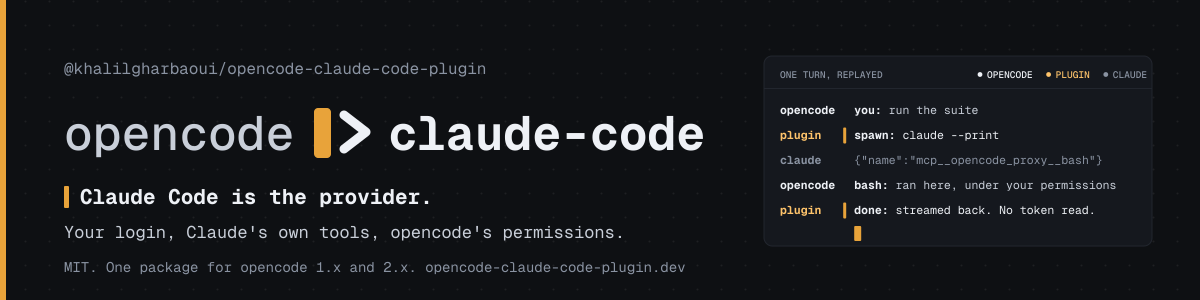
@khalilgharbaoui/opencode-claude-code-plugin











Claude Code is the provider. This opencode plugin runs Anthropic's Claude models through the official Claude Code CLI (claude) as a subprocess instead of calling the HTTP API. opencode inherits whatever that CLI is logged in as (a Claude subscription, an API key, Bedrock or Vertex), gets Claude's own tools, MCP servers and skills, and keeps running the tools that touch your machine itself, behind its own permission prompts. One package serves opencode 1.x and 2.x.
- Your CLI's login, untouched. The plugin never reads, stores or replays a token. Lifting the OAuth session out of the official client is what proxy-style plugins do, and Anthropic disallowed that for third-party Claude use in February 2026. This plugin structurally cannot do it.
- opencode runs the tools.
Bash,Edit,Write,WebFetchandTaskare proxied by default: Claude calls an in-process MCP tool and opencode executes it, under its own permissions and audit log. - Billed as your CLI bills. Headless
claude --printon a subscription draws from the plan's ordinary usage limits; an API key bills pay as you go. The CLI'sapiKeySourcesays which, every session, and the plugin warns when a strayANTHROPIC_API_KEYwould move the bill.
Docs: https://opencode-claude-code-plugin.dev/ (the same pages are the markdown under docs/, which GitHub renders on its own).
Quickstart
Install and log in the Claude Code CLI. The plugin drives an existing
claude; it does not bundle one.claude --version # e.g. 2.1.284 (Claude Code) claude auth status # which account you are signed in as claude auth login # only if you are not signed in yetAdd the package to opencode's global config. That spec is the whole install. Do not
npm installit yourself: opencode resolves and caches plugin packages on its own.{ "plugin": ["@khalilgharbaoui/opencode-claude-code-plugin"] }~/.config/opencode/opencode.jsonon opencode 1.x. opencode 2 reads the same key; its native spelling isplugins.Quit opencode fully and relaunch. Plugins load once, at process start. The model picker now has a Claude Code (Default) provider with entries such as
Claude Sonnet 5.5 (2×)andClaude Opus 5 (5×); the suffix is each model's list price relative to Haiku.
Nothing in the picker? Troubleshooting is keyed on the first thing you see. /claude-code-doctor in any session prints what the plugin thinks is happening, without calling a model.
What you get
| Selective tool proxy | Choose, per tool, whether Claude Code or opencode executes it. Proxied calls end on an event (the result, an abort, the next message, the child exiting), never on a clock. Guide |
| Claude's own tools, MCP and skills | Read, Grep, Glob, WebSearch run in Claude Code; your opencode MCP servers are bridged in; your opencode skills can be staged for Claude's Skill tool. MCP · Skills |
| Several accounts | "accounts": ["personal", "work"] becomes one provider per account. Out of usage mid-task? One line says which account, which window and when it resets in your own time zone, and names the others to pick a model from. Accounts |
| Subagents: your account, their model | forceModel, reasoningEffort and cacheTtl in an agent file, inheriting the caller's account. task_batch runs several subagents at once. Subagents |
| The whole model range, reasoning variants, fast mode | Haiku 4.5 through Opus 5.5, Fable and Mythos, each with a (N×) list-price suffix, low to max effort variants, and a fallback chain for a model this account cannot run today. The badge above counts them. Models |
/btw and /claude-code-doctor |
Side questions on the live process, and a health report whose bundle form is redacted by allowlist so it is safe to paste into a public issue. /btw · Doctor |
| Ships its own setup skill | Ask Claude to configure it. The bundled claude-code-plugin skill knows every option, env var, model id and troubleshooting rule, is staged into Claude Code on every spawn, and tests keep it in step with the code. Skills |
| Read-only preset, plan mode | "permissionPreset": "read-only" holds at the CLI, the proxy and the permission layer at once. Permissions |
How this compares
opencode's native anthropic provider |
This plugin | Proxy and token-reuse plugins | |
|---|---|---|---|
| Authentication | A Platform API key in opencode's auth store. | Whatever the official claude CLI holds. No token is read, stored or replayed. |
The Claude OAuth session, used outside the official client. |
| Terms-of-service status | The ordinary API route. | Sanctioned: the official client does the authenticating. | Disallowed. Anthropic disallowed reusing subscription authentication for third-party Claude use in February 2026, and each of those projects carries its own disclaimer. |
| Who runs Bash, Edit, Write | opencode. | opencode, by default; Read, Grep, Glob run in Claude Code. |
opencode. |
| What it costs you | Baseline. | A claude child per conversation under a cap of 16; Claude Code may compact its own context behind opencode's back. |
One more moving part, plus the account risk above. |
The full comparison has nine rows, names the projects in the third column, and quotes their own READMEs.
Built from measurements
A dozen test files drive a fake claude through real turns: the stream parser, the proxy broker, both watchdogs, abort, respawn, account failover and the model fallback chain are exercised end to end. Every rule in AGENTS.md names the probe, the version and the number that produced it, and the evidence lives in docs/agents-history.md. Two runtime dependencies. The site reports the live numbers: it rebuilds itself after every release, on every push that moves a figure, and every six hours.
Documentation
- Start here: Introduction · Getting started · opencode 2 · Models · Billing
- Configuration: Options · Environment variables · Accounts · Subagents · Permissions · MCP · Skills · Logging
- Guides: Tool proxy · Background subagents ·
/btw·/claude-code-doctor· Per-turn stats · Compaction and thinking · Interactive transport · Other plugins - Troubleshooting: Start from the symptom · Longer cases · Which login bills what · Known limitations
- Internals: How a turn works · How a proxied call ends · Scratch files and security · Measurement culture · Testing · Development · Releasing
Where the old README sections went
This README used to hold all of the above. Release notes and bookmarks point at its anchors, so:
| Old README anchor | Now at |
|---|---|
#configuration, #options-reference |
docs/configuration/options.md |
#environment-variables |
docs/configuration/environment.md |
#models, #fast-mode |
docs/models.md |
#multiple-claude-code-accounts, #account-failover |
docs/configuration/accounts.md |
#billing |
docs/billing.md |
#troubleshooting |
docs/troubleshooting/symptoms.md |
#plugin-health-with-claude-code-doctor |
docs/guides/doctor.md |
#selective-tool-proxy |
docs/guides/tool-proxy.md |
#credits |
docs/credits.md |
Credits
Made and maintained by Khalil Gharbaoui (@khalilgharbaoui). This plugin absorbs work from its forks directly, cherry-picked with the original authorship preserved or reimplemented with the author named in the commit. The people behind the features you are using, and what each built, are on the Credits page; git log --author on this repo shows the preserved authorship.
Free and MIT-licensed. If the plugin saves you time, you can buy its maintainer a coffee:

License
MIT. See LICENSE. The first version was written by Émilien (@unixfox); everything since by Khalil Gharbaoui and the people in Credits.
Reviews (0)
Sign in to leave a review.
Leave a reviewNo results found