deck-factory
Health Gecti
- License — License: MIT
- Description — Repository has a description
- Active repo — Last push 0 days ago
- Community trust — 51 GitHub stars
Code Gecti
- Code scan — Scanned 12 files during light audit, no dangerous patterns found
Permissions Gecti
- Permissions — No dangerous permissions requested
Bu listing icin henuz AI raporu yok.
One line of intent → a presentation-grade, dark-editorial HTML deck. A Claude Code skill.
English | 한국어
deck-factory
One line of intent → a presentation-grade dark/paper editorial HTML deck.




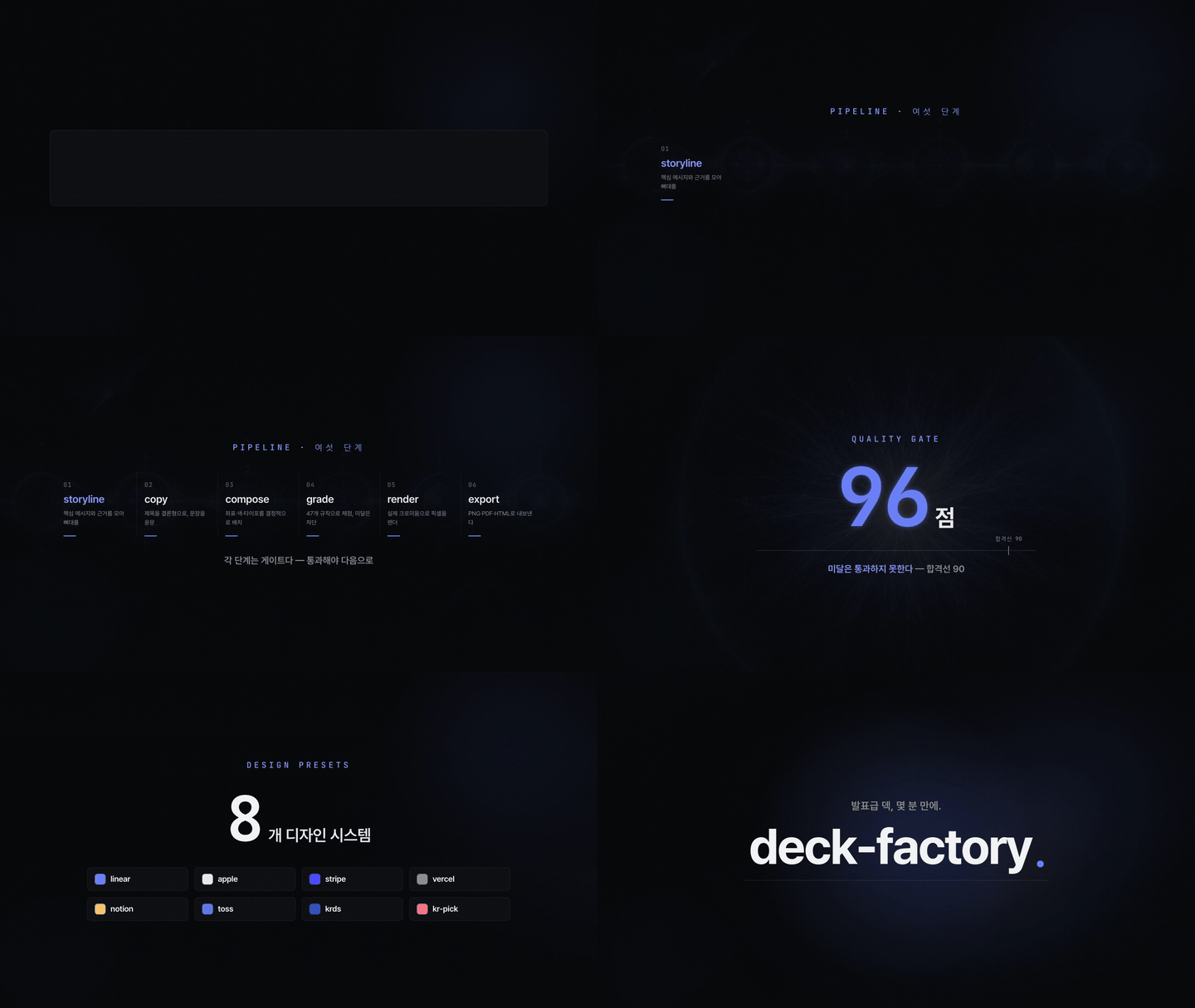
▶ Watch the full films:
Hook · 30s ·
Making-of · 40s ·
Usage · 30s
What is this?
You know the pain: it's midnight before the review, and you're still nudging text boxes, fighting gray cards, and shrinking fonts nobody in the back row will read. deck-factory replaces that grind with a design system. Give it one sentence about what you want to say, and it builds the front-of-house — an editorial deck with giant numbers, four-corner chrome, hairline structure, and zero amateur boxes. Dark remains the keynote default; report, document, and print-oriented briefs switch to a paper-light profile.
The verified deliverable today: 12 premium slides + 3 motion-graphics films, all built from this design system. The full generation pipeline (below) is the roadmap that automates it end to end.
Quick start
# 1. Add the plugin marketplace
/plugin marketplace add kimsh-1/deck-factory

# 2. Install the skill
/plugin install deck-factory@deck-factory

# 3. Call it with one sentence
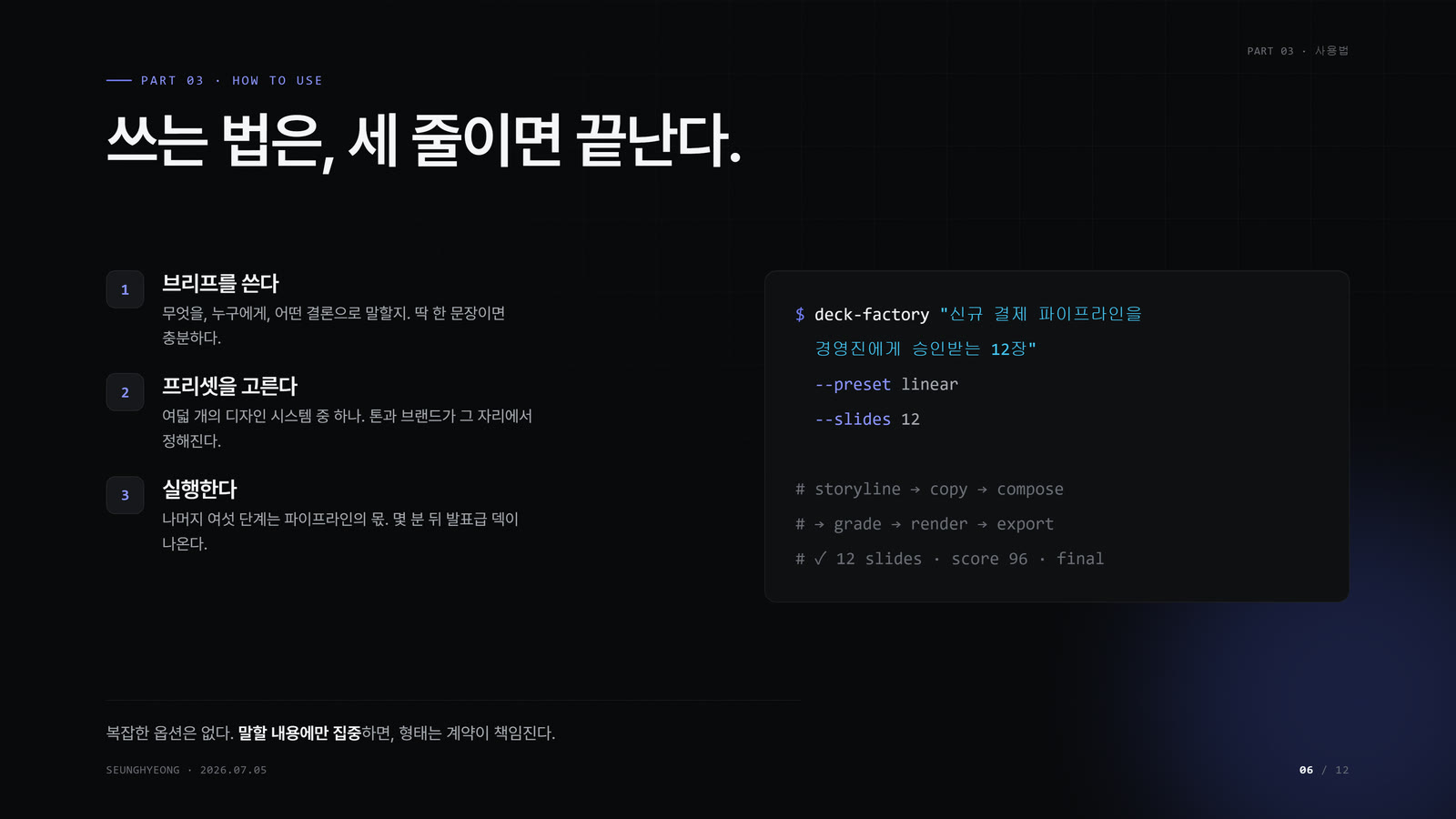
/deck-factory "Series A IR deck, 12 slides, why our retention curve wins"

# Document-style briefs auto-select the light profile
/deck-factory "Board report, 10 slides, Q2 retention analysis"

# Explicit overrides also work
/deck-factory "Proposal deck, 8 slides, profile: light"
Installation via the plugin marketplace is the intended path. The design system and skill are real and ready to use; the fully-automated one-command pipeline is being wired up (see How it works).
Features
| Dark + paper-light profiles | near-black #08090A by default, paper #F7F4EC for document decks, lavender-blue accent family, Pretendard, giant stat numbers. |
no_box · giant numbers · four-corner chrome |
no gray filler cards — structure comes from hairlines and a surface ladder. 120px+ stat numbers with value > label > context hierarchy. |
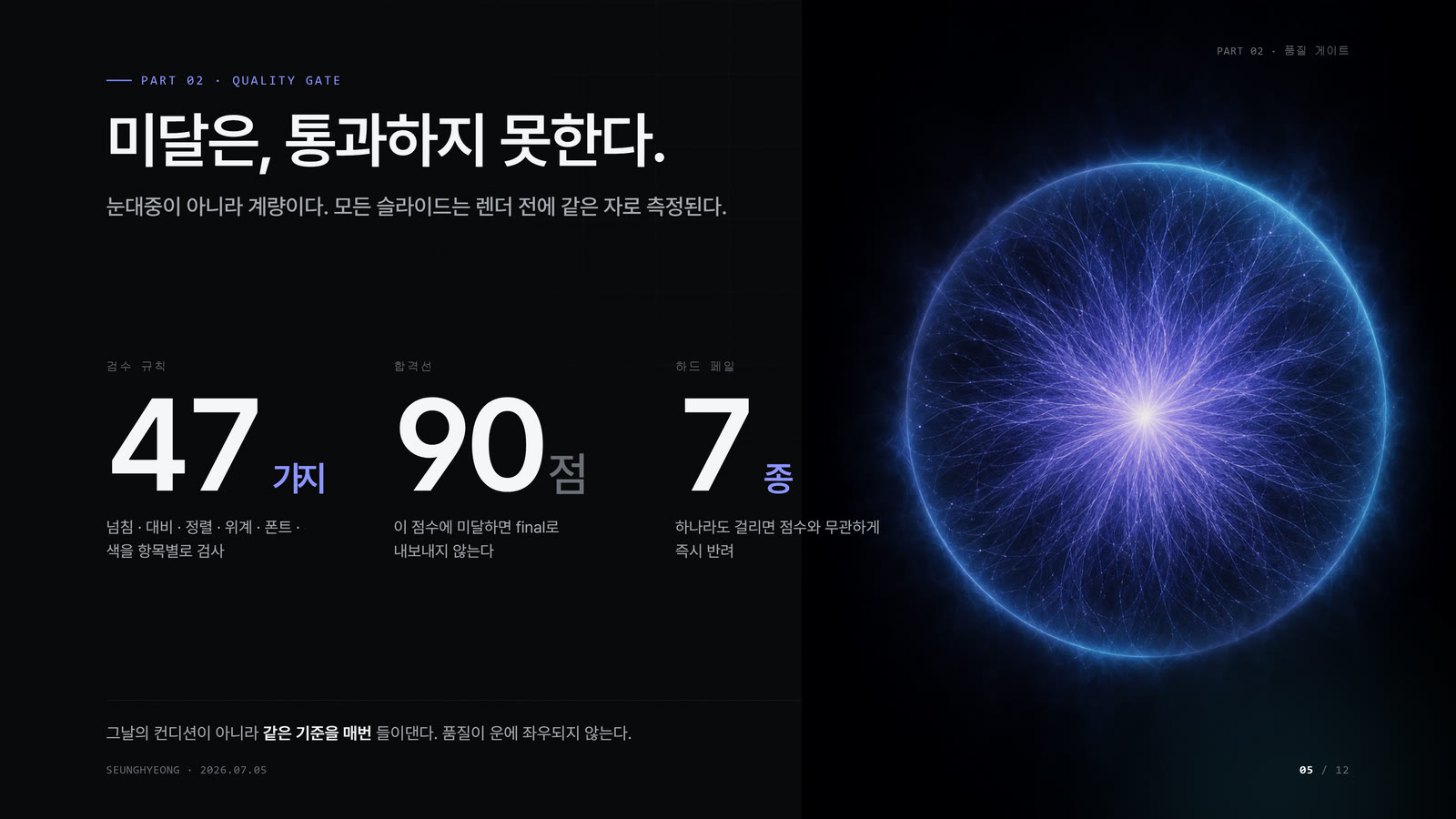
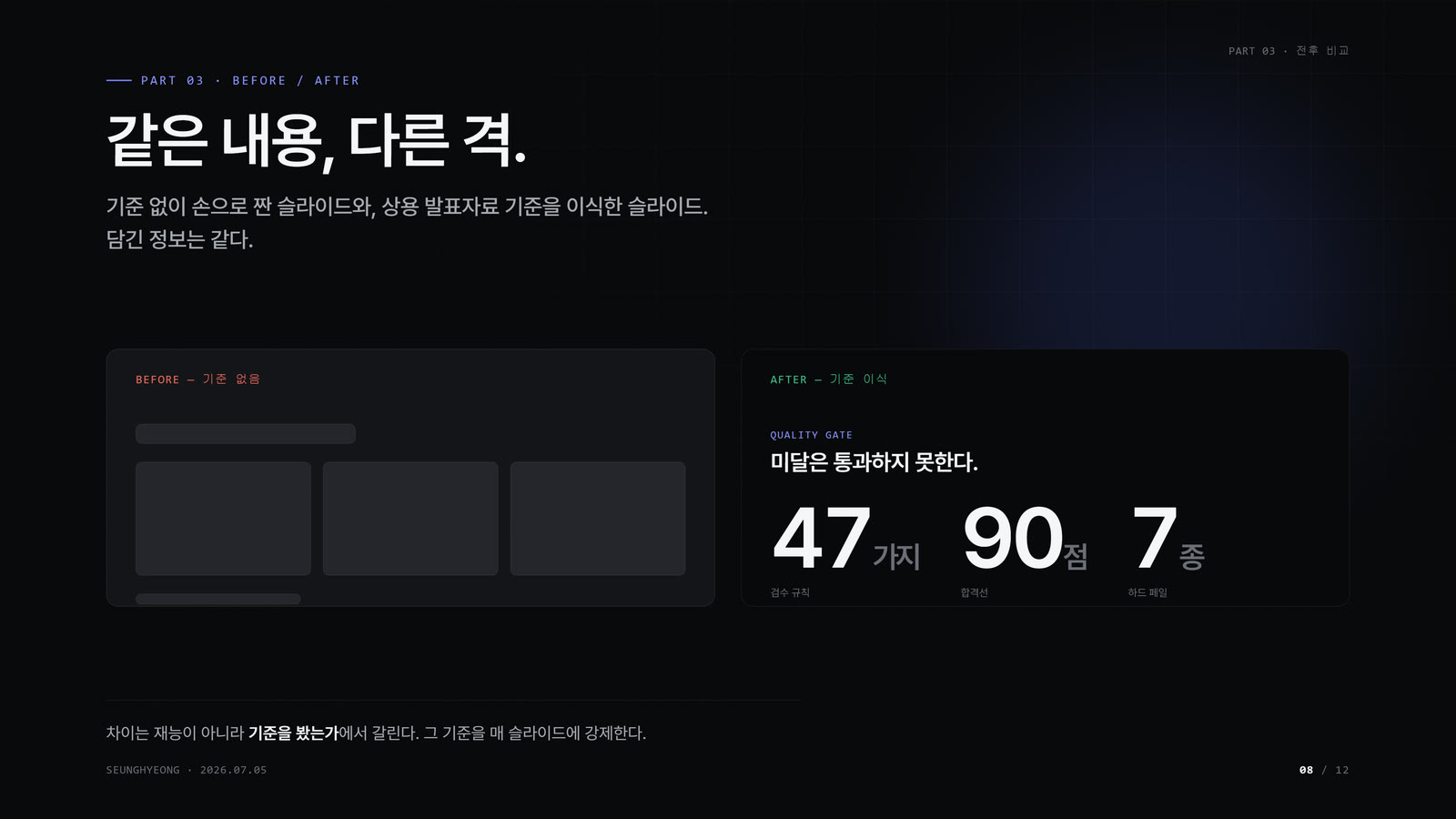
| Quality gate — by design | 47 deterministic checks across 6 weighted categories (typography, structure, trust, data-viz, color, alignment), a 90-point pass line, and 7 hard-fail thresholds. Autoscoring is calibration-pending; the gate is designed so a sub-grade deck can't quietly reach final. |
| Real Chromium render | slides are laid out in HTML/CSS and rendered by an actual browser engine — what you see is what exports. |
| Compact share PDF by default | raw Chrome PDFs are archival; *-lite.pdf is the default shareable artifact. |
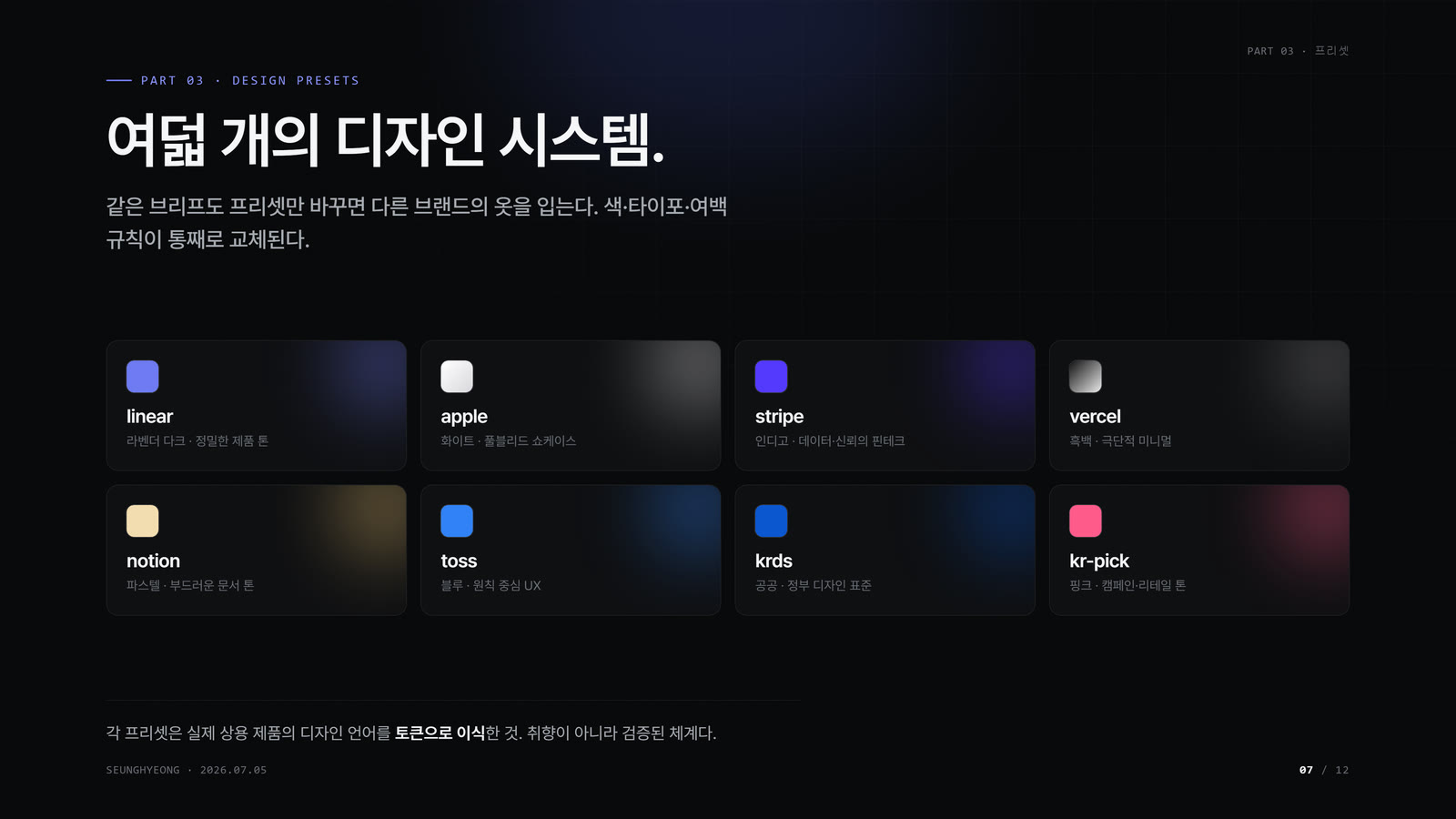
| 8 style presets | apple · linear · notion · stripe · vercel · krds · toss-principles · kr-pick. |
| CJK-safe | keep-all line-breaking and Hangul break rules — no text shattering mid-syllable. |
Gallery
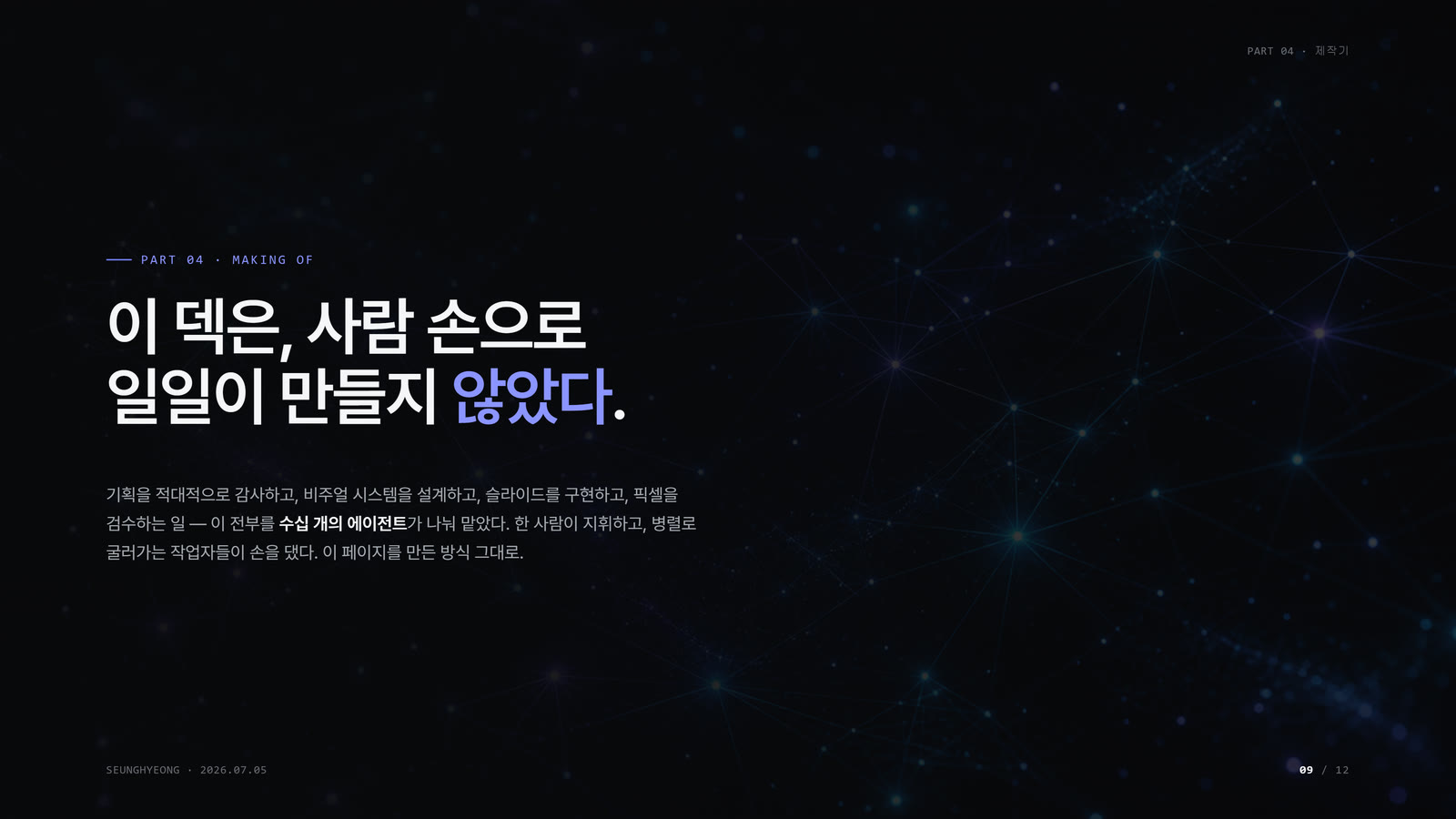
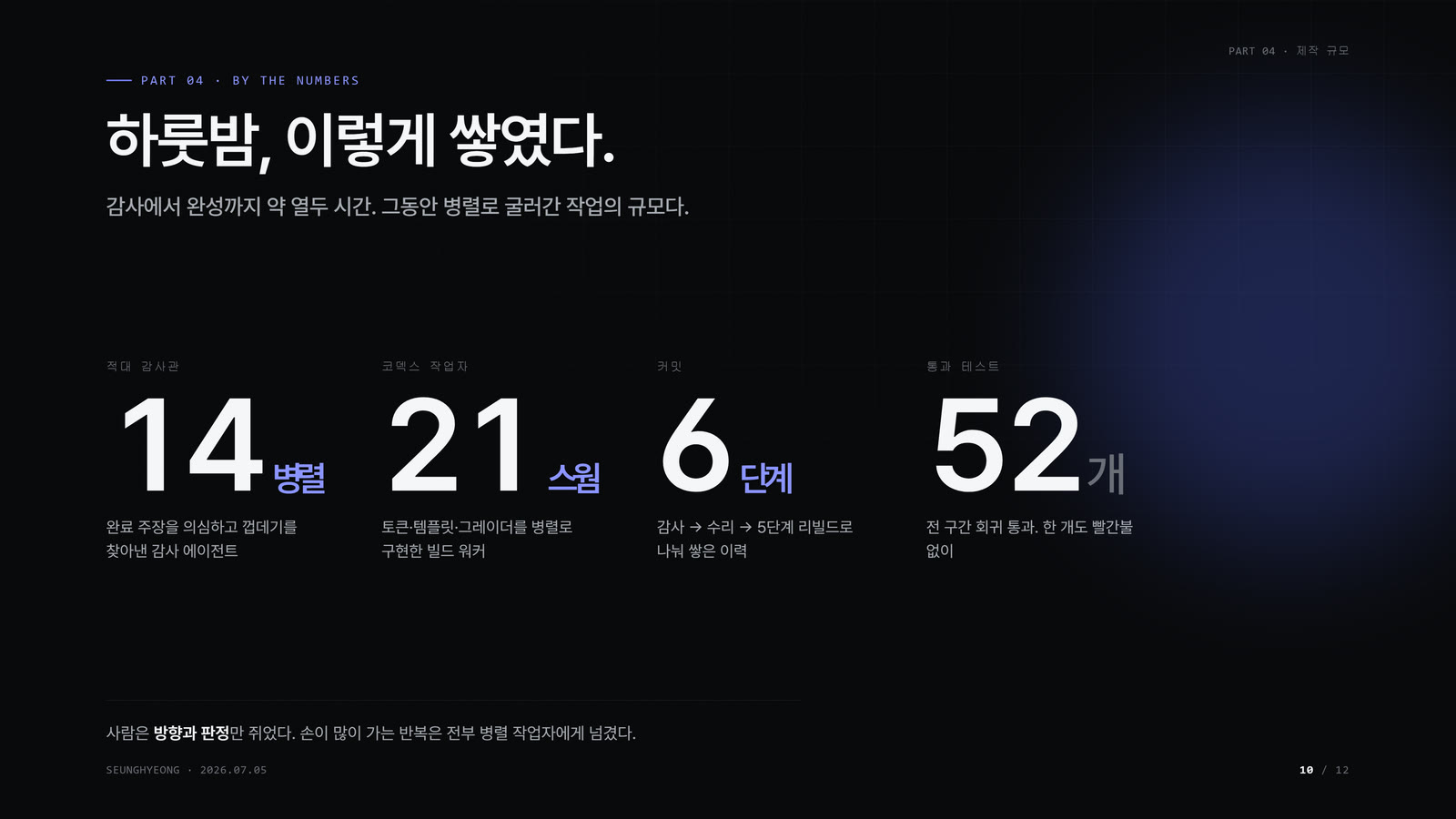
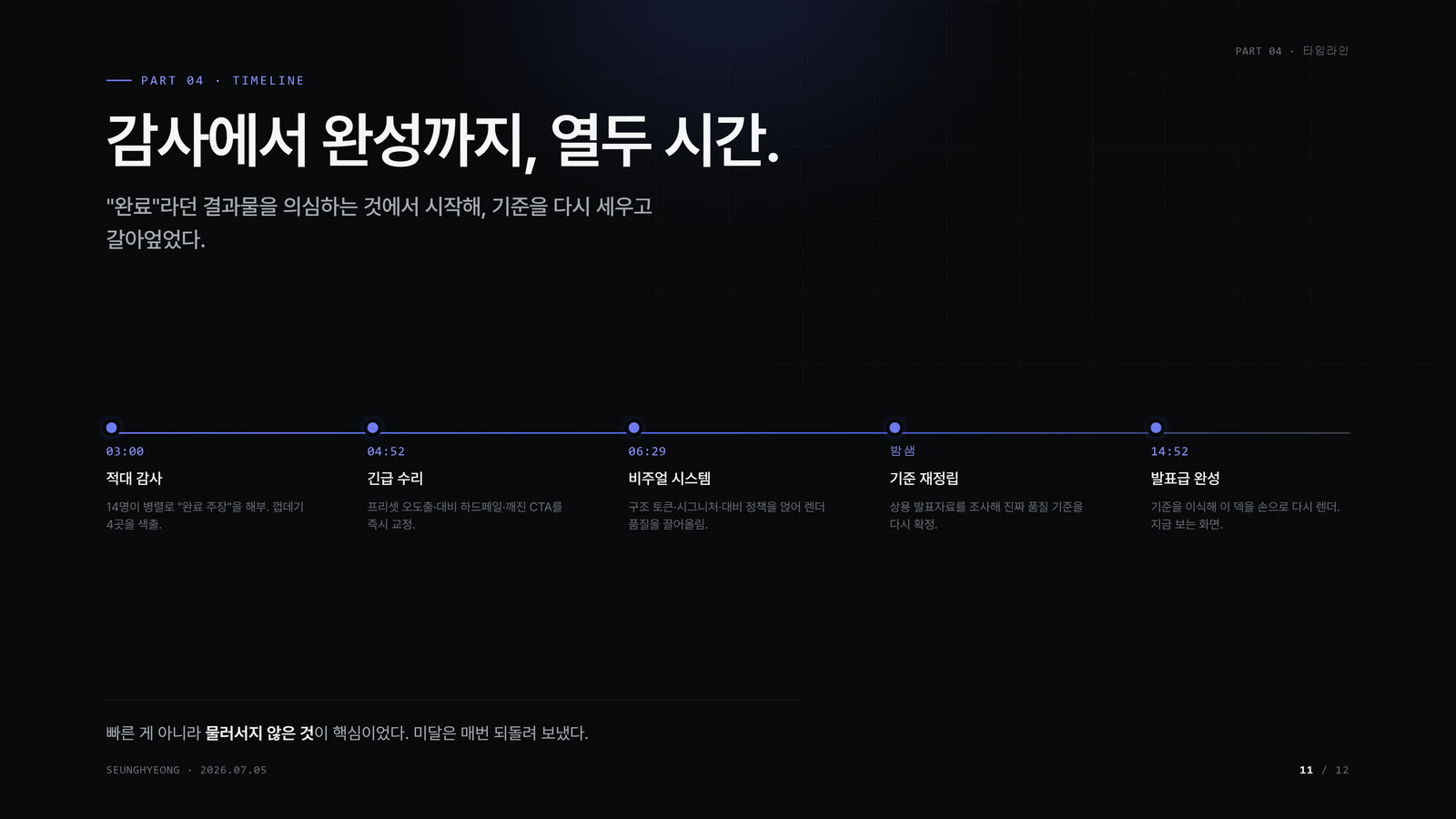
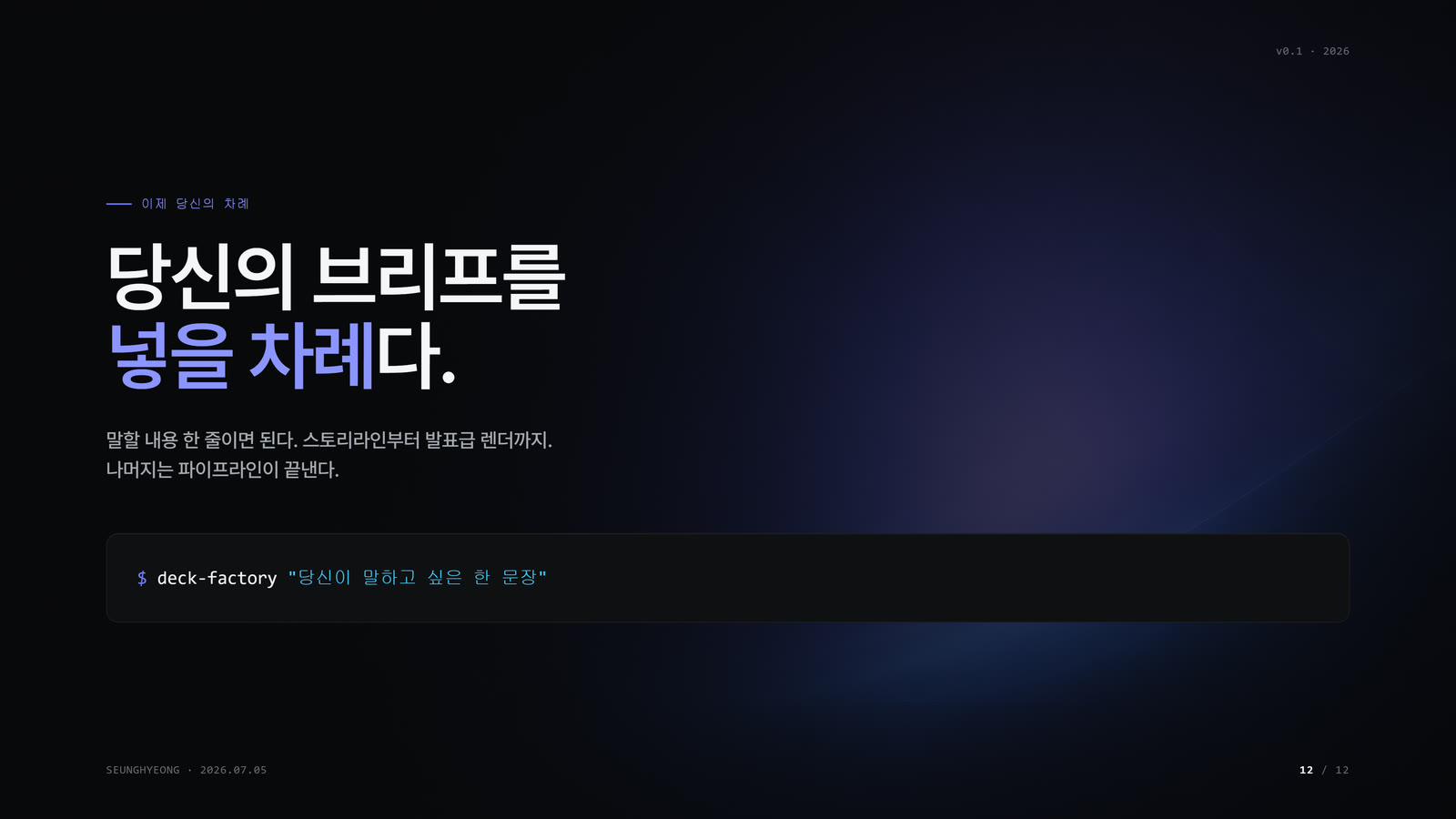
Twelve slides, one design system. This is the proof.
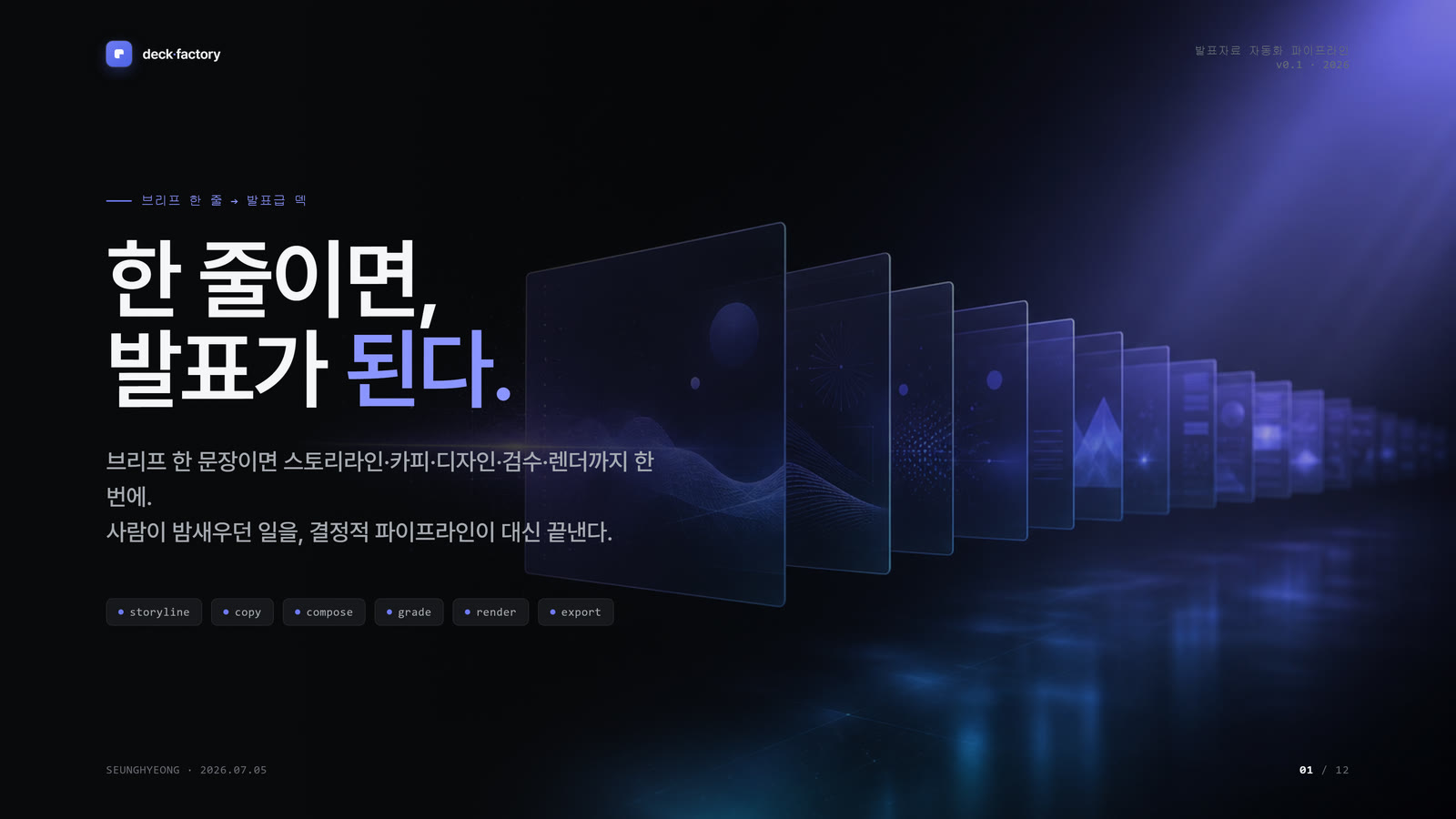 |
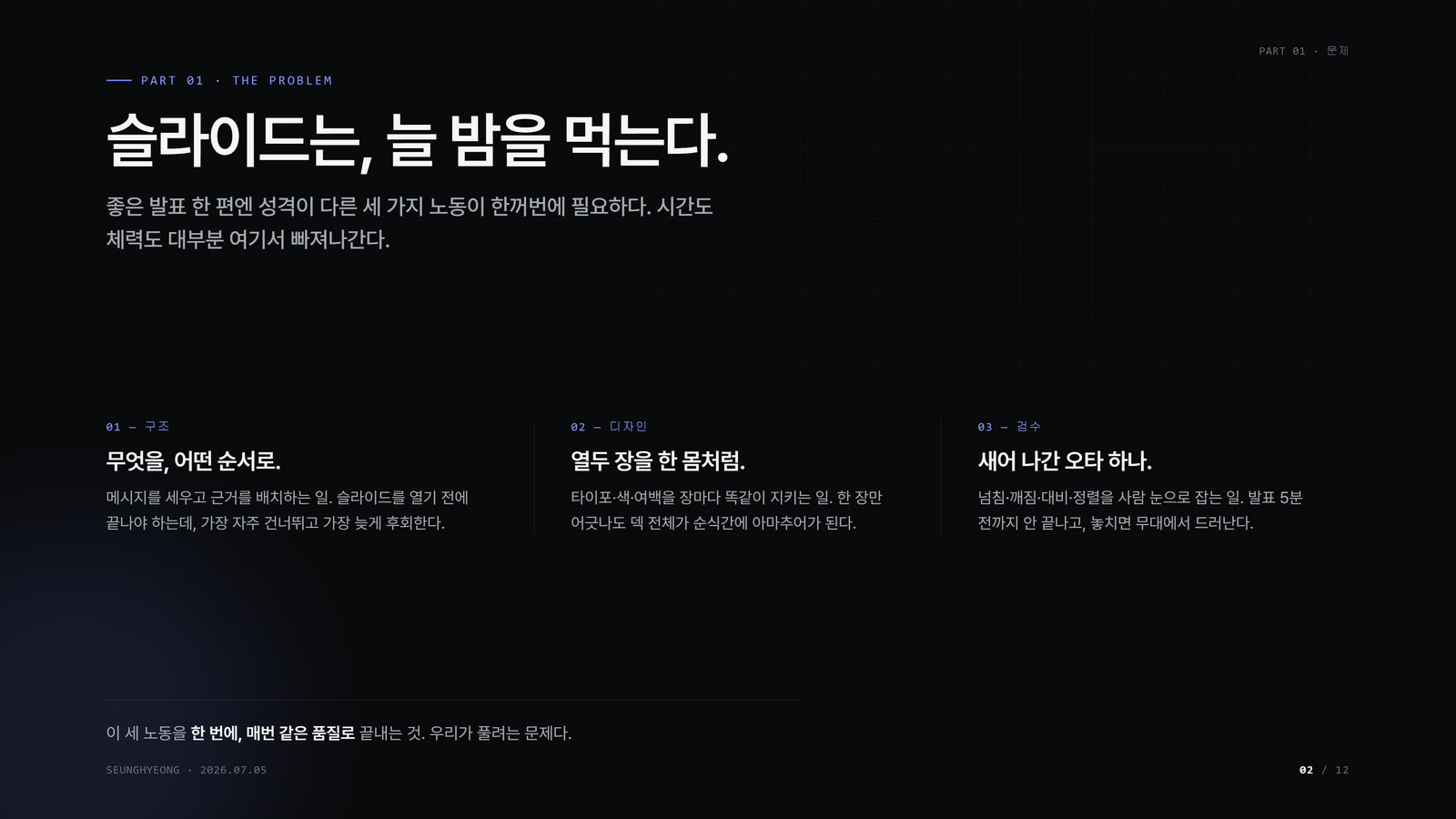 |
 |
 |
 |
 |
 |
 |
 |
 |
 |
 |
How it works

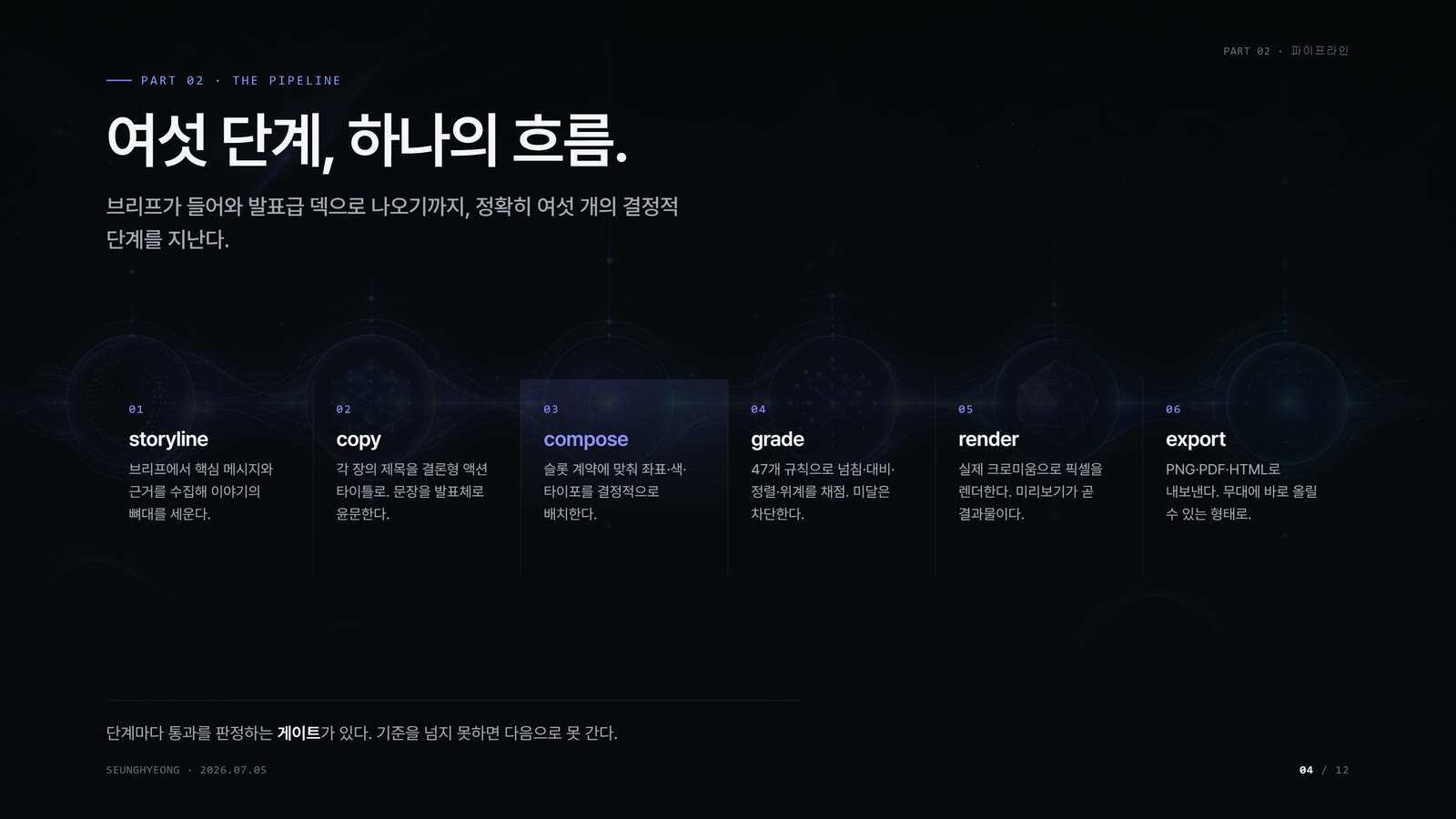
The design system is here today. The pipeline below is the vision that turns one sentence into a finished deck automatically — a six-stage chain where each stage hands off a file the next one verifies:
- storyline — gather sources and claims from your one-line brief.
- copy — write action titles (declarative, ending in a period — never noun lists).
- compose — deterministically assemble slides from a fixed layout vocabulary (the model writes content; code owns coordinates, color, and z-order).
- grade — run the quality gate; anything below the pass line is quarantined as
draft, never silently promoted. - render — lay out and paint via a real Chromium engine.
- export — emit PNG / PDF / PPTX. Shareable PDFs default to a compact
*-lite.pdfartifact.
Stages storyline through render/export exist as working code in the incubator; end-to-end autoscoring and the final polish pass are the remaining calibration work.
Design system
The whole look reduces to a few enforced tokens — the skill is the source of truth:
- Canvas — dark uses
--bg-0: #08090A(near-black, never pure black); light uses--bg-0: #F7F4EC(paper). Both use surface ladders and hairlines for depth instead of drop shadows. - Accent — lavender-blue
#6E7BF2and cyan#43C7F4, one accent moment per slide. - Ink —
#FFFFFF/#A1A1A6/#6B6B70, a three-step foreground hierarchy. - Type — Pretendard, aggressive negative tracking on display, ≤ 3 font sizes per slide.
- Structure —
no_box, alpha-white hairlines, four-corner chrome (brand chip · section · author · page), one dominant object per slide.
→ Full contract: skills/deck-factory/SKILL.md
Repository layout
deck-factory/
├── skills/deck-factory/     # the skill — SKILL.md + assets/styles.css
├── docs/
│   ├── media/               # hero.gif, pipeline.png
│   └── gallery/             # slide-01.jpg … slide-12.jpg
├── videos/                  # the three motion-graphics films
├── design/                  # DECK-STANDARD.md — the quality contract (SSOT)
└── incubator/               # pipeline code: deck-grader, deck-tokens, deck-editor
Customizing: pick a preset (/deck-factory "… preset: linear"), force a profile (/deck-factory "… profile: light"), or edit the token values in the skill's stylesheet to retune the palette. Presets change structure and signature devices; color always resolves through token variables.
Credits & license
Released under the MIT License.
- Font — Pretendard (SIL Open Font License).
- Motion — GSAP and HyperFrames for the showcase films.
Built with Claude Code — powered by the deck-factory skill.
One line in. A deck worth presenting out.
Yorumlar (0)
Yorum birakmak icin giris yap.
Yorum birakSonuc bulunamadi