shipproof
Health Pass
- License — License: MIT
- Description — Repository has a description
- Active repo — Last push 0 days ago
- Community trust — 18 GitHub stars
Code Warn
- process.env — Environment variable access in .github/workflows/publish-npm.yml
Permissions Pass
- Permissions — No dangerous permissions requested
No AI report is available for this listing yet.
Evidence-first Codex, Claude plugin for bugs, security, and 10k-to-1M-user scale readiness.

ShipProof
A local-first production evidence gate for AI-assisted software.
Security · Correctness · Scale · Performance · Release evidence





ShipProof is an independently developed production gate for repositories written by people, coding agents, or both. It scans source without executing repository code, evaluates measured CPU/RAM/latency budgets, models reviewed capacity assumptions, and emits evidence through terminal output, JSON, SARIF, pre-commit, GitHub Actions, or an optional read-only MCP adapter.
ShipProof is not a certification, penetration test, formal proof, or substitute for product-specific threat modeling and runtime tests. It makes assumptions visible, reports the strength of available evidence, and preserves human authority for consequential actions and releases.
Project resources: Website · Commands · Contributing · Support · Governance · Security · Community validation · Research methodology · Roadmap · Citation
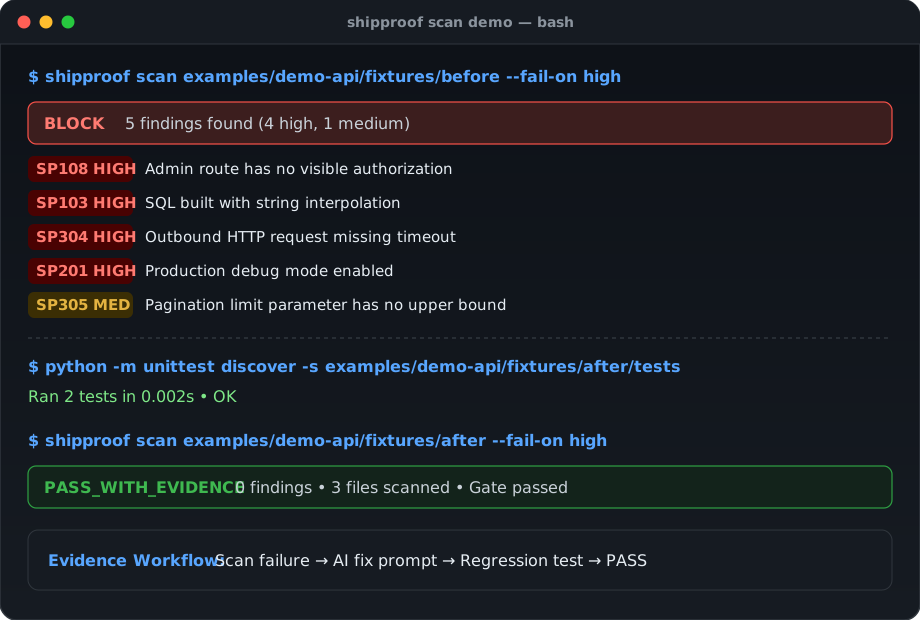
Understand it in 30 seconds
The checked-in demo API contains five real, intentionally vulnerable code paths: missing admin authorization, interpolated SQL, unbounded pagination, a missing outbound timeout, and production debug mode.
shipproof scan examples/demo-api/fixtures/before --fail-on high
# BLOCK · 5 findings

python -m unittest discover -s examples/demo-api/fixtures/after/tests -v
shipproof scan examples/demo-api/fixtures/after --fail-on high
# PASS_WITH_EVIDENCE · 0 findings
The test suite verifies the exact before/after contract. Additional Node.js, Python, secure, and performance fixtures guard against missed findings and obvious false positives.
Quickstart
Run directly in any repository without creating a configuration file first:
npx github:kingggg5/shipproof check
The git form works without any registry credentials. Once the package is published to the public npm registry, the shorter npx @kingggg5/shipproof check will also work; GitHub Packages requires authentication even for public packages, so it is not used for the one-liner.
Or install globally:
npm install --global github:kingggg5/shipproof
shipproof doctor .
shipproof init . --target both
shipproof check .
init adds repository-scoped skills to .agents/skills for Codex and .claude/skills for Claude Code. It skips existing skill directories unless you explicitly pass --force.
Node.js 20+ runs the front-door CLI. Python 3.10+ is needed for scan, check, all gate and labs commands, and the MCP tools. The core has no runtime npm or Python package dependencies.
Scope and project status
ShipProof applies the same review contract regardless of who wrote the code. Its executable scanner currently contains 635 deterministic rules for locally observable security, correctness, scale, performance, configuration, and supply-chain risks. The default path is read-only, offline, and dependency-free beyond Node.js and the Python standard library.
| Property | Current contract |
|---|---|
| Current release | v0.10.0 reviewed release |
| Runtime | Node.js 20+; Python 3.10+ for scanner-backed commands |
| Executable rules | 635 (SP001–SP665, with deliberate reserved gaps) |
| Evidence levels | L0 pattern, L1 structural/artifact, L2 interprocedural taint (--cross-file; Python + JavaScript/TypeScript) |
| Research inventory | 7,800 catalogued candidates plus 1,000 reserved promotion slots; none are findings until promoted |
| Exit codes | 0 pass, 1 policy gate failure, 2 invalid or unavailable evidence |
| Default data flow | Local filesystem and subprocesses only; no telemetry or source upload |
Rule design is informed by primary references such as MITRE CWE, OWASP ASVS, OWASP API Security, NIST SSDF, owning framework documentation, and real vulnerability records. A source identifies a risk class; it does not automatically justify a detector. Promotion requires local observability, a bounded implementation, positive/negative/adversarial fixtures, mappings, remediation, and a documented false-positive boundary.
Trust model
| ShipProof guarantees | ShipProof does not claim |
|---|---|
| Deterministic output for the same supported inputs and version | Absence of vulnerabilities or production incidents |
Stable rule IDs, schemas, fingerprints, and 0/1/2 exit semantics |
Cross-file reachability or runtime exploitability from regex alone |
| Redacted evidence and no repository-code execution in the default scanner | Compliance certification for CWE, OWASP, NIST, or another standard |
| Explicit unknown/unavailable evidence rather than a fabricated pass | A universal capacity target, SLO, or architecture |
| Review-first severity for heuristics that need context | Replacement of CodeQL, dependency/SBOM tools, fuzzing, or human review |
Evidence output
ShipProof formats findings as actionable review cards with source context, confidence levels, why the risk matters, and recommended fixes:
  [BLOCK] ShipProof: BLOCK
  Scanned 24 files | 1 blocking issue | 0 suppressed
  HIGH: 1

  [HIGH] Sensitive route lacks visible authorization (SP108)
     src/routes/admin.py:42  |  confidence: LIKELY

     Evidence:
       40
       41   @app.post("/admin/users/{user_id}/ban")
       42 > def ban_user(user_id: str):
       43       return db.ban(user_id)

     Why: An admin or internal route has no visible authorization dependency.
     Fix: Require an explicit authorization dependency or verify application-wide control.
     Ref: CWE-862 | OWASP ASVS V4

  ----------------------------------------------------------------------

  -> Run `shipproof scan --fix-prompt` to generate AI-ready fix instructions
  -> Run `shipproof explain SP108` for attack scenarios and testing guidance
Verification workflow
ShipProof turns development into a verified feedback loop: AI writes code, ShipProof finds risks, AI fixes with explicit constraints, and ShipProof re-verifies.
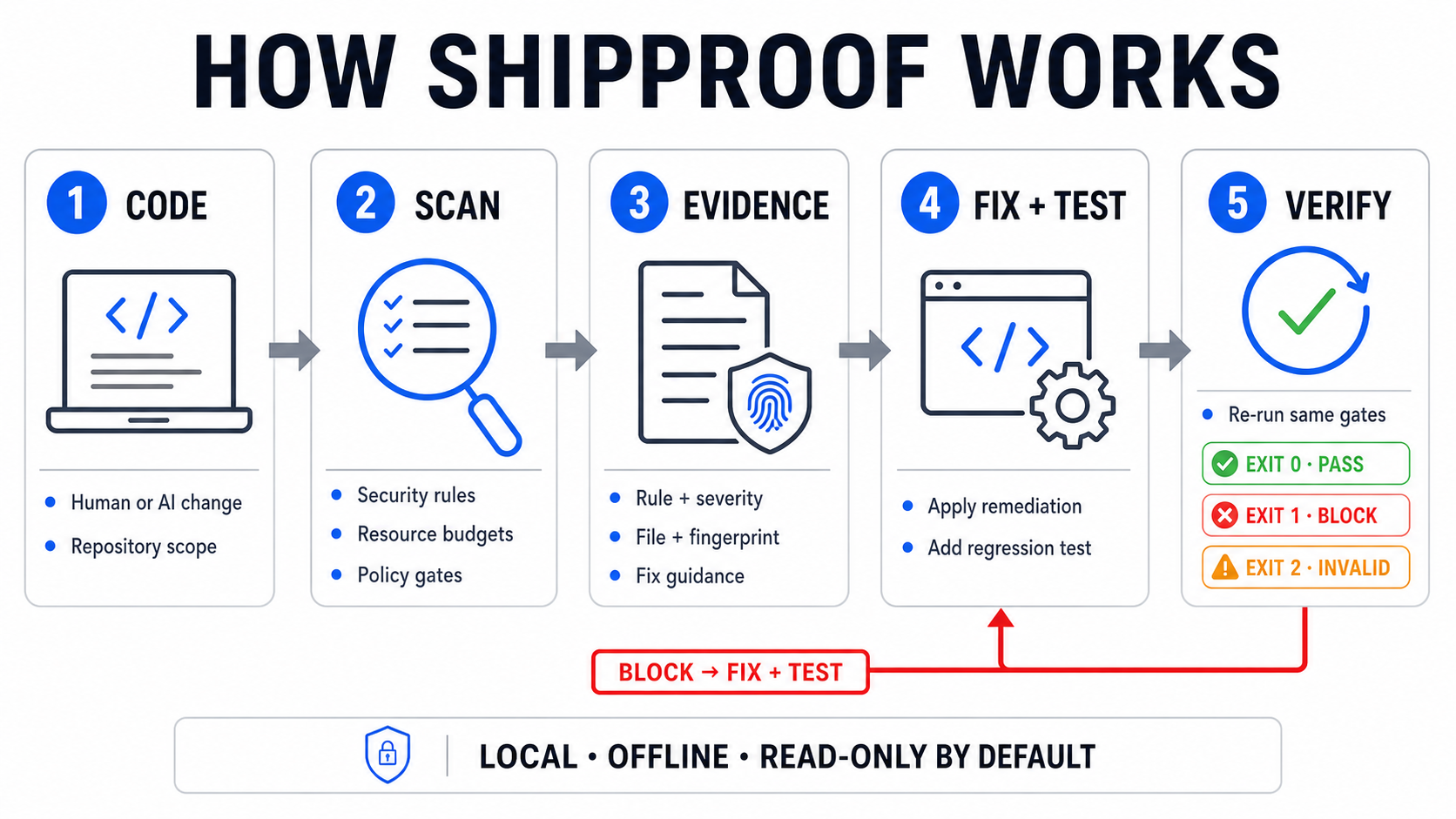
If verification blocks the change, the evidence goes back into the fix-and-test step. A pass means the configured gate has evidence for the reviewed scope—not that the software is universally vulnerability-free.
Accessible workflow sourceflowchart LR
A["AI writes code"] --> B["ShipProof finds risks"]
B --> C["shipproof scan --fix-prompt"]
C --> D["AI fixes code + regression tests"]
D --> E["ShipProof verifies evidence"]
shipproof scan --fix-prompt        # structured handoff for Codex/Claude Code/Cursor/Copilot
shipproof explain SP108            # rationale, attack scenario, false positives, test plan
shipproof labs impact src/app.py   # experimental blast radius before editing
Full prompt samples, invariant analysis, token cost budgeting, worktree isolation, status badges, and --trace output live in docs/features.md.
Detection rules
635 deterministic executable rules (SP001–SP665, with deliberate reserved gaps) across security, correctness, scale, performance, configuration, and supply-chain risks. Findings carry an evidence proof_level: L0 pattern match, L1 structural/AST/artifact evidence, and L2 interprocedural taint flows (--cross-file; Python plus JavaScript/TypeScript route-to-sink chains since v0.8).
The complete catalog, severity, category, and detection method per rule, plus the ecosystem/framework mapping that decides where each structural check runs, lives in docs/rules.md.
False Positive Control
ShipProof prioritizes high precision over noisy alerts:
- Inline suppression: Add
# shipproof-ignore SP101or// shipproof-ignore SP101directly on the line or on the line immediately preceding it. The marker is honored only inside a comment (or at the start of a documentation line), never inside string data, and may list several rules at once (for example# shipproof-ignore SP101 SP102). Both the regex and the Python AST engines honor these markers. - Confidence filtering: Run with
--min-confidence highto surface only confirmed, high-confidence issues. - Reviewed baselines: Record existing technical debt into
.shipproof-baseline.jsonusingshipproof scan --baseline-out .shipproof-baseline.json.
Add the GitHub Action
Add a deterministic gate to pull requests:
name: ShipProof
on: [pull_request]
permissions:
  contents: read
jobs:
  production-gate:
    runs-on: ubuntu-latest
    steps:
      - uses: actions/checkout@v4
      - uses: kingggg5/[email protected]
        with:
          fail-on: high
The action writes a structured Markdown status card to the GitHub Step Summary. The example uses the v0.10.0 release tag; pin the action to a reviewed full commit SHA when an immutable supply-chain reference is required.
For pull requests that touch a large repository, scan only what changed relative to the base branch:
      - uses: actions/checkout@v4
        with:
          fetch-depth: 0
      - uses: kingggg5/[email protected]
        with:
          fail-on: high
          changed-since: origin/main
The scanner resolves the git diff (added, copied, modified, and renamed files, plus untracked files) and reports the ref under changed_since in JSON output. Findings outside the diff are not reported for that run; keep a scheduled full scan as the safety net.
The default report format is sarif, which the action writes into the workspace. To surface findings as inline Code Scanning alerts, upload that artifact with GitHub's official action after the gate step:
      - uses: kingggg5/[email protected]
        with:
          fail-on: high
          format: sarif
          output: shipproof.sarif
      - uses: github/codeql-action/upload-sarif@v3
        if: always()
        with:
          sarif_file: shipproof.sarif
Uploading requires permissions: security-events: write (keep contents: read) on the job or workflow.
One Policy, One Command
Commit a bounded .shipproof.yml, then run every declared repository gate:
version: 1
scan:
  path: .
  exclude:
    - vendor/**
security:
  fail_on: high
performance:
  baseline: perf/baseline.json
  current: perf/current.json
  budget: perf/budget.json
capacity:
  config: capacity.json
shipproof check .
The dependency-free YAML subset rejects executable tags, anchors, duplicate keys, unknown fields, path traversal, and arbitrary commands. The full shape is documented by the policy schema.
Two skills, one workflow
| Skill | Use it for |
|---|---|
$engineer-production-systems |
Bounded implementation with explicit security, CPU/RAM/latency, and failure budgets |
$audit-production-readiness |
Independent release gates: Security, Correctness, Data & Privacy, Scale, Operability, Supply Chain |
The full workflow diagram, systems coverage ladder, host compatibility table, and the production playbook are in docs/features.md and docs/production-playbook.md.
Command Reference
shipproof check [path] [--config <file>]     Run every gate (works without config)
shipproof scan [path] [options]              Scan repository (--format terminal|markdown|json|sarif|github)
shipproof explain <rule-id>                  Explain a rule in detail (e.g. explain SP108)
shipproof doctor [path] [--json]             Inspect local runtime and integration health
shipproof init [path] [--scope <scope>]      Add project/global skills and a project policy
shipproof config validate [path]             Validate policy without running gates
shipproof gate budget [options]              Enforce CPU/RAM/latency regression budgets
shipproof gate evidence [path] [options]     Run allowlisted TypeScript, Go, or Rust analyzers
shipproof labs impact <file>[:line]          Experimental blast-radius analysis
shipproof labs invariants [path]             Experimental invariant analysis
shipproof labs cost [path] [options]         Experimental token/cost estimate
shipproof labs capacity [options]            Experimental capacity model and k6 export
shipproof mcp                                Start the read-only stdio MCP server
shipproof help                               Show command help
shipproof version                            Print current version
See docs/commands.md for full argument options and exit codes.
Install from a Clone
git clone https://github.com/kingggg5/shipproof.git
cd shipproof
npm install --global .
Then invoke the skill while building:
Use $engineer-production-systems to implement this feature with explicit security,
CPU, RAM, latency, and failure budgets.
Before release:
Use $audit-production-readiness to audit this repository for production.
Claude Code can also load the repository directly as a plugin during development:
claude --plugin-dir .
Plugin-installed Claude skills use the namespaced commands /shipproof:engineer-production-systems and /shipproof:audit-production-readiness.
Budgets, capacity, MCP, and layering
- Resource budgets: gate measured p95 latency/CPU/RAM/throughput regressions with
shipproof gate budget; runnable samples in examples/performance. - Capacity planning: turn reviewed workload assumptions into a transparent model or a deterministic k6 scaffold with
shipproof labs capacity. - MCP mode:
shipproof mcpexposes five read-only tools to any MCP client with canonical paths, bounded runtime, and redacted evidence. - Language-native evidence:
shipproof gate evidence . --adapter typescript|go|rustruns approved local analyzers without downloading dependencies, records the probed analyzer version, and bounds/redacts diagnostics. Repository-controlled TypeScript and Rust paths require explicit consent. - Layering: pair ShipProof with mature SAST, SCA, secret-history, and supply-chain tools already present in your environment; it routes to them and never silently installs anything.
All detailed walkthroughs are in docs/features.md.
Research & evaluation status
The scanner ships 635 executable rules. Behind them sits a research backlog of 7,800 catalogued candidates. The current promotion triage identifies 934 targets with a possible local signature, 435 that need dataflow evidence beyond today's engines, and 1,595 design, process, or hardware classes that a regex-based gate cannot catch; the remaining catalog entries retain discovery status until their evidence boundary is reviewed. The bounded P2 batch-A record reviews 25 direct candidates across nine requested ecosystems: 3 reached research-only fixture_ready, 22 were rejected as duplicates or wrong evidence routes, and none was silently promoted without representative shadow metrics. See the batch record and the broader plan.
Fixture battery (median of 3 runs, --cross-file, labels in benchmarks/head-to-head-labels.json):
| Corpus | Precision | Recall | F1 |
|---|---|---|---|
| vulnerable-node-api | 1.0 | 1.0 | 1.0 |
| vulnerable-python-api | 1.0 | 1.0 | 1.0 |
| node-taint-crossfile | 1.0 | 1.0 | 1.0 |
| adversarial-node | 1.0 | 1.0 | 1.0 |
| secure-node-api / node-secure-crossfile | : | : | 0 findings |
The version-2 label contract distinguishes expected finding locations from context-only source/helper files in a vulnerable chain. Those context files remain listed and hashed but do not count as false negatives for a sink-reporting detector. The adversarial corpus holds look-alikes inside comments and string literals that must stay silent, next to disguised chains (two-hop aliasing, destructured parameters, cookie-to-DOM, three-file taint) that must fire.
The opt-in real-world evaluator pins express, flask, and requests as clean baselines plus juice-shop, DVWA, and NodeGoat as intentionally vulnerable apps. The reviewed 2026-08-24 manifest run scanned 1,805 files and observed 310 application-scope findings (2 / 9 / 3 / 184 / 84 / 28 in that order). Every alert remains explicitly unreviewed; these inventory counts are not a real-world precision claim.
Operating profile: no repository or contributor limits, fully offline against local files only, and interprocedural taint for JavaScript/TypeScript and Python in the open core. Bounded added-line git-history scanning is available with --history; live credential validation, SBOM/licensing, and AppSec management remain outside the core and should be paired with dedicated tools (layering guidance). Measurement methodology and current results: docs/benchmarks.md.
Research methodology and provenance
ShipProof is independently implemented. References are used to define questions, terminology, and expected safety boundaries; external detector code and license-restricted rule sets are not copied. The research notebook records the page consulted, the question asked, the decision retained, and the claims deliberately not inferred.
The evidence hierarchy for a rule proposal is:
- Owning standards, platform/framework documentation, and language specifications.
- CWE/CVE/KEV records and vendor advisories for demonstrated failure classes.
- Reproducible project fixtures, measurements, and compatibility contracts.
- Community reports only as discovery signals that must be confirmed by a primary source.
- Model-generated ideas only as untrusted hypotheses.
A research candidate becomes an executable SPxxx rule only after deduplication, an observable local invariant, a bounded implementation, CWE/control mapping, remediation, false-positive analysis, and positive/negative/adversarial tests. Severity expresses the potential impact of the matched condition; proof level expresses the strength of local evidence. Neither is a probability of exploitation.
| Research artifact | Scope | Runtime effect |
|---|---|---|
| Expert candidate catalog | 1,000 model-assisted, source-mapped hypotheses | None |
| 2021–2026 annual catalog | 1,800 time-bounded CVE/CWE/community signals | None |
| Language catalog | 5,000 deduplicated ecosystem/CWE research slots | None |
| Executable rule table | 635 reviewed detectors | Emits versioned findings |
The machine-derived rule assurance inventory verifies all 635 executable rules through explicit positive/negative/adversarial contracts. The checked-in debt baseline is empty and fail-closed: any new partial or uncontracted executable rule fails CI instead of silently joining legacy debt.
See the production playbook, development plan, and delivery roadmap for operational boundaries and acceptance gates. Cite a release using CITATION.cff. ShipProof deliberately avoids a single readiness score because one veto-level failure must not be averaged away by many clean checks.
Project governance
ShipProof uses a maintainer-led, evidence-first decision model. Backward compatibility, rule promotion, releases, security response, and changes to the default trust boundary follow GOVERNANCE.md. Contributions must follow CONTRIBUTING.md and the Code of Conduct. Public feature and defect discussions belong in GitHub Issues; exploitable vulnerabilities belong in the private reporting channel described in SECURITY.md.
Development
npm ci --ignore-scripts
python -m pip install -r requirements-dev.txt
npm run check
python skills/audit-production-readiness/scripts/scan_repo.py . --fail-on high
The core runtime uses only Node and the Python standard library; Ruff is development-only. The optional MCP adapter uses the MCP SDK and Zod as explicitly installed peers. CI tests Node 20/22/24 and Python 3.10/3.11/3.12/3.13/3.14, verifies an exact package allowlist, smoke-tests the packed artifact, and runs CodeQL for Python and JavaScript/TypeScript.
The scoped npm manifest and manual OIDC workflow are ready for a future public npm release. Until the owner establishes the package, protected environment, and trusted-publisher relationship, use the GitHub npm install shown above; this project does not claim an unpublished registry release. See docs/releasing.md.
License, citation, and security
ShipProof is available under the MIT License. Academic and research users can cite the project with CITATION.cff. Report vulnerabilities privately according to SECURITY.md.
Reviews (0)
Sign in to leave a review.
Leave a reviewNo results found