kjarni
Health Gecti
- License — License: Apache-2.0
- Description — Repository has a description
- Active repo — Last push 0 days ago
- Community trust — 39 GitHub stars
Code Basarisiz
- rm -rf — Recursive force deletion command in .github/workflows/ci.yml
- rm -rf — Recursive force deletion command in .github/workflows/sync-go.yml
- rm -rf — Recursive force deletion command in .github/workflows/sync-nuget.yml
- eval() — Dynamic code execution via eval() in bench/clip_reference.py
- eval() — Dynamic code execution via eval() in bench/compare/clip_worker.py
Permissions Gecti
- Permissions — No dangerous permissions requested
Bu listing icin henuz AI raporu yok.
Local embeddings, semantic search, classification, reranking, chat, speech to text and image search for Python, C#, Go, Rust, C++, the browser and the command line, plus an MCP server for AI agents. Same output as PyTorch.
Kjarni






Run transformer models inside your program, in any language. Same output as PyTorch.
Kjarni is a transformer inference library: local AI inference as one native engine for Python, C#, Go, C++, Rust and the browser. It runs embeddings, classification, reranking, semantic search, chat, speech to text, summarization, translation and image search on your CPU or GPU, downloads its own models, and works entirely on your machine. It is written from scratch in Rust and ships as a single shared library.
Try it in 30 seconds
Nothing to install: the browser demo runs the engine in your own tab.
Or one command, and it works:
curl -fsSL https://kjarni.ai/install.sh | sh # Windows: irm https://kjarni.ai/install.ps1 | iex
$ kjarni classify "This is wonderful"
  ✓       POSITIVE  ████████████████████  100.0%
          NEGATIVE  ░░░░░░░░░░░░░░░░░░░░    0.0%

$ kjarni similarity "doctor" "physician"
  █████████████████░░░   86.0%  highly similar

$ echo "Great service" | kjarni classify --format json | jq -r '.label'
POSITIVE
The model downloads on first use and is cached. Everything after that works offline.
In your own code, it is the same three lines in every language:
using var embedder = new Embedder("minilm-l6-v2");
Console.WriteLine(embedder.Similarity("doctor", "physician"));   // 0.8598
dotnet add package Kjarni                             # C# / .NET
go get github.com/kjarni-ai/kjarni-go@latest   # Go
Every language below, including C++ and the browser.
The name is Icelandic [ˈkʰjartnɪ]. It means "core."
Install · Examples · Browser demo · Why it exists · How it compares
Install
C# / .NET — nuget.org/packages/Kjarni
dotnet add package Kjarni
Go — pkg.go.dev/github.com/kjarni-ai/kjarni-go
go get github.com/kjarni-ai/kjarni-go@latest
CLI
curl -fsSL https://kjarni.ai/install.sh | sh    # Linux / macOS
irm https://kjarni.ai/install.ps1 | iex         # Windows
Python
pip install kjarni          # no dependencies at all
pip install kjarni[numpy]   # adds ndarray returns from encode_batch
The plain install pulls nothing: no PyTorch, no ONNX Runtime, no numpy. The native
library ships inside the wheel and the vectors match sentence-transformers to four
decimal places.
Rust
cargo add kjarni
C++ — no package manager. Four commands from nothing to output:
mkdir kjarni-quickstart && cd kjarni-quickstart
curl -sL https://github.com/kjarni-ai/kjarni/releases/latest/download/kjarni-x86_64-linux.tar.gz | tar xz
curl -sO https://raw.githubusercontent.com/kjarni-ai/kjarni/main/crates/kjarni-ffi/examples/cpp/hello.cpp
g++ -std=c++23 hello.cpp -I. -L. -lkjarni_ffi -Wl,-rpath,'$ORIGIN' -o hello && ./hello
related:   0.5510
unrelated: -0.0630
The archive holds the shared library, kjarni.h (the C ABI) and kjarni.hpp (a
header-only C++23 wrapper with RAII handles and std::expected errors). macOS and
Windows builds are on the same releases
page; see the C++ guide for those and for
classification, reranking and chat.
Only kjarni.hpp needs C++23, and only for std::expected. kjarni.h is plain C and
works from C++11 upward, which is what every other binding here is built on;hello_c_api.cpp is the same program
written that way.
Browser (WebAssembly) — npmjs.com/package/kjarni-wasm
npm i kjarni-wasm
Or without a bundler, straight from a CDN:
<script type="module">
  import { Kjarni } from "https://cdn.jsdelivr.net/npm/kjarni-wasm/dist/index.js";
</script>
Nothing installed at all: one file that downloads a model and ranks sentences by
meaning in your browser.
curl -sO https://raw.githubusercontent.com/kjarni-ai/kjarni/main/crates/kjarni-wasm/examples/quickstart.html
python3 -m http.server 8000    # then open http://localhost:8000/quickstart.html
It imports the wasm module straight from a CDN and runs on the page, no Worker and
no build step. See the browser examples for search,
classification and chat, and the package guide
for the Kjarni wrapper that moves inference off the main thread.
The package runs inference in a Web Worker, so loading a model or generating a reply never freezes the page. The raw wasm-bindgen bundle is also in kjarni-wasm.tar.gz on releases if you would rather drive it yourself.
Models for the browser are packed as .kjq, a single file holding config, tokenizer and int8 weights. See the format guide for how to make your own.
Models download on first use and are cached in ~/.cache/kjarni (%LOCALAPPDATA%\kjarni on Windows). No configuration required.
The same thing in every language
Semantic similarity, the smallest useful program, in each binding.
C#
using var embedder = new Embedder("minilm-l6-v2");
Console.WriteLine(embedder.Similarity("doctor", "physician"));   // 0.8598
C++
#include "kjarni.hpp"

auto embedder = kjarni::Embedder::create({.model = "minilm-l6-v2"});
auto a = embedder->encode("doctor");
auto b = embedder->encode("physician");
std::println("{:.4f}", kjarni::cosine(*a, *b));                  // 0.8598
Go
e, _ := kjarni.NewEmbedder("minilm-l6-v2")
defer e.Close()
sim, _ := e.Similarity("doctor", "physician")
fmt.Println(sim)                                                 // 0.8598
Python
from kjarni import Classifier

classifier = Classifier("distilbert-sentiment")
print(classifier.classify("i love kjarni").label)                # POSITIVE
Rust
let result = classifier::classify("distilbert-sentiment", "I love this product!").await?;
println!("{} ({:.1}%)", result.label, result.score * 100.0);
Browser
import { Kjarni } from "kjarni-wasm";

const url = "https://huggingface.co/olafuraron/all-MiniLM-L6-v2-q8/resolve/main/all-MiniLM-L6-v2-q8.kjq";
const kjarni = await Kjarni.load({ encoder: url });
console.log(await kjarni.similarity("doctor", "physician"));   // 0.8598
CLI
kjarni embed "doctor" --format json
echo "I love this product" | kjarni classify
More examples: C# (RAG pipeline, ASP.NET API, Semantic Kernel) · C++ and Qt/QML · browser · Go · Rust · or try the live demo with nothing installed.
What each language can do
Every capability is in every native binding. Each one wraps the same C ABI, so the
same input gives byte-identical output in all of them, which the tests check.
| Capability | Rust | C# | Go | Python | C / C++ | CLI | Browser (WASM) |
|---|---|---|---|---|---|---|---|
| Embeddings and similarity | ✓ | ✓ | ✓ | ✓ | ✓ | ✓ | ✓ |
| Classification | ✓ | ✓ | ✓ | ✓ | ✓ | ✓ | ✓ |
| Reranking | ✓ | ✓ | ✓ | ✓ | ✓ | ✓ | ✓ |
| Indexing and hybrid search | ✓ | ✓ | ✓ | ✓ | ✓ | ✓ | ✓ |
| Chat and streaming | ✓ | ✓ | ✓ | ✓ | ✓ | ✓ | ✓ |
| Speech to text (Whisper) | ✓ | ✓ | ✓ | ✓ | ✓ | ✓ | |
| Summarization | ✓ | ✓ | ✓ | ✓ | ✓ | ✓ | |
| Translation | ✓ | ✓ | ✓ | ✓ | ✓ | ✓ | |
| Image search by description (CLIP) | ✓ | ✓ | ✓ | ✓ | ✓ | ✓ |
The browser build covers the encoder and chat paths; Whisper, the seq2seq models and
CLIP are native only for now.
As an OpenAI-compatible server
kjarni serve puts Kjarni behind an HTTP API in OpenAI's format, so the OpenAI client libraries, and the tools built on them, run against your own machine by changing the base URL.
kjarni serve
curl http://127.0.0.1:8080/v1/chat/completions -H "Content-Type: application/json" -d '{
  "model": "qwen2.5-0.5b-instruct",
  "messages": [{"role": "user", "content": "What is the capital of France?"}]
}'
from openai import OpenAI

client = OpenAI(base_url="http://127.0.0.1:8080/v1", api_key="unused")
vectors = client.embeddings.create(model="minilm-l6-v2", input=["hello", "world"])
| Endpoint | Format | Does |
|---|---|---|
/v1/chat/completions |
OpenAI | chat, streamed or whole |
/v1/completions |
OpenAI | continues raw text |
/v1/embeddings |
OpenAI | embeddings, as floats or base64 |
/v1/audio/transcriptions, /v1/audio/translations |
OpenAI | speech to text, and to English; JSON, text, SRT or WebVTT |
/v1/models |
OpenAI | every model Kjarni has, and which endpoint each serves |
/v1/rerank |
Cohere and Jina | orders documents by relevance to a query |
/v1/classify |
Kjarni | sentiment, emotion and other labels, or zero-shot with "labels" you choose |
/v1/translate, /v1/summarize, /v1/ner |
Kjarni | translation, summarization, named entities |
A request picks its model by Kjarni name, and each model loads on its first request and stays loaded. Without a model, each endpoint uses a default you can set with flags such as --chat qwen2.5-1.5b-instruct. The server listens on 127.0.0.1 only; to accept other machines, use --host 0.0.0.0 --api-key KEY. Tool calling, JSON mode and log probabilities are not supported yet, and requests that ask for them get an error instead of a quiet answer without them.
For AI agents (MCP)
kjarni mcp serves Kjarni's capabilities to any MCP client (Claude Code, Cursor, Claude Desktop, VS Code) as tools that run on your machine: search_folder (semantic and hybrid search over a folder of documents or code, indexed on first use and kept up to date), search_images (find photos in a folder by describing them, with CLIP), transcribe, classify, rerank and similarity.
claude mcp add kjarni -- kjarni mcp # Claude Code
For Cursor, Claude Desktop and other clients, add it to the client's MCP configuration:
{ "mcpServers": { "kjarni": { "command": "kjarni", "args": ["mcp"] } } }
Nothing leaves your machine, there is no API key, and models load once per session. Indexes are kept in Kjarni's cache, never in your folders; build output, dependencies and hidden folders are skipped.
Why Kjarni exists
Adding semantic search or classification to a .NET or Go application usually means standing up a Python service, shipping a multi-gigabyte PyTorch image, or exporting models to ONNX and hand-writing the tokenization and pooling around them. If your data cannot leave the building — legal, healthcare, defense, finance — the hosted-API path is closed to you entirely.
Kjarni is a single .so/.dll/.dylib that runs inside your process, with predictable behavior and no external infrastructure.
How it compares
| Kjarni | ONNX Runtime | sentence-transformers | fastembed | |
|---|---|---|---|---|
| Setup steps | 1 (add package) | Runtime + export each model | Python + PyTorch + model | Python + onnxruntime |
| Python runtime required | No | No | Yes | Yes |
| Model conversion step | None | .onnx export required |
None | None |
| First-class C# API | Yes | Low-level tensors only | No | No |
| First-class Go API | Yes | Third-party cgo wrappers | No | No |
| Tokenization included | Yes | Bring your own | Yes | Yes |
| Pooling / normalization | Yes | Bring your own | Yes | Yes |
| Built-in hybrid search (BM25 + vector) | Yes | No | No | No |
| Built-in cross-encoder rerank | Yes | No | Separate model plumbing | Limited |
| Runs in the browser (WASM) | Yes | Yes (ort-web) | No | No |
| GPU | WebGPU (Vulkan / DX12 / Metal) | CUDA, DirectML, others | CUDA | No |
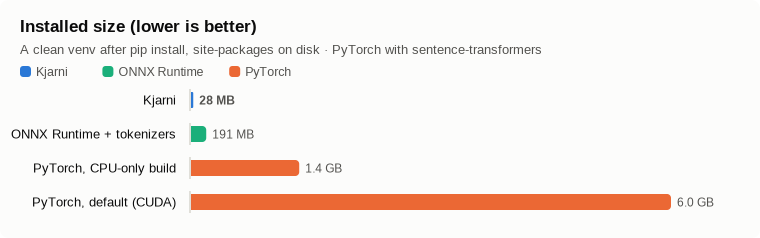
| Installed size (pip) | 28 MB | 191 MB with tokenizers | 1.4 GB CPU-only, 6.0 GB default | onnxruntime |
| License | MIT / Apache-2.0 | MIT | Apache-2.0 | Apache-2.0 |
ONNX Runtime is a general-purpose tensor executor and does that job well. Kjarni is task-level: you ask for an embedding or a ranking, not for a graph execution. That is the difference the table is describing.
Install size, start-up and speed
Kjarni's advantage is overhead: it installs in 28 MB, starts in a tenth of a second
and needs no Python. Its speed is competitive. On the CPU it's level with PyTorch, a
little ahead on some tasks and a little behind on others; on the GPU it's behind the
CUDA engines.
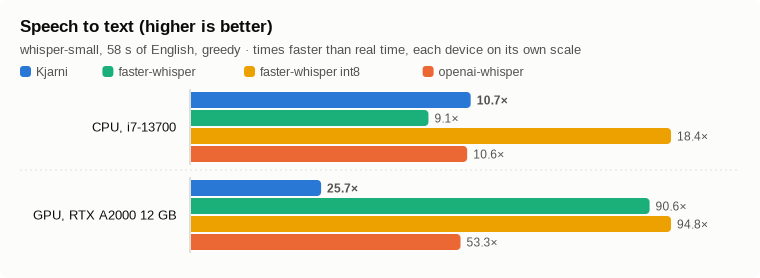
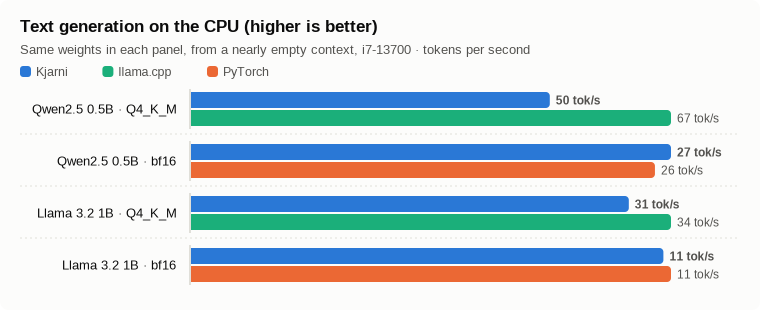
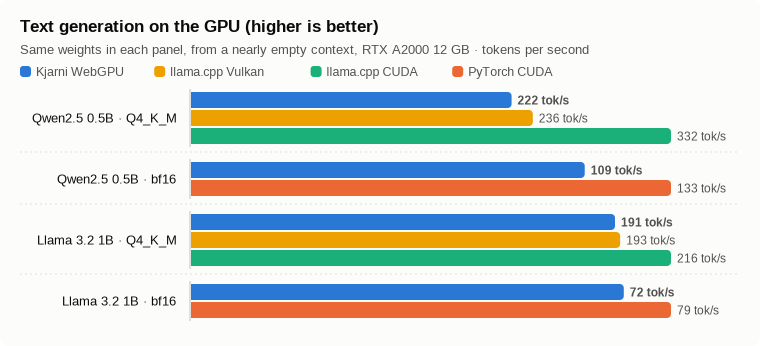
Measured against the same weights in PyTorch, ONNX Runtime, faster-whisper,
openai-whisper, open_clip and llama.cpp, each engine in its own process and at its
best thread count and precision. Quantised models are compared only with llama.cpp.
This was one machine, an i7-13700 with an RTX A2000 12 GB on Linux; Windows, macOS and
ARM haven't been benchmarked to any extent.
- Install:
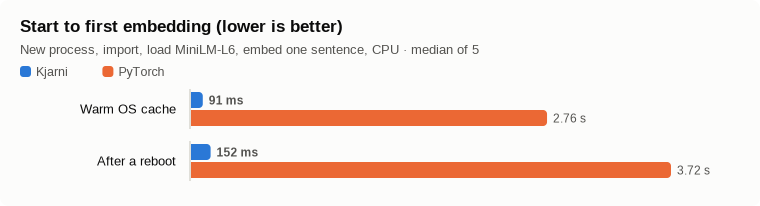
pip install kjarniis 28 MB in one package, CPU and GPU. PyTorch with sentence-transformers is 1.4 GB in 45 packages from the CPU-only index and 6.0 GB in 64 by default; ONNX Runtime with tokenizers is 191 MB in 20. - Start-up: a new Python process imports Kjarni, loads all-MiniLM-L6-v2 and returns its first embedding in 91 ms, or 152 ms with nothing in the OS file cache, as after a reboot. The same with PyTorch takes 2.8 s and 3.7 s, most of it importing torch.
- Load time: MiniLM loads in 79 ms against 478 ms for ONNX Runtime and 2.4 s for PyTorch; bge-m3 in 1.25 s against 1.30 s and 6.8 s; whisper-small in 0.42 s against 1.5 s for faster-whisper and 2.0 s for openai-whisper.
- Same answers as PyTorch: on the CPU, embeddings agree to within 1e-6 on MiniLM, mpnet and bge-m3, and within 5e-6 across rerank scores, class probabilities and CLIP. On the GPU, embeddings agree to within 2.2e-6, closer than ONNX Runtime's CUDA path at 3.8e-4. Summaries, translations and greedy chat replies come out word for word the same on the CPU, and Whisper's transcript is the same on CPU and GPU on the test clips.
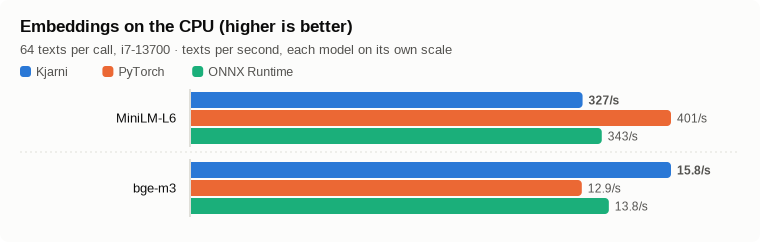
- Speed on the CPU, against PyTorch: level overall. Batches of 64 texts: PyTorch is 18% faster on MiniLM and 8% on reranking; Kjarni is 7% faster on mpnet and 23% on bge-m3; classification is level. Whisper runs at 10.7× real time against openai-whisper's 10.6×, summarization takes 1.65 s against 1.76 s, translation 625 ms against 585 ms, and CLIP indexes 65 images a second against open_clip's 70.
- Against ONNX Runtime: ONNX Runtime is 10% faster on MiniLM batches and 3% on mpnet, and faster on a single text (1.4 ms against 2.0 ms on MiniLM). Kjarni is 15% faster on bge-m3.
- Against faster-whisper: at full precision Kjarni is faster (10.7× real time against 9.1×); faster-whisper's int8 mode is faster still (18.3×).
- Generation on the CPU: with the same bf16 weights, Kjarni and PyTorch generate at the same speed (26.5 against 24.6 tokens a second on Qwen2.5 0.5B, 10.9 against 10.9 on Llama 3.2 1B), since both are limited by memory bandwidth. PyTorch processes prompts 1.5 times as fast. On the same Q4_K_M files Kjarni generates at 75% of llama.cpp's speed on Qwen2.5 0.5B and 91% on Llama 3.2 1B, and processes prompts at 91% and 64%.
- On the GPU, no CUDA: WebGPU runs on NVIDIA, AMD, Intel and Apple hardware with nothing to install. On this NVIDIA card the CUDA engines are ahead: ONNX Runtime embeds about 5 times as fast and faster-whisper transcribes 3.5 times as fast. On Q4_K_M chat models Kjarni generates at 67% of llama.cpp CUDA's speed on Qwen2.5 0.5B, 88% on Llama 3.2 1B and within 5% from 3B up,, and close to or ahead of llama.cpp's Vulkan backend; llama.cpp processes long prompts 5 to 7 times as fast. Kjarni's GPU beats its CPU by 1.8 to 4.4 times on batches, Whisper and generation.
- Memory: after a batch on the CPU, MiniLM holds 273 MB against 417 MB in ONNX Runtime and 649 MB in PyTorch. bge-m3 is the other way round, peaking at 3.4 GB against 1.9 GB and 2.4 GB, because Kjarni copies its 250,000-word vocabulary table into memory instead of leaving it mapped from disk.
GPU charts, summarization, translation, image search, method and every number: bench/BENCHMARKS.md.
Cost of the language binding
There is none you can measure. One MiniLM embedding of a short text, the worst case for a binding, through each one against the same library on the CPU:
| C | Rust | Python | Go | C# |
|---|---|---|---|---|
| 3.44 ms | 3.43 ms | 3.49 ms | 3.37 ms | 3.47 ms |
Those differences are run-to-run noise: Go comes out ahead of C, which cannot be overhead. Median of 3,000 calls, best of three runs.
What it does
Embeddings
using var embedder = new Embedder("minilm-l6-v2");
float[] vector = embedder.Encode("Hello world");        // 384 dims
float[][] batch = embedder.EncodeBatch(documents);
float sim      = embedder.Similarity("doctor", "physician");
e, _ := kjarni.NewEmbedder("minilm-l6-v2")
defer e.Close()
vector, _ := e.Embed("Hello world")
sim, _    := e.Similarity("doctor", "physician")
Semantic search over your own documents
Indexing and hybrid retrieval are built in — there is no separate vector database to run.
using var indexer = new Indexer(model: "minilm-l6-v2", quiet: true);
indexer.Create("my_index", new[] { "docs/" });

using var searcher = new Searcher(
    model: "minilm-l6-v2",
    rerankerModel: "minilm-l6-v2-cross-encoder");

foreach (var r in searcher.Search("my_index", "how do returns work?", mode: SearchMode.Hybrid))
    Console.WriteLine($"{r.Score:F4}  {r.Text}");
Search modes: Semantic (vector), Keyword (BM25), Hybrid (both, fused).
Kjarni requests an exclusive file lock for index writes. If the filesystem
reports that locking is unsupported, Kjarni proceeds without the lock, even ifwrite.lock exists. On network drives, the lock may fail to prevent concurrent
writes from different machines even when the filesystem accepts it. Keep the
index on a local drive, or make sure only one machine writes to it at a time.
Reranking
using var reranker = new Reranker("minilm-l6-v2-cross-encoder");
var ranked = reranker.Rank(query, candidates);
Classification
using var classifier = new Classifier("roberta-sentiment");
Console.WriteLine(classifier.Classify("I love this product!"));
// positive (98.5%)

using var toxic = new Classifier("toxic-bert");
Console.WriteLine(toxic.Classify("You are an idiot").ToDetailedString());
From the command line
The CLI exposes the same capabilities, reads from stdin, and writes JSON — so it pipes like any UNIX tool.
$ kjarni classify "Best purchase ever"
  ✓       POSITIVE  ████████████████████  100.0%
          NEGATIVE  ░░░░░░░░░░░░░░░░░░░░    0.0%

$ echo "Great service" | kjarni classify --format json | jq -r '.label'
POSITIVE

$ kjarni classify -q -m minilm-zeroshot --labels "sizing,shipping,price" "Arrived two weeks late"
shipping

$ kjarni index create my-docs docs/*
✓ Indexed 15 documents (39.52 KB)

$ kjarni search my-docs "keeping data safe" --top-k 3
  1. cryptography.txt
     ████████████████████  100.0%
     "Symmetric and asymmetric cryptography protect digital communications by…"

  2. tcpip.txt
     ██████████░░░░░░░░░░   49.2%
     "TCP/IP is a layered protocol suite that enables reliable data transmiss…"

$ kjarni similarity "doctor" "physician"
  █████████████████░░░   86.0%  highly similar
Supported models
Referenced by short name; the underlying HuggingFace model is listed for searchability. Models download on first use.
| Task | Kjarni name | HuggingFace model | Size |
|---|---|---|---|
| Embeddings | minilm-l6-v2 |
sentence-transformers/all-MiniLM-L6-v2 |
22 MB |
| Embeddings | mpnet-base-v2 |
sentence-transformers/all-mpnet-base-v2 |
110 MB |
| Embeddings | nomic-embed-text |
nomic-ai/nomic-embed-text-v1.5 |
137 MB |
| Embeddings (multilingual) | bge-m3 |
BAAI/bge-m3 |
567 MB |
| Question answering | distilbert-base |
distilbert-base-cased-distilled-squad |
66 MB |
| Reranking | minilm-l6-v2-cross-encoder |
cross-encoder/ms-marco-MiniLM-L-6-v2 |
22 MB |
| Sentiment (binary) | distilbert-sentiment |
distilbert/distilbert-base-uncased-finetuned-sst-2-english |
66 MB |
| Sentiment (3-class) | roberta-sentiment |
cardiffnlp/twitter-roberta-base-sentiment-latest * |
125 MB |
| Sentiment (multilingual, 5-star) | bert-sentiment-multilingual |
nlptown/bert-base-multilingual-uncased-sentiment * |
168 MB |
| Toxicity | toxic-bert |
unitary/toxic-bert * |
110 MB |
| Emotion (7-class) | distilroberta-emotion |
j-hartmann/emotion-english-distilroberta-base * |
82 MB |
| Emotion (28-class) | roberta-emotions |
SamLowe/roberta-base-go_emotions |
125 MB |
| Speech-to-text | whisper-small |
openai/whisper-small |
244 MB |
| Speech-to-text | whisper-large-v3 |
openai/whisper-large-v3 |
3.1 GB |
| Summarization | distilbart-cnn |
sshleifer/distilbart-cnn-12-6 * |
306 MB |
| Summarization | bart-large-cnn |
facebook/bart-large-cnn |
406 MB |
| Translation (English to German) | opus-mt-en-de |
Helsinki-NLP/opus-mt-en-de * |
285 MB |
| Translation (German to English) | opus-mt-de-en |
Helsinki-NLP/opus-mt-de-en * |
285 MB |
| Zero-shot (labels you choose) | minilm-zeroshot |
cross-encoder/nli-MiniLM2-L6-H768 |
328 MB |
| Named entities | distilbert-ner |
dslim/distilbert-NER |
66 MB |
| Instruction / seq2seq | flan-t5-base |
google/flan-t5-base |
250 MB |
| Instruction / seq2seq | flan-t5-large |
google/flan-t5-large |
780 MB |
* Downloaded from a safetensors conversion mirrored under olafuraron or kjarni-ai; the upstream model and its license are unchanged.
Models from the Hugging Face Hub
Any folder in the Hugging Face layout loads with --model-path in the CLI, model_path in Rust, Python and C, modelPath in C# and WithModelPath in Go: sentence encoders and classifiers (BERT, RoBERTa, XLM-RoBERTa, DistilBERT, MPNet), cross-encoders, token classifiers for named entities, decoder chat models (Llama, Qwen2, Qwen 3.5, Mistral, Phi-3, GPT-2), BART and T5 for summarization, Marian (Helsinki-NLP/opus-mt-*) and T5 for translation, and Whisper for speech. Weights can be safetensors or pytorch_model.bin, and the tokenizer can be tokenizer.json or the files the Python tokenizer reads (vocab.txt, vocab.json with merges.txt, or a SentencePiece model).
kjarni translate --model-path ./opus-mt-is-en --src is --dst en -i "Veðrið er gott í dag."
kjarni model list shows the full catalog, including the decoder LLMs (Llama 3.2, Qwen 2.5, Qwen 3.5, Mistral, Phi-3.5, DeepSeek-R1) the engine supports. Text generation runs through the same engine in every language binding, the CLI and the browser. If raw single-model generation throughput is what you are optimising for, llama.cpp is more specialised. Kjarni's lane is breadth of language and deployment rather than raw generation speed: the same engine behind a NuGet package, a Go module, a C header, a CLI binary and a WASM bundle.
FAQ
Does it need Python?
No. Kjarni is a Rust library compiled to a native shared object. There is no Python interpreter, no PyTorch, and no transformers package involved at any point. The optional Python binding lets you call Kjarni from Python — it does not make Python a dependency of the engine.
Does it work offline or air-gapped?
Yes. Models are downloaded once and cached on disk; after that, nothing touches the network. For a fully air-gapped install, pre-populate the cache directory (or point KJARNI_CACHE_DIR at it) and the engine never attempts a connection. No telemetry is collected.
Is a GPU required?
No. Every capability runs on CPU with hand-tuned SIMD kernels (AVX2/FMA on x86, NEON on ARM). GPU acceleration is optional and uses WebGPU — Vulkan on Linux, DX12 or Vulkan on Windows, Metal on macOS. CUDA is not required and not used. On the GPU, embeddings, classification, reranking and chat give the same results as on the CPU; speech to text gives the same transcript on the test clips. It is faster for batches, generation and transcription, not for one short text. Translation runs on the CPU only for now.
How does it compare to ONNX Runtime?
ONNX Runtime executes a computation graph; you supply the tokenization, the pooling, the normalization, and an exported .onnx file for every model. Kjarni is task-level: Encode(text) returns a finished, normalized embedding, and models are referenced by name with no export step. Kjarni also includes indexing, BM25, hybrid fusion, and cross-encoder reranking, which ONNX Runtime leaves to you. If you need to run arbitrary models from arbitrary frameworks, use ONNX Runtime. If you need embeddings and search in a .NET or Go application, Kjarni is considerably less work.
Can I trust the prebuilt libraries?
The NuGet package, the Go module and the Python wheels ship a native library built by
this repository's CI from the tagged commit, never uploaded by hand. From 0.2.6 on,
every release also carries a SHA256SUMS file and a signed build-provenance
attestation for each library, so you can check where a binary came from:
gh attestation verify libkjarni_ffi.so --repo kjarni-ai/kjarni
Or build it yourself: cargo build --release -p kjarni-ffi produces the same library.
Can I use it as a vector database?
For small to medium corpora, yes — the built-in index handles storage, BM25, vector search, and hybrid fusion with no separate service. It is an embedded index inside your program, not a replacement for a distributed vector store at hundreds of millions of vectors.
Does it run in the browser?
Yes. The encoder path compiles to WebAssembly and runs client-side, which means text never leaves the user's machine — it powers the Obsidian semantic-search plugin, which does all of its indexing and querying locally in the browser runtime.
Which platforms are supported?
| Platform | CPU | GPU | Status |
|---|---|---|---|
| Linux x64 | Yes | Yes (Vulkan) | Tested in CI |
| Linux ARM64 | Yes | Yes (Vulkan) | Built in CI |
| Windows x64 | Yes | Yes (DX12 / Vulkan) | Built in CI |
| macOS ARM64 | Yes | Metal | Binaries published; test coverage in progress |
| WebAssembly | Yes | n/a | Embeddings, classification, reranking, search, chat |
The only system dependency on Linux is glibc 2.17 or newer.
What license is it under?
MIT or Apache-2.0, at your option — including commercial and on-premise use.
How it works
Kjarni does not wrap ONNX, LibTorch, or any external inference engine. The runtime is written in Rust from scratch.
- Hand-tuned SIMD kernels (AVX2/FMA, NEON)
- Custom WGSL compute shaders for GPU inference
- Memory-mapped model files, read straight from the safetensors or GGUF on disk
- BF16 compute path
- Quantized weights from GGUF files: Q4_K, Q6_K, Q8_0, and Q4_0/Q5_0 converted to Q8_0 without loss
- Single shared library, no runtime linkage beyond libc
Project structure
crates/
├── kjarni/               # High-level task API (Embedder, Classifier, Searcher…)
├── kjarni-transformers/  # Engine — kernels, attention, GPU shaders, tokenizer
├── kjarni-models/        # Per-architecture models (BERT, T5, BART, Llama, Whisper…)
├── kjarni-search/        # BM25, vector, hybrid fusion
├── kjarni-rag/           # Index writer/reader, chunking, document loading
├── kjarni-ffi/           # C ABI + C#, Go, Python bindings
│   └── bindings/
├── kjarni-cli/           # Command-line tool
└── kjarni-wasm/          # WebAssembly build
The Go module and NuGet package are published from this monorepo by CI on release.
Building from source
cargo build --release -p kjarni-ffi
cargo build --release -p kjarni-cli
cargo test --workspace
Requires Rust 1.91.1 or newer.
Documentation
- kjarni.ai — quickstarts, guides, and the browser demo
- Semantic Search in C# — Without a Vector Database
- Build a Document Search Engine in C#
- Sentiment Analysis in C# — Without Python or External APIs
- Semantic Search in C++ without Python, libtorch or ONNX Runtime
- Why I Built a Native ML Inference Engine in Rust
License
MIT or Apache-2.0, at your option.
Yorumlar (0)
Yorum birakmak icin giris yap.
Yorum birakSonuc bulunamadi