agent-self-edit-gate
Health Warn
- License — License: Apache-2.0
- Description — Repository has a description
- Active repo — Last push 0 days ago
- Low visibility — Only 6 GitHub stars
Code Fail
- rm -rf — Recursive force deletion command in examples/demo.sh
Permissions Pass
- Permissions — No dangerous permissions requested
No AI report is available for this listing yet.
Policy-enforced self-edit gateway for coding agents: mutable behaviour, protected authority, verifiable receipts.
Agent Self-Edit Gate
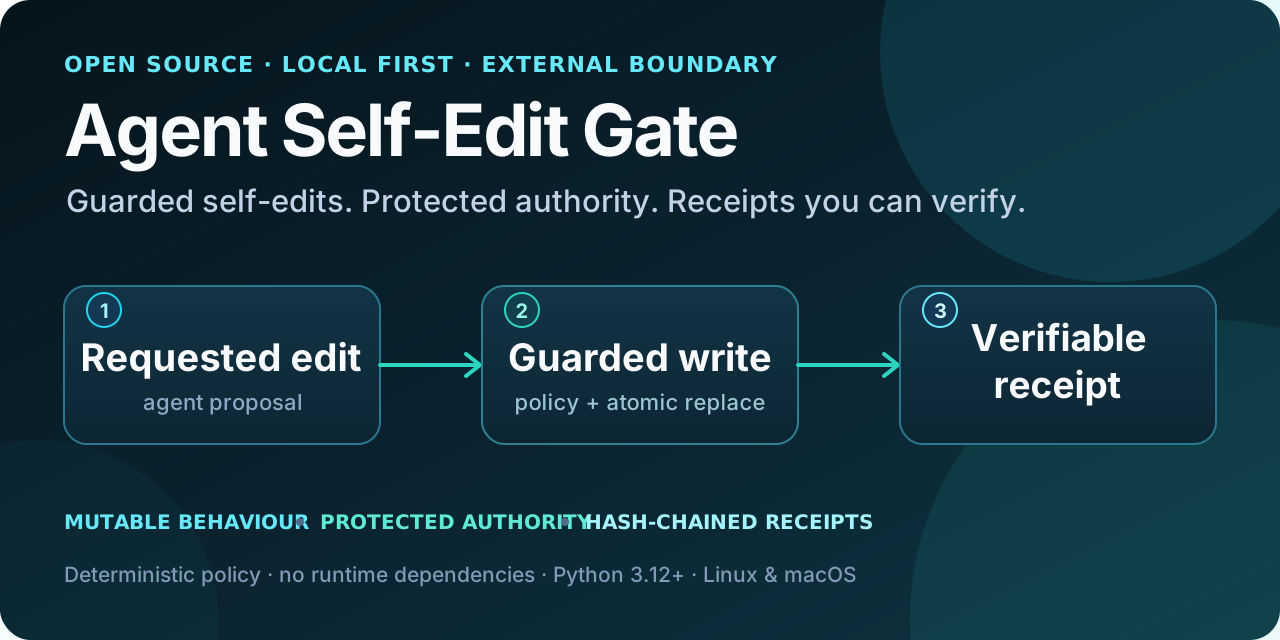
Policy-enforced self-edit gateway for coding agents: let agents improve
prompts and skills without rewriting permissions, hooks, or enforcement.
[!IMPORTANT]
The CLI is an enforcement boundary only when a sandbox, OS policy, or
protected broker makes it the agent's only writer. With unrestricted shell or
filesystem access, an agent can bypass it. Read the
threat model before deployment.



Coding-agent behaviour and authority often live side by side:
.claude/skills/reviewer/SKILL.md   behaviour: may improve
.claude/settings.json             authority: must not self-edit
.codex/agents/reviewer.toml       behaviour: may improve
.codex/config.toml                authority: must not self-edit
Agent Self-Edit Gate puts a deterministic write path between “the agent wants
to edit itself” and “the repository accepts that edit.” Policy is plain TOML;
decisions never depend on an LLM. Accepted writes are atomic and leave a
two-phase, hash-chained receipt.
15-second demo
python -m pip install "agent-self-edit-gate==0.1.1"
git clone --depth 1 --branch v0.1.1 \
  https://github.com/korovin-aa97/agent-self-edit-gate.git
cd agent-self-edit-gate
bash examples/demo.sh
The demo performs an allowed exact edit, verifies its two receipts, and proves
that a protected .github/workflows path is denied.
Install from PyPI for normal use:
python -m pip install "agent-self-edit-gate==0.1.1"
selfedit-gate --version
Quickstart
Agent Self-Edit Gate supports Python 3.12+ on Linux and macOS.
evaluation_root=$(mktemp -d)
mkdir -p "$evaluation_root/.agents"
cp profiles/generic.toml "$evaluation_root/selfedit-policy.toml"
printf '%s\n' 'Review code carefully.' > "$evaluation_root/.agents/reviewer.md"
cd "$evaluation_root"

selfedit-gate --policy selfedit-policy.toml check .agents/reviewer.md
root = "." is relative to the policy file, so copy a reviewed profile into the
repository root instead of using it in place from the cloned profiles/
directory. For an exact edit, put the one expected old fragment and replacement
in regular files:
printf '%s\n' 'Review code carefully.' > old.txt
printf '%s\n' 'Review code and cite evidence.' > new.txt
selfedit-gate --policy selfedit-policy.toml replace .agents/reviewer.md old.txt new.txt
selfedit-gate --policy selfedit-policy.toml verify-receipts
For a bounded whole-file update:
printf '%s\n' 'Review code, tests, and docs.' > proposed-reviewer.md
selfedit-gate --policy selfedit-policy.toml write \
  .agents/reviewer.md proposed-reviewer.md
printf '%s\n' 'Review all evidence.' | \
  selfedit-gate --policy selfedit-policy.toml write .agents/reviewer.md -
Add --json before the command for machine-readable success or stable error
codes. Refusals exit 2; a successful command exits 0.
See the error-code reference for automation.
Policy in one screen
schema_version = 1

[gate]
root = "."
receipt_log = ".selfedit-gate/receipts.jsonl"
max_bytes = 262144
max_changed_bytes = 65536
allow_create = false

[[zones]]
name = "behaviour"
mode = "mutable"
patterns = ["AGENTS.md", ".agents/**/*.md"]
extensions = [".md"]

[[zones]]
name = "authority"
mode = "immutable"
patterns = ["selfedit-policy.toml", ".selfedit-gate/**", ".github/**"]
Protected and immutable matches always override mutable matches. The gate also
refuses traversal, symlink components, unsupported extensions, non-UTF-8/NUL
content, oversized files/diffs, ambiguous replacement anchors, owner/type
changes, policy swaps, target races, and audit failures.
See the complete policy reference and ready-to-copy
generic, Claude Code, and
Codex profiles.
What happens on a write
The hero condenses the protocol to requested edit → guarded write → verifiable
receipt. The complete order is:
- Receive the requested edit.
- Classify its path, with deny rules taking precedence.
- Bound the content and hash the current target.
- Persist and
fsyncan intent receipt. - Recheck the policy and target identity.
- Atomically replace the target and
fsyncits directory. - Persist and
fsynca commit receipt. - Verify the result independently.
Every receipt names the exact policy, before bytes, proposed bytes, operation,
and prior receipt hash. A crash between intent and commit leaves a dangling
intent that verification refuses. Details and canonicalization rules are in
the receipt protocol.
Where enforcement comes from
| Deployment | What the gate provides | Security boundary? |
|---|---|---|
| Agent voluntarily invokes the CLI | predictable edits and local audit trail | No |
| Protected CI verifies receipts and Git diff | independent detection before merge | Yes, at merge time |
| OS-isolated writer/broker is the only process that can modify behaviour files | prevention plus receipts | Yes, at write time |
| Project-local hook the agent can rewrite | convenience interception | No |
The deployment guide describes each pattern without
pretending a CLI can sandbox its own caller.
Scope compared with adjacent tools
| Approach | Primary job | This project |
|---|---|---|
| Claude Code/Codex permissions and sandboxing | control tools and execution | uses them as an external trust anchor |
| General agent/MCP gateway | govern tool or protocol traffic | intentionally narrower; mutates repository files |
| Skill registry/package manager | distribute and scan skills | edits already-installed behaviour under local policy |
| Git branch protection/CODEOWNERS | review and merge governance | supplies file-level mutation receipts before review |
The dated landscape check cites direct sources and
explains the positioning. This is not a generic “AI firewall.”
Security limits
- Receipts are tamper-evident hash chains, not signatures or identities.
- Allowed prompt content can still be malicious; the gate controls where and
how much, not semantic safety. - Network filesystems and Windows are unsupported in v0.1.
- v0.1 has not received an independent professional security audit.
- Recovery from a dangling intent is deliberately manual.
Please use GitHub private vulnerability reporting, not a public
issue, for suspected vulnerabilities.
Development
git clone https://github.com/korovin-aa97/agent-self-edit-gate.git
cd agent-self-edit-gate
uv sync --all-groups
uv run ruff check .
uv run ruff format --check .
uv run mypy src tests
uv run pytest --cov=selfedit_gate --cov-report=term-missing
uv build
The runtime has no third-party dependencies. See CONTRIBUTING.md,
the changelog, and the public roadmap.
Origin and license
Built from operating a mixed Claude/Codex production fleet, then extracted as a
narrow standalone tool without fleet orchestration, telemetry, or hosted
control plane.
Licensed under Apache-2.0.
Reviews (0)
Sign in to leave a review.
Leave a reviewNo results found