ctxfire
Health Uyari
- License — License: MIT
- Description — Repository has a description
- Active repo — Last push 0 days ago
- Low visibility — Only 7 GitHub stars
Code Gecti
- Code scan — Scanned 12 files during light audit, no dangerous patterns found
Permissions Gecti
- Permissions — No dangerous permissions requested
Bu listing icin henuz AI raporu yok.
Static cost analyzer for multi-agent context graphs: explain what agents load and estimate tokens per fire and per day.
ctxfire
See what each configured coding agent can load, why it is included, and what
that repeated context could cost.
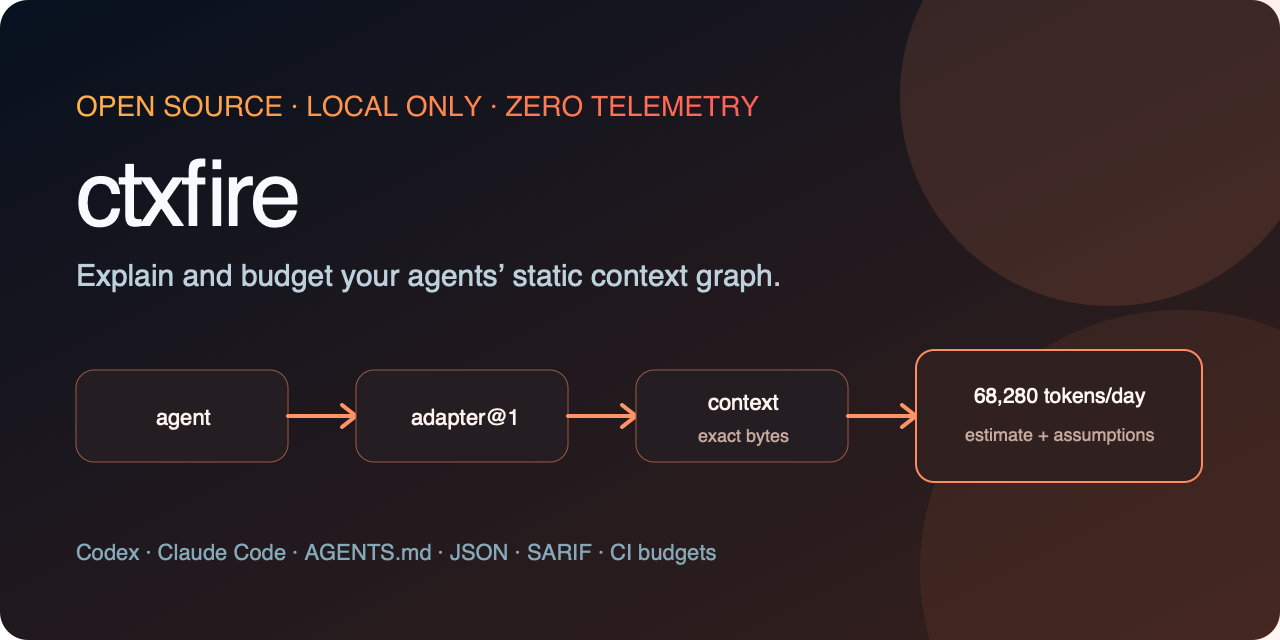
ctxfire is a local, telemetry-free static analyzer for multi-agent context
graphs. It connects agent definitions to repository instructions, rules, and
skills; multiplies the estimated input by each agent's schedule; and keeps every
assumption visible.
Illustrative output (exact byte sizes plus estimates under declared
assumptions):
implementer [codex@1]
  context candidates: 3 files, 18120 exact bytes/fire
  estimate: 3810 tokens/fire × 8/day = 30480 tokens/day
reviewer [claude-code@2]
  context candidates: 4 files, 22644 exact bytes/fire
  estimate: 4725 tokens/fire × 8/day = 37800 tokens/day

TOTAL estimated tokens/day: 68280
This is not a runtime meter or an invoice calculator. File sizes are exact;
tokens, conditional activation, cache behavior, schedules, and API-equivalent
prices are estimates recorded in every report.
Why another context-cost tool?
Most repository analyzers ask, “How large is this codebase?” Runtime meters ask,
“What did this one session consume?” ctxfire asks a different question:
What is the transitive instruction surface of each agent, and what happens
when the team loads it repeatedly every day?
The unit of analysis is agent → loading rule → context file → schedule, not a
flat repository walk.
Quickstart
The runtime requires Python 3.11+ and Git. Install the published package withpipx (recommended) or another Python package manager:
pipx install 'ctxfire==0.2.0'
ctxfire --version
curl -fsSLo ctxfire.toml \
  https://raw.githubusercontent.com/korovin-aa97/ctxfire/v0.2.0/ctxfire.example.toml
ctxfire scan
The downloaded file is a template: edit the agent names, schedules, working
directories, and context paths before treating its estimates as meaningful.
Missing example paths are reported as warnings rather than silently ignored.
Or run without a persistent install:
uvx --from 'ctxfire==0.2.0' ctxfire scan --config ctxfire.toml
For a no-edit smoke test from a source checkout, scan ctxfire itself:
uvx --from 'ctxfire==0.2.0' ctxfire scan \
  --config examples/ctxfire-self.toml
The dated self-scan
records the config, output, commit, and limitations.
Start from ctxfire.example.toml:
schema_version = "1"

[project]
name = "my-agent-team"
root = "."
bytes_per_token = 4.0
tokenizer = "byte-estimate"
model = "unspecified"
price_date = "unspecified"
cache_assumption = "no-cache-credit"
conditional_activation_rate = 0.25

[[agents]]
name = "implementer"
adapter = "codex@1"
working_directory = "."
fires_per_day = 8
include = ["docs/product-rules.md"]
conditional = ["docs/playbooks/**/*.md"]
usd_per_million_input_tokens is optional. Add it only with a model and a
dated price you have verified. ctxfire deliberately ships no silently aging
vendor price table.
Commands
# Human report
ctxfire scan --config ctxfire.toml

# Stable schema 1.1 snapshot
ctxfire scan --format json --output before.json

# Why is each edge present?
ctxfire explain --agent implementer
ctxfire explain --file AGENTS.md

# Attribute change between snapshots
ctxfire diff before.json after.json

# CI: exit 2 only when a budget is exceeded
ctxfire check --max-tokens-per-day 75000

# GitHub-compatible SARIF
ctxfire check --max-tokens-per-day 75000 --format sarif --output ctxfire.sarif
Exit codes are stable: 0 success/pass, 1 invalid input or operational error,
and 2 a valid scan that exceeded a check budget.
Exact versus estimated
| Field | Kind | Meaning |
|---|---|---|
| relative path, file presence, byte size | Exact | Facts from the local working tree |
| adapter and inclusion reason | Declared model | Versioned loading semantics used for the graph |
| tokens | Estimated | ceil(bytes / bytes_per_token) by default, or an opt-in local tokenizer count |
| conditional activation | Estimated | User-provided rate from 0 to 1 |
| fires/day | Assumption | Planning input; ctxfire is not a scheduler |
| USD/day | Estimated equivalence | Dated input-token price × estimated tokens; not a bill |
| cache | Assumption | Stated in the report; ctxfire does not observe cache hits |
The default byte estimator is dependency-free and reads only file sizes for the
metadata-only adapters. claude-code@2 locally reads matched rule, skill, and
subagent Markdown to derive frontmatter and catalog components; it never prints,
retains, or uploads that content. The byte ratio remains less accurate than a
model-specific tokenizer—especially for non-English text and code-heavy files.
For an opt-in local tokenizer:
pipx install 'ctxfire[tokenizers]'
Then set tokenizer = "tiktoken:cl100k_base" (or another explicit tiktoken
encoding). The report records the installed tokenizer version and changesdiscovery.content_access to matched-file-content-local. Matched bytes are
read only in memory; they are never printed, stored, or uploaded.
Supported adapters
| Adapter | Always-on context | Conditional candidates |
|---|---|---|
explicit@1 |
include patterns |
conditional patterns |
agents-md@1 |
ancestor AGENTS.md chain for working_directory |
configured patterns |
codex@1 |
precedence-selected ancestor instruction chain, under a declared byte cap | ancestor .agents/skills/*/SKILL.md bodies |
claude-code@1 |
ancestor project memory and conservative project rules | descendant memory and project skill bodies |
claude-code@2 |
ancestor project memory, unscoped rules, skill/subagent catalogs; selected subagent definition and preloaded skills | paths:-scoped rules, descendant memory, full skill bodies |
claude-code@1 remains available as the metadata-only compatibility model. Useclaude-code@2 for content-aware Claude projects. Omit claude_subagent for a
main session; set claude_subagent = "reviewer" to model an invocation or a
session started with that project subagent, including its declared skills:
preloads. A complete synthetic fixture lives inexamples/claude-v2.
Adapters are conservative static models, not claims that every candidate is
loaded on every invocation. Details, source links, and known uncertainty are indocs/ADAPTER_SPEC.md.
Git-aware and private by default
- Uses
git ls-files --cached --others --exclude-standardat a Git top-level. - Includes tracked files and non-ignored untracked files; ignored build output
does not silently inflate the graph. - Probes only known exact engine instruction paths and exact configured paths
outside that universe, so an ignoredCLAUDE.local.mdis still counted and
clearly warned without opening arbitrary ignored trees. - Skips symlinks rather than following them outside the repository.
- Skips submodule gitlinks and missing/non-regular paths with a warning.
- Emits repository-relative paths, never an absolute workstation path.
- Default byte mode reads file metadata only unless an adapter explicitly
declares local metadata parsing.claude-code@2and the optional tokenizer
read only matched files locally; no mode makes network calls, emits telemetry,
uploads content, or invokes a model.
For non-Git directories, a clearly reported conservative filesystem fallback is
used. See docs/PRIVACY.md
and docs/DISCOVERY.md.
CI example
- name: Enforce agent context budget
  run: |
    pipx install 'ctxfire==0.2.0'
    ctxfire check --max-tokens-per-day 75000 \
      --format sarif --output ctxfire.sarif
Pin a package version in CI. ctxfire diff also lets reviewers see
whether a context-cost increase came from a new file, a removed file, or a size
change.
Current limitations
- The default byte-ratio estimator is intentionally approximate. The optional
tiktoken backend is more repeatable for a named encoding but still does not
prove which tokenizer a hosted agent runtime used. claude-code@2classifies each rule from top-levelpaths:frontmatter, but
weights all path-scoped rules with the configured aggregate activation rate;
it does not observe which project files a real session opens.- Skill support files, Markdown
@imports, settings overrides, MCP servers,
hooks, and auto-memory are not inferred. Add repository-authored support
files explicitly when they matter to the budget. - User-level/global engine instructions are outside the project root and are
intentionally not scanned. - Submodule contents and symlink targets are not traversed.
- Subscription quotas, tool output, conversation history, cached-token billing,
output tokens, and runtime prompt construction are outside scope.
Development
python -m venv .venv
. .venv/bin/activate
python -m pip install -e '.[dev]'
ruff check .
mypy src
pytest
python -m build
The report contract is public API. Schema changes require a new schema version,
fixture updates, and a changelog entry.
See the deterministic before/after demo
for a small, inspectablediff walkthrough.
Questions about bills, privacy, shared files, rules, symlinks, or prices are
answered in the FAQ.
If a supported adapter includes or misses a file you did not expect, please
open an adapter report.
The config and ctxfire explain output are useful; repository contents are not
needed and should not be attached.
The default package has no runtime dependencies; the optional tokenizer stack
and its licenses are recorded in the
dependency review.
Project status
v0.2.0 adds the first content-aware Claude Code adapter in response to an
external evaluation while keeping claude-code@1 unchanged. The analyzer was
also exercised against 18 unrelated public repositories;
the dated methodology and results live indocs/VALIDATION.md.
Contributions are welcome—seeCONTRIBUTING.md
and the extension guide.
Built from operating a mixed Claude/Codex production fleet. The analyzer is a
clean, generic extraction: no private fleet configuration or telemetry is
included.
MIT © 2026 Alexander Korovin.
Yorumlar (0)
Yorum birakmak icin giris yap.
Yorum birakSonuc bulunamadi