Sonder-runtime
Health Warn
- License — License: Apache-2.0
- Description — Repository has a description
- Active repo — Last push 0 days ago
- Low visibility — Only 5 GitHub stars
Code Fail
- Hardcoded secret — Potential hardcoded credential in admin_auth.py
Permissions Pass
- Permissions — No dangerous permissions requested
No AI report is available for this listing yet.
Sonder Runtime — private-first GPU-backed AI orchestration, grounded execution, web tools, memory, and adaptive learning.
Sonder Runtime

Your models. Your memory. Your machine.
Sonder is a private, adaptive AI runtime that brings models, memory, tools,
agents, and optional training into one local-first system. It runs around an
Ollama model rather than shipping model weights itself, so you can choose the
model and hardware that fit your needs.





Why Sonder
- Private by default. Local models, embeddings, memory, and tools stay on
your machine. Web, remote Ollama, and cloud tiers require separate opt-ins. - Learns from real outcomes. Sonder stores what worked after a compile,
test, or user judgment, then retrieves relevant lessons for later work. - Useful beyond chat. Guarded file tools, code execution, repository
inspection, research, artifacts, and bounded agent fleets share one runtime. - Model and hardware agnostic. Use the Ollama model that fits your CPU,
NVIDIA/AMD/Intel GPU, Apple unified memory, or mixed-device setup. - Available where you work. Use the desktop/mobile app, terminal REPL,
OpenAI-compatible API, MCP tools, or a private remote server. - Inspectable and recoverable. Activity evidence, policy gates, backups,
transactional operations, and rollback paths are built into the workflow.
How it fits together
App / terminal / API / MCP
            |
            v
Sonder Runtime
policy + memory + tools + agents + training control
            |
            v
Ollama
model storage + CPU/GPU inference
- Retrieval — hybrid lexical (SQLite FTS5) + semantic (local embeddings), with a relevance threshold so only genuinely on-topic lessons are injected (irrelevant lessons hurt, so it injects nothing when nothing fits).
- Capture — every learning call is logged locally to
memory.db. - Grounding — you (or your fleet) call
record_outcomewith a real signal; execution outcomes are the reward. - Reflection — a good outcome distills a deduped one-line lesson future prompts can retrieve.
The loop is model-agnostic: point it at a compatible Ollama model. The selected
local code model is memory-augmented; a stronger paid/cloud model can answer
without local-lesson injection while its grounded good outcomes are distilled into
lessons and fine-tuning data the local model retrieves later. Which
tiers learn is configurable (SONDER_LEARN_TIERS, default local aliases:fast,code,general). Memory, capture, and distillation stay on the runtime host.
A cloud-tier prompt leaves only after SONDER_ALLOW_CLOUD=1. The fast, code,
and general aliases use loopback Ollama by default; pointing OLLAMA_HOST at a
non-loopback server is blocked unless SONDER_ALLOW_REMOTE_OLLAMA=1 explicitly
acknowledges that prompts and embeddings leave this machine. Remote Ollama and
hosted/cloud consent are separate gates. Their shared mappings
and each execution lane's preferred alias live in the hot-reloadable runtime
policy described below. Environment values seed the first policy file; cloud
aliases and cloud opt-in remain separate host-owned configuration.
Loopback model requests use one bounded, same-model retry by default for narrowly
transient transport failures and HTTP 408/429/502/503/504 responses. The retry
shares the original timeout budget, checks fleet cancellation before resending,
and never changes endpoint, model, or tier. Hosted/cloud calls are always
single-attempt to avoid silently duplicating metered work. SetSONDER_LOCAL_RETRIES=0..2 and SONDER_LOCAL_RETRY_DELAY_MS=0..1000 to tune the
loopback policy. Explicit remote Ollama and hosted/cloud calls are single-attempt.
One extra attempt exists on top of that policy, and only for a classified
context overflow. The gateway reads the failure text - never the HTTP status,
which providers and proxies get wrong often enough that a real overflow can
arrive as a 429 - and if it says the prompt did not fit, a loopback call may
compact the prompt once and resend it inside the same timeout and cancellation
budget. Compaction drops the oldest turns and leaves a short in-band note, the
same discipline the session live-turn window already uses; it never rewrites or
truncates a message, and it never raises num_ctx behind the context policy's
back. A request that is one oversized turn has nothing safe to drop and is
reported rather than retried. Body-too-large, device out-of-memory, plain rate
limits, and missing models are recognised as explicitly not overflow and are
never retried this way. Hosted and remote routes keep their single-attempt
posture unless the call site declares the request idempotent andSONDER_HOSTED_OVERFLOW_RETRY=1 is set.
Good-outcome lesson reflection does not queue another model request behind an
active fleet: the outcome is committed immediately and its lesson remains
retryable. When the fleet is idle, reflection uses a separate shared generation
and embedding budget (SONDER_DISTILLATION_TIMEOUT, default 20 seconds,
bounded by SONDER_TIMEOUT) so record_outcome cannot inherit the normal
five-minute model-call ceiling.
Sonder is a runtime, not a foundation model. Names such assonder:latest are local Ollama aliases; the underlying weights remain managed
by Ollama. Ollama is the local model server.
Model requirements
You do not need every model or every tier in the catalog.
| What you want to use | What must be available locally |
|---|---|
| Normal REPL, API chat, and code work | Ollama plus one generative local model. Bootstrap or setup_alias.py chooses/pulls that base model and exposes it as sonder:latest. The fast, code, and general roles can all share it. |
| Semantic memory, lesson recall, and vector search | An embedding model as well (the bootstrap default is nomic-embed-text). Core chat still starts without one, but those semantic features are unavailable until an embedding model is configured. |
| Image or screenshot analysis | An explicitly configured local vision-language model; it is only needed when using a vision-capable feature. |
| Separate reasoning, reranking, extraction, tool-oriented, speech, or experimental model families | Optional specialist models. Install and bind them only when the matching feature is enabled and supported. |
| Cloud tiers | No local download, but explicit cloud opt-in is required and prompts leave the machine for those calls. |
The bootstrap and setup_alias.py intentionally try to pull both a base
model and the default embedding model so a new local installation has memory
enabled out of the box. The generative base model is required; if the optional
embedding pull is unavailable, bootstrap still creates sonder:latest and
explains how to enable recall/lessons later. See the
Model Catalog for tier bindings and the
collection runbook for specialist
setups. Use setup_alias.py --no-embedding when you intentionally want the
smallest chat-only installation.
Installing a tag only puts a model in Ollama's catalog; it does not by itself
enable a Sonder feature. Bind supported models through/runtime set ...and
use the matching tool or route. A downloaded speech or reranker tag remains
optional until Sonder has a provider-backed integration for that capability.
Verify and choose your models
All read-only. Run these after bootstrap, or any time a model-related error
looks like configuration rather than capability.
ollama list                          # what the provider actually has
ollama show sonder:latest            # prove the stable alias exists
python -m sonder_runtime doctor      # config, runtime policy, Ollama reachability
python -m sonder_runtime preflight   # startup checks without binding a port
In the REPL, /model lists every selectable tier plus the installed tags and
switches this session (/model general, /model qwen2.5-coder:7b); /runtime
shows the shared tier→model and lane→tier policy with a readiness summary, and/runtime set code=<installed-model> rebinds it for every surface.
Missing models degrade rather than crash: an unbound reasoning/vision tier
is simply not offered and the router falls back to a base tier, a missing
embedding model disables semantic recall while chat and lexical retrieval keep
working, and a cloud-* tier is withheld entirely until you opt in. Ifsonder:latest itself is gone, re-run setup_alias.py. Full behavior table,
per-surface commands, and the local-vs-cloud gates:
Model Requirements & Onboarding.
Quick start
The app-latest badges are a mutable prerelease snapshot. They may lag main
and are not a versioned, release-ready build. Versioned app-vX.Y.Z releases
must pass the repository's version, artifact-integrity, SBOM, and provenance
gates.
Packaged app or bundled runtime
Run the one-time bootstrap from the extracted bundle. It starts Ollama and
chooses a compatible local model. A bundle is intentionally self-contained:
it does not modify your shell PATH. Use its launcher directly, or add
the bundle directory to PATH yourself if you want to invoke sonder by
name in later terminals.
# Windows PowerShell, from the installed bundle
.\bootstrap-engine.cmd
.\sonder.cmd
# Linux/macOS, from the installed bundle
./bootstrap-engine.sh
. ./sonder-runtime.sh
"$SONDER_PYTHON" -m sonder_runtime repl
From source
Install and start Ollama first. The following command
blocks create a virtual environment, install the runtime, configure the localsonder model alias, and open the REPL.
# Linux/macOS
git clone https://github.com/Krilliac/Sonder-runtime.git
cd Sonder-runtime
python3 -m venv venv
./venv/bin/pip install -r requirements-runtime.txt
./venv/bin/python setup_alias.py
./venv/bin/python -m sonder_runtime repl
# Windows PowerShell
git clone https://github.com/Krilliac/Sonder-runtime.git
Set-Location Sonder-runtime
python -m venv venv
.\venv\Scripts\pip.exe install -r requirements-runtime.txt
.\venv\Scripts\python.exe setup_alias.py
.\venv\Scripts\python.exe -m sonder_runtime repl
packaging\install_workstation_local.ps1 automates the venv/install/preflight
steps above in one idempotent command; see
install-workstation-local.
For a Linux loopback service install that provisions Ollama, its local model,
and systemd in one step, run bash deploy_sonder.sh --serve as root from a
source checkout. Use the production installer and TLS runbook for non-loopback
hosting.
Launch and use
After an installation has added a sonder launcher to your PATH, simply
type sonder in Bash or PowerShell. (On Windows, sonder resolves tosonder.cmd; an extracted bundle alone is not a PATH installation.) From a
source checkout or an extracted POSIX bundle, use the explicit command below.
In either case, ask normally; type /help for guarded commands and use the
visible composer shortcuts for history and editing.
sonder
# or, from this source checkout:
python -m sonder_runtime repl
# sonder > explain this repository's test layout
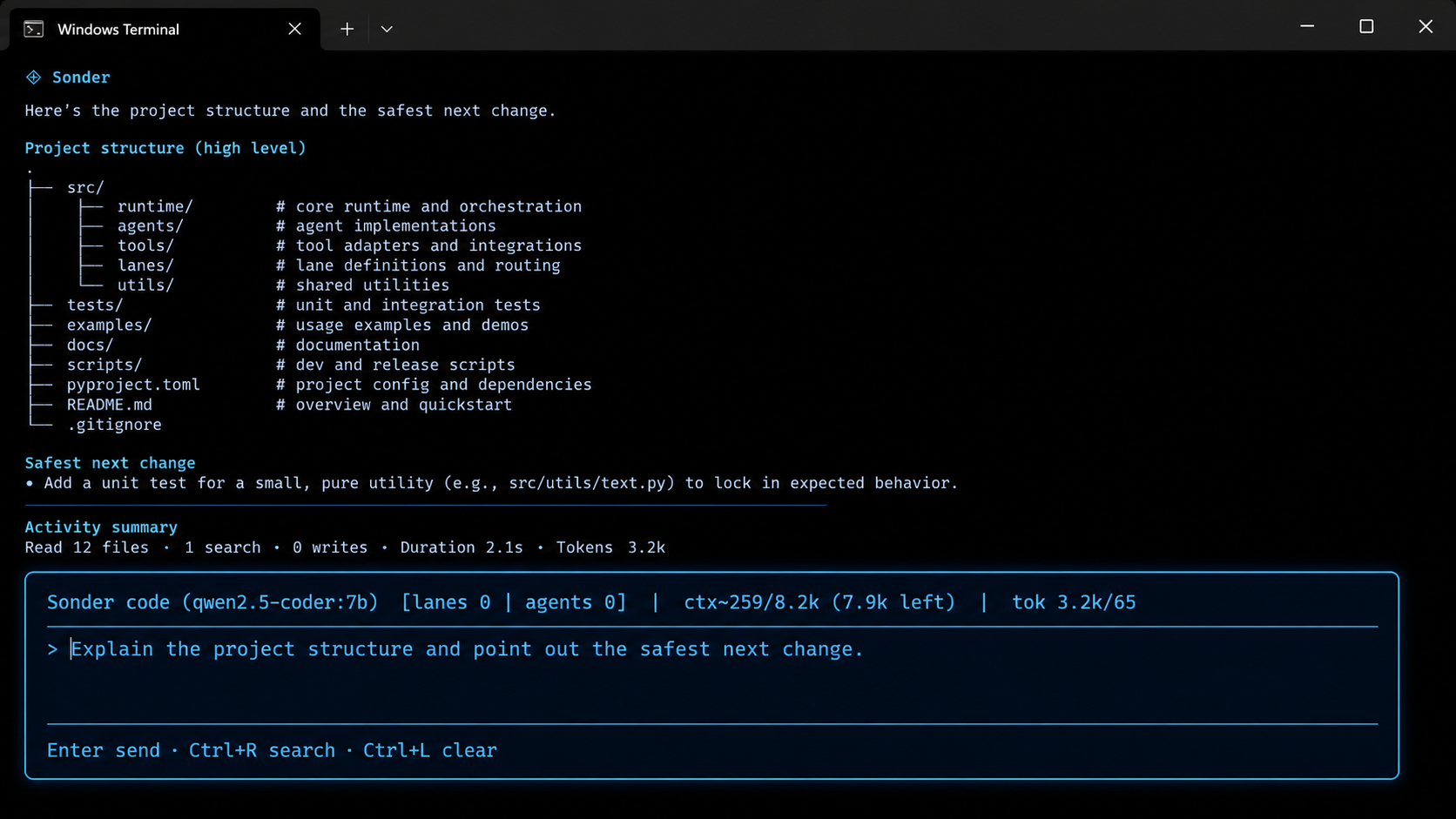
The terminal REPL keeps the current model, active lanes, context budget, token
usage, and elapsed time visible while you work. Type normally, use /help to
discover guarded commands, and use /model <tag-or-tier> to choose an
installed chat model. /sessions lists past threads with age and project,/replay [id|title] [N] re-renders a stored thread read-only, and/resume <id|title> continues one. Known failures add a one-line hint:
under the interactive error panel; piped output stays plain and script-safe,
and SONDER_REPL_NDJSON=1 opts a piped session into one JSON line per turn
(schema sonder.repl-turn.v1).
Check or update this source checkout
The REPL banner shows its loaded and newest known source revisions without
network I/O. Use /updatecheck to refresh the canonical origin/main ref and
report the installed/newest commit and timestamps. /update is a guarded
fast-forward for a clean checkout on main with the canonical Sonder remote;
it refuses feature branches, local commits, and dirty trees. Restart Sonder
after a successful source update. These REPL commands are separate from the
signed release-manager commands documented in the update guide.
If local workflow edits make a source checkout dirty, /stash shows the
recovery state; /stash save preserves tracked edits, /stash save-untracked
also preserves generated files, and /stash pop restores the most recent
recovery stash only onto a clean canonical main checkout. Saved workflows
now live in the normal per-user state directory (for example,%LOCALAPPDATA%\sonder\workflows.json on Windows), so new workflow saves no
longer dirty an installed source tree. Existing root workflows.json files are
copied once on first use; the original is left untouched for review.
Start the loopback OpenAI-compatible API in a second terminal when another
client needs it. Run doctor first if this is a new machine.
python -m sonder_runtime doctor
python -m sonder_runtime serve
curl http://127.0.0.1:11435/v1/chat/completions \
  -H "Content-Type: application/json" \
  -d '{"model":"sonder","messages":[{"role":"user","content":"Hello"}]}'
# PowerShell equivalent (run after `python -m sonder_runtime serve`)
$body = @{
  model = "sonder"
  messages = @(@{ role = "user"; content = "Hello" })
} | ConvertTo-Json -Depth 4
Invoke-RestMethod http://127.0.0.1:11435/v1/chat/completions `
  -Method Post -ContentType "application/json" -Body $body
For a source checkout, prefix the commands with the venv Python shown above;
for example ./venv/bin/python -m sonder_runtime serve or.\venv\Scripts\python.exe -m sonder_runtime serve. For an MCP client, runpython -m sonder_runtime mcp. See the
getting-started guide,
HTTP API reference, and
CLI reference for configuration,
authentication, hosting, and full command details.
What you get
| Area | Highlights |
|---|---|
| Models | Local fast/code/general tiers, explicit cloud fallbacks, model routing |
| Memory | Hybrid retrieval, project scoping, grounded lessons, preferences |
| Tools | Guarded files, repositories, code, data, web, artifacts, office formats |
| Agents | Single agent, durable autopilot, bounded parallel fleets, cancellation |
| Apps | Windows, Linux, macOS, Android, terminal, API, and MCP clients |
| Operations | Activity evidence, backups, recovery, signed updates, live reload |
| Personalization | Optional adapter training with validation, deployment, and rollback |
Honest boundaries
- A small local model is not a frontier model. Give it the facts, delegate
bounded transformations, and review its work. - Learning is grounded only when a caller records a real outcome; self-graded
success is not treated as proof. - Remote access is powerful because Sonder can execute code and modify files.
Never expose the convenience loopback service directly to a network. - Multi-PC inference is supported with
SONDER_OLLAMA_WORKERS: each host runs
its own Ollama/model store and Sonder schedules requests across HTTPS worker
origins with bounded transport failover. This is request-level pooling, not
model-weight sharding or shared-memory GPU federation. - Deliberately unrestricted model testing is available only through the
exact-acknowledgement unsafe lab runbook. It
removes model-loop host-tool policy; it does not provide OS isolation. - NPU support is an optional utility path for compatible routing or embedding
work; token generation remains on the model server's CPU/GPU path.
Documentation
- Getting started
- Architecture
- Configuration
- Agent, autopilot, and fleets
- Models and gateways
- Model requirements and onboarding
- Tools and languages
- Natural-language tool calling
- Natural-language capability queries
- Training
- Client and private hosting
- Developer SDK contracts and plugin manifests
- Unsafe lab model testing
- Runbooks
- Full wiki
Security and contributing
Read SECURITY.md before enabling remote access. Use the
server-private profile behind TLS and report vulnerabilities privately through
GitHub's Security tab.
Optional direct MCP container execution is documented in
docs/security/ISOLATED_EXECUTION.md. It
uses a fixed Docker/Podman policy and is stronger than local run_code, but it
still relies on the external runtime and host kernel and is not escape-proof.
Contributions are welcome under the Apache License 2.0. See
CONTRIBUTING.md for the development and review workflow.
- WP1 Forty-Fifth Slice: the HTTP chat usage presentation helper now lives in
sonder_runtime.adapters.observability.chat_formatting. - WP1 Forty-Sixth Slice: the pure REPL duration presentation helper now lives in
sonder_runtime.adapters.observability.repl_formatting. - WP1 Forty-Seventh Slice: the active architecture legacy-root policy now covers only roots with live package callers;
autopilot_storeis migration-only. - WP1 Forty-Eighth Slice: pure HTTP command-completion limit normalization now lives in
sonder_runtime.adapters.command_completion. - WP1 Fifty-First Slice: pure runtime model-readiness presentation now lives in
sonder_runtime.adapters.runtime_readiness_formatting. - WP1 Fifty-Second Slice: pure run-result presentation now lives in
sonder_runtime.adapters.observability.run_result_formatting. - WP1 Fifty-Fifth Slice: the Ollama gateway now reads its endpoint through the packaged
sonder_runtime.adapters.ollama.endpointboundary; the remaining server model-routing dependency is explicit. - WP1 Fifty-Fourth Slice: pure goal presentation now lives in
sonder_runtime.adapters.goal_formatting. - WP1 Fifty-Sixth Slice: pure learning-tier model/provider presentation now lives in
sonder_runtime.adapters.learning_tier_formatting. - WP1 Sixty-Seventh Slice: the embedding-cache adapter now consumes database paths through
sonder_runtime.platform.paths. - WP1 Fifty-Seventh Slice: the import-time model/tier seed now has a typed immutable projection in
sonder_runtime.domain.runtime_model_configuration; server compatibility aliases and live policy refresh remain intact. - WP1 Fifty-Eighth Slice: Ollama process-lifecycle policy now lives in the packaged
sonder_runtime.adapters.ollama_lifecycleboundary; the root module remains a compatibility import. - WP1 Fifty-Ninth Slice: the live cloud-default compatibility repair now consumes its replacement from the frozen typed runtime-model configuration projection.
- WP1 Sixtieth Slice: the root Ollama lifecycle compatibility import now exposes only the packaged adapter's two public helpers; private process and trust hooks remain package-internal.
- WP1 Seventy-Fifth Slice: the filesystem workbench now consumes the canonical
sonder_runtime.platform.loggingseam, preserving handler setup and redaction semantics. - WP1 Eighty-First Slice: filesystem operations now consume the canonical
sonder_runtime.platform.pathsseam, preserving default-home resolution and containment semantics. - WP1 Seventy-Seventh Slice: local observability now consumes the canonical
sonder_runtime.platform.loggingseam, preserving logger identity and redaction semantics.- WP1 Seventy-First Slice: the packaged preference adapter now resolves its default memory database path through
sonder_runtime.platform.paths.
- WP1 Seventy-First Slice: the packaged preference adapter now resolves its default memory database path through
- WP1 Sixty-First Slice: the preflight adapter now consumes
SonderConfigthroughsonder_runtime.platform.config, preserving the root implementation's environment/default semantics while reducing a package caller's root dependency. - WP1 Sixty-Fourth Slice: the HTTP interface now reads the API-key policy through
sonder_runtime.platform.config, preserving the canonical configuration defaults and environment-backed implementation. - WP1 Sixty-Third Slice: the packaged entrypoint now consumes typed configuration through
sonder_runtime.platform.config, preserving the historicalsonder_pathscompatibility attribute. - WP1 Sixty-Sixth Slice: the evaluation-history adapter now consumes state locations through
sonder_runtime.platform.paths, preserving existing path resolution and migration behavior. - WP1 Sixty-Eighth Slice: local-system packaging now proves that retired
eval_history.pyis excluded while the canonical evaluation-history store and application package are included. - WP1 Sixty-Ninth Slice: the runtime-policy adapter now consumes its state-file path through
sonder_runtime.platform.paths, preserving explicit policy-path overrides and legacy home resolution. - WP1 Seventieth Slice: the packaged HTTP lifecycle now consumes the shutdown coordinator through
sonder_runtime.platform.shutdown, preserving the root implementation and all drain semantics. - WP1 Seventy-Second Slice: the packaged HTTP lifecycle now consumes
MetricsRegistrythroughsonder_runtime.platform.metrics, preserving metric names, labels, and semantics. - WP1 Seventy-Fourth Slice: the packaged backup adapter now consumes build identity through
sonder_runtime.platform.version, preserving stamped version and commit metadata. - WP1 Sixty-Fifth Slice: the read-only doctor checks now load typed configuration through
sonder_runtime.platform.config, preserving diagnostic output and error handling. - WP1 Fiftieth Slice: the active architecture legacy-root policy now excludes
fleet_store; its root alias remains only for immutable migration replay.
WP1 Seventy-Eighth Slice: the packaged NPU manifest adapter now resolves its manifest directory through the canonical platform path seam.
WP1 Seventy-Ninth Slice: the NPU service now resolves its shadow-ledger state file through the canonical platform path seam.
WP1 Eighty-Eighth Slice: the operations store now consumes redaction through the canonical sonder_runtime.platform.logging seam, preserving durable event persistence semantics.
WP1 Ninetieth Slice: the strangler unit-of-work now resolves its default memory database through sonder_runtime.platform.paths, preserving the live memory-store port and explicit path overrides.
WP1 Ninety-First Slice: the filesystem workbench now resolves its Bash executable through sonder_runtime.platform.paths, preserving workspace resolution and containment semantics.
WP1 Eighty-Ninth Slice: the migrations adapter now resolves the operations database through the canonical sonder_runtime.platform.paths seam; immutable migration replay and database locations are unchanged.
WP1 Eightieth Slice: the packaged secret-rotation adapter now resolves its default rotation state through the canonical platform path seam.
WP1 Eighty-Second Slice: the update engine now reads build identity through the canonical platform version seam; signed-update verification and release metadata behavior are unchanged.
WP1 Eighty-Third Slice: workflow persistence now resolves its mutable state home through the canonical platform path seam; workspace overrides, containment, legacy migration, and atomic writes are unchanged.
WP1 Eighty-Fourth Slice: the update service now reads build identity through the canonical platform version seam; bundle metadata and signed-update verification behavior are unchanged.
WP1 Eighty-Sixth Slice: fleet persistence now resolves its database and principal-credential paths through the canonical sonder_runtime.platform.paths seam; SQLite and migration semantics are unchanged.
- WP1 Eighty-Seventh Slice: queued-action persistence now resolves its database path through the canonical
sonder_runtime.platform.pathsseam; queue and immutable migration semantics are unchanged. - WP1 Ninety-Second Slice: the update engine now resolves default release and active-pointer paths through the canonical
sonder_runtime.platform.pathsseam; signed-update verification and bootstrap behavior are unchanged. - WP1 Ninety-Fourth Slice: the migrations adapter now resolves all store paths and the migration lock through the identity-preserving
sonder_runtime.platform.pathsseam; immutable migration replay and database locations are unchanged. - WP1 Ninety-Fifth Slice: the packaged entrypoint now resolves its default backup target through
sonder_runtime.platform.paths, preserving default-home resolution and explicit/configured target precedence. - WP1 Eighty-Fifth Slice: moved the autopilot persistence database-path caller to
sonder_runtime.platform.pathswhile preserving database and migration semantics. - WP1 Ninety-Third Slice: packaged entrypoint build metadata now crosses the canonical platform version boundary; root release metadata remains available for tooling compatibility.
- WP1 Ninety-Sixth Slice: packaged web lifecycle build identity now crosses the canonical platform version boundary; lifecycle metrics and version payloads remain unchanged.
- WP1 Ninety-Seventh Slice: filesystem path implementation ownership now lives in
sonder_runtime.platform.paths; the rootsonder_pathsmodule remains a thin identity-preserving compatibility alias with environment and legacy-migration behavior unchanged. - WP1 Ninety-Eighth Slice: structured logging, redaction, and child-environment filtering now belong to
sonder_runtime.platform.logging;sonder_loggingremains a thin module-identity compatibility shim preserving logger and monkeypatch behavior. - WP1 One-Hundred-Eleventh Slice: metrics ownership is now single-path under
sonder_runtime.platform.metrics; the duplicatesonder_metrics.pyroot delegate is retired after all production callers and focused tests moved to the canonical module. - WP1 One-Hundred-Twelfth Slice: unsafe-lab state now belongs to the security adapter, with pure explicit-input policy separated into the platform seam and zero architecture violations.
- WP1 One-Hundred-Twenty-Third Slice: durable operations-event sink ownership now belongs to
sonder_runtime.adapters.operations_event_sink; the generic strangler name remains an identity-preserving compatibility alias. - WP1 One-Hundred-Twenty-Fourth Slice: pure schema-gap formatting now belongs to
sonder_runtime.domain.schema_policy, preserving the server compatibility alias. - WP1 One-Hundred-Thirteenth Slice: autopilot repository ownership now belongs to
sonder_runtime.adapters.persistence.autopilot_repository, removing the generic strangler repository implementation. - WP1 One-Hundred-Fourteenth Slice: HTTP serve-temperature policy now belongs to
sonder_runtime.interfaces.http.serve_policy, preserving the server compatibility alias. - WP1 One-Hundred-Sixteenth Slice: process-probe ownership now belongs to
sonder_runtime.adapters.process_probe.ProcessProbeAdapter; the generic strangler no longer owns that port adapter. - WP1 Two-Hundred-Twenty-Fifth Slice: live-process fingerprint selection now belongs to
sonder_runtime.adapters.process_liveness.process_identity;ProcessProbeAdapter.identityremains the compatibility port surface. - WP1 One-Hundred-Fifteenth Slice: pure model-catalog capability normalization now belongs to
sonder_runtime.domain.model_capabilities, preserving the server compatibility alias. - WP1 One-Hundred-Eighteenth Slice: pure inline-thinking output policy now belongs to
sonder_runtime.domain.thinking_policy, preserving the server compatibility alias. - WP1 One-Hundredth Slice: full shutdown coordination now belongs to
sonder_runtime.platform.shutdown;sonder_shutdownremains an identity-preserving compatibility shim with cancellation, signal, drain, deadline, and concurrent idempotence semantics unchanged. - WP1 One-Hundred-Fifth Slice: process and dependency state now belong to
sonder_runtime.platform.service_state;sonder_service_stateremains an identity-preserving compatibility shim while lifecycle and shutdown consume the canonical implementation. - WP1 One-Hundred-First Slice: build identity implementation now belongs to
sonder_runtime.platform.version;sonder_version.pyretains its literal release-toolingVERSIONand identity-preserving compatibility surface. - WP1 One-Hundred-Third Slice: the persistence migration registry now consumes build identity from
sonder_runtime.platform.version; immutable migration bytes, checksums, replay, and release metadata remain unchanged. - WP1 One-Hundred-Sixth Slice: full system-profile implementation ownership now lives in
sonder_runtime.platform.system_profile; the root module remains an identity-preserving shim while hardware detection, mutable probe state, profile editing, and monkeypatch behavior remain unchanged. - WP1 One-Hundred-Seventh Slice: the
sonder_versionroot-platform allowance is removed after all packaged runtime callers moved tosonder_runtime.platform.version; the literal rootVERSIONcontract remains intact for release tooling. - WP1 One-Hundred-Eighth Slice: pure Ollama-origin normalization and fail-closed security policy now live in
sonder_runtime.domain.ollama_policy;unsafe_labno longer imports the transport adapter, preserving the security gate while removing the blocked platform-to-adapter dependency. - WP1 Two-Hundred-Twenty-Sixth Slice: system-profile boolean environment overrides now use the canonical
sonder_runtime.platform.config_environmentpolicy, preserving the_env_boolcompatibility alias and hardware override behavior. - WP1 Two-Hundred-Twenty-Eighth Slice: launcher-health nonce, identity, and HMAC proof status policy now live in the packaged
sonder_runtime.domain.launcher_healthboundary, preserving the rootsonder_healthcompatibility aliases. - WP1 Two-Hundred-Forty-Sixth Slice: the remaining root doctor configuration-check policy now lives in the packaged
sonder_runtime.bootstrap.config_loadingboundary, preserving the root_check_configcompatibility delegate. - WP1 Two-Hundred-Thirtieth Slice: the bounded local-observability percentile helper now lives in
sonder_runtime.adapters.observability.latency_formatting, preserving thelocal_observability._percentilecompatibility alias and the root logging identity. - WP1 Two-Hundred-Thirty-First Slice: headless argument parsing and command sequencing now live in
sonder_runtime.interfaces.cli.headless, whilesonder_headless.pypreserves the supervisor implementation and compatibility surface. - WP1 Two-Hundred-Thirty-Third Slice: unstamped build identity now reuses the packaged version commit probe, preserving the root
sonder_versionmodule identity and_commit_from_gitcompatibility helper. - WP1 Two-Hundred-Thirty-Fourth Slice: cooperative cancellation now belongs to
sonder_runtime.platform.process; packaged shutdown and rootsonder_shutdownkeep identity-preserving aliases. - WP1 Two-Hundred-Thirty-Fifth Slice: speculative-tool safety policy now lives in the packaged
sonder_runtime.domain.speculation_policyboundary, preserving the rootsonder_speculation.SPECULATABLE_TOOLSalias and predictor seam. - WP1 Two-Hundred-Forty-Third Slice: speculative-execution configuration helpers now live in the packaged
sonder_runtime.platform.speculationboundary, preserving root helper aliases and the packaged domain safety policy. - WP1 Two-Hundred-Thirty-Sixth Slice: the debug-dump export boundary now imports
Redactorfrom canonical packaged logging, preserving thedebug_dump.Redactorand rootsonder_loggingidentities. - WP1 Two-Hundred-Thirty-Seventh Slice: the lifecycle metric projection now belongs to
sonder_runtime.application.lifecycle, preserving the web_state_numberalias and rootsonder_service_stateidentity. - WP1 Two-Hundred-Forty-Second Slice: the remaining pure hardware sizing
helpers now belong to the packaged domain boundary; accelerator and host
platform probe ownership is documented without changing inventory or
filesystem-text behavior. - WP1 Two-Hundred-Forty-Fifth Slice: root hardware probe classification now
uses identity-preserving aliases to the packaged platform boundary; the
accelerator and host-platform probe seams remain explicitly packaged. - WP1 Two-Hundred-Forty-Eighth Slice: standalone-client endpoint comparison and connection-error fallback now live in packaged client adapters; root names remain compatibility aliases.
- WP1 Two-Hundred-Forty-Ninth Slice: pure launcher output-tail, timeout, and operation-retention policy now live in
sonder_runtime.adapters.launcher_output; root private helper names remain identity-preserving compatibility aliases. - WP1 Two-Hundred-Fiftieth Slice: read-only memory-quality doctor policy now lives in
sonder_runtime.bootstrap.doctor_checks, preserving the root_check_memory_qualitycompatibility delegate and injected legacy collaborators. - WP1 Two-Hundred-Thirty-Eighth Slice: context-health text formatting now belongs to the packaged observability health-formatting boundary, preserving the generic packaged formatter alias while leaving the root launcher-health contract unchanged.
- WP1 Two-Hundred-Thirty-Ninth Slice: standalone-client HTTP execution now lives in
sonder_runtime.adapters.client_transport, preserving the rootsend_promptandbuild_requestcompatibility seams. - WP1 Two-Hundred-Fortieth Slice: pure doctor terminal formatting and status rollup now live in
sonder_runtime.bootstrap.doctor_formatting, preserving root rendering, status, and rollup aliases. - WP1 Two-Hundred-Forty-First Slice: pure thinking-budget exhaustion detection now lives in
sonder_runtime.domain.thinking_policy, preserving the rootserver._thinking_exhausted_budgetalias. - WP1 Two-Hundred-Forty-Seventh Slice: pure agent tool-invocation mutation policy now lives in
sonder_runtime.domain.agent_mutation_policy, preserving the root mutation tool-set and predicate aliases. - WP1 Two-Hundred-Forty-Fourth Slice: launcher idempotency-key normalization and durable replay validation now live in
sonder_runtime.adapters.launcher_idempotency, preserving root helper and regex aliases. - WP1 Two-Hundred-Twenty-Seventh Slice: environment-file parsing now belongs to the packaged
sonder_runtime.platform.config_environmentpolicy boundary, preserving the rootsonder_config.parse_env_fileandConfigErrorcontract. - WP1 Two-Hundred-Twenty-Ninth Slice: packaged HTTP default-home and server-log resolution now use the canonical
sonder_runtime.platform.pathsboundary; the rootsonder_pathsidentity alias remains compatible. - WP1 Two-Hundred-Thirty-Second Slice: pure launcher lifecycle
context_sizenormalization now belongs tosonder_runtime.application.lifecycle, preserving the rootsonder_launcherhelper and compatibility constants. - WP1 One-Hundred-Second Slice: complete typed configuration ownership now belongs to
sonder_runtime.platform.config;sonder_configremains a thin external-tooling compatibility surface with exact class, loader, exception, precedence, default, and validation semantics preserved.
WP1 One-Hundred-Tenth Slice
- Extracted the state-independent runtime identity prompt renderer into
sonder_runtime.domain.runtime_identity, reducing composition-root policy
while preserving theserver._runtime_identity_blockcompatibility surface.
Reviews (0)
Sign in to leave a review.
Leave a reviewNo results found