software-factory
Health Uyari
- License — License: MIT
- Description — Repository has a description
- Active repo — Last push 0 days ago
- Low visibility — Only 5 GitHub stars
Code Gecti
- Code scan — Scanned 12 files during light audit, no dangerous patterns found
Permissions Gecti
- Permissions — No dangerous permissions requested
Bu listing icin henuz AI raporu yok.
Lanes, tickets, and a human merge. Runner and telemetry are plugs.
Software factory
One agent doing the whole job is an intern with admin. A factory is lanes, a ticket, and a human who merges.
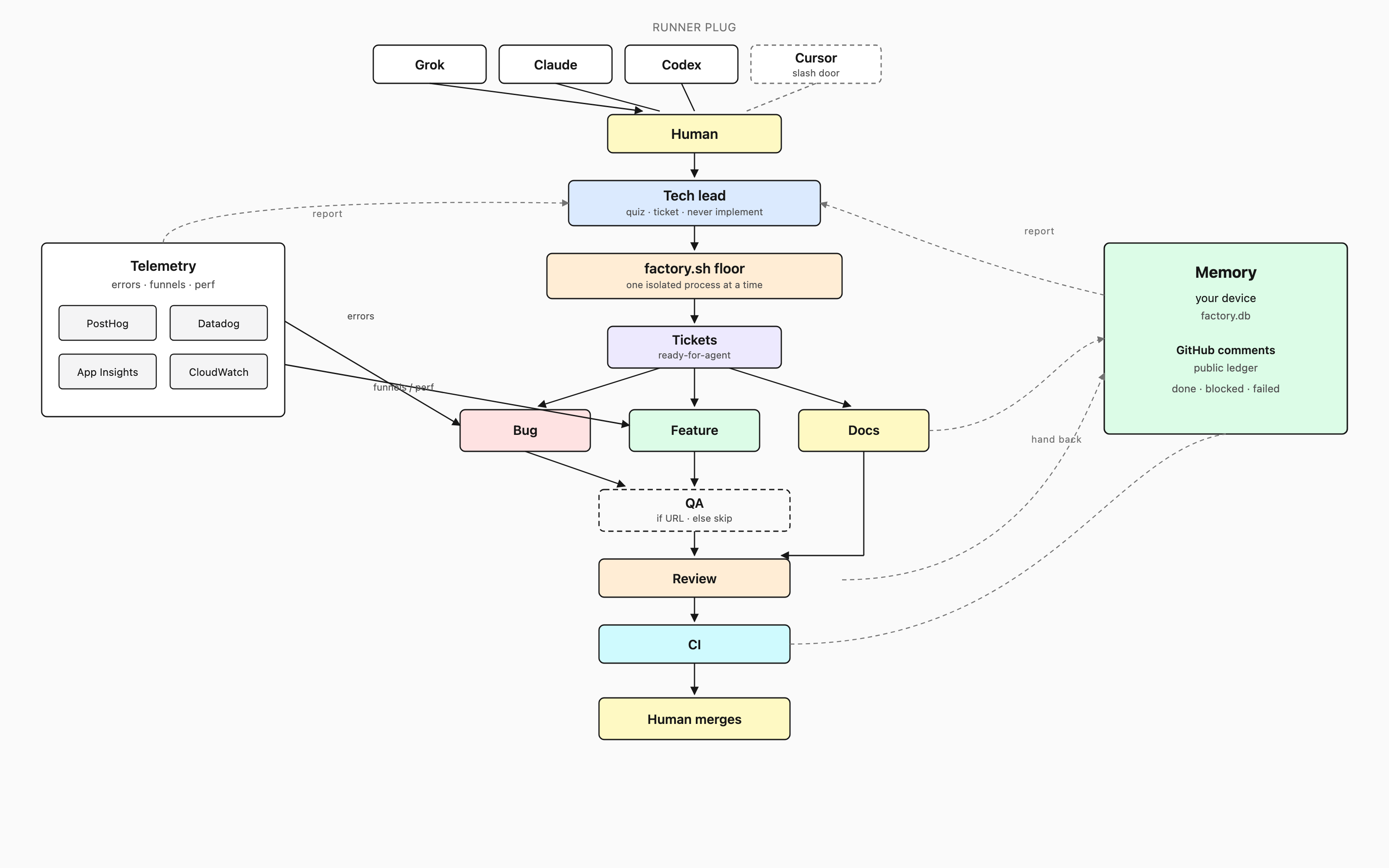
Classify the work. Cut tracer-bullet tickets. Implement on the checkout. Smoke it in a browser. Review like you hate the PR. Watch CI until green. A person merges. Agents never merge.
The runner is a plug. Grok, Claude Code, Codex, Cursor. Same AGENTS.md, same skills.
Telemetry is a plug too. Not an error inbox. It answers whether a path broke or a feature died: signup, onboarding, checkout, invite, the core loop, a shipped screen nobody finishes. PostHog, Datadog, Azure App Insights, and CloudWatch all speak telemetry/CONTRACT.md. Swap the vendor. Keep the questions.
How it runs
Open one CLI. /lead or factory.sh lead classifies, quizzes, and tickets. It does not write product code. After tickets exist it starts factory.sh floor. If the lead session implements, reviews, or watches CI, that run failed.
Floor is bash. It starts one isolated factory.sh lane, waits, then starts the next. Each worker is a new process with that lane's rules. Floor does not implement. Floor does not merge.
Order is implement (feature, bug, or docs), then QA if you passed a URL, else skip QA, then review, then CI. Telemetry runs first when the ticket looks like breakage or drop-off and nobody has pulled evidence yet. Stop when a person should merge, or a lane reports blocked or failed.
Lanes report back. They do not dispatch the next lane. Tech lead or floor does.
Cursor is a slash-command door, not a factory.sh --runner. /lead in Cursor starts factory.sh, which needs Claude, Codex, or Grok on PATH. Two of those installed means you set FACTORY_RUNNER or --runner. One installed means factory.sh uses it. It does not prefer Grok.
Handoff and hand back
Two ledgers. Keep them apart.
Local. factory.sh mem write and mem read hit ~/.factory/memory/factory.db. The next /bug or factory.sh feature reads those rows at start. A worker writes started only if nothing is in progress, then done, blocked, or failed. If the db is missing, warn once and continue. Optional. Best-effort. Not git. Never .env.
GitHub. On done, blocked, or failed (not started), the write leaves one GitHub comment. The body is the one-sentence summary. When a PR exists, a blank line, then a markdown link [PR n](url). That comment is the public ledger. Tech lead reads GitHub when local memory has no rows. Memory is a hint, not a lock.
Floor asks GitHub whether there is a PR, a review, and green checks. It asks local memory for blocked / failed and for "QA was skipped, no URL."
Lanes
| Lane | Job |
|---|---|
| Tech lead | Classify. Quiz. Ticket. Dispatch via factory.sh (usually floor). Do not implement. |
| Telemetry | Breakage and product performance. Funnels, feature completion, errors, logs, sessions. Evidence only. Never implements. |
| Bug | Reproduce from evidence. Web bugs: browser first, then TDD fix. |
| Feature | Do not expand the ask. TDD, implement, unslop. |
| Docs | Docs only. |
| Review | Harsh maintainability review. Comments, not patches. |
| CI | gh pr checks until green. Failures only. |
| QA | Smoke or browser-walk a running app. Report only. |
Install
Add this GitHub repo as a marketplace and install software-factory at the Release tag. Not main.
Claude Code:
/plugin marketplace add Kripu77/[email protected]
/plugin install software-factory@software-factory
Grok Build:
grok plugin install Kripu77/[email protected] --trust
Or add this repo as a marketplace at tag v1.0.0, then install software-factory.
Codex:
codex plugin marketplace add Kripu77/[email protected]
codex plugin add software-factory@software-factory
Cursor:
Add GitHub marketplace Kripu77/software-factory at tag v1.0.0, then install software-factory.
/lead loads. So do the other factory commands. Codex gets the skills.
Clone plus ./install.sh is the from-source path:
git clone https://github.com/Kripu77/software-factory.git
cd software-factory
./install.sh
That creates ~/.factory/memory, installs the plugin, and puts factory on ~/.local/bin. Codex: ./install.sh /path/to/your-checkout also writes AGENTS.md there. Then:
cd /path/to/your-checkout
grok          # or claude
/lead
The versioned pack is on GitHub Releases. Set plugin versions in .claude-plugin/plugin.json, .cursor-plugin/plugin.json, .grok-plugin/plugin.json, and .codex-plugin/plugin.json to the tag without the v, then:
git tag v1.0.0
git push origin v1.0.0
Tag and push. A push to main does not cut a Release.
Owner and repo come from git remote. Workspace is this directory. Put ~/.local/bin on PATH if factory is missing. Two of claude, codex, grok on PATH: set FACTORY_RUNNER.
| Harness | How it loads |
|---|---|
| Cursor | GitHub marketplace at the Release tag, or local plugin at ~/.cursor/plugins/local/software-factory |
| Claude Code | marketplace plugin at the Release tag, or skills + slash commands under ~/.claude |
| Grok Build | GitHub shorthand at the Release tag, or grok plugin install . --trust from a clone |
| Codex | marketplace plugin at the Release tag, or skills under ~/.codex/skills plus AGENTS.md |
Run
Start at lead:
/leadwith owner/repo#issue
Or one lane, still one ticket:
/featurewith owner/repo#issue/bugwith owner/repo#issue/reviewwith owner/repo#pr/ciwith owner/repo#pr/qawith a URL or owner/repo#pr/telemetrywith the question/unslopon any writing/poteto-modefor the writing and playbook style
Headless. Never merges.
./factory.sh lead   --repo api --issue 12
./factory.sh floor  --repo api --issue 12
./factory.sh feature --repo api --issue 12
./factory.sh bug     --repo api --issue 13
./factory.sh review  --repo api --pr 40
./factory.sh ci      --repo api --pr 40
./factory.sh telemetry --question "login 500s last 24h"
./factory.sh qa --repo frontend --pr 12 --url http://localhost:3000
./factory.sh mem write --lane feature --status started --issue 12 --harness grok --summary "Add the memory store"
./factory.sh mem read --issue 12
factory.sh ship is an alias of floor. QA URL is --url or FACTORY_QA_URL. --yes is for workers. Lead stays interactive for quiz and for blocked.
Per-repo conventions: feature, bug, and docs lanes are always told to check for relevant skills before writing code. To steer them, author .factory/conventions in the target checkout. Each line is one of: # comment, skill-name: when it applies (a skill entry with context, e.g. euc-go: Go services and migrations), a bare skill-name, or any other text, injected verbatim as repo context (e.g. never add jest tests; never raw HTML). Any skill available to the runner can be listed; the lane is told to invoke each one that applies. factory.sh adds .factory/ to the checkout's .git/info/exclude when it reads the file, which keeps an untracked file from being committed.
What this pack will not do
A person still quizzes before tickets, logs in for a protected browser, and merges.
Telemetry adapters in this repo are vendor notes and a contract. They do not pull production data. /telemetry only works if the product checkout already has an adapter wired.
We used these lanes to build this factory. That does not mean they have been walked on your app. ./install.sh, cd into a repo you own, /lead, and you merge.
./install.sh does not make every CLI a factory.
Hard rules
- Never merge. A person merges.
- Never
git commit --no-verify. - Never read or send
.env/.env.local. Never store.envin factory memory. - Never attribute factory code to other products.
- Only the ticket or PR you were given.
- Issues live on the owning service, not a catch-all.
- PR title:
Type/<issue.number>/<short description>(Feat,Bug,Arch,Chore,Refactor,General).
Telemetry
See telemetry/CONTRACT.md. Funnels are any instrumented path, not one screen. Session replay is optional. If the vendor cannot replay or cannot funnel, say so. Do not invent either. This pack does not ship a live PostHog, Datadog, App Insights, or CloudWatch client. Wire the adapter in the product. Then ask /telemetry.
Yorumlar (0)
Yorum birakmak icin giris yap.
Yorum birakSonuc bulunamadi